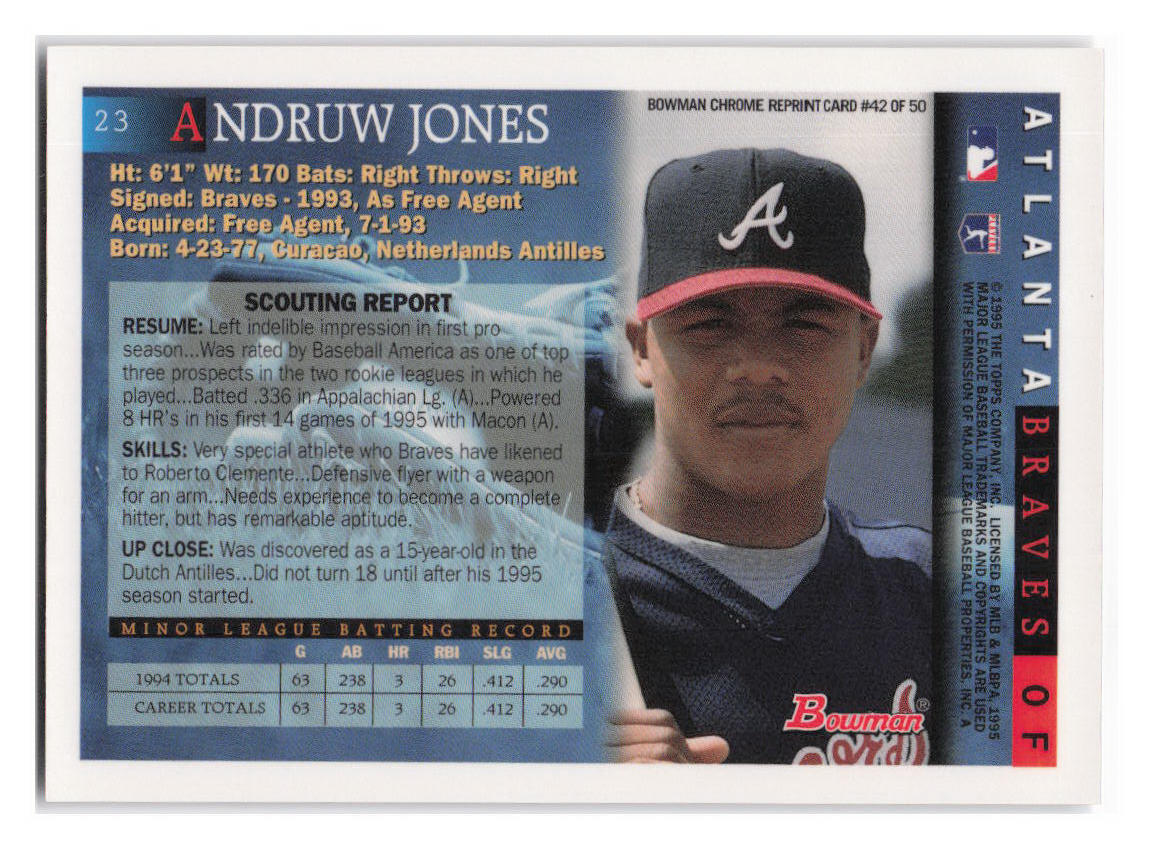
An ungraded Andruw Jones rookie or early prospect card generally ranges in value from $2 to $50 for standard base issues, while certified high-grade specimens like a PSA 10 Gem Mint 1995 Bowman's Best Refractor or rare 1996 Select Certified parallels command anywhere from several hundred to tens of thousands of dollars.
Understanding the Andruw Jones Card Era: 1995–1997 Distinctions
Evaluating the market value of Andruw Jones cards requires understanding how sports card releases were classified in the mid-1990s. Unlike modern collecting standards, where a player's official "Rookie Card" (RC) designation is strictly tied to the year they make their Major League Baseball (MLB) debut, the mid-1990s market featured overlapping definitions between early prospect cards, regional releases, minor league sets, and official rookie card logos.
Andruw Jones made his MLB debut with the Atlanta Braves in August 1996 at just 19 years old. However, his first major trading card appearances occurred a year earlier, in 1995.
- 1995 Releases (First Prospect Cards): The 1995 Bowman's Best set represents Jones’s first licensed, major-manufacturer appearance. While technically a prospect card, collectors and market platforms often treat the 1995 Bowman's Best issue as his premier card due to its historical precedence and low population in high grades.
- 1996 Releases (Debut Year Cards): During his 1996 debut season—where he became the youngest player to hit a home run in World Series history—manufacturers including Leaf, Select, Pinnacle, SP, and Bowman featured him prominently. Cards from this year represent his true in-season rookie cards.
- 1997 Releases (Traditional Base Set RCs): Traditional flagship sets like Topps (#457) and Topps Chrome (#115) listed Jones as a rookie or cup winner in 1997, marking his first widespread mainstream distribution across flagship products.
Because of these overlapping years, the value landscape for Andruw Jones varies dramatically depending on whether a collector is evaluating early prospect chromium issues, ultra-rare mid-90s parallels, or standard paper-stock base cards.
Key Factors Influencing Andruw Jones Rookie Card Values
The valuation of any sports card depends on supply, demand, condition, and contextual market drivers. For Andruw Jones, four major factors dictate where an individual card falls on the price spectrum:
1. Professional Card Grading (PSA, BGS, SGC)
The secondary sports card market heavily favors third-party authentication and grading by companies such as Professional Sports Authenticator (PSA), Beckett Grading Services (BGS), and Sportscard Guaranty Corporation (SGC). Because mid-1990s cards were printed on various materials—ranging from delicate paper stock to ultra-glossy surfaces and sensitive metallic foils—finding copies in flawless condition is difficult.
A card rated as PSA 10 (Gem Mint) often sells for 5 to 20 times the price of the exact same card in PSA 9 (Mint) condition, while raw (ungraded) copies sell at a fraction of graded prices due to undetected surface scratching, soft corners, or off-center borders.
2. Parallel Rarity and Serial Numbering
The mid-1990s marked the birth of high-end parallel cards and low-print-run insert sets. Refractor technology from Topps/Bowman and the introduction of color-coded foil parallels (such as the 1996 Select Certified Mirror series) fundamentally altered card values. A standard base card from this era might have thousands of copies in circulation, whereas a rare parallel may have a print run restricted to 30 copies worldwide.
3. Surface Sensitivities and Production Defects
Cards produced between 1995 and 1997 are notoriously susceptible to specific condition flaws:
- Greening/Fading: Early metallic chrome coatings used by Topps and Bowman frequently oxidise over time, giving the surface a distinct green tint that negatively impacts grading scores and collector demand.
- Foil Chipping and Edge Wear: Sets with dark borders or full-bleed foil surfaces, such as 1996 SP or Select Certified, show micro-flaking along the edges straight from original factory packs.
- Surface Clouding and Peeling: Protective coatings on mid-90s products can cloud or yellow if exposed to heat, humidity, or UV radiation over decades.
4. Hall of Fame Narrative and Legacy
As a 10-time consecutive Gold Glove Award winner, 5-time All-Star, and owner of 434 career home runs, Andruw Jones’s standing among Baseball Hall of Fame voters is a primary macro-economic driver for his card values. Strong voting momentum and ongoing Cooperstown debates routinely spark increased transaction volume and price appreciation for his top-tier cards.
Overview of Values for Top Andruw Jones Rookie & Prospect Cards
The table below outlines approximate secondary market values across key key issues in raw, PSA 9, and PSA 10 conditions. Prices reflect historical sales patterns and prevailing market conditions.
| Card Description | Release Year | Card # | Raw / Ungraded Value | PSA 9 (Mint) Value | PSA 10 (Gem Mint) Value | Key Parallel / Notes |
|---|---|---|---|---|---|---|
| Bowman's Best Base | 1995 | #B1 | $5 – $15 | $25 – $40 | $150 – $250 | First major prospect issue |
| Bowman's Best Refractor | 1995 | #B1 | $75 – $150 | $350 – $600 | $2,000 – $4,000+ | Premier mid-90s prospect card |
| Bowman Base | 1996 | #205 | $2 – $5 | $15 – $25 | $75 – $125 | Standard paper stock debut issue |
| Select Certified Base | 1996 | #239 | $5 – $12 | $30 – $50 | $150 – $250 | High surface-chipping sensitivity |
| Select Certified Mirror Red | 1996 | #239 | $150 – $300 | $800 – $1,500 | $3,500 – $6,000+ | Limited print run (~90 copies) |
| Select Certified Mirror Gold | 1996 | #239 | $1,500+ | $5,000 – $10,000+ | $25,000+ | Legendary grail; print run of 30 |
| SP Base | 1996 | #182 | $3 – $8 | $20 – $35 | $100 – $180 | Premium foil stock; delicate edges |
| Leaf Signature Autograph | 1996 | N/A | $40 – $80 | $120 – $200 | $400 – $750 | Features on-card signature |
| Topps Chrome Base | 1997 | #115 | $3 – $10 | $20 – $35 | $100 – $175 | Official flagship Chrome RC |
| Topps Chrome Refractor | 1997 | #115 | $40 – $80 | $200 – $350 | $1,000 – $1,800 | High susceptibility to greening |
Detailed Analysis of the Top Andruw Jones Cards
To build or value an Andruw Jones collection effectively, it helps to analyze his primary releases individually, evaluating historical context, grading populations, and specific variations.
- 1995 Bowman's Best #B1 Premier Early Prospect Card
- 1996 Select Certified Pinnacle of 90s Parallels (Mirror Gold / Red)
- 1996 Leaf Signature On-Card Autographed Standard
- 1997 Topps Chrome #115 Flagship Chromium Debut
1. 1995 Bowman's Best #B1 (Base and Refractor)
The 1995 Bowman's Best card #B1 is widely regarded by hobbyists as Andruw Jones’s most important card. Issued standard with a dual-sided design (featuring Jones on the "Red" prospect side), this card captured the young outfielder while he was destroying minor league pitching.
- Base Version: The standard base card features a metallic finish. Because print runs for 1995 Bowman's Best were moderate compared to overproduced early-90s sets, base copies in PSA 10 condition hold consistent value, typically selling between $150 and $250.
- Refractor Parallel: The Refractor version features a rainbow-like sheen when rotated under light. It remains one of the premier 1990s prospect cards in the entire sports collecting landscape. Raw copies often carry surface scratches, making PSA 9 and PSA 10 copies exceedingly valuable. A PSA 10 copy can easily surpass $3,000 depending on auction dynamics and HOF election cycles.
2. 1996 Select Certified #239 (Base and Mirror Parallels)
Pinnacle Brands released 1996 Select Certified, introducing metallic technology and micro-fractional print runs that redefined modern card collecting. Card #239 features Jones during his breakout rookie campaign.
Base Card: Built on a silver metallic card stock, the base card suffers from edge chipping and micro-scratches. High-grade copies are relatively scarce despite a reasonable base print volume.
Mirror Red, Mirror Blue, and Mirror Gold: The "Mirror" parallels are legendary.
- Mirror Red: Reported print run of roughly 90 copies.
- Mirror Blue: Reported print run of roughly 45 copies.
- Mirror Gold: Stated print run of just 30 copies.
A 1996 Select Certified Mirror Gold Andruw Jones #239 is a true holy grail of 1990s card collecting. Due to the extreme scarcity and dedicated fanbase for 1990s parallel inserts, a Mirror Gold in strong condition regularly commands tens of thousands of dollars when it surfaces at public auction.
3. 1996 Leaf Signature Series Autographs
Before the late 1990s, certified pack-pulled autographs were rare. The 1996 Leaf Signature Series featured authentic, on-card signatures from top prospects and stars.
Jones signed three main tiers of cards for this release:
- Standard / Bronze Autograph: Most common, usually featuring a blue ink signature directly on the card surface.
- Silver Autograph: Limited print run (typically estimated around 1,000 copies).
- Gold Autograph: Limited print run (estimated around 500 copies).
Because these cards feature on-card signatures rather than modern sticker autographs, they are highly sought after by Braves fans and autographed card collectors alike. Ungraded copies typically sell between $40 and $80, whereas slabbed PSA 10 or BGS 9.5 copies with flawless 10-rated signatures trade for several hundred dollars.
4. 1996 SP #182 and 1996 Bowman #205
For collectors seeking entry-level, budget-friendly options from his true debut season:
- 1996 SP #182: Upper Deck’s premium SP set featured a sleek, full-bleed border design. The dark foil borders make condition grading tough; corners easily show white paper flaking. A PSA 10 copy commands a solid premium over raw stock due to low gem-rate yields.
- 1996 Bowman #205: Bowman’s flagship 1996 issue is a classic paper card. While easy to find in raw condition for a few dollars, centering issues and factory print spots make high-grade PSA 10 copies a staple for collectors completing high-grade vintage registry sets.
5. 1997 Topps Chrome #115 (Base and Refractor)
By 1997, Topps Chrome had established itself as the industry standard for flagship rookie cards. Card #115 features Jones coming off his dramatic 1996 World Series performance.
- Base Chrome: Highly popular due to the iconic Topps branding. Clean, un-peeled copies with sharp centering trade steadily around $20 to $35 in PSA 9 condition.
- Chrome Refractor: The 1997 Refractor features the iconic rainbow coating. Buyers must examine these cards closely under natural light for "greening"—a natural chemical degradation of the surface layer that alters the silver tone to an olive tint. Un-greened, bright PSA 10 copies command significant market premiums, frequently fetching $1,200 to $1,800.
Technical Details: Grading Standards and Population Metrics
When assessing Andruw Jones cards for submission to grading services like PSA, SGC, or BGS, understanding specific physical parameters will help set realistic expectations for final grades.
Centering and Physical Tolerances
- PSA 10 Gem Mint Requirements: The image must be centered within a tolerance not to exceed approximately 55/45 to 60/40 percent on the front, and 75/25 percent on the back. For border-heavy designs like 1995 Bowman's Best, off-center alignment is the most common reason cards fall to a PSA 8 or PSA 9 grade.
- BGS Sub-Grades: Beckett evaluates cards across four sub-categories: Centering, Corners, Edges, and Surface. Mid-90s chromium cards frequently receive lower surface grades due to invisible factory wax residue or microscopic hairline scratches from pack foil wrapping.
Population Report Analysis
Across major card grading databases, early prospect cards like the 1995 Bowman's Best #B1 have thousands of total graded entries. However, the ratio of PSA 10 Gem Mint copies to total submissions (often called the "Gem Rate") is frequently under 20% for foil and chrome cards of this era. This scarcity of high-grade copies explains why a PSA 10 can command a price 10x higher than a PSA 9.
Market Outlook: The Hall of Fame Catalyst
Card values for retired players typically follow predictable market cycles. While active players experience weekly price fluctuations based on game performance or injuries, retired stars see price movements tied to major milestone events:
- Hall of Fame Voting Announcements: Every January, when the Baseball Writers' Association of America (BBWAA) releases election results, candidates receiving strong momentum see increased transaction volume. Andruw Jones's steady rise in voting percentage has maintained consistent interest in his high-grade rookie and prospect cards.
- Induction Ceremony Surges: Actual induction into Cooperstown traditionally generates a temporary spike in buying interest, particularly for key rookie cards, certified autographs, and rare 1990s parallels.
- Long-Term Vintage/90s Market Stability: The market for rare 1990s inserts and low-print-run parallels (such as Select Certified Mirrors and Bowman Refractors) has evolved into a mature alternative asset market. Dedicated parallel collectors often hold these cards long-term, insulating them from wider sports card market pullbacks.
Practical Buying and Selling Strategies
Whether you are looking to purchase an Andruw Jones rookie card for a personal collection or liquidate an inherited portfolio, following established marketplace practices will protect your capital.
Tips for Buyers
- Inspect Chromium Surfaces for Greening: When buying 1995 Bowman's Best or 1997 Topps Chrome cards online, request high-resolution photos under neutral white lighting. Avoid cards displaying a yellowish-green hue on the player's face or jersey background if you plan to submit them for grading.
- Verify Authenticity of 1990s Parallels: Because high-value cards like 1996 Select Certified Mirror parallels command thousands of dollars, verify that serial numbers, surface textures, and foil stamps match known authentic reference copies. Purchasing encapsulated cards verified by PSA, BGS, or SGC reduces risk.
- Distinguish Between Prospect and True Rookie Cards: Decide whether your collecting goal is his first overall card (1995 Bowman's Best) or his true debut season cards (1996 Select/SP/Bowman). Prospect cards often carry higher financial upside, but flagship debut issues represent classic historical milestones.
Tips for Sellers
- Grade High-Condition Raw Copies Before Selling: If you own clean raw copies of 1995 Bowman's Best Refractors or 1996 Select Certified base cards with sharp corners and centered alignment, paying for professional grading can unlock substantial hidden value.
- Time Listings Around Major Baseball Events: List high-end cards during peak baseball news cycles—such as Spring Training, the MLB All-Star Game, or the January Hall of Fame announcement window—when buyer traffic and search volume for historical players peak.
- Use Specialty Consignment Services for Ultra-Rare Parallels: For high-value items like a 1996 Select Certified Mirror Red or Gold, selling through specialized sports card auction houses or established consignment dealers can attract high-net-worth collectors willing to pay top market prices.
Frequently Asked Questions
What is Andruw Jones’s official rookie card?
While Andruw Jones’s first licensed card is the 1995 Bowman's Best #B1 (prospect card), his official debut-year cards were released in 1996 across products like Leaf Signature, Select Certified, SP, and Bowman. Flagship sets like Topps (#457) and Topps Chrome (#115) followed with official rookie designations in 1997.
Why is the 1995 Bowman's Best Refractor so expensive?
The 1995 Bowman's Best Refractor (#B1) represents Jones's very first metallic refractor card. Combining low overall print runs with high susceptibility to surface scratches and greening, copies that survive in PSA 10 condition are exceedingly rare, making them premier targets for high-end 1990s baseball card collectors.
How do I know if my 1997 Topps Chrome card is a Refractor?
A standard 1997 Topps Chrome card has a smooth metallic surface. A Refractor parallel displays a distinctive rainbow prism effect when held under direct light. Additionally, modern third-party graders identify the "Refractor" designation directly on the slab label.
How much is an autographed Andruw Jones rookie card worth?
Value depends heavily on whether the signature is certified by the card manufacturer (such as the 1996 Leaf Signature series) or signed after-market (in-person). Factory-certified autographs generally range from $40 ungraded to over $500 in PSA 10 condition. Uncertified in-person signatures require third-party authentication (such as PSA/DNA or JSA) to hold substantial market value.
Are mid-1990s Andruw Jones cards affected by the "Junk Wax" era?
No. The "Junk Wax" era of extreme overproduction primarily spanned from 1987 to 1993. By 1995–1997, card manufacturers had significantly reduced print runs for premium sets, introduced higher price points, and created scarce parallel inserts. As a result, top-grade Andruw Jones cards maintain real scarcity and stable collector demand.
Final Recommendation
If you are looking to add an Andruw Jones rookie card to your portfolio or personal collection:
- For High-End Investors: Target a high-grade 1995 Bowman's Best Refractor #B1 (PSA 9 or PSA 10) or any 1996 Select Certified Mirror parallel. These cards offer the highest historical scarcity and long-term prestige among 1990s card collectors.
- For Mid-Range Collectors: Look for a 1997 Topps Chrome Refractor #115 or a 1996 Leaf Signature Autograph. Ensure the Chrome Refractor exhibits bright original colors without greening.
- For Budget Collectors: A sharp 1995 Bowman's Best Base #B1 or 1996 SP #182 in a PSA 9 slab offers strong eye appeal and historical significance at an accessible price point under $50.