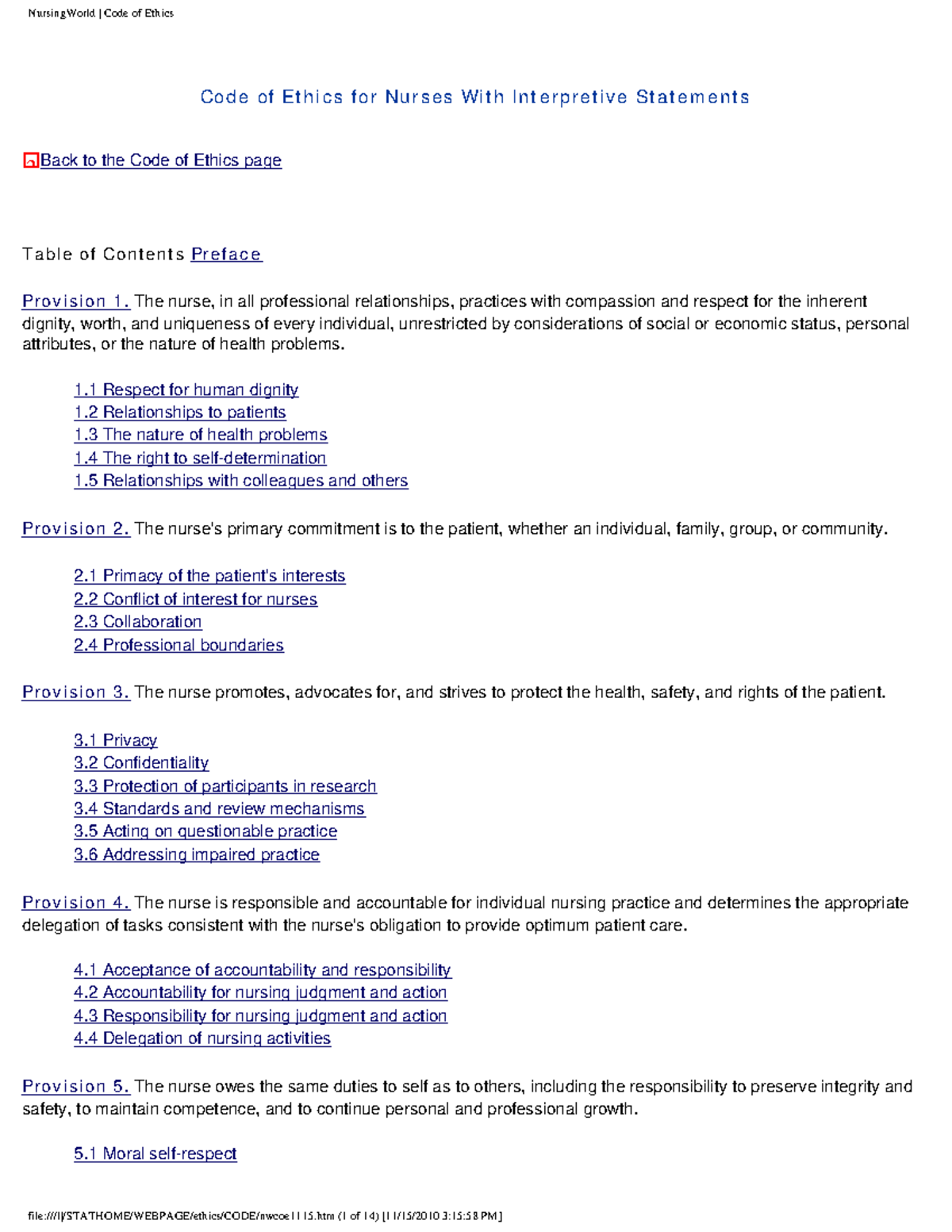
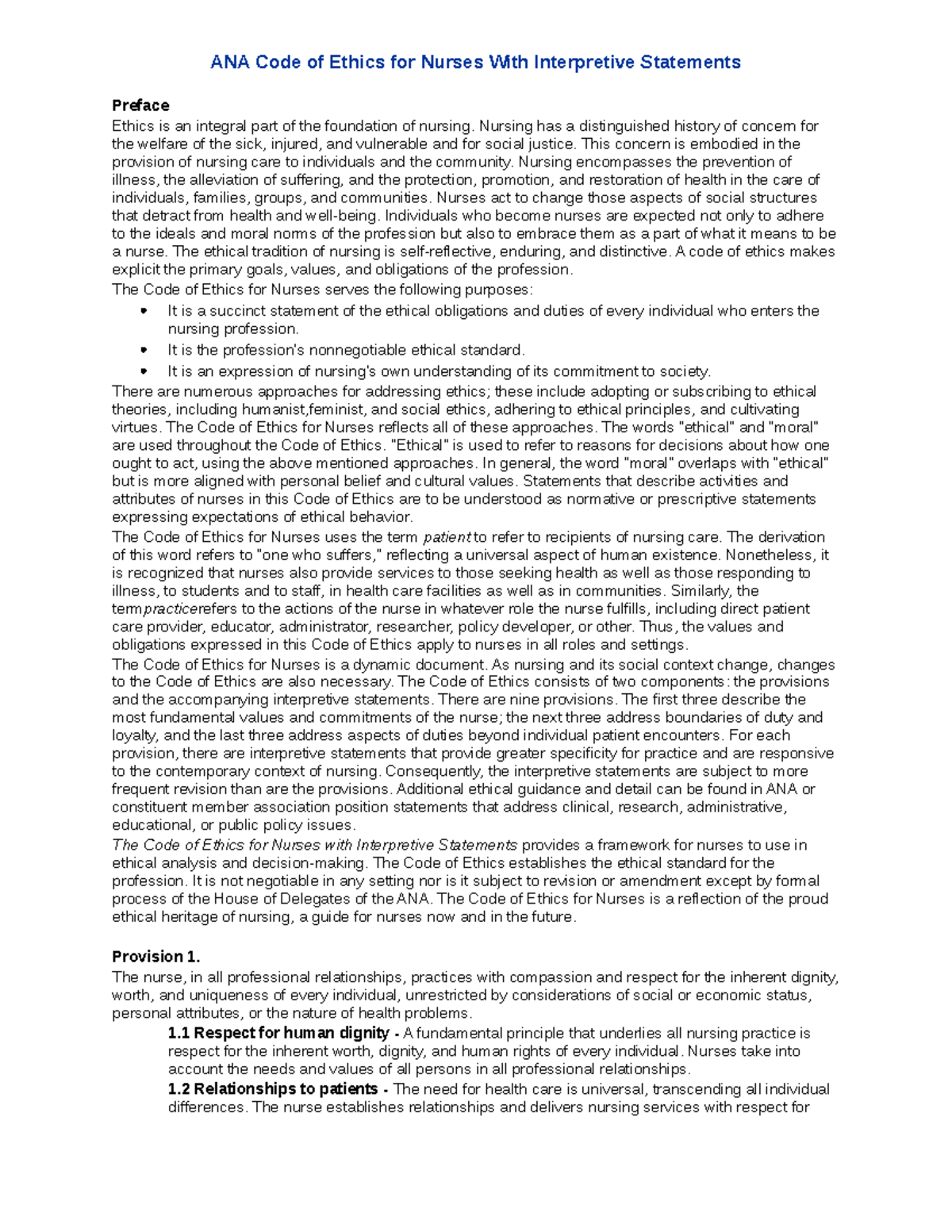
The official American Nurses Association (ANA) Code of Ethics for Nurses with Interpretive Statements is the foundational ethical framework governing professional nursing practice in the United States. Nurses, students, and healthcare organizations can access a view-only version directly through the official ANA portal, while full downloadable PDFs or print editions are available via the ANA Enterprise publishing division for personal, clinical, or academic reference.
Disclaimer: This article provides informational analysis regarding professional nursing ethics and regulatory frameworks. It does not constitute legal counsel, formal bioethical consultation, or professional nursing advice. Licensure requirements and legal definitions of nursing scope vary by state and jurisdiction under individual State Boards of Nursing.
How to Access and Download the Official ANA Code of Ethics PDF
Finding the authentic version of the Code of Ethics for Nurses with Interpretive Statements requires navigating official distribution channels maintained by the American Nurses Association (ANA). Because the Code serves as both an ethical benchmark and a legal reference point in regulatory hearings, ensuring you hold the authoritative text is critical.
Official ANA Portal vs. Educational Distribution
The ANA hosts a dedicated online portal through its primary domain, providing free view-only access to the full text of the Code, including all nine provisions and their associated interpretive statements. This read-only version allows practicing nurses, researchers, and students to review ethical standards directly within a web browser without financial cost.
For institutional use—such as hospital compliance programs, academic course syllabi, or clinical orientation binders—educational licenses or permission agreements are required to distribute printed physical copies or redistribute electronic files across internal networks. Many accredited nursing schools provide institutional access to full, downloadable PDF versions of the text through academic library subscriptions such as CINAHL, Ovid, or PubMed Central databases.
Free View-Only Access vs. eBook and Print Editions
While the basic text of the nine provisions is accessible online for public review, standard PDF downloads that permit saving, printing, or offline annotation are issued primarily as purchased publications through the ANA Enterprise bookstore (Nursing Knowledge Center).
- Read-Only Web View: Available at no charge on the official ANA website for immediate reference.
- E-Book / Downloadable PDF: Available for purchase through official publishing channels, offering full searchability, offline availability, and print capabilities for personal study.
- Softcover Print Edition: Frequently required for undergraduate and graduate nursing curricula, offering formatted interpretive statements, historical context, and comprehensive cross-references.
When searching for an "ANA nursing code of ethics PDF," avoid unauthorized third-party file-sharing repositories. Third-party uploads may contain truncated versions, lack official interpretive statements, or present outdated draft revisions that fail to reflect current professional standards.
Structure of the Code: The 9 Provisions Explained
The Code of Ethics for Nurses with Interpretive Statements is structured into nine core provisions. These provisions act as a non-negotiable ethical standard, establishing the professional duties of the nurse across clinical practice, leadership, research, and policy development.
- ANA CODE OF ETHICS ARCHITECTURE
- PROVISIONS 1–3: Fundamental Values & Patient Commitments
- Human Dignity
- Compassion
- Primary Loyalty
- Patient Advocacy & Privacy
- PROVISIONS 4–6: Boundaries of Duty & Personal Integrity
- Accountability
- Responsibility
- Self-Regard
- Ethical Work Environments
- PROVISIONS 7–9: Broader Societal & Professional Obligations
- Practice Advancement
- Human Rights
- Global Health Integrity & Policy
- PROVISIONS 1–3: Fundamental Values & Patient Commitments
Provisions 1 to 3: Fundamental Values and Commitments
The first three provisions outline the primary duties nurses owe to individual patients, families, and communities. They emphasize respect, loyalty, and protective advocacy.
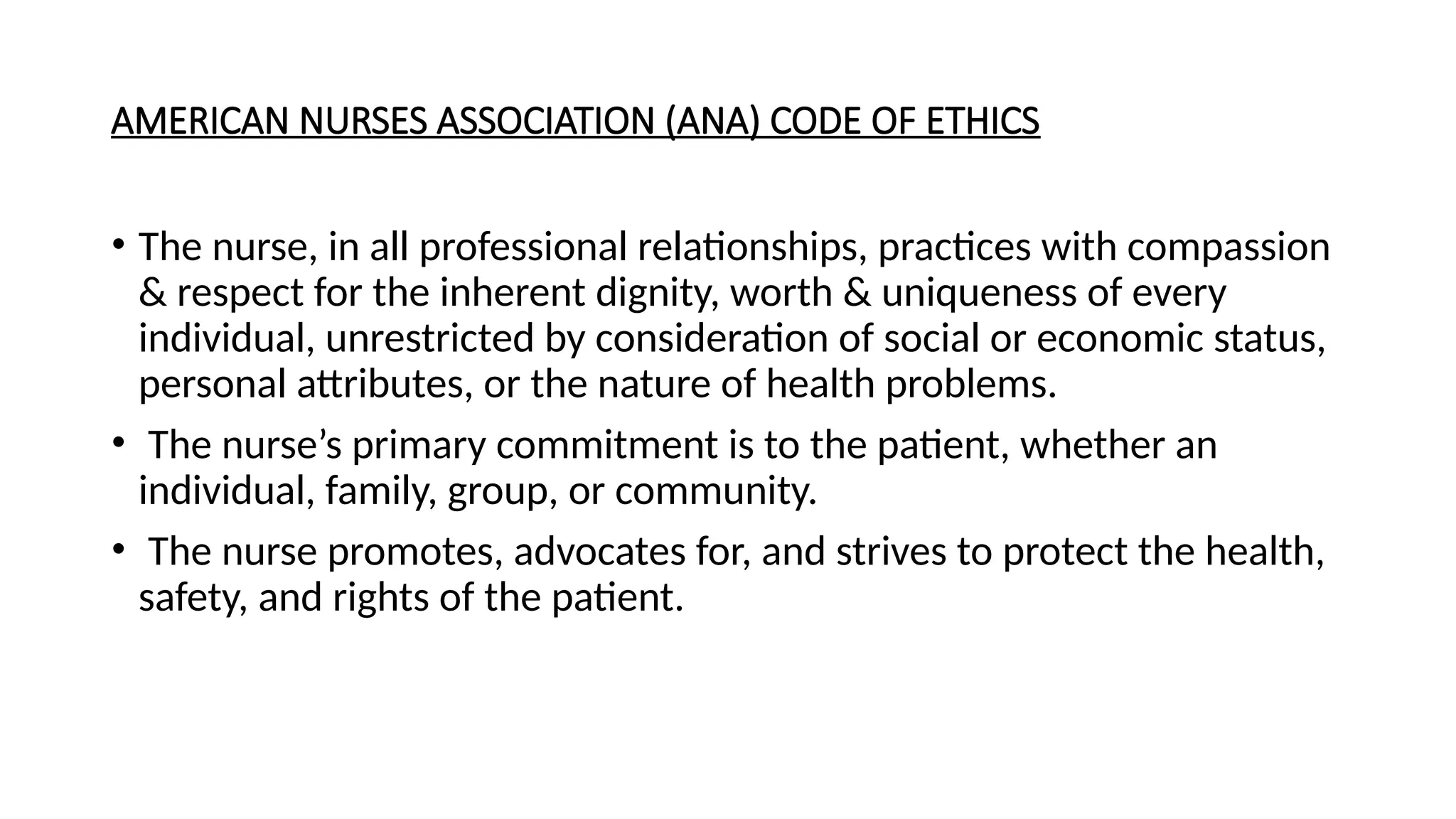
- Provision 1: The nurse practices with compassion and respect for the inherent dignity, worth, and unique attributes of every person. This provision mandates universal care regardless of a patient's background, socio-economic status, lifestyle, or medical diagnosis. It establishes that human dignity is intrinsic, not earned.
- Provision 2: The nurse’s primary commitment is to the patient, whether an individual, family, group, community, or population. This provision resolves potential conflicts of interest. When organizational policies, financial pressures, or outside demands collide with patient safety, the nurse's legal and ethical allegiance remains firmly with the patient.
- Provision 3: The nurse promotes, advocates for, and protects the rights, health, and safety of the patient. This section governs informed consent, patient privacy under HIPAA standards, confidentiality, and the explicit duty to intervene when a colleague's practice appears impaired or unsafe.
Provisions 4 to 6: Boundaries of Duty and Loyalty
Provisions 4 through 6 define professional responsibility, personal accountability, and the duty to maintain moral integrity within healthcare environments.
- Provision 4: The nurse has authority, accountability, and responsibility for nursing practice; makes decisions; and takes action consistent with the obligation to provide optimal patient care. This provision clarifies that nurses remain individually responsible for their clinical judgments, delegation decisions to unlicensed assistive personnel (UAP), and actions taken under direct supervision.
- Provision 5: The nurse owes the same duties to self as to others, including the responsibility to promote health and safety, preserve wholeness of character and integrity, maintain competence, and continue personal and professional growth. Nurses cannot deliver high-quality care if they compromise their own safety, physical health, or moral integrity. Moral self-regard and lifelong learning are explicit ethical obligations.
- Provision 6: The nurse, through individual and collective effort, establishes, maintains, and improves the ethical environment of the work setting and conditions of employment that are conducive to safe, quality health care. This provision requires nurses to actively shape their workplaces, challenging toxic environments, reporting staffing hazards, and fostering ethical clinical cultures.
Provisions 7 to 9: Duties Beyond Individual Patient Care
The final three provisions expand the nurse's scope beyond bedside practice to encompass policy, research, human rights, and global health equity.
- Provision 7: The nurse, in all roles and settings, advances the profession through research and scholarly inquiry, professional standards development, and the generation of both nursing and health policy. Clinical practice must be grounded in evidence-based research, and nurses are encouraged to contribute to quality improvement initiatives and academic studies.
- Provision 8: The nurse collaborates with other health professionals and the public to protect human rights, promote health diplomacy, and reduce health disparities. This provision addresses social determinants of health, disaster response obligations, access to healthcare resources, and community advocacy.
- Provision 9: The profession of nursing, collectively through its professional organizations, must articulate nursing values, maintain the integrity of the profession, and integrate principles of social justice into nursing and health policy. Provision 9 commits nursing professional bodies to public advocacy, lobbying for social justice, and protecting the public interest on national and international scales.
Summary Table: Breakdown of the 9 Provisions
The following reference table synthesizes the nine provisions, outlining their primary domain of application and key clinical directives:
| Provision | Focus Area | Primary Domain | Essential Clinical Obligation |
|---|---|---|---|
| Provision 1 | Human Dignity & Respect | Fundamental Values | Provide non-judgmental, compassionate care to all individuals regardless of background. |
| Provision 2 | Primary Loyalty | Patient Allegiance | Keep the patient's best interests central, resolving conflicts of interest ethically. |
| Provision 3 | Advocacy & Privacy | Patient Rights | Protect confidentiality, secure informed consent, and report unsafe practice. |
| Provision 4 | Accountability & Delegation | Professional Duty | Accept personal ownership of decisions; delegate tasks safely according to competence. |
| Provision 5 | Self-Regard & Integrity | Personal Duty | Maintain physical safety, engage in lifelong learning, and preserve moral character. |
| Provision 6 | Ethical Environment | Workplace Culture | Foster safe, ethical clinical environments and address toxic or unsafe conditions. |
| Provision 7 | Practice Advancement | Professional Growth | Contribute to research, evidence-based guidelines, and institutional policy formation. |
| Provision 8 | Global Health & Equity | Social Justice | Collaborate across disciplines to reduce health disparities and protect human rights. |
| Provision 9 | Professional Integrity | Social Policy | Engage professional bodies to champion health policy reform and social justice. |
Legal Standing, State Board Oversight, and Clinical Impact
A common point of confusion among nursing students and licensed professionals is the relationship between the ANA Code of Ethics and legal statutes. While the ANA is a professional organization rather than a government regulatory agency, its Code carries deep legal weight in courts of law and licensing boards.
- ETHICAL VS. LEGAL FRAMEWORK INTERSECTION
- STATE BOARD OF NURSING (Administrative Law)
- State Nurse Practice Acts (NPAs)
- Statutory Authority: Licensing, Revocation, Discipline
- Adopts ANA Code Standards into Legal Rules of Conduct
- Incorporates Standard of Care
- ANA CODE OF ETHICS (Ethical Framework)
- Professional Standard of Practice
- Referenced in Malpractice Litigation & Expert Witness Testimony
- Binding Duty: Patient Advocacy & Whistleblower Protections
- STATE BOARD OF NURSING (Administrative Law)
The Code vs. Nurse Practice Acts: Legal Distinctions
Every state in the U.S. enforces a Nurse Practice Act (NPA) passed by its legislature, which is administered by a State Board of Nursing (SBN). The NPA represents administrative law: it defines the legal scope of practice, licensure requirements, and grounds for disciplinary action (such as license suspension or revocation).
By contrast, the ANA Code of Ethics represents professional self-regulation. However, State Boards of Nursing frequently incorporate the principles of the ANA Code into their administrative rules and regulations. If a nurse is accused of unprofessional conduct or gross negligence, the licensing board often uses the ANA Code to define the accepted standard of care.
In civil medical malpractice lawsuits, plaintiff attorneys and expert witnesses routinely cite provisions of the ANA Code to demonstrate that a nurse breached their duty of care to the patient.
Ethical Decision-Making Frameworks in Daily Practice
When ethical dilemmas arise in high-acuity settings—such as end-of-life care, organ allocation, or surrogate decision-making—nurses rely on structured decision-making models rooted in the Code. A standard clinical ethics framework follows these steps:
- Assessment: Gather clinical facts, identify key stakeholders, and determine patient values and advance directives.
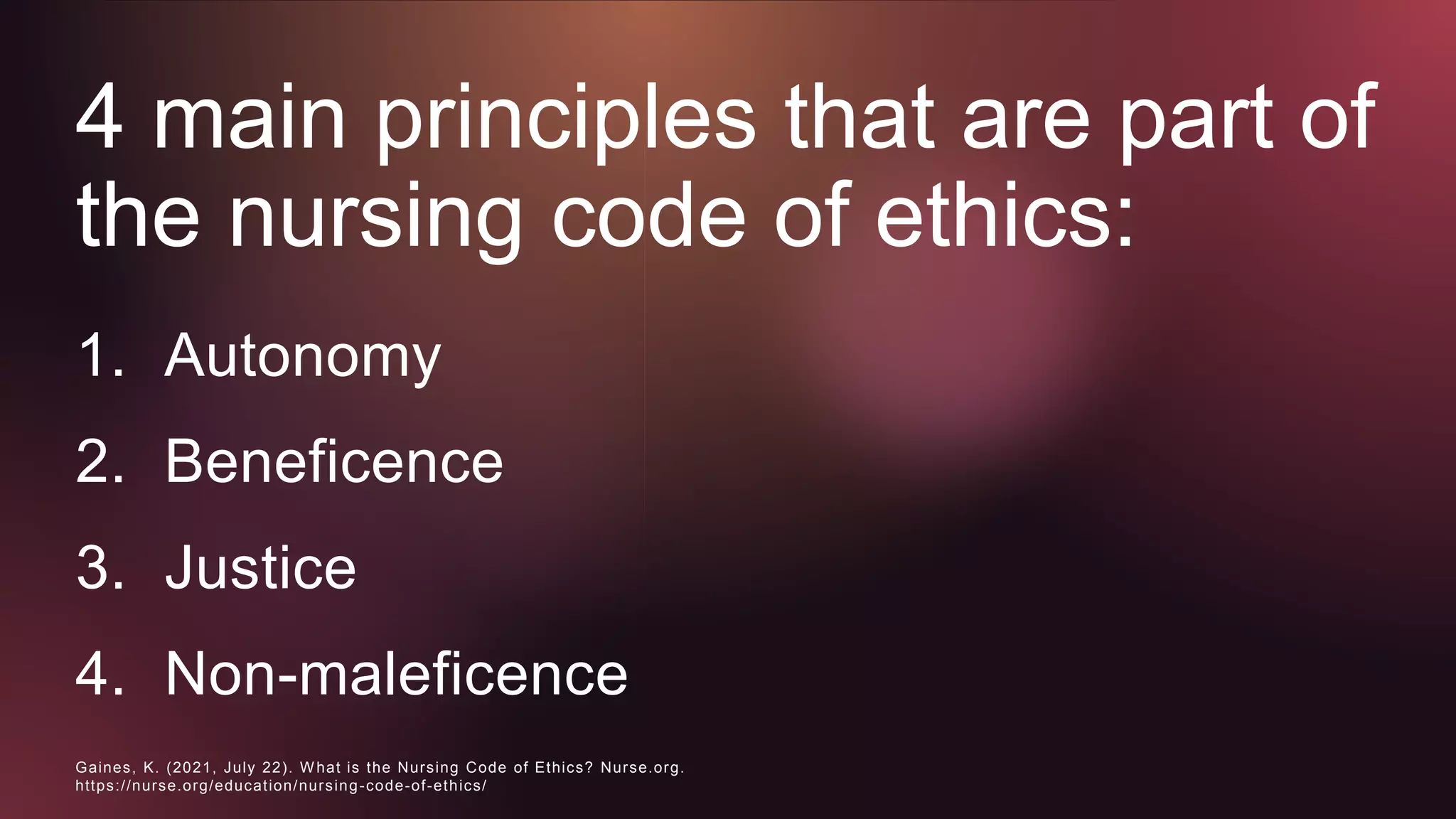
- Ethical Problem Identification: Clarify whether the conflict stems from autonomy vs. beneficence, non-maleficence vs. justice, or moral distress.
- Analysis via Provisions: Evaluate how Provisions 1, 2, and 3 apply to the patient's immediate trajectory.
- Option Generation: Formulate alternative clinical pathways, consulting institutional Ethics Committees or Palliative Care teams.
- Action Plan: Implement the chosen strategy while documenting the ethical rationale thoroughly in the medical record.
- Evaluation: Review the outcomes for the patient, family, and healthcare team to inform future practice.
Whistleblowing, Conscientious Objection, and Moral Distress
The Code offers explicit support for nurses facing severe ethical conflicts in institutional settings.
- Conscientious Objection: Under Provisions 1 and 5, nurses have the ethical right to refuse participation in specific procedures (such as elective terminations or terminal sedation protocols) if doing so directly violates their deeply held moral or religious beliefs. However, this right requires timely notification to management so that alternative care coverage is arranged without abandoning the patient.
- Whistleblowing & Safety Reporting: Provision 3 mandates that nurses report unsafe working conditions, incompetent colleagues, or systematic fraud. Federal and state whistleblower statutes protect nurses from retaliation when reporting such issues in good faith to regulatory authorities.
- Moral Distress Mitigation: Moral distress occurs when a nurse knows the ethically correct action to take but is prevented from acting by institutional constraints, physician orders, or administrative policy. Provision 6 obligates institutions and nurse leaders to establish ethical climate committees and debriefing mechanisms to address burnout and moral injury.
Common Compliance Pitfalls and Ethical Dilemmas
Nurses face evolving ethical challenges driven by technological shifts, social media adoption, and systemic workplace pressures. Reviewing how the Code applies to modern practice helps prevent common regulatory violations.
Social Media and Patient Privacy (Provisions 3 & 4)
Digital communications represent one of the fastest-growing areas of State Board disciplinary actions. Even well-intentioned posts can violate patient privacy rights under HIPAA and Provision 3 of the Code.
- Never share identifiable patient media: Photographing a patient, medical chart, or rare wound—even without showing the patient's face—violates privacy if the setting, diagnosis, or timing could allow identification.
- Avoid venting about shifts online: Discussing specific cases online, even in private professional groups, violates confidentiality guidelines and damages public trust in the profession (Provision 9).
- Maintain digital professional boundaries: Accepting friend requests or communicating privately with current or former patients on personal social media accounts blurs professional boundaries and impairs clinical objectivity.
Professional Boundaries and Nurse-Patient Relationships
The nurse-patient relationship operates on an inherent power imbalance. Patients place trust in nurses during periods of extreme vulnerability. Provision 2 and Provision 4 require nurses to establish and preserve clear professional boundaries.
Overinvolvement—such as accepting substantial personal gifts, entering financial arrangements with patients, or pursuing romantic relationships—constitutes professional misconduct. Conversely, underinvolvement, which manifests as emotional detachment, neglect, or withholding necessary care due to personal biases, breaches Provision 1.
Self-Care and Competence Obligations (Provision 5)
Provision 5 explicitly frames self-care not as a personal luxury, but as an ethical duty. Practicing while impaired by severe exhaustion, physical illness, substance use disorder, or untreated psychological distress directly compromises patient safety.
- PROVISION 5: ETHICAL SELF-REGARD OBLIGATIONS
- Physical Safety & Wellness
- Fatigue mgmt
- Impairment self-reporting
- Professional Competence
- Continuing ed
- Skills updates
- Certifications
- Moral Integrity & Boundaries
- Refusal of unsafe tasks
- Value alignment
- Physical Safety & Wellness
Nurses are ethically required to:
- Decline excessive mandatory overtime shifts if severe fatigue impairs clinical judgment.
- Maintain clinical competence through ongoing continuing education (CE) credits and clinical skills assessments.
- Seek confidential assistance programs (such as State Nursing Peer Assistance Programs) at the earliest sign of substance impairment or severe burnout.
Frequently Asked Questions
Where can I download the official ANA Nursing Code of Ethics PDF for free?
You can read the full text of the Code of Ethics for Nurses with Interpretive Statements for free on the official American Nurses Association (ANA) website at nursingworld.org. While the web version is free to view, downloadable and printable PDF versions or physical copies are licensed documents available for purchase through the ANA Enterprise bookstore or accessible via institutional library subscriptions.
How often is the ANA Code of Ethics updated?
The ANA periodically reviews and updates the Code of Ethics to reflect changes in medical technology, societal values, and healthcare delivery models. The major structural overhaul that established the current nine provisions with detailed interpretive statements was published in 2015. The ANA Ethics Advisory Board maintains continuous oversight to ensure its interpretive guidance aligns with modern nursing practice.
What is the legal status of the ANA Code of Ethics?
While the ANA Code of Ethics is published by a professional association rather than a government legislature, it carries substantial legal weight. State Boards of Nursing frequently reference the Code to interpret statutory standards of conduct, and courts accept the Code as standard-of-care evidence in professional malpractice and disciplinary hearings.
What is the difference between the Code's provisions and interpretive statements?
The nine provisions represent the core, non-negotiable ethical principles of professional nursing. The interpretive statements follow each provision, offering detailed explanations, clinical context, and practical guidelines on how those overarching principles should be applied in real-world healthcare scenarios, research settings, and administrative environments.
Can a nurse refuse an assignment based on the ANA Code of Ethics?
Yes. Under Provision 5 (Self-Regard and Integrity) and Provision 1 (Respect for Dignity), a nurse has the ethical right to object to an assignment if it violates their moral principles or if they lack the clinical competency to perform the duty safely. However, this objection must be raised promptly through established management channels to ensure alternative patient coverage is arranged without committing patient abandonment.
Recommended Next Steps
To effectively integrate the ANA Code of Ethics into your professional practice, academic studies, or clinical leadership, consider the following action steps:
- Access the Official Text: Visit the official ANA portal at nursingworld.org to review the full view-only version of the nine provisions and interpretive statements.
- Verify Institutional Resources: If you are a student or healthcare employee, check your institution's digital library catalog (such as CINAHL or Ovid) for licensed, printable PDF downloads of the complete text.
- Review Board Regulations: Consult your specific State Board of Nursing (SBN) website to see how your state's Nurse Practice Act incorporates the ANA Code into legal misconduct definitions.
- Engage Institutional Ethics Committees: If you face recurring moral distress or ethical uncertainty in your clinical unit, request a consultation with your facility's Bioethics Committee or review institutional policy against Provisions 3, 5, and 6.