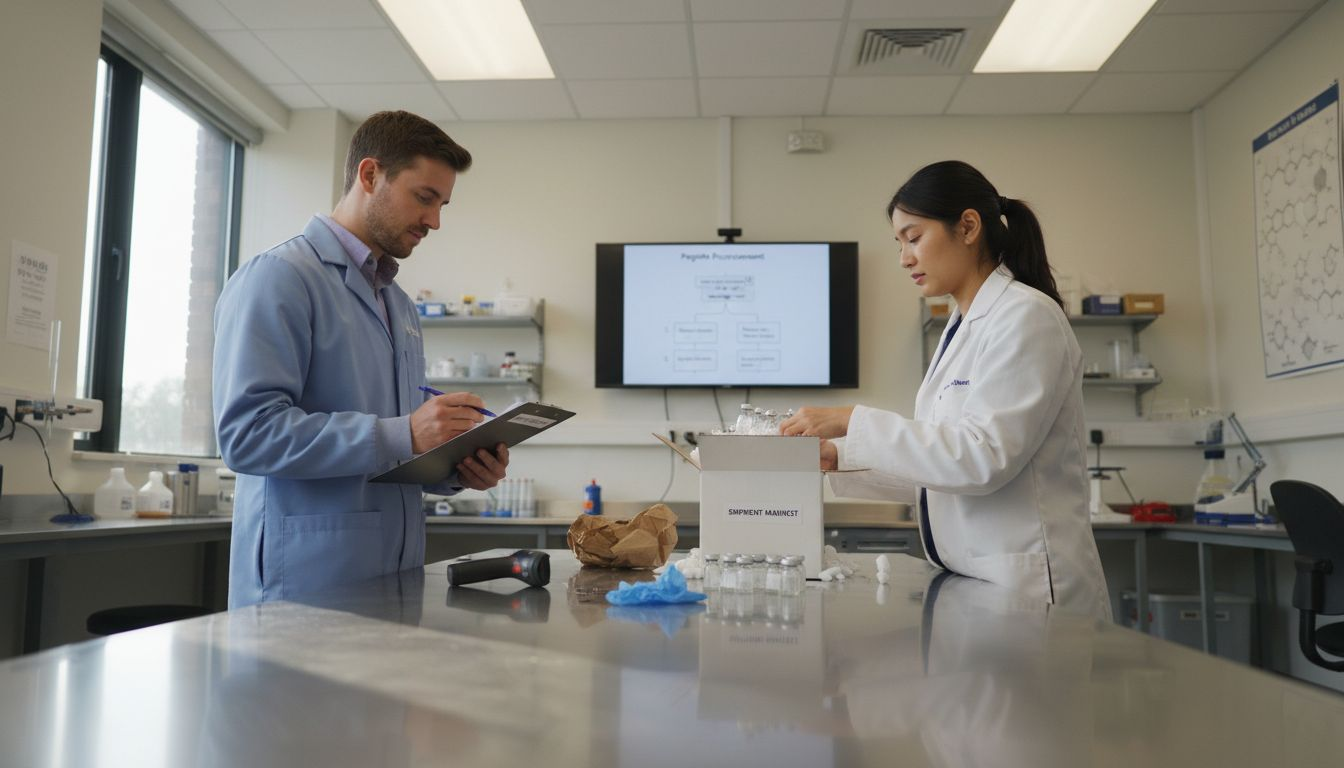
Securing high-purity peptides for laboratory research requires a rigorous approach to supplier verification, analytical documentation, and quality control protocols. Lab scientists must prioritize providers that offer transparent batch testing, including High-Performance Liquid Chromatography (HPLC) and Mass Spectrometry (MS) results, to ensure the structural integrity and sequence accuracy necessary for reproducible experimental outcomes.
Establishing Quality Standards in Peptide Synthesis
For professional research environments, the procurement of peptides is not merely a transactional activity but a critical component of experimental design. Peptides are widely used in biochemistry, immunology, and pharmacology for applications such as enzyme inhibition, receptor binding assays, and antibody production. The efficacy of these studies relies heavily on the quality of the synthetic peptide provided.
When evaluating an amino research peptide supplier, the primary metric is purity. Most standard laboratory applications require a purity level of at least 95%, though critical structural studies or therapeutic research may necessitate 98% or higher. Purity is determined by the presence of impurities resulting from incomplete coupling during synthesis, truncated sequences, or oxidation. A reputable supplier must provide a Certificate of Analysis (CoA) for every specific batch—not a generic sample—clearly showing the HPLC trace.
Mass Spectrometry (MS) serves as the second pillar of verification. While HPLC determines purity by separating components in a mixture, MS confirms the molecular weight and identifies the specific amino acid sequence, ensuring that the synthesized product matches the intended design. Scientists should expect this documentation to be readily available upon request or provided alongside the shipment.
Technical Prerequisites for Laboratory Peptide Procurement
Before engaging with a supplier, the principal investigator or the laboratory procurement officer must define the technical requirements of the peptide. Improperly defined specifications lead to delays and potential experimental failure.
- Sequence Integrity: Ensure the sequence is verified. For complex peptides, particularly those with disulfide bridges or specific modifications (such as phosphorylation, biotinylation, or amidation), verify that the supplier has a track record of handling similar chemistry.
- Solubility and Storage Requirements: Peptides possess varying degrees of hydrophobicity. The supplier should offer guidance on the appropriate solvent—be it water, acetic acid, or DMSO—and provide instructions on storage (typically -20°C or -80°C under inert gas to prevent hydrolysis and oxidation).
- Salt Form: Peptides are often supplied as trifluoroacetate (TFA) salts. However, for cell-based assays, TFA can be cytotoxic. If the research involves living cells, scientists must request an ion exchange service to convert the salt to acetate or chloride to ensure physiological compatibility.
- Quantity and Format: Determine whether the peptide should be delivered in bulk or as pre-aliquoted lyophilized (freeze-dried) powder. Lyophilized samples are significantly more stable for long-term storage than liquid formulations.
Evaluating Supplier Credibility and Transparency
In the current landscape of 2026, the marketplace for research peptides is vast, ranging from large-scale catalog companies to boutique custom synthesis firms. Distinguishing reliable partners from vendors who lack robust oversight is essential for maintaining research integrity.
A reliable supplier should demonstrate a commitment to standardized quality management systems. Companies that adhere to ISO 9001 standards often have more rigorous internal controls regarding documentation and process mapping. Furthermore, consider the following checklist when vetting a potential source:
- Batch Traceability: Can the supplier provide the full history of the raw materials used, specifically the protected amino acids and resins?
- Methodology Disclosure: Are the synthesis methods (typically Solid-Phase Peptide Synthesis - SPPS) documented for the specific product?
- Third-Party Validation: Does the laboratory periodically send samples to an independent facility to audit their internal testing processes?
- Technical Support: Is there direct access to a synthesis chemist or technical support scientist who can address questions regarding sequence complexity or synthesis feasibility?
Comparative Analysis of Procurement Strategies
| Procurement Strategy | Advantages | Potential Drawbacks | Best For |
|---|---|---|---|
| Large Catalog Vendors | High availability, lower cost, rapid shipping. | Less customization, standardized purity levels. | Routine experiments, initial pilot studies. |
| Boutique Custom Firms | High precision, complex modifications, expert consultation. | Longer lead times, higher per-mg costs. | Complex synthesis, therapeutic research. |
| Contract Research Orgs (CROs) | End-to-end integration with downstream testing. | Requires formal project management. | Multi-stage drug discovery or clinical validation. |
Navigating Regulatory and Safety Considerations
While amino research peptides are intended for laboratory use, scientists must remain cognizant of the regulatory environment governing their handling and procurement. In many jurisdictions, peptides designated for "research use only" (RUO) are strictly prohibited from human or animal clinical applications unless they have undergone formal regulatory review by bodies such as the FDA or the EMA.
Safety Data Sheets (SDS) should be reviewed prior to handling any shipment. Peptides are biologically active molecules. Even in a laboratory setting, researchers should utilize standard personal protective equipment (PPE), including gloves, eye protection, and, where appropriate, a fume hood or biosafety cabinet to prevent accidental inhalation or skin exposure. If a peptide is known to be highly potent or a specific signaling molecule with systemic effects, clear labeling and restricted storage access are mandatory.
Troubleshooting Common Procurement Issues
Even with reputable suppliers, issues can arise during synthesis or shipping. Familiarity with common challenges can prevent loss of research time.
Sequence Difficulties: Some sequences are inherently difficult to synthesize due to aggregation, steric hindrance, or the presence of multiple hydrophobic amino acids. If a supplier reports low yields, ask if they utilized alternative coupling reagents (e.g., HATU, PyBOP) or adjusted the synthesis temperature.
Shipping Degradation: Peptides are sensitive to moisture and heat. Ensure that your supplier ships the product in lyophilized form with appropriate cold-chain logistics (e.g., dry ice or cold packs). Upon arrival, check for signs of moisture in the vial. Any condensation or clumping upon receipt should be reported immediately, as it suggests a breach in the vacuum seal or improper shipping conditions.
Reconstitution Failures: When a peptide fails to dissolve, it is often a matter of incorrect solvent selection rather than product quality. Always check the supplier's recommendations for the specific peptide’s hydrophobicity index. If you encounter unexpected insolubility, performing a brief sonication or adding a minimal amount of buffer can often facilitate dissolution without compromising the peptide's activity.
Frequently Asked Questions
1. Why does my peptide require HPLC purification before it can be used? Crude synthetic peptides contain truncated sequences and side-products generated during the synthesis process. HPLC purification is necessary to isolate the target sequence, ensuring that the biological effects observed in your experiment are attributable to the peptide itself and not to impurities or incomplete byproducts.
2. Is there a difference between "Research Grade" and "Clinical Grade" peptides? Yes. "Research Grade" peptides are synthesized to high standards but do not necessarily adhere to Good Manufacturing Practice (GMP) requirements. GMP-compliant peptides undergo rigorous validation, facility auditing, and documentation trails specifically designed for human clinical trials. Never substitute Research Grade materials for clinical applications.
3. How should I store lyophilized peptides once they arrive at the lab? Most lyophilized peptides are stable at -20°C for extended periods. However, for long-term stability and to prevent moisture absorption, store the vials in a desiccator, preferably in the original packaging. Once reconstituted, the peptide should be aliquoted and frozen to avoid repeated freeze-thaw cycles, which accelerate degradation.
4. Can I request specific salt forms if my research is cell-based? Yes. If your current supplier provides TFA salts, request an "acetate conversion." This process replaces the trifluoroacetate ions with acetate, which is significantly less toxic to mammalian cell cultures and is the standard practice for functional in vitro assays.
Practical Steps for Procurement Success
To ensure success, adopt a proactive procurement workflow. Start by establishing a library of verified vendors who have consistently met your purity and documentation standards. When ordering, provide the vendor with the exact amino acid sequence, requested purity, and specific ion-exchange requirements if relevant. Upon delivery, perform an immediate visual inspection of the vials and compare the provided HPLC/MS traces against your original design parameters. Keeping detailed logs of supplier performance and peptide performance in your experiments will allow for more informed decisions in future research cycles, ultimately safeguarding the reliability of your data.