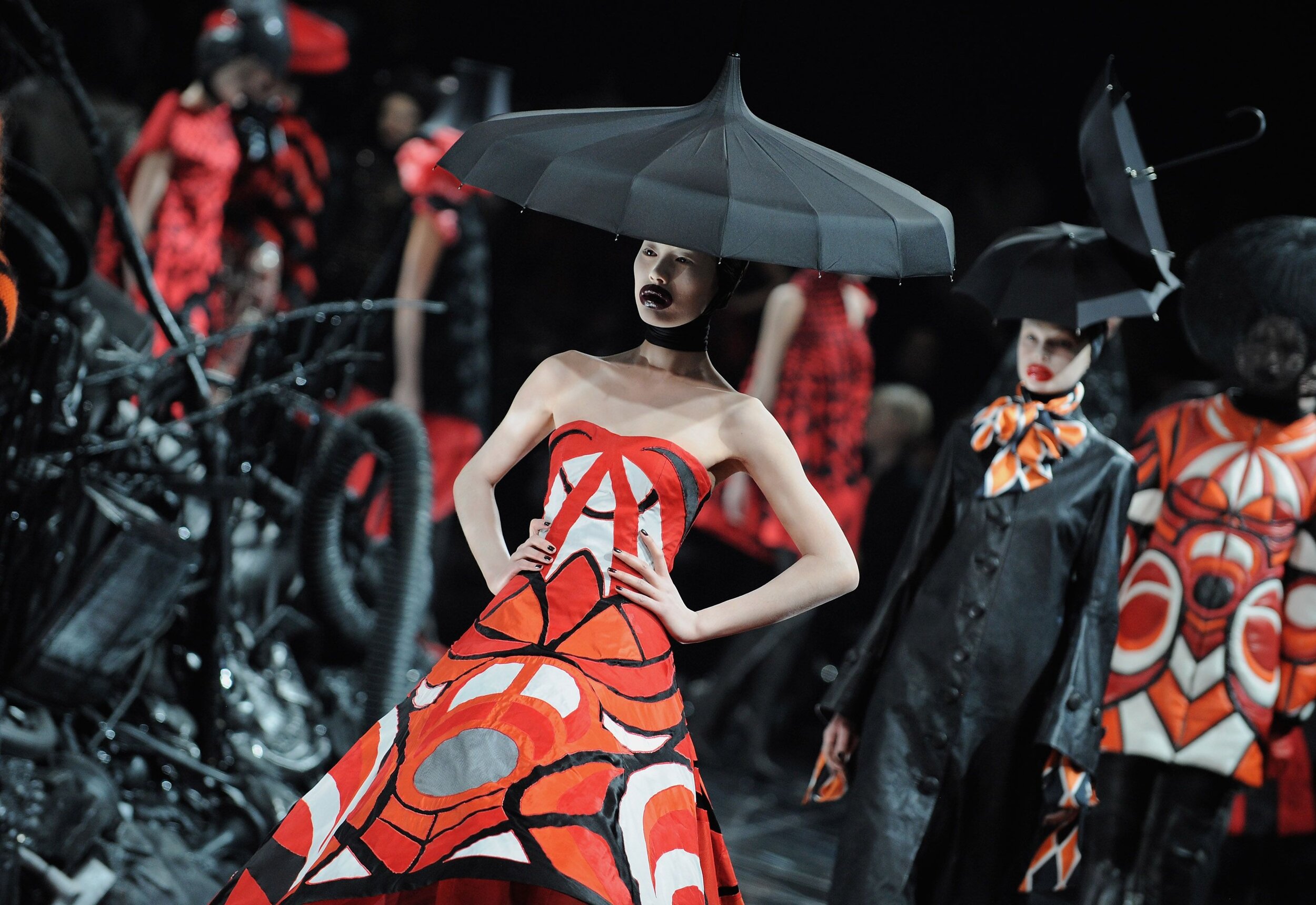
The fashion house Alexander McQueen was founded in 1992 by the late British designer Lee Alexander McQueen. Established in London immediately following McQueen’s graduation from Central Saint Martins, the brand quickly became synonymous with provocative tailoring, dark romanticism, and a rebellious spirit that challenged the conventions of the global luxury market.
Since its inception in 1992, Alexander McQueen has transitioned from an avant-garde East London startup to one of the most prestigious names in high fashion. While the house has evolved through various creative leaderships, its core identity remains rooted in the tension between tradition and modernity, a hallmark established by Lee McQueen during his formative years. As of 2026, the brand continues to operate under the Kering umbrella, maintaining its status as a pillar of British couture and ready-to-wear innovation.
The Genesis of the Brand (1992)
To understand why Alexander McQueen was founded in 1992, one must look at the climate of British fashion at the time. The early 1990s were marked by a shift away from the excess of the 1980s toward a more raw, "grunge" aesthetic. However, Lee Alexander McQueen brought something entirely different: a rigorous technical foundation paired with a visceral, often macabre, artistic vision.
McQueen’s decision to launch his own label was not merely an act of ambition but a necessity for his creative output. After completing his Master of Arts in Fashion Design at Central Saint Martins, his graduation collection, titled "Jack the Ripper Stalks His Victims," caught the eye of the influential fashion editor Isabella Blow. Blow famously purchased the entire collection for £5,000, paying it off in weekly installments. This transaction provided the initial momentum and the vital professional endorsement needed to establish the brand officially in 1992.
The Influence of Savile Row
Before the founding of his label, McQueen underwent intensive training that would define the technical superiority of his brand. At age 16, he apprenticed at Savile Row tailors Anderson & Sheppard, followed by Gieves & Hawkes. Here, he mastered the art of the "sharp shoulder" and the structured silhouette. This technical prowess is what separated Alexander McQueen from other avant-garde designers of the 90s; while his concepts were wild, his construction was flawless.
Core Philosophical Pillars Established at Founding
When Alexander McQueen was founded in 1992, it was built on several non-negotiable principles that still guide the house in 2026. These pillars include:
- Tailoring as Architecture: McQueen viewed clothing as a means to modify the human form. His "bumster" trousers, introduced in his early collections, were designed to elongate the torso, a move that was both technically difficult and socially provocative.
- Narrative and Storytelling: Each collection was conceived as a narrative. Whether exploring his Scottish heritage or the dark corners of Victorian London, McQueen used the brand as a vehicle for complex, often autobiographical storytelling.
- The Macabre and the Beautiful: The brand frequently explores the intersection of life and death, nature and technology, and fragility and strength. This duality is a signature that persists across decades of collections.
The Evolution of Brand Identity: 1992 to 2026
The trajectory of the house can be divided into three distinct eras, each defined by how they interpreted the founding principles of 1992.
The Lee Alexander McQueen Era (1992–2010)
This period was characterized by high-concept runway shows that functioned more as performance art than traditional fashion presentations. Iconic moments such as the "VOSS" show (Spring/Summer 2001), where models were trapped in a glass box, and "Plato’s Atlantis" (Spring/Summer 2010), which introduced the famous Armadillo boot, cemented the brand's reputation for pushing technological and aesthetic boundaries.
In 2000, a pivotal business shift occurred when the Gucci Group (now Kering) acquired a 51% stake in the company. This provided the financial infrastructure necessary for the brand to expand globally, moving beyond the niche London scene into boutiques in New York, Milan, and Paris.
The Sarah Burton Era (2010–2023)
Following Lee McQueen's tragic passing in 2010, his long-time right hand, Sarah Burton, took the helm. Burton is credited with softening the brand's image while maintaining its rigorous craftsmanship. She famously designed the wedding dress for Catherine, Princess of Wales, in 2011, a moment that brought the brand to a massive global audience. Under Burton, the house focused heavily on the "community" aspect of the brand, integrating British craft traditions and hand-embroidery into the core of the collections.
The Modern Era under Seán McGirr (2024–Present)
As of 2026, the brand is under the creative direction of Seán McGirr. McGirr’s tenure has focused on returning to the "compressed" energy and raw provocation that defined the early 1990s. By revisiting the archives from the founding years, the current collections seek to reconcile the house’s historical aggression with contemporary luxury standards.
Technical Specifications and Craftsmanship
A defining feature of the Alexander McQueen brand since 1992 has been its refusal to compromise on construction. Even as the brand scaled, the techniques remained rooted in traditional couture and Savile Row standards.
Signature Silhouettes and Fabrics
The brand is known for specific silhouettes that have become industry standards:
- The Hourglass Blazer: A masterclass in internal padding and darting to create a snatched waist.
- The Hybrid Garment: Often seen in 2026 collections, this involves merging two disparate items, such as a trench coat and a leather biker jacket.
- Lace and Leather: The juxtaposition of delicate Chantilly lace with heavy, often distressed leather, reflecting the brand’s obsession with contrast.
| Feature | Founding Era (1992-2000) | Expansion Era (2001-2010) | Heritage Era (2011-2023) | Contemporary Era (2024-2026) |
|---|---|---|---|---|
| Primary Focus | Provocation & Tailoring | Narrative & Spectacle | Craft & Femininity | Archive & Subversion |
| Key Creative | Lee McQueen | Lee McQueen | Sarah Burton | Seán McGirr |
| Ownership | Independent / Gucci Group | Kering | Kering | Kering |
| Defining Silhouette | The Bumster | The Armadillo | The Royal Wedding Dress | The Compressed Tailoring |
The Business of McQueen: Market Position in 2026
In 2026, Alexander McQueen occupies a unique position in the luxury landscape. It is categorized as a "hard luxury" fashion brand, meaning its value is derived as much from its archival significance and artistic merit as from its current retail performance.
The brand's revenue streams are diversified across several key categories:
- Ready-to-Wear (RTW): This remains the heart of the brand, contributing to its prestige and "editorial" presence.
- Accessories: The "Oversized Sneaker," launched years ago, continues to be a commercial juggernaut, providing the capital necessary to fund the more experimental runway pieces.
- Leather Goods: Bags like the "The Knuckle" and the "The Seal" have become staple luxury items, recognized for their unique hardware that echoes the brand’s subversive roots.
Common Myths Regarding the Founding of Alexander McQueen
Because the brand's history is so steeped in lore, several misconceptions often arise regarding its 1992 origins.
"Was the brand always called Alexander McQueen?"
Yes and no. The designer's full name was Lee Alexander McQueen. He chose to use "Alexander McQueen" for the brand name at the suggestion of Isabella Blow, who felt it sounded more aristocratic and "established" than the more common "Lee McQueen." To his friends and family, he remained Lee until his death.
"Did he start with a large investment?"
No. The brand was founded on a shoestring budget. In the early days, McQueen famously used cheap fabrics—and even unconventional materials like cling film—because he could not afford high-quality textiles. It was his ability to make these materials look like high fashion that proved his genius.
How to Verify Authentic McQueen Heritage Pieces
For collectors and enthusiasts looking at pieces from the 1990s, verification is crucial. Because the brand was founded in 1992 and grew rapidly, labeling and construction techniques changed significantly between the "early London years" and the "post-acquisition years."
- Label Analysis: Early pieces (1992–1996) often feature simple white labels with "Alexander McQueen" in a minimalist font. Later labels became more standardized under the Gucci Group.
- Internal Construction: Authentic McQueen tailoring, even from the early 90s, will feature impeccable internal finishing. Look for hand-stitched linings and specific canvas weights in the lapels.
- Hardware: Signature hardware, such as the skull motif or knuckle-duster grips, was introduced later in the brand's history (mid-2000s). Early pieces rely more on the cut of the fabric than on branded hardware.
Frequently Asked Questions
Why was 1992 a significant year for the brand?
1992 was the year Lee Alexander McQueen graduated from Central Saint Martins and presented his MA collection. It marks the formal transition of McQueen from a student and apprentice to a professional designer and business owner. Without the 1992 founding, the "Cool Britannia" fashion movement of the 1990s would have lacked its most subversive voice.
Who owns Alexander McQueen in 2026?
The brand is owned by Kering, the French luxury conglomerate that also owns brands like Gucci, Saint Laurent, and Balenciaga. Kering has owned a majority stake in the brand since late 2000, providing the global distribution network and financial stability the house enjoys today.
What happened to the brand after Lee McQueen died?
After the founder's death in 2010, the house continued under the creative direction of Sarah Burton, who had worked closely with McQueen for 14 years. This ensured a seamless transition of aesthetic codes. In 2023, Burton stepped down, and Seán McGirr took over, leading the brand into its current 2026 iteration.
Is Alexander McQueen considered "haute couture"?
While Alexander McQueen shows in Paris and produces garments with couture-level craftsmanship, it is technically a "ready-to-wear" (prêt-à-porter) house. However, many of its bespoke pieces for celebrities and royalty are created using traditional haute couture methods in the brand's London atelier.
What is the most famous piece from the founding era?
The "Bumster" trousers, which debuted shortly after the brand was founded, are likely the most famous early creation. They were designed to sit extremely low on the hips, challenging the traditional proportions of the body and sparking a global trend for low-rise fashion that lasted well into the 2000s.
Summary of Next Actions for Enthusiasts
For those looking to engage more deeply with the legacy of a brand founded in 1992, the following steps are recommended:
- Visit the Archives: If possible, view the permanent collections at the Victoria and Albert Museum (V&A) in London or the Metropolitan Museum of Art in New York, both of which hold significant historical McQueen pieces.
- Study the Tailoring: To truly appreciate why the brand has lasted since 1992, examine the construction of a McQueen blazer in person. Pay attention to the shoulder structure and the internal "floating" canvas.
- Follow Current Collections: Monitor the work of Seán McGirr as of 2026 to see how the brand continues to interpret its 1992 founding principles for a modern, digital-first audience.
Alexander McQueen remains a testament to the power of technical mastery combined with an uncompromising artistic vision. From its humble, rebellious beginnings in 1992 to its status as a global luxury powerhouse in 2026, the brand continues to define the cutting edge of fashion.