Becoming and operating as an aircraft pilot requires navigating a complex framework of medical certifications, rigorous training milestones, federal regulations, and sophisticated flight operations procedures. Whether pursuing aviation as a rewarding recreational hobby or an intensive commercial career, understanding the legal prerequisites, structured licensing steps, and daily operational protocols is essential for safety and compliance.
Operating an aircraft requires meeting stringent legal and medical prerequisites, progressing through structured certification tiers from Private Pilot to Airline Transport Pilot, maintaining aircraft airworthiness, and executing pre-flight, in-flight, and emergency procedures in compliance with aviation authorities like the Federal Aviation Administration (FAA) or the European Union Aviation Safety Agency (EASA).
Foundations of Pilot Certification and Legal Prerequisites
The journey into aviation begins long before an individual ever touches the flight controls of an aircraft. Prospective aviators must first satisfy foundational legal and medical benchmarks established by national civil aviation authorities. In the United States, the Federal Aviation Administration (FAA) governs these standards, ensuring that every individual operating an aircraft possesses the requisite physical health, cognitive faculties, and legal standing to maintain safety in the national airspace system.
Medical Certification Standards
Before undertaking solo flight training, a student pilot must obtain an Aviation Medical Examiner (AME) certificate. These medical certificates are categorized into First, Second, and Third Class tiers, each corresponding to different operational privileges:
- Third-Class Medical: Required for student pilots, private pilots, and recreational pilots. It evaluates baseline cardiovascular health, visual acuity, hearing, and neurological stability.
- Second-Class Medical: Required for commercial pilots operating operations such as crop dusting or corporate non-airline flying.
- First-Class Medical: The most stringent evaluation, mandatory for Airline Transport Pilots (ATPs) acting as PIC (Pilot in Command) in scheduled air carrier operations.
In addition to traditional medical certificates, programs like BasicMed allow certain pilots to operate small aircraft under specific weight and passenger limits without a formal FAA medical exam, provided they hold a valid state driver's license and have completed a physical examination by a state-licensed physician within the past 48 months.
Age, Citizenship, and Language Proficiency
Beyond physical health, regulatory bodies enforce strict administrative boundaries. For example, a student pilot must be at least 16 years old to operate a powered aircraft solo (14 for glider or balloon operations) and 17 to obtain a Private Pilot Certificate. Candidates must also demonstrate the ability to read, speak, write, and understand the English language, as English is the universal language of international aviation radio communication established by the International Civil Aviation Organization (ICAO).
The Path to Licensure: Step-by-Step Progression
Flight training is an incremental process designed to build stick-and-rudder competence, decision-making capabilities, and system mastery. Pilots rarely jump straight into complex commercial jets; instead, they progress through a standardized hierarchy of certificates and ratings.
- Student Pilot Certificate
- Private Pilot License (PPL)
- Commercial Pilot License (CPL) & Instrument Rating (IR)
- Airline Transport Pilot (ATP)
1. Student Pilot Phase
The initial phase involves training with a Certified Flight Instructor (CFI). Students learn aerodynamic principles, airspace classifications, basic flight maneuvers, and emergency protocols. This phase culminates in the first solo flight, a major milestone requiring endorsements for both pre-solo written exams and specific aircraft makes and models.
2. Private Pilot License (PPL)
The Private Pilot License is the baseline certification for non-commercial flyers. Under FAA regulations (specifically 14 CFR Part 61), a PPL requires a minimum of 40 hours of flight time, though the national average typically ranges between 60 and 75 hours. Training covers cross-country navigation, night flying, stall recognition and recovery, and radio communication. Private pilots can carry passengers and share operational expenses (such as fuel and rental costs) but cannot fly for compensation or hire.
3. Instrument Rating (IR)
While a Private Pilot can fly in clear weather conditions known as Visual Meteorological Conditions (VMC), an Instrument Rating is mandatory for operating solely by reference to aircraft instruments in Instrument Meteorological Conditions (IMC). This rating trains pilots to navigate through clouds, fog, and low-visibility environments using ground-based navaids, GPS, and air traffic control vectors. It represents a dramatic leap in safety, systems knowledge, and procedural discipline.
4. Commercial Pilot License (CPL)
To fly for money, a pilot must upgrade to a Commercial Pilot License. This certification demands a higher standard of aircraft control, precision maneuvers, and advanced commercial operations knowledge. Minimum hour requirements jump to 250 total flight hours under Part 61. CPL holders can work as flight instructors, banner towers, aerial photographers, or corporate charter pilots.
5. Airline Transport Pilot (ATP) Certificate
The pinnacle of pilot certification is the ATP. Required to act as captain for a scheduled airline, the ATP certificate demands 1,500 hours of total flight time (with various military and collegiate reductions available), alongside rigorous multi-engine training and an intensive practical checkride.
Overview of Pilot Certifications and Operational Privileges
| Certification Level | Minimum Flight Hours (FAA) | Operational Privileges | Key Restrictions |
|---|---|---|---|
| Student Pilot | Varies (Solo at ~10–20 hrs) | Learn under CFI supervision; solo flights. | Cannot carry passengers; cannot fly for hire. |
| Private Pilot (PPL) | 40 Hours (60–75 typical) | Carry passengers; fly worldwide in VMC. | Cannot fly for compensation or hire. |
| Instrument Rating | Varies (Approx. 40 instrument hours) | Fly in IMC and controlled instrument airspace. | Requires prior PPL attainment. |
| Commercial Pilot (CPL) | 250 Hours | Fly for compensation, hire, instruction, and charter. | Does not permit acting as airline captain (requires ATP). |
| Airline Transport Pilot | 1,500 Hours | Act as Pilot in Command for scheduled air carriers. | Requires rigorous multi-engine and turbine experience. |
Aircraft Operations and Flight Planning Protocols
Flight operations extend far beyond managing the controls in mid-air. Every safe flight is the product of meticulous pre-flight preparation, systematic in-flight monitoring, and strict adherence to standard operating procedures (SOPs).
Pre-Flight Planning and Weather Briefings
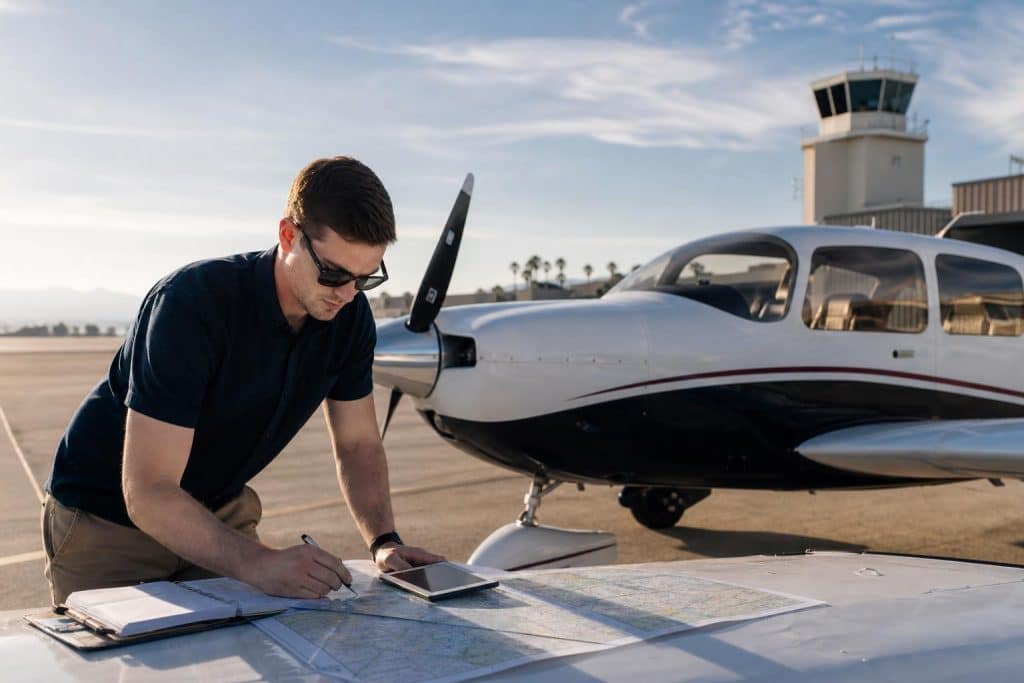
Federal regulations require the Pilot in Command to become thoroughly familiar with all available information concerning a proposed flight before departure. This process encompasses:
- Weather Analysis: Reviewing METARs (Meteorological Terminal Aviation Reports), TAFs (Terminal Aerodrome Forecasts), winds aloft, and severe weather advisories provided by sources such as the FAA Aviation Weather Center.
- Notams (Notices to Air Missions): Checking active airspace restrictions, runway closures, unlit towers, and navigational aid outages along the route.
- Performance Calculations: Computing takeoff and landing distances, weight and balance limits, and fuel reserves required for the journey, including contingency fuel reserves mandated by regulations (e.g., 30 minutes of extra fuel for daytime VFR, 45 minutes for IFR).
Aircraft Airworthiness Verification
Before stepping into the cockpit, the pilot must verify that the aircraft is legally and mechanically safe to fly. This involves checking the mandatory aircraft documents summarized by the acronym AUMR:
- Airworthiness Certificate
- Unregistered/Registered State and Federal documents
- Manual (Operating Handbook / POH)
- Registration Certificate
Furthermore, pilots must verify that all required aircraft inspections have been completed. These include annual inspections, 100-hour inspections for aircraft used for hire, altimeter and static system checks, transponder tests, and Emergency Locator Transmitter (ELT) battery inspections.
In-Flight Operations and Airspace Management
Once airborne, operations transition into dynamic airspace management, engine monitoring, and adherence to air traffic control (ATC) clearances.
Airspace Classification
Pilots must navigate an intricate mosaic of airspace classes:
- Class A: Controlled airspace from 18,000 feet MSL (Mean Sea Level) up to flight level 600, where IFR flight is mandatory.
- Class B, C, and D: Controlled airspaces surrounding increasingly busy commercial airports, requiring two-way radio communication and, in Class B and C, specific clearances or transponder modes.
- Class E and G: Controlled and uncontrolled lower-level airspaces where specific visibility and cloud clearance cloud rules apply.
Emergency Procedures and Risk Management
Aviation safety relies heavily on aeronautical decision-making (ADM) and Crew Resource Management (CRM). Pilots utilize standardized checklists for normal operations as well as emergency scenarios such as engine failure, electrical fires, or hydraulic loss. Memorized memory items, coupled with quick-reference handbooks (QRH), guide pilots through crisis mitigation while maintaining aircraft control.
Frequently Asked Questions About Aircraft Pilot Requirements
What are the vision requirements to become a commercial pilot?
Commercial pilots must possess distant visual acuity of 20/20 or better in each eye, with or without corrective lenses (glasses or contact lenses). They must also possess acceptable color vision to distinguish aeronautical chart markings, signal lights, and instrument displays. Corrective eye surgery, such as LASIK or PRK, is generally acceptable provided the candidate passes a specialized evaluation by an AME.
How much does it cost to get a private pilot license?
The cost of obtaining a Private Pilot License varies based on geographic location, aircraft rental rates, instructor fees, and student learning pace. In the United States, total costs typically range from $10,000 to $18,000. This encompasses aircraft rental, ground school materials, FAA written exam fees, medical exam costs, and the final practical checkride fee paid to an FAA Designated Pilot Examiner (DPE).
Can I fly commercially if I wear glasses?
Yes. Wearing glasses or contact lenses does not disqualify an individual from obtaining a private, commercial, or airline transport pilot certificate, provided your uncorrected or corrected vision meets the specific class standard required by your medical certificate.
What is the difference between Part 61 and Part 141 flight schools?
Part 61 flight schools offer a more flexible, customized training syllabus tailored to the student's personal schedule and pace. Part 141 flight schools operate under strict, FAA-approved curricula with rigid stage checks and structured milestones. Part 141 schools often allow students to complete certifications with lower minimum flight hour thresholds due to the rigorous oversight and standardization of their training programs.
How do pilots maintain their qualifications once licensed?
Pilots must complete ongoing training and currency requirements to remain legally active. This includes completing a biennial Flight Review with a certified instructor every 24 calendar months, maintaining instrument currency (performing specific approaches and holding procedures within a six-month window), and holding a valid, unexpired medical certificate.
Final Recommendations for Aspiring Aviators
Embarking on a path in aviation demands dedication, financial planning, and continuous study. For those starting out, the best initial action is to schedule an introductory "discovery flight" at a local flight school to experience the cockpit environment firsthand. Simultaneously, prospective students should schedule an appointment with an Aviation Medical Examiner to secure their medical certificate before investing heavily in ground school. By prioritizing safety, regulatory compliance, and consistent training habits, aviators can build a lifelong, successful foundation in the skies.