Choosing between advertising and sponsorship depends entirely on your marketing goals, timeline, and budget. Advertising delivers immediate, direct messaging with quantifiable short-term metrics like impressions and clicks, whereas sponsorship builds long-term brand equity, consumer trust, and community alignment through association with an event, organization, or creator.
When businesses and marketing professionals evaluate promotional channels, the conversation frequently arrives at the fundamental choice between advertising and sponsorship. While both strategies require financial investment to secure brand visibility, their operational mechanisms, audience engagement patterns, pricing structures, and long-term business outcomes differ significantly. Understanding these distinctions is critical for allocating marketing budgets effectively and maximizing return on investment.
Defining Advertising: Direct Promos and Immediate Reach
Advertising encompasses paid, public announcements designed to promote a product, service, brand, or idea directly to a targeted consumer base. The defining characteristic of advertising is control. Advertisers purchase specific blocks of time, space, or digital real estate—such as pre-roll video slots, social media carousels, search engine result pages, or billboard placements—to deliver a tailored message precisely how and when they choose.
The core objective of advertising is short-term conversion and brand awareness. Because the medium is explicitly recognized by consumers as a paid commercial pitch, the psychological contract between the brand and the audience is transactional. The viewer knows the brand is selling something, which reduces the friction of direct sales calls-to-action (CTAs) like "Buy Now," "Sign Up Today," or "Download the App."
Types of Advertising Channels
Modern advertising spans multiple distinct channels, each requiring specific asset creation and optimization strategies:
- Digital and Programmatic Advertising: Includes search engine marketing (SEM), display banners, social media ads (Meta, LinkedIn, TikTok), and video pre-roll. Digital ads offer granular audience targeting based on demographics, search intent, browsing behavior, and geographic location.
- Traditional Broadcast Advertising: Encompasses television and radio commercials. While television offers broad visual reach and high production value, radio provides localized, frequency-heavy messaging targeted to specific commuter or demographic habits.
- Out-of-Home (OOH) Advertising: Covers billboards, transit shelters, digital signage in urban centers, and public transport wraps. OOH relies heavily on high-traffic physical locations to secure massive, passive visibility.
- Print Advertising: Utilizes magazines, newspapers, and niche trade journals. Although its overall market share has declined in favor of digital mediums, print remains valuable for reaching hyper-targeted, engaged demographic segments.
Advantages and Limitations of Advertising
Advertising excels in scalability and speed. Once ad creatives are approved and budgets are allocated, campaigns can launch within hours, driving immediate traffic to landing pages or retail locations. Furthermore, advanced analytics dashboards allow marketers to monitor impressions, click-through rates (CTR), cost-per-acquisition (CPA), and conversion rates in real-time, facilitating rapid A/B testing and budget reallocation.
However, advertising faces notable limitations. Consumers frequently experience "banner blindness" and ad fatigue, actively ignoring commercial messages or utilizing ad-blocking software to bypass them. Additionally, advertising requires continuous funding; the moment you stop paying for ads, your visibility drops to zero, making it a recurring operational expense rather than an appreciating asset.
Defining Sponsorship: Alignment, Association, and Trust
Sponsorship is a financial or in-kind investment in an event, organization, team, individual creator, or cause in exchange for brand association and integrated promotional opportunities. Unlike traditional advertising, which interrupts the consumer experience with a direct sales pitch, sponsorship integrates a brand into an existing environment, experience, or community.
The foundational premise of sponsorship is the transfer of equity. When a reputable brand sponsors a major sports league, a respected industry conference, or a prominent cultural festival, the positive sentiments, excitement, and trust associated with that entity rub off on the sponsor. This process, known in marketing as brand halo effect, fosters deep emotional resonance that raw advertising struggle to replicate.
Core Categories of Sponsorship
Sponsorship manifests across diverse sectors, requiring tailored partnership agreements and asset valuations:
- Event Sponsorship: Involves funding music festivals, charity galas, marathons, or tech conferences. Brands secure physical signage, naming rights, product sampling booths, and VIP hospitality experiences.
- Sports Sponsorship: Ranges from global partnerships with organizations like the International Olympic Committee to local youth sports team jerseys. Brands gain massive global visibility through jersey placements, stadium naming rights, and televised broadcast mentions.
- Content and Creator Sponsorship: Involves partnering with podcasters, YouTubers, newsletter authors, and independent journalists. The creator personally endorses or integrates the product into their content, blending advertising with trusted recommendation.
- Cause-Related Marketing: Aligns a for-profit corporation with a non-profit organization or social initiative. The brand provides financial support while boosting public relations and demonstrating corporate social responsibility (CSR).
Advantages and Limitations of Sponsorship
The primary advantage of sponsorship is credibility and audience trust. When a trusted creator or established event endorses or features a brand, audience skepticism decreases significantly. Sponsorship also creates clutter-free zones; while a consumer might see dozens of banner ads on a website, an exclusive automotive sponsor of a major auto show faces minimal direct competition within that physical or experiential footprint.
Conversely, sponsorships involve higher financial risk and long-term commitments. Contracts frequently span months or years, locking brands into fixed financial obligations regardless of fluctuating economic conditions or external controversies affecting the sponsored entity. Furthermore, measuring the exact return on investment (ROI) for a sponsorship is notoriously difficult compared to performance-based digital advertising.
Comprehensive Comparison: Advertising vs Sponsorship
To evaluate which strategy aligns with your organizational objectives, it is necessary to examine how advertising and sponsorship stack up across critical business dimensions.
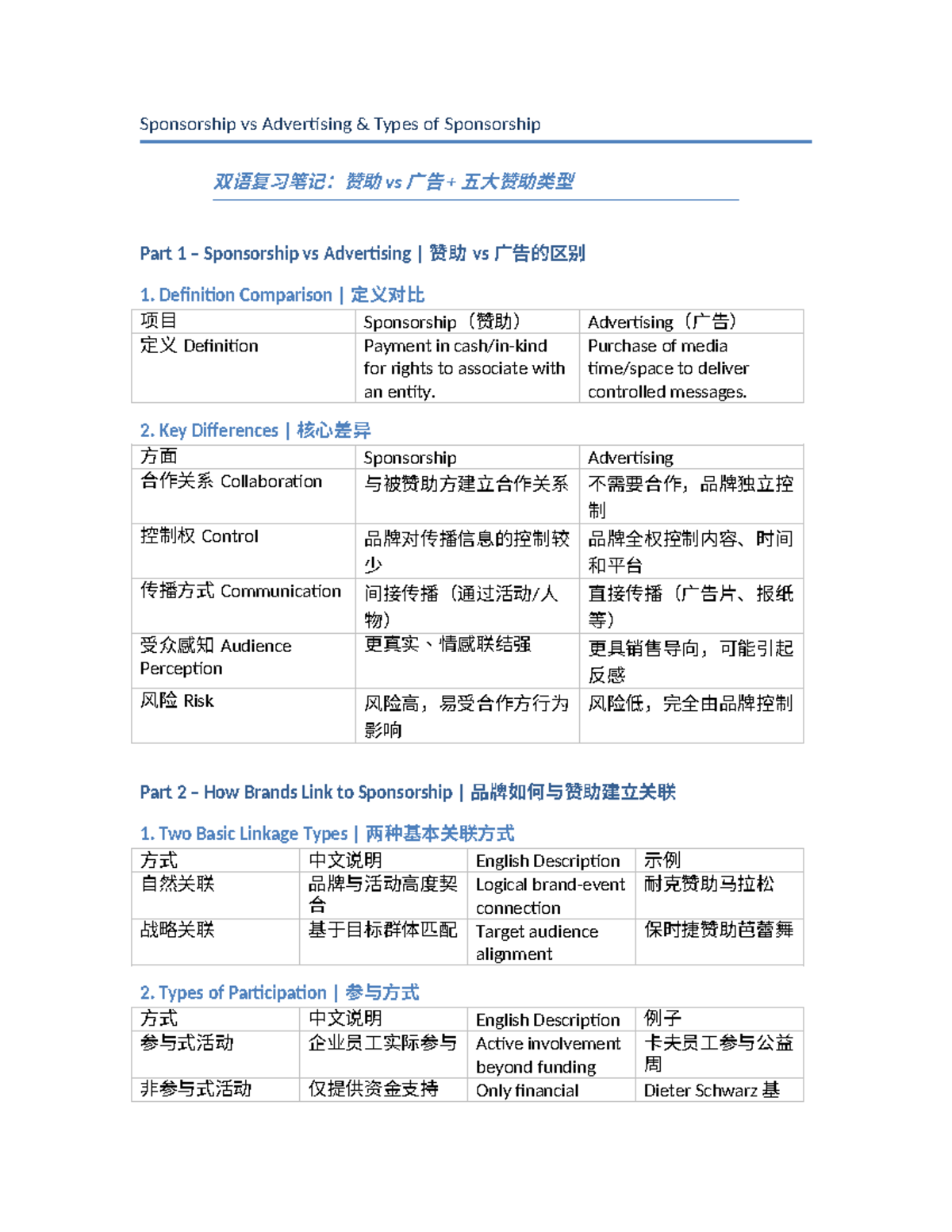
| Feature / Metric | Advertising | Sponsorship |
|---|---|---|
| Primary Goal | Direct sales, lead generation, immediate awareness. | Brand equity, trust-building, community integration. |
| Message Delivery | Direct, explicit commercial pitch controlled entirely by the brand. | Integrated, ambient association mediated by a third-party property. |
| Time Horizon | Short-term; active only as long as budgets sustain. | Medium-to-long-term; tied to event durations or multi-year contracts. |
| Cost Structure | Flexible, pay-per-click (PPC), cost-per-mille (CPM), or flat media buys. | Fixed fee, often requiring significant upfront capital plus activation costs. |
| Measurement & Data | Highly quantifiable (clicks, conversions, ROAS, impressions). | Complex and multifaceted (media equivalency, brand lift studies, sentiment analysis). |
| Audience Reception | Often viewed as intrusive; susceptible to ad-blockers and fatigue. | Generally viewed as supportive and non-intrusive; higher goodwill. |
Strategic Decision-Making: When to Choose Which
Determining whether to deploy advertising, sponsorship, or a hybrid strategy requires evaluating your product lifecycle, marketing budget, target demographic behavior, and overall business maturity.
When to Prioritize Advertising
- Launching a New Product or Service: When introducing a SKU that requires immediate search volume or direct e-commerce sales, digital performance advertising delivers rapid visibility and transactional velocity.
- Running Time-Sensitive Promotions: Flash sales, seasonal holiday pushes, and limited-time discounts demand the agility and precise scheduling control inherent in programmatic and social advertising.
- Operating on Tight Budgets with Strict ROI Demands: Small businesses with limited capital benefit from advertising because budgets can be adjusted daily, paused instantly, and measured down to the exact cost-per-lead.
When to Prioritize Sponsorship
- Entering a New Market or Niche Community: If your brand lacks recognition within a specialized industry, partnering with a trusted trade association or industry event grants immediate institutional legitimacy.
- Building Long-Term Brand Equity: Established enterprises seeking to maintain market dominance, enhance corporate reputation, or associate with cultural passion points (such as sustainability or arts) leverage sponsorship to deepen emotional consumer bonds.
- Engaging B2B Decision-Makers: High-value enterprise sales cycles rely heavily on relationship-building. Sponsoring exclusive executive roundtables or industry symposiums provides organic networking opportunities that digital banner ads cannot achieve.
Common Mistakes to Avoid in Promotional Strategy
Misallocating promotional spend is a frequent pitfall for growing businesses. Avoiding these common strategic errors ensures capital efficiency:
- Treating Sponsorship Like an Ad Placement: Expecting immediate, direct-response web traffic from a brand logo on a stadium banner or podcast mention usually leads to disappointment. Sponsorship requires supplementary activation marketing to harvest the equity built.
- Failing to Budget for Activation: Securing a sponsorship right is only half the expense. Brands must invest additional capital in designing activation booths, creating promotional merchandise, running social media campaigns around the partnership, and hosting clients.
- Ignoring Measurement Frameworks: While sponsorships are harder to track than programmatic ads, failing to establish baseline metrics—such as pre- and post-campaign brand lift surveys, coupon code tracking, or media impressions—prevents accurate future budgeting.
Frequently Asked Questions
Can advertising and sponsorship be used together in the same campaign?
Yes, integrated marketing campaigns frequently combine both strategies. For example, a beverage company might sponsor a major music festival (securing on-site pouring rights, VIP lounge naming, and artist associations) while simultaneously running geo-targeted social media ads and programmatic video campaigns inviting local consumers to visit their festival booth. This synergy amplifies reach and reinforces the brand message across multiple touchpoints.
How is the return on investment (ROI) measured for a sponsorship?
Measuring sponsorship ROI involves a combination of quantitative and qualitative metrics. Common methods include calculating Media Equivalency Value (estimating what it would cost to buy equivalent television or print ad space), tracking unique promotional discount codes or landing page URLs specific to the sponsorship, conducting brand lift studies to measure changes in consumer sentiment, and analyzing social media engagement and earned media value (EMV) generated during the partnership.
Why is sponsorship generally more expensive than digital advertising?
Sponsorships often require higher upfront costs because you are paying for exclusive association rights, physical infrastructure access, and the established equity of a third-party property. Furthermore, sponsorships typically involve fixed-fee contracts rather than flexible pay-per-click models, shifting more financial risk onto the sponsoring brand.
What is brand equity, and why is it more heavily impacted by sponsorships?
Brand equity refers to the commercial value derived from consumer perception of a brand name, rather than the product or service itself. Sponsorships impact brand equity more profoundly because psychological transfer occurs: when a consumer sees a brand supporting their favorite sports team or cultural event, they subconsciously transfer their positive feelings toward that entity onto the sponsoring brand, fostering deep-seated loyalty.
Conclusion and Next Actions
Both advertising and sponsorship remain powerful tools within the modern marketing arsenal, serving fundamentally different psychological and commercial functions. Advertising commands attention through direct, controlled, and instantly measurable commercial messaging, making it ideal for immediate customer acquisition and performance campaigns. Sponsorship, by contrast, builds lasting credibility and brand equity through strategic association and community integration.
To take action, audit your current marketing objectives for the year 2026. If your primary goal is immediate pipeline growth and traceable conversions, allocate your capital toward targeted performance advertising. If your objective is long-term market penetration, brand repositioning, or building deep affinity within a specific community, research high-fit sponsorship opportunities that authentically align with your core values and audience demographics.