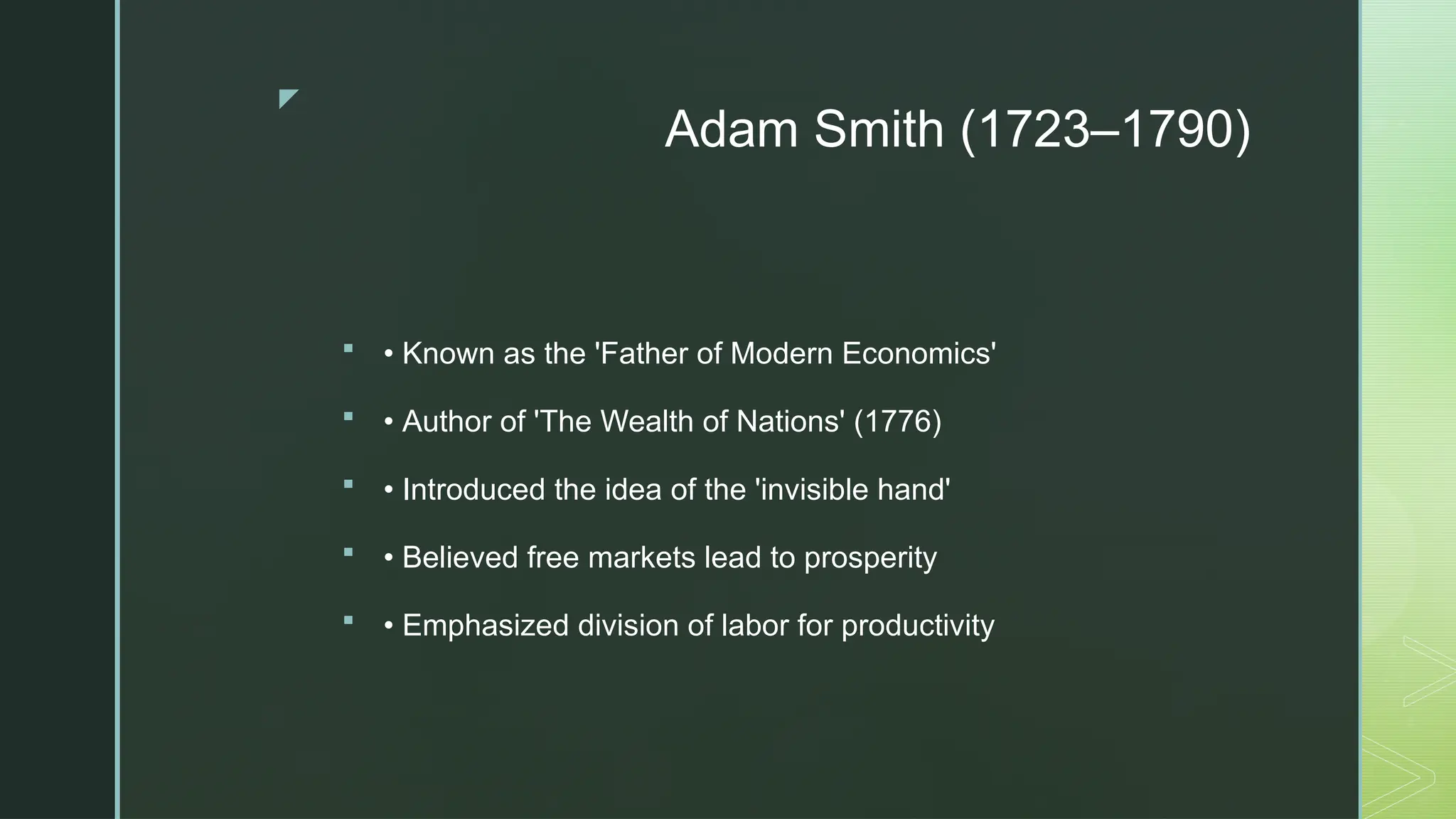
Adam Smith’s contribution to economics centers on his role as the architect of classical economic theory, emphasizing the power of the "invisible hand," the benefits of the division of labor, and the necessity of free-market competition. His work shifted economic thought from mercantilist state control toward a model defined by individual self-interest, voluntary exchange, and capital accumulation.
The Intellectual Context of Adam Smith’s Work
To understand Smith’s contribution, one must first recognize the environment in which he wrote. In the mid-18th century, European economic policy was dominated by mercantilism. This philosophy held that national wealth was measured solely by a country's stock of gold and silver. Consequently, governments implemented rigid protections, monopolies, and high tariffs to ensure a favorable balance of trade—exporting more than they imported.
Smith, a Scottish philosopher and economist, challenged this zero-sum perspective. In his seminal work, An Inquiry into the Nature and Causes of the Wealth of Nations (1776), he argued that a nation’s wealth is not the amount of precious metal in its coffers, but the total sum of its production and consumption—what we now define as Gross Domestic Product (GDP). This fundamental shift provided the groundwork for modern macroeconomic analysis.
The Division of Labor and Productivity
One of Smith’s most famous observations involves the pin factory. He noted that a single worker, acting alone, could barely produce one pin a day. However, by breaking the production process down into discrete, specialized tasks—drawing the wire, straightening it, cutting it, and grinding the point—a small group of workers could produce thousands of pins daily.
This concept, the division of labor, is the cornerstone of industrial efficiency. Smith identified three reasons why specialization increases output:
- Skill acquisition: Workers become more adept at their specific tasks through constant repetition.
- Time savings: Transitioning between different tools and activities consumes time that is eliminated when focusing on one task.
- Technological innovation: When labor is subdivided, it becomes easier to identify ways to improve machines or processes to simplify specific parts of the task.
In a modern 2026 context, this theory explains everything from global manufacturing supply chains to the high efficiency of specialized professional services.
The Invisible Hand and Self-Interest
Perhaps Smith’s most misunderstood concept is the "invisible hand." Often misconstrued as a justification for unregulated greed, it actually describes a decentralized mechanism that aligns individual action with public benefit.
Smith observed that a baker does not produce bread out of benevolence; he does so to support himself and his family. To earn that profit, however, he must produce bread that is high-quality and priced reasonably so that consumers will choose his product over competitors. Thus, by pursuing his own interest, the baker unintentionally promotes the best interests of society by providing a useful, affordable product.
This "invisible hand" implies that when markets are allowed to operate without unnecessary state interference, they naturally allocate resources to their most efficient uses. It assumes that voluntary exchange makes both the buyer and the seller better off.
Market Pricing and the Theory of Value
Smith grappled with the "diamond-water paradox," a question that had long puzzled thinkers: why is water, which is essential for life, cheap, while diamonds, which are largely ornamental, are incredibly expensive?
Smith began the process of distinguishing between value in use (utility) and value in exchange (market price). He noted that the scarcity of an item—its cost of production and the labor required to acquire it—largely dictates its market price. While he did not fully resolve the paradox (a task left for later marginalist economists in the 19th century), his focus on labor and production costs paved the way for the labor theory of value, a central tenet of classical economics for the next century.
The Role of Government
Contrary to the popular belief that Smith advocated for total anarchy or a complete absence of government, he was a pragmatic proponent of the "system of natural liberty." He argued that the state should be limited but active in specific areas where the market fails to provide necessary public goods.
According to Smith, the government has three primary duties:
- National Defense: Protecting the society from foreign aggression.
- Justice: Protecting individuals from the oppression of others and maintaining a system of courts and law enforcement.
- Public Works and Institutions: Maintaining infrastructure (like roads and bridges) and supporting public education—services that are essential for the public good but are not profitable for private actors to provide.
Comparison of Economic Models
| Feature | Mercantilism (Pre-Smith) | Classical Economics (Smith) |
|---|---|---|
| Source of Wealth | Accumulation of gold/silver | Total production (labor and capital) |
| Primary Driver | State-granted monopolies | Competitive self-interest |
| Trade Policy | Protectionism and tariffs | Free trade and voluntary exchange |
| Role of State | Direct intervention and control | Provision of justice and public goods |
Implications for Modern Economic Policy
By the year 2026, Smith’s influence remains the bedrock of global economic policy. Modern fiscal policy often balances the tension between the efficiency of the free market—which Smith championed—and the regulatory needs of society.
His arguments against monopolies are the direct ancestor of modern antitrust laws. When Smith argued against the East India Company’s privileges, he was highlighting that when a company becomes too large or is protected by the state, it loses the incentive to innovate and drives up costs for the consumer. Today, regulators continue to use this principle to maintain competitive markets, even in the era of multinational technology giants.
Furthermore, his insight into international trade—that specialization allows countries to produce goods at lower opportunity costs—remains the fundamental defense for global trade agreements. While modern economists have refined these theories to include factors like comparative advantage and information asymmetry, the core premise that trade is a positive-sum game remains attributed to Smith’s early observations.
Common Misconceptions
- "Self-interest is the same as selfishness": Smith saw self-interest as a neutral driving force, not a moral failing. He emphasized that in a well-functioning market, self-interest requires cooperation and honesty to build a reputation.
- "Smith wanted zero regulation": He was a fierce critic of "mercantile systems" (crony capitalism) that used regulations to favor specific industries. However, he consistently advocated for regulations that prevented fraud and ensured fair competition.
- "He believed only in the labor theory of value": While he emphasized labor, he recognized that capital investment and land rent also played significant roles in the final pricing of goods.
Frequently Asked Questions
1. What does the "Invisible Hand" mean in practice?
The invisible hand refers to the tendency of free markets to self-regulate. When individuals act in their own self-interest, they are incentivized to provide goods and services that others value. This competition prevents prices from rising too high and forces producers to maintain quality, all without a central authority directing them.
2. Why is Smith’s division of labor still relevant in 2026?
The division of labor is the foundation of the modern global economy. It is the reason why a smartphone can be designed in one country, contain components from ten others, and be assembled in another. Specialization remains the primary driver of technological advancement and cost-efficiency.
3. Did Adam Smith invent capitalism?
Smith did not "invent" capitalism, as the term itself was not widely used during his life. Rather, he was the first to formalize and explain the mechanics of the market economy. He observed what was already happening in growing commercial societies and identified the principles that allowed them to thrive.
4. What was the "Wealth of Nations" primarily trying to achieve?
The goal of the book was to identify the most effective way for a nation to grow its standard of living. Smith’s conclusion was that liberating trade from state-imposed monopolies and encouraging the natural movement of capital and labor were the most effective ways to create universal "opulence."
5. Are there limits to Smith’s economic theories?
Yes. Smith’s model assumes perfect information and rational agents. In reality, markets can suffer from "market failures" such as externalities (e.g., pollution), monopolies, and informational asymmetries. Modern economics uses Smith as a starting point, then adds layers of regulation and intervention to address these specific, documented failures.
Next Actions for Further Study
To deepen your understanding of Adam Smith’s contributions, it is recommended to read the introduction and the first three chapters of An Inquiry into the Nature and Causes of the Wealth of Nations. These sections contain the core arguments regarding the division of labor and the nature of market exchange. For those interested in the philosophical side of his work, The Theory of Moral Sentiments provides necessary context on how he viewed human behavior and ethics, which serves as the behavioral foundation for his later economic theories.