An accountant certificate is a professional credential that validates an individual's expertise in specific branches of accounting, such as auditing, financial management, or taxation. These certifications, including the CPA, CMA, and ACCA, represent a standardized level of competency and are often required for high-level roles, legal signing authority, and career advancement within the global financial sector.
Professional accounting certifications serve as a bridge between academic theory and practical, industry-standard application. While a university degree provides the foundational knowledge of debits, credits, and financial statements, a certification proves to employers and clients that the holder has mastered the rigorous standards of professional practice. In 2026, the landscape of these certificates has evolved to emphasize not just mathematical accuracy, but also data analytics, ethical leadership, and strategic advisory skills.
Understanding the Distinction: Certificate vs. License vs. Degree
The terms "certificate" and "certification" are often used interchangeably in casual conversation, but in the professional accounting world, they carry distinct meanings. It is essential for aspiring professionals to understand these differences before investing time and capital.
Academic Certificates
An academic certificate is usually awarded by a college or university upon the completion of a specific course of study. These are often used by career changers who already hold a degree in another field but need the specific accounting credits required to sit for professional exams. They are educational milestones rather than legal authorizations to practice.
Professional Certifications
Professional certifications (like the CMA or CIA) are granted by global or national professional bodies. They signify that the individual has passed a rigorous examination and meets specific experience requirements. These credentials demonstrate specialized "niche" expertise but do not always grant legal authority to sign audit reports.
Professional Licenses
A license, most notably the Certified Public Accountant (CPA) in the United States or Chartered Accountant (CA) in other jurisdictions, is a legal permit to practice. These are regulated by government-appointed boards. A license is the only credential that allows an accountant to provide an "attest" opinion on financial statements, which is a requirement for publicly traded companies.
Primary Accountant Certificates in 2026
The choice of which certificate to pursue depends heavily on your geographic location and your specific career goals. Below are the most prominent certifications recognized globally in 2026.
Certified Public Accountant (CPA)
The CPA remains the "gold standard" in the United States and has significant global reciprocity. Administered by the American Institute of Certified Public Accountants (AICPA) and the National Association of State Boards of Accountancy (NASBA), the CPA has undergone significant changes recently to reflect the digital-first nature of modern finance.
The CPA exam now utilizes a "Core + Discipline" model. Every candidate must pass three core sections: Auditing and Attestation (AUD), Financial Accounting and Reporting (FAR), and Taxation and Regulation (REG). Candidates then choose one of three disciplines to demonstrate deeper knowledge:
- Business Analysis and Reporting (BAR)
- Information Systems and Controls (ISC)
- Tax Compliance and Planning (TCP)
Certified Management Accountant (CMA)
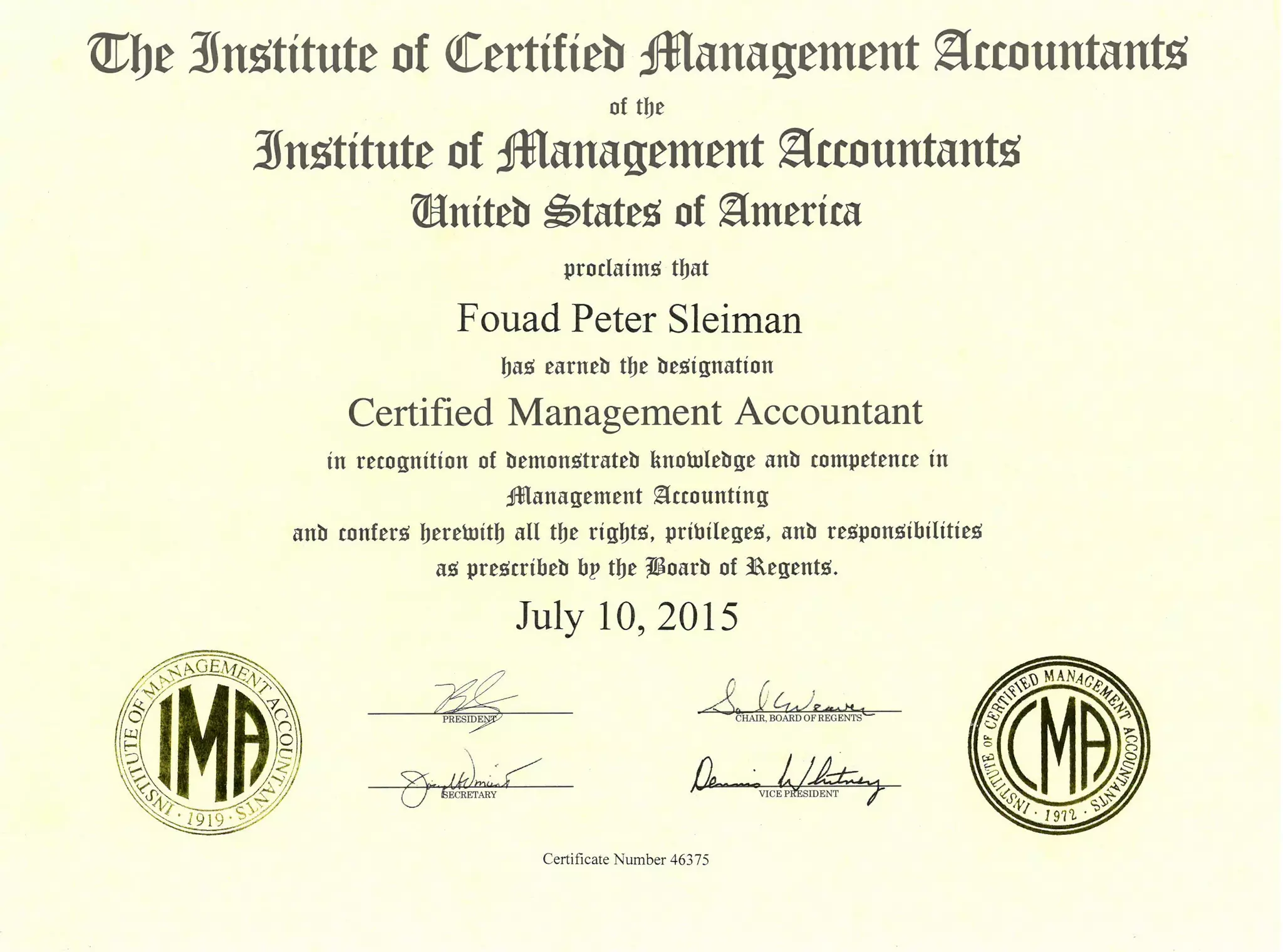
Offered by the Institute of Management Accountants (IMA), the CMA is the premier certification for accountants working within corporate environments. Unlike the CPA, which focuses heavily on external reporting and tax law, the CMA focuses on internal decision-making.
Key areas of mastery include financial planning, performance analysis, control, and professional ethics. It is highly valued by manufacturing firms, multinational corporations, and private equity groups where strategic financial management is prioritized over public auditing.
Association of Chartered Certified Accountants (ACCA)
The ACCA is a global body for professional accountants, with a massive footprint in Europe, Africa, and Asia. It is often the preferred choice for those seeking international mobility. The ACCA qualification is comprehensive, covering everything from basic accounting principles to advanced strategic business leadership. In 2026, the ACCA continues to be a leader in integrating Environmental, Social, and Governance (ESG) reporting into its core curriculum.
Certified Internal Auditor (CIA)
Managed by the Institute of Internal Auditors (IIA), the CIA is the only globally accepted designation for internal auditors. This certificate focuses on the internal controls of an organization, risk management, and governance. As corporate fraud and cybersecurity threats become more sophisticated, the demand for CIAs has reached record highs in 2026.
Comparison of Major Accounting Certifications
| Certification | Governing Body | Primary Focus | Exam Structure | Typical Completion Time |
|---|---|---|---|---|
| CPA | AICPA / NASBA | Public Accounting / Audit | 4 Parts (Core + Discipline) | 12 - 24 Months |
| CMA | IMA | Corporate Finance / Strategy | 2 Parts | 12 - 18 Months |
| ACCA | ACCA Global | International Finance | Up to 13 Exams | 3 - 4 Years |
| CIA | The IIA | Risk / Internal Controls | 3 Parts | 12 - 18 Months |
| CFA | CFA Institute | Investment / Portfolio Mgmt | 3 Levels | 2 - 4 Years |
Educational and Experience Requirements
Securing an accountant certificate is not merely about passing an exam; it is a holistic process involving education, testing, and verified work experience.
The 150-Hour Rule
In the United States, most state boards require CPA candidates to have completed 150 semester hours of college credit. Since a standard bachelor’s degree is typically 120 hours, most candidates pursue a Master’s in Accounting or additional post-baccalaureate certificates to bridge the 30-hour gap. This requirement ensures that the candidate has a broad education alongside technical accounting skills.
Professional Experience
Most certifications require a period of "qualifying experience." For the CPA, this is generally 1 to 2 years of work under the direct supervision of a licensed CPA. The CMA requires two years of continuous professional experience in management accounting or financial management. This ensures that the certificate holder can apply theoretical knowledge to real-world business problems.
Ethical Examinations
Integrity is the cornerstone of the accounting profession. Many jurisdictions require a separate ethics exam. This test covers the specific code of professional conduct, focusing on independence, objectivity, and the avoidance of conflicts of interest.
The Financial Investment: Costs and Fees
Pursuing a certificate is a significant financial commitment. Candidates must account for application fees, exam registration, and study materials.
- Application and Registration: Most bodies charge an initial application fee ranging from $100 to $250. Each exam section typically costs between $250 and $450 in 2026.
- Review Courses: Because the pass rates for these exams are often below 50%, the vast majority of candidates invest in "review providers" such as Becker, Gleim, or UWorld. These comprehensive study packages can cost anywhere from $1,500 to $3,500.
- Maintenance Fees: Once certified, you must pay annual membership dues to maintain the right to use the designation. For the CPA, this also includes the cost of an annual license renewal with your state board.
The Exam Process and Preparation Strategies
The transition to fully digital, computer-based testing (CBT) was completed years ago, but 2026 has introduced more sophisticated Task-Based Simulations (TBS) that require candidates to manipulate data in spreadsheets and interpret complex datasets within a timed environment.
Study Hours
Success typically requires a disciplined schedule. Experts generally recommend the following study allocations:
- CPA: 80–120 hours per section (totaling roughly 400 hours).
- CMA: 150–170 hours per part (totaling roughly 300+ hours).
- CIA: 100 hours per part.
The "NTS" and Testing Windows
In the US, once your educational credits are verified, you receive a Notice to Schedule (NTS). In 2026, most exams have moved away from restrictive "testing windows" to a more flexible year-round testing model, allowing candidates to sit for exams at their convenience at Prometric or similar testing centers.
Continuing Professional Education (CPE)
Obtaining the certificate is only the beginning. To keep the credential active, accountants must participate in Continuing Professional Education (CPE). Most jurisdictions require 40 hours of CPE per year.
This requirement ensures that accountants stay current with changing tax laws, new Financial Accounting Standards Board (FASB) updates, and emerging technologies like blockchain or AI-driven auditing tools. Failure to meet CPE requirements can lead to the "inactive" status of a license or even revocation of the certificate.
Impact on Salary and Career Growth
The return on investment (ROI) for an accountant certificate remains exceptionally high in 2026. Data from the Bureau of Labor Statistics (BLS) and various industry recruiters consistently show that certified accountants earn significantly more than their non-certified peers.
- Entry Level: A CPA or CMA can expect a starting salary 10–15% higher than a staff accountant without a designation.
- Mid-Career: For roles like Controller, Finance Director, or Audit Manager, a professional certificate is often a non-negotiable requirement.
- Lifetime Earnings: Estimates suggest that a CPA can earn $1 million more over their career compared to a non-certified accountant.
Furthermore, certifications provide "job security" during economic downturns. Companies value the high ethical standards and proven technical ability that these certificates represent, making certified professionals the last to be let go and the first to be promoted.
Frequently Asked Questions
Which certificate is best for a career in the "Big Four"?
The CPA is the essential credential for anyone aiming for a career at Deloitte, PwC, EY, or KPMG, particularly in the audit or tax service lines. While these firms hire non-CPAs for consulting roles, the path to Partnership almost always requires a CPA license.
Can I get an accountant certificate without an accounting degree?
Yes, but it is challenging. Most certifications require a specific number of accounting and business credits. If your degree is in a different field (e.g., Liberal Arts or Biology), you will likely need to take a bridge program or a university accounting certificate program to satisfy the educational prerequisites for the professional exams.
Does a CPA license from one state work in another?
In 2026, most U.S. states have adopted "mobility" rules. This allows a CPA in good standing in their home state to practice in another state without obtaining a new license, provided the states have substantially equivalent requirements. However, if you move permanently, you will usually need to transfer your license via reciprocity.
Is the CMA recognized outside of the United States?
Yes, the CMA is a highly respected global designation. It is particularly popular in the Middle East, China, and India, where US-based management accounting standards are frequently used by multinational corporations.
How long do I have to pass all parts of the CPA exam?
In most jurisdictions in 2026, once you pass your first section of the CPA exam, you have a 30-month rolling window to pass the remaining three sections. If you do not pass the others within this timeframe, the credit for the first section expires, and you must retake it.
Final Recommendation
If you are beginning your career in 2026, the most versatile and valuable credential remains the CPA (Certified Public Accountant). Its legal authority and broad recognition provide the strongest foundation for both public and private sector roles. However, if your passion lies strictly in corporate strategy and internal operations, the CMA offers a more targeted and slightly more efficient path to leadership. For those seeking a career in internal risk and oversight, the CIA is the clear choice. Regardless of the path you choose, start by verifying your educational transcripts against your local board's requirements to ensure a smooth application process.