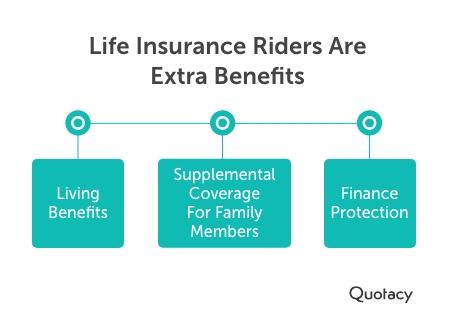
Life insurance riders are optional provisions or endorsements added to a standard policy that provide additional benefits or customize coverage to meet specific needs. These add-ons allow policyholders to address risks—such as disability, chronic illness, or accidental death—that a basic death benefit might not fully cover, ensuring a more robust financial safety net in 2026.
Life insurance is rarely a "one-size-fits-all" financial product. While a standard term or whole life policy provides a lump-sum payment to beneficiaries upon the insured's death, many individuals face unique risks during their lifetime that require more flexible solutions. This is where insurance riders become essential. By paying a slightly higher premium, policyholders can customize their contracts to include "living benefits" or enhanced protections.
In the current 2026 insurance landscape, riders have evolved to be more integrated and modular. Understanding how these function in real-world scenarios is crucial for anyone looking to optimize their estate planning or income protection strategies. Below, we examine five detailed case examples that illustrate the practical application, triggers, and outcomes of common life insurance riders.
1. The Waiver of Premium Rider: Protection Against Total Disability
The Waiver of Premium rider is designed to keep a life insurance policy in force if the insured becomes "totally disabled" and is unable to work. In this scenario, the insurance company waives the future premium payments while maintaining the full death benefit and any cash value accumulation.
Case Example: The Injured Professional Consider Sarah, a 38-year-old civil engineer with a 30-year term life insurance policy valued at $1,000,000. In early 2026, Sarah is involved in a severe car accident that results in a traumatic brain injury and significant mobility issues. Her physicians determine that she is "totally disabled" according to the definition in her policy, which usually means she cannot perform the material duties of her own occupation (or any occupation, depending on the specific contract language).
Because Sarah added a Waiver of Premium rider when she purchased her policy five years ago, she initiates a claim. After a standard six-month waiting period—during which she must continue to pay premiums—the insurance company approves her claim. The insurer refunds the premiums paid during those six months and assumes all future premium payments for the duration of her disability.
The Impact: Without this rider, Sarah would have to choose between paying her insurance premiums out of her disability savings or letting the policy lapse. Because the rider was in place, her $1,000,000 of coverage remains active, protecting her family even though her earning capacity has vanished. Most carriers, such as those monitored by the National Association of Insurance Commissioners (NAIC), require that the disability occurs before age 60 or 65 for this rider to remain valid.
2. Accelerated Death Benefit Rider: Accessing Living Benefits
The Accelerated Death Benefit (ADB) rider allows a policyholder to receive a portion of their death benefit while they are still alive if they are diagnosed with a terminal illness or, in some cases, a chronic or critical illness.
Case Example: The Terminal Diagnosis Robert, a 62-year-old retiree, holds a whole life insurance policy with a $500,000 face value. In 2026, Robert is diagnosed with an aggressive form of pancreatic cancer. His medical team provides a prognosis of 12 months or less to live. Under the terms of his Accelerated Death Benefit rider (specifically the Terminal Illness provision), Robert is eligible to "accelerate" up to 80% of his death benefit.
Robert chooses to access $200,000 of his benefit immediately. He uses these funds to pay for experimental treatments not covered by health insurance and to settle his outstanding mortgage, ensuring his spouse is not burdened by debt.
The Impact: When Robert passes away, the remaining $300,000 (minus any administrative fees or interest adjustments) is paid to his beneficiaries. The ADB rider transformed a future-dated asset into a current liquid resource when it was most needed. It is important to note that according to Internal Revenue Code Section 101(g), these accelerated benefits are generally received tax-free if the insured is certified as terminally ill by a physician.
3. Guaranteed Insurability Rider: Adapting to Life Milestones
The Guaranteed Insurability Rider (GIR) allows a policyholder to purchase additional life insurance coverage at specified dates or during specific life events without undergoing a new medical exam or providing evidence of insurability.
Case Example: The Growing Family Marcus is a 26-year-old medical resident who purchased a $250,000 whole life policy in 2022. At the time, he was healthy and secured a "Preferred" rating. His policy included a Guaranteed Insurability Rider that allows him to purchase an additional $100,000 of coverage every three years until age 40, or upon major life events like marriage or the birth of a child.
In 2026, Marcus develops Type 2 diabetes, a condition that would normally make increasing his life insurance coverage significantly more expensive or even impossible. However, Marcus and his wife welcome their first child in late 2026. This "life event" triggers an option to buy more coverage. Marcus exercises his right under the GIR to add $100,000 to his death benefit.
The Impact: Despite his new health diagnosis, Marcus receives the additional coverage at standard rates based on his current age, not his new health status. He successfully bypassed the medical underwriting process that would have otherwise penalized him for his diabetes. This rider is a critical tool for young professionals whose insurance needs will likely outpace their current health stability.
4. Accidental Death Benefit Rider: The "Double Indemnity" Scenario
The Accidental Death Benefit (ADB) rider provides an additional payment to beneficiaries if the insured dies as a result of an accident. This is often referred to as "double indemnity" because the additional benefit often equals the face amount of the base policy.
Case Example: The Unexpected Tragedy Elena is a 45-year-old executive with a $1,000,000 life insurance policy. Seeking extra protection because she travels frequently for work, she added an Accidental Death Benefit rider for an additional $1,000,000. In 2026, while traveling for a conference, Elena is a passenger in a commercial airline crash that results in no survivors.
Because her death was purely accidental—meeting the policy's strict definition of an external, violent, and visible means of death—her beneficiaries receive a total of $2,000,000.
The Impact: This rider is specifically focused on the "shock" of an unexpected death, which often leaves families with no time to prepare financially. However, it is important to understand the exclusions. If Elena had died from a heart attack while on the plane, or if the crash was caused by a self-inflicted act, the rider would not pay out. Only the base $1,000,000 would be distributed. This distinction makes the ADB rider a low-cost but highly specific form of supplemental insurance.
5. Child Term Rider: Family-Wide Protection
A Child Term rider provides a small amount of term life insurance coverage (typically between $5,000 and $25,000) for all of the insured’s children. This coverage is usually available at a flat rate, regardless of the number of children in the household.
Case Example: The Household Safety Net The Thompson family consists of two parents and four children. In 2024, the father, David, added a Child Term rider to his primary life insurance policy for a cost of approximately $60 per year. This rider covers all four children for $15,000 each.
Tragically, in 2026, their youngest son passes away due to a sudden illness. The rider pays out the $15,000 death benefit to David.
The Impact: While $15,000 is not a life-changing sum in terms of long-term wealth, it provides immediate liquidity to cover funeral expenses and medical bills, allowing the family to grieve without the immediate pressure of these costs. Furthermore, most Child Term riders include a "conversion" feature. When the surviving children reach age 21 or 25, they can convert their $15,000 term coverage into a permanent whole life policy (often for up to five times the original amount) without a medical exam, ensuring they have their own base of coverage for adulthood.
Comparison of Common Life Insurance Riders
The following table compares the five riders discussed above based on their primary triggers and typical cost structures in the 2026 market.
| Rider Name | Primary Trigger | Benefit Type | Typical Relative Cost |
|---|---|---|---|
| Waiver of Premium | Total disability (6+ months) | Policy stays active without payments | Moderate |
| Accelerated Death | Terminal or chronic illness | Advance on the death benefit | Low (often included) |
| Guaranteed Insurability | Specific ages or life events | Ability to buy more coverage | Moderate |
| Accidental Death | Death via external accident | Additional lump sum payout | Low |
| Child Term | Death of a child | Small lump sum for expenses | Very Low (flat fee) |
Key Considerations and Potential Limitations
While riders offer significant value, they are not without technical limitations and costs. Before adding a rider to a policy in 2026, consumers must evaluate the following:
- Cost vs. Benefit: Every rider comes with an additional premium. Over a 20 or 30-year period, a "Waiver of Premium" rider might cost thousands of dollars. Policyholders must weigh this against the statistical likelihood of using the benefit.
- Definitions and Exclusions: The definition of "disability" or "accident" varies wildly between insurance companies. Some policies use an "own-occupation" definition (easier to trigger), while others use "any-occupation" (harder to trigger).
- Age Limits: Most riders have an expiration date. For example, Guaranteed Insurability options usually expire by age 40 or 45, and Accidental Death coverage often ends at age 70.
- Underwriting Requirements: While riders like the GIR help you avoid future underwriting, adding a rider to an existing policy often requires a "statement of good health" or a mini-medical exam. It is almost always more cost-effective to add riders at the time of the initial policy purchase.
Frequently Asked Questions
Can I add a rider to my life insurance policy at any time?
In most cases, riders are added at the time the policy is originally issued. While some insurers allow you to add certain riders later, it typically requires a process called "re-underwriting," where you must prove you are still in good health. Additionally, some riders, like the Child Term rider, are more flexible about being added mid-term compared to the Guaranteed Insurability rider.
Does an Accelerated Death Benefit rider reduce the amount my family receives?
Yes. Any amount you receive while you are alive through an accelerated death benefit is deducted from the final death benefit that goes to your beneficiaries. Furthermore, some companies charge a small administrative fee or an interest adjustment for "early" payment, which may further reduce the final payout.
Is the Accidental Death Benefit rider worth it if I already have a large policy?
It depends on your risk profile. If you have a high-risk occupation or travel frequently, it can be a cost-effective way to "layer" coverage. However, many financial experts argue that if you need $2 million in coverage, you should simply buy a $2 million base policy, as the Accidental Death rider will not pay out if you die from natural causes like a heart attack or stroke—which are statistically more likely.
What happens to a Child Term rider when the child grows up?
Most Child Term riders expire when the child reaches a certain age, typically 21, 23, or 25. At that point, the rider usually offers a "conversion privilege," allowing the child to convert the term coverage into a permanent policy of their own. This is a significant benefit if the child has developed a health condition that would make them otherwise uninsurable.
Are premiums waived permanently under the Waiver of Premium rider?
The premiums are only waived for as long as the insured meets the policy’s definition of "totally disabled." If the insured recovers and returns to work, they must resume paying the premiums to keep the policy active. If the disability is permanent, the premiums are typically waived until the policy matures or the insured passes away.
Practical Recommendation
When structuring your life insurance policy in 2026, do not view riders as mere "upsells." Instead, treat them as specialized tools to address gaps in your financial plan. If you are a primary breadwinner, the Waiver of Premium is often the most vital addition, as it protects your most valuable asset: your ability to earn an income. If you have a family history of illness, prioritize the Accelerated Death Benefit and Guaranteed Insurability riders.
Always request a "Policy Illustration" that shows the cost of the base policy both with and without the riders. This transparency allows you to see exactly how much each feature is costing you over the life of the policy. Consult with a licensed insurance advisor to ensure the definitions of "accident" or "disability" in your contract align with your actual needs and occupation.