Maintaining your 2025 Kia Sportage is the most effective way to protect your investment, ensure long-term reliability, and keep your industry-leading Kia warranty intact. Under normal driving conditions, the 2025 Kia Sportage requires a service visit every 8,000 miles or 12 months, whichever comes first. This primary interval includes a synthetic oil change, tire rotation, and a comprehensive multi-point inspection to identify potential issues before they become costly repairs.
As we move through 2026, many owners of the 2025 Sportage—including the gas, Hybrid (HEV), and Plug-in Hybrid (PHEV) variants—are reaching their first or second major service milestones. Because the Sportage features advanced Gasoline Direct Injection (GDI) and sophisticated electrified powertrains, adhering to the manufacturer-specified schedule is more critical than ever. This guide provides a deep dive into the specific requirements for every powertrain, the differences between "normal" and "severe" maintenance, and how to document your service to safeguard your 10-year/100,000-mile powertrain warranty.
Understanding the 2025 Kia Sportage Service Intervals
Kia categorizes maintenance into two main tracks: Normal and Severe. While most marketing materials highlight the "Normal" schedule, many American drivers actually fall under the "Severe" category due to short commutes, stop-and-go traffic, or extreme seasonal temperatures.
The Standard 8,000-Mile Service
For those driving under ideal conditions, the 8,000-mile mark is the baseline for the 2025 Sportage. At this interval, the primary focus is the engine's lubrication and tire health.
- Engine Oil and Filter Change: The 2.5L four-cylinder and the 1.6L Turbo-Hybrid engines both require high-quality full synthetic oil (typically 0W-20). Synthetic oil resists thermal breakdown better than conventional oil, which is vital for the turbochargers found in the Hybrid and PHEV models.
- Tire Rotation: To ensure even tread wear across all four tires, Kia recommends a rotation every 8,000 miles. For All-Wheel Drive (AWD) models, this is particularly important to prevent strain on the center differential and transfer case.
- Fuel Additive: If you do not consistently use "Top Tier" detergent gasoline, Kia recommends adding a bottle of fuel system cleaner at this interval to prevent carbon buildup on the GDI fuel injectors.
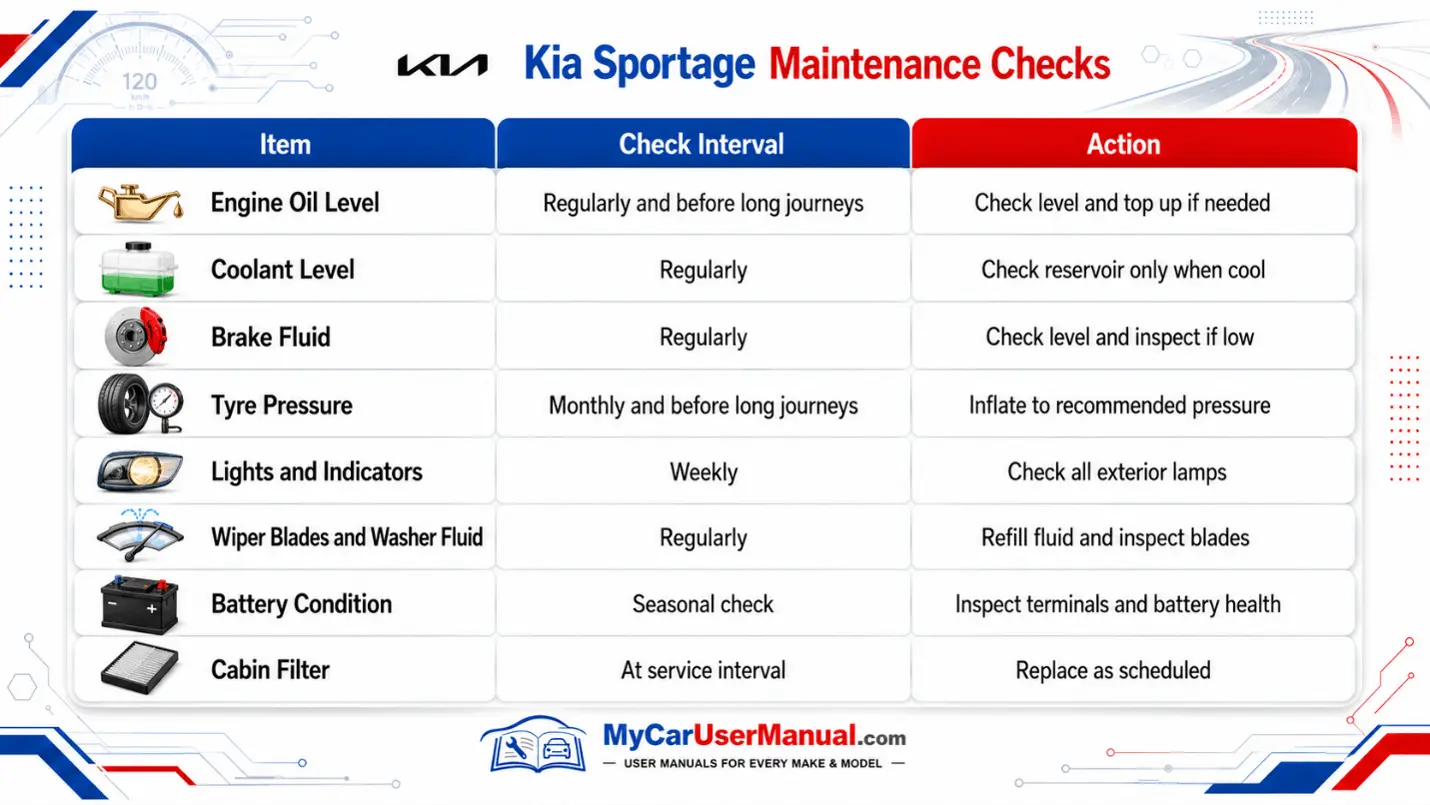
- Multi-Point Inspection: Technicians will check fluid levels (coolant, brake fluid, washer fluid), battery health, and external lights.
The 16,000-Mile Intermediate Service
At 16,000 miles (or 24 months), the service requirements expand to include the vehicle's "breathing" and hydraulic systems.
- Cabin Air Filter Replacement: This filter prevents dust, pollen, and pollutants from entering the HVAC system. In areas with high pollution or heavy seasonal allergies, replacing this is essential for passenger comfort and to prevent "musty" odors from the AC vents.
- Brake Inspection: Technicians perform a visual and physical inspection of the brake pads, rotors, calipers, and lines. They look for uneven wear or signs of heat glazing on the rotors.
- Suspension and Chassis Check: Inspection of the drive shafts, boots, and suspension bolts to ensure everything remains torqued to factory specifications.
The 30,000 to 32,000-Mile Major Service
Often considered the first "Major" service, the 32,000-mile interval is where the Sportage requires more significant component replacements.
- Engine Air Filter: A clogged engine air filter restricts airflow, forcing the engine to work harder and reducing fuel economy. For the 1.6L Turbo engines, a clean filter is vital for maintaining turbocharger efficiency.
- Climate Control Air Filter: A second replacement of the cabin filter is usually due here.
- Detailed Fluid Analysis: While not always a "flush" interval, technicians check the condition of the transmission fluid and, on AWD models, the rear differential and transfer case oil.
Maintenance Schedule Table for 2025 Kia Sportage
The following table outlines the service requirements for the 2025 Kia Sportage (Gas, HEV, and PHEV) under Normal driving conditions through the first 96,000 miles.
| Mileage Interval | Key Actions Required | Powertrain Specifics |
|---|---|---|
| 8,000 Miles | Oil & Filter Change, Tire Rotation, Multi-Point Inspection | Add Fuel Additive if not using Top Tier gas |
| 16,000 Miles | All 8k items + Replace Cabin Air Filter, Inspect Brakes | Inspect Drive Shafts and Boots |
| 24,000 Miles | All 8k items + Inspect Suspension & Steering Gear | Inspect Fuel Lines and Hoses |
| 32,000 Miles | All 16k items + Replace Engine Air Filter | Inspect Parking Brake and Brake Lines |
| 40,000 Miles | All 8k items + Inspect Brake Fluid | Check Drive Belt condition |
| 48,000 Miles | All 16k items + Deep Brake/Suspension Inspection | Exhaust system visual check |
| 60,000 Miles | Replace Coolant (Hybrid/PHEV Inverter Coolant) | Inspect Valve Clearance (2.5L Gas) |
| 80,000 Miles | Inspect All Belts, Hoses, and Fluid Levels | Major Battery Health Check (HEV/PHEV) |
| 96,000 Miles | Replace Spark Plugs (Turbo models), Engine Coolant | Full drivetrain fluid assessment |
Note: For the 2025 Sportage Hybrid and PHEV, the HSG (Hybrid Starter Generator) belt should be inspected every 20,000 miles or 24 months to ensure smooth transitions between electric and gas power.
Normal vs. Severe Maintenance: Which One Are You?
Most owners mistakenly follow the Normal schedule when their driving habits actually dictate the Severe schedule. Kia defines Severe Driving Conditions as:
- Repeatedly driving short distances (less than 5 miles in normal temp or 10 miles in freezing temp).
- Extensive engine idling or low-speed driving for long distances (delivery services, heavy traffic).
- Driving on rough, dusty, muddy, unpaved, or salt-spread roads.
- Driving in areas where salt or other corrosive materials are used or in very cold weather.
- Driving in heavy traffic or areas above 90°F (32°C).
- Driving in hilly or mountainous terrain.
- Towing a trailer or using a roof rack (frequent loading).
If you fall into any of these categories, you should shorten your oil change interval to 5,000 miles or 6 months. Furthermore, items like the engine air filter and brake components may need more frequent replacement. Neglecting the Severe schedule when your driving habits demand it can lead to premature engine wear and potential warranty claim denials.
Powertrain Specifics: Gas vs. Hybrid vs. PHEV
While the chassis and interior maintenance remain largely the same, the 2025 Sportage's three powertrain options have unique needs.
2.5L Gas Engine (FWD/AWD)
The naturally aspirated 2.5L engine is the simplest of the three but relies heavily on the GDI system. Owners should be vigilant about carbon buildup. Periodic use of a high-quality fuel system cleaner is recommended by Kia to maintain idle quality and fuel efficiency.
1.6L Turbo Hybrid (HEV) and Plug-in Hybrid (PHEV)
These models utilize a sophisticated parallel hybrid system.
- Inverter Coolant: Electrified Sportages use a specialized coolant for the power electronics (inverter). This is separate from the engine coolant and must be inspected and eventually replaced to prevent overheating of the electric drive components.
- Turbocharged Engine Maintenance: Turbochargers operate at extremely high RPMs and temperatures. Ensuring you use the correct synthetic oil grade and never skip an oil change is vital for turbo longevity.
- Brake Regeneration: Because Hybrids and PHEVs use regenerative braking to charge the battery, the physical brake pads often last longer than on gas-only models. However, the calipers can sometimes seize due to under-use in salt-heavy regions, making annual brake cleaning and lubrication a wise choice.
The Importance of the 10-Year/100,000-Mile Warranty
One of the primary reasons consumers choose the 2025 Kia Sportage is the "Power to Surprise" warranty. However, this coverage is conditional. To maintain the powertrain warranty, you must:
- Keep Meticulous Records: If you perform DIY maintenance or use an independent shop, keep every receipt. The receipt must show the date, mileage, VIN, and the specific parts/fluids used (e.g., "Full Synthetic 0W-20 Oil").
- Use OEM or Equivalent Parts: While you aren't required to use Kia-branded filters, using low-quality "no-name" filters that fail can give the manufacturer grounds to deny a claim if that failure causes engine damage.
- Address Recalls Promptly: Check the NHTSA website periodically or use the Kia Access app to ensure no safety recalls or technical service bulletins (TSBs) are pending for your VIN.
DIY Maintenance: What You Can Do at Home
For the 2025 Sportage owner who enjoys working on their vehicle, several tasks are straightforward:
- Cabin Air Filter: Located behind the glovebox, this can be swapped in under two minutes without tools.
- Engine Air Filter: The airbox features simple clips; no tools are required for replacement.
- Fluid Top-offs: Regularly checking and topping off windshield washer fluid and checking the oil dipstick are basic but essential habits.
- Tire Pressure: The Sportage includes a Tire Pressure Monitoring System (TPMS), but manually checking pressures with a gauge once a month ensures maximum fuel economy and even wear.
However, tasks involving the Hybrid/PHEV High-Voltage system should never be attempted by an owner. The orange cables signify high-voltage electricity that can be fatal if mishandled. Always leave battery and electric motor service to Kia-certified technicians.
Common Maintenance Mistakes to Avoid
- Ignoring the "Low Oil" Light: Modern GDI engines can consume a small amount of oil between changes. Checking your oil level every 1,000 miles is a "best practice" that prevents running the engine low on lubrication.
- Using the Wrong Coolant: Kia uses a specific phosphate-organic acid technology (P-OAT) coolant. Mixing it with "Universal" green or orange coolant can cause gelling and clog the radiator or heater core.
- Skipping Brake Fluid Flushes: Brake fluid is hygroscopic, meaning it absorbs moisture from the air over time. This can lead to internal corrosion and a "spongy" brake pedal. Kia typically recommends a flush every 48,000 miles or 48 months.
Frequently Asked Questions
Does the 2025 Kia Sportage have a timing belt or timing chain?
All 2025 Kia Sportage engines (the 2.5L Gas and the 1.6L Turbo Hybrid/PHEV) utilize a timing chain. Unlike timing belts, timing chains are designed to last the life of the engine and do not require periodic replacement, provided the engine oil is changed regularly to keep the chain lubricated.
How often should I change the oil in my 2025 Sportage Hybrid?
Even though the gasoline engine in a Hybrid or PHEV doesn't run 100% of the time, you should still follow the 8,000-mile or 12-month interval. Short trips where the engine doesn't reach full operating temperature can lead to fuel dilution in the oil, making regular changes essential regardless of EV-mode usage.
Is the first service free for the 2025 Kia Sportage?
Kia Motors America does not offer a standard nationwide "free maintenance" program for all models. However, many individual dealerships include the first or second oil change as part of the purchase agreement. Check your sales contract or contact your local dealer's service department to see if your vehicle is enrolled in a complimentary maintenance plan.
Can I use 87-octane fuel in my Sportage Turbo?
Yes, the 1.6L Turbo engine in the Sportage Hybrid and PHEV is calibrated to run on 87-octane (Regular) unleaded gasoline. While using premium fuel won't hurt the engine, it generally does not provide a significant performance or efficiency boost for this specific powertrain. Ensuring the fuel is "Top Tier" is more important than the octane rating.
Why is my tire pressure light on when the tires look full?
The 2025 Sportage uses a direct TPMS. As temperatures drop in the autumn and winter, the air inside your tires contracts, lowering the pressure. Usually, adding a few PSI to reach the recommended "Cold Tire Pressure" (found on the sticker inside the driver's door jamb) will resolve the light once you drive for a few minutes.
Final Recommendation for Owners
To maximize the lifespan of your 2025 Kia Sportage, the single most important action is to follow the "Severe" maintenance schedule if you live in a climate with extreme temperatures or drive in heavy traffic. While the 8,000-mile interval is the standard, a 5,000-mile synthetic oil change is the best "insurance policy" for the longevity of your GDI or Turbo-Hybrid engine. Always keep your service records organized in a folder or digitally via the Kia Access app to ensure your warranty remains valid until 2035 or 100,000 miles.