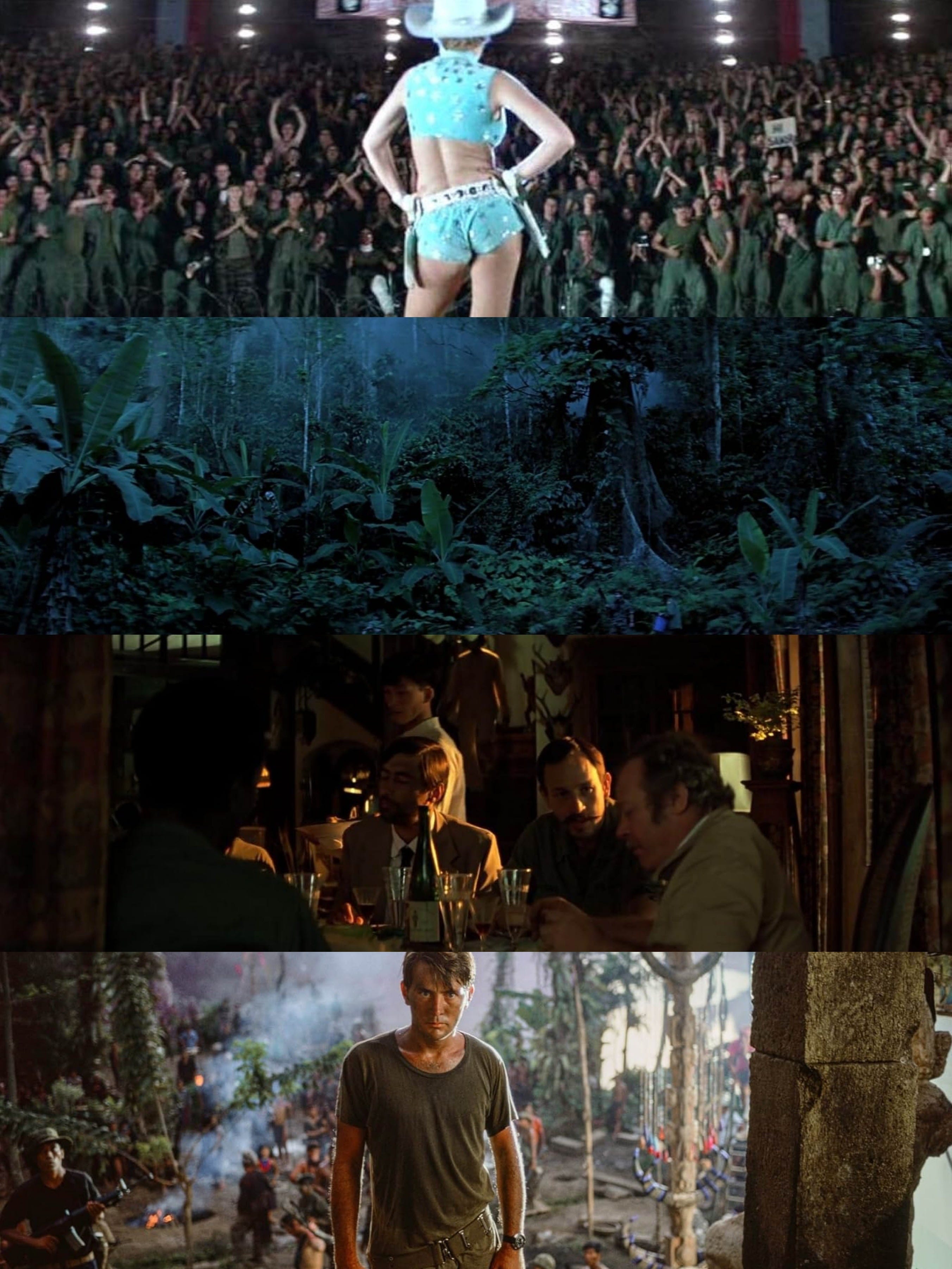
Francis Ford Coppola filmed Apocalypse Now in the Philippines between March 1976 and August 1977 to replicate the dense jungle terrain of Vietnam and Cambodia. Production took place primarily in Baler, Pagsanjan, and Iba, enduring tropical typhoons, military conflicts with local insurgents, health emergencies, and severe budget overruns that nearly destroyed the project.
Why Francis Ford Coppola Chose the Philippines for Vietnam
When Francis Ford Coppola embarked on adapting Joseph Conrad’s classic novella Heart of Darkness into a Vietnam War epic written by John Milius, he faced a fundamental logistical hurdle: shooting in Vietnam itself was impossible. The Vietnam War had ended only a year before pre-production began in 1975, leaving the region politically unstable and completely off-limits to Hollywood studios.
Coppola needed a location that possessed untamed tropical rainforests, wide river networks suitable for a military patrol boat (PBR) journey, access to U.S.-style military equipment, and a cheap labor force capable of constructing massive movie sets. After considering locations in Australia and South America, Coppola settled on the island of Luzon in the Philippines.
The political environment of the Philippines under President Ferdinand Marcos offered distinct logistical advantages. The Armed Forces of the Philippines (AFP) possessed U.S.-manufactured Sikorsky helicopters and military hardware that resembled the equipment used by the United States military during the Vietnam War. Coppola struck a deal with the Marcos administration to lease these military helicopters and their pilots directly for the film shoot. Additionally, the close proximity of U.S. military bases—specifically Clark Air Base and Subic Bay Naval Base—provided an essential supply pipeline for production logistics and equipment shipping.
However, substituting the Philippines for Vietnam created unexpected complexities. The decision thrust a massive American film crew into a country operating under martial law, battling an active domestic insurgency, and subject to unpredictable Pacific weather patterns.
Key Filming Locations Across the Philippine Islands
Production for Apocalypse Now was anchored across three primary regions on the island of Luzon. Each site served a specific narrative purpose, standing in for locations along the fictional Nung River trajectory toward Colonel Walter E. Kurtz’s remote outpost.
Luzon Filming Hubs:
- Baler, Aurora (East Coast)
- Village of Air Cavalry attack & "Charlie's Point" beach surf scene
- Pagsanjan River & Falls, Laguna (South of Manila)
- The Nung River journey & Kurtz's Cambodian compound set
- Iba, Zambales (West Coast)
- U.S. Army base camp, runway sets, & helicopter staging staging area
Baler, Aurora (Charlie’s Point and the Beach Attack)
The town of Baler, situated on the eastern coast of Luzon in Aurora province, provided the backdrop for one of the most famous sequences in cinema history: the helicopter assault on a coastal village commanded by Lieutenant Colonel Bill Kilgore (played by Robert Duvall).
The production constructed a realistic Vietnamese coastal village along the coastline at Sabang Beach and nearby areas. It was here that Coppola filmed the iconic air cavalry attack set to Richard Wagner’s "Ride of the Walkyries." The location earned the nickname "Charlie's Point" among the crew, directly referencing Kilgore’s famous line, "Charlie don't surf!"
Beyond its cinematic significance, the Baler shoot left a lasting real-world imprint on local Philippine culture. Members of the film crew brought surfboards to ride the Pacific swells during production breaks. When the crew wrapped filming and departed, they left several surfboards behind with local residents. This event is widely recognized as the historical birth of surfing culture in the Philippines, transforming Baler into the country's modern surfing capital.
Pagsanjan River, Laguna (The Upriver Journey and Kurtz's Compound)
To portray the surreal, winding Nung River that Captain Benjamin Willard (Martin Sheen) travels along to track down Kurtz, the production moved to the Pagsanjan River and Pagsanjan Falls in Laguna province, south of Manila.
The dense jungle foliage along the river canyon provided an imposing natural backdrop for Willard’s journey on the PBR Erebus. In the town of Pagsanjan, production designer Dean Tavoularis oversaw the construction of two enormous sets:
- The Do Lung Bridge: A sprawling, nightmarish battlefield set complete with barbed wire, sunken vehicles, and floodlights, representing the final outpost of American military order.
- Kurtz’s Cambodian Compound: Built near the river, this massive set combined ancient Khmer temple architecture with terrifying pagan ritual decorations, requiring hundreds of local extras to portray Kurtz’s devoted Montagnard followers.
The physical terrain of Pagsanjan was challenging. Humidity frequently hovered near 100%, and moving heavy equipment, cameras, and riverboats through narrow, rocky river passages posed constant risks to crew safety and gear.
Iba, Zambales (Base Camps and Airstrips)
On the western shore of Luzon, the town of Iba in Zambales province hosted the production's base camps, storage facilities, and several military encampment sets. The flat coastal topography allowed the art department to build large-scale military bases, supply depots, and aircraft runways.
Iba served as the staging ground for large logistics, housing hundreds of cast and crew members, technicians, and local workers. However, its exposed position along the South China Sea made it vulnerable to coastal weather events.
Natural Disasters and Logistical Nightmares
What was originally planned as a five-month shoot stretching from March to August 1976 quickly spiraled into a 16-month grueling production that wrapped principle photography in August 1977. The delay was caused by environmental destruction and unprecedented operational barriers.
Typhoon Olga (Typhoon Didang)
In May 1976, just two months into filming, Typhoon Olga (known locally in the Philippines as Typhoon Didang) swept across Luzon. The storm brought catastrophic rainfall and winds exceeding 100 miles per hour, devastating the island's infrastructure.
The impact on the film production was severe:
- Set Destruction: The sprawling base camp sets at Iba, Zambales, were almost entirely flattened. The coastal village sets in Baler suffered immense structural damage, and the river sets in Pagsanjan flooded completely.
- Equipment Damage: Sensitive camera equipment, electrical generators, and audio hardware were submerged in water or ruined by mud.
- Production Shutdown: Coppola was forced to shut down production entirely for more than six weeks. Most of the American cast and crew were evacuated back to the United States while local crews worked to rebuild destroyed sets from scratch.
The cost of rebuilding sets and repairing ruined gear added millions of dollars to the budget before even half of the film had been shot.
Military Helicopter Shortages and Political Conflicts
The production's reliance on President Ferdinand Marcos' military hardware created constant, unpredictable delays. Coppola had leased U.S.-supplied Sikorsky UH-1 Iroquois "Huey" helicopters directly from the Armed Forces of the Philippines. These aircraft were essential for the massive air assault sequences in Baler.
However, during filming in 1976, the Philippine government was actively fighting anti-government insurgents, including the Communist New People's Army (NPA) and the Moro National Liberation Front (MNLF) in the southern region of Mindanao.
"We had the helicopters lined up for a massive multi-camera shot, and suddenly the pilots would turn their engines back on and fly away because Marcos needed them to fight real insurgents down south." — Documented accounts from the film's production crew
Whenever active fighting escalated, the Philippine military would unexpectedly recall the helicopters mid-shoot. Pilots would literally start their engines and fly off the set in the middle of a take, leaving Coppola and his cinematographers stranded without their primary aerial assets. Furthermore, every time a new batch of replacement pilots arrived on set, production had to halt to re-paint the helicopters with fake U.S. Army insignia, only to repaint them with official Philippine military markings whenever they were recalled to active combat.
Human Toll: Health Crises, Cast Changes, and Financial Ruin
The physical and psychological strain of working in the Philippine jungle severely impacted the cast and crew, bringing the production close to total collapse multiple times.
Timeline of Production Challenges (1976–1977):
- March 1976: Principle photography begins in the Philippines
- April 1976: Harvey Keitel fired; Martin Sheen recast as Willard
- May 1976: Typhoon Olga destroys sets; 6-week shutdown
- Sept 1976: Marlon Brando arrives unprepared on set
- March 1977: Martin Sheen suffers near-fatal heart attack
- August 1977: Principle photography finally wraps (16 months total)
Recasting and Martin Sheen’s Heart Attack
The role of Captain Willard was originally given to actor Harvey Keitel. However, after reviewing the first few weeks of footage shot in the Philippines, Coppola realized Keitel's intense, aggressive acting style did not fit the introspective nature he envisioned for the character. Coppola made the difficult decision to fire Keitel and hire Martin Sheen, who flew to the Philippines on short notice.
The relentless pressure, high humidity, heavy alcohol consumption, and physical demands of the shoot took a severe toll on Sheen. In March 1977, while shooting scenes deep in the jungle near Pagsanjan, the 36-year-old actor suffered a severe, near-fatal heart attack and nervous breakdown.
Because the production was located hours away from modern medical facilities in Manila, Sheen had to crawl along a dirt road to reach help before being transported by pickup truck and helicopter to a hospital. To prevent the film's financial backers and insurance companies from pulling the plug on the project, Coppola kept the severity of Sheen’s health condition secret from the press, claiming the actor was suffering from heat exhaustion. For several weeks, close-up shots of Sheen were substituted using his brother, Joe Estevez, who served as a body double for non-speaking scenes.
Marlon Brando’s Arrival and Script Overhauls
When Marlon Brando arrived on set in the Philippines in September 1976 to play Colonel Kurtz, Coppola faced a new crisis. Brando was paid an unprecedented $1 million per week for three weeks of work, but he arrived at the location significantly overweight, had not read Conrad’s Heart of Darkness, and had not learned his lines.
Because Brando was far too heavy to convincingly portray an elite, battle-hardened Green Beret officer, Coppola had to quickly adapt the production:
- Lighting and Wardrobe: Cinematographer Vittorio Storaro used high-contrast chiaroscuro lighting, placing Brando in deep shadows to conceal his frame and emphasize his face. Brando was dressed in simple black clothing rather than a military uniform.
- Script Rewrites: Production was halted for days while Coppola and Brando sat in a houseboat on the Pagsanjan River, discussing the character's philosophy and rewriting the film's climax line by line.
Financial Crisis and Personal Collateral
As filming dragged past its initial deadlines, the budget ballooned from an initial estimate of $12–14 million to over $31 million. United Artists, the film's distributor, refused to provide additional funding without extreme guarantees.
Determined to complete the film, Francis Ford Coppola placed his personal wealth on the line. He pledged his personal assets, including his homes, private property, and his Napa Valley winery (Inglenook), as collateral to secure bank loans to fund the continuing production in the Philippines. The constant threat of total financial ruin brought Coppola to the brink of a nervous breakdown, a struggle captured candidly by his wife, Eleanor Coppola, in her audio recordings and journals.
Production Summary Table
The key technical and operational elements of the Philippine shoot illustrate the immense scale of the production:
| Aspect | Details & Specifications | Impact on Production |
|---|---|---|
| Primary Filming Period | March 1976 – August 1977 (16 Months) | Exceeded original 5-month schedule by nearly a full year. |
| Primary Locations | Baler (Aurora), Pagsanjan (Laguna), Iba (Zambales) | Diversified terrain substituted for Vietnam, Cambodia, and U.S. bases. |
| Initial vs. Final Budget | $13 Million (Initial) vs. $31.5 Million (Final) | Over 140% budget increase; funded via Coppola’s personal collateral. |
| Weather Disasters | Typhoon Olga / Didang (May 1976) | Destroyed sets in Iba and Baler; forced a 6-week shutdown. |
| Military Hardware | Sikorsky UH-1 Huey Helicopters (Leased from AFP) | Recalled mid-shoot by Marcos government to fight local insurgencies. |
| Key Cast Changes | Harvey Keitel replaced by Martin Sheen | Required re-shooting weeks of early footage; delayed timeline. |
| Medical Emergencies | Martin Sheen heart attack (March 1977) | Forced production to use body doubles and alter shooting schedules. |
| Cultural Legacy | Crew left surfboards behind in Baler | Credited with establishing surfing culture in the Philippines. |
Cultural and Cinematic Legacy of the Philippine Shoot
Despite the immense chaos of its production, Apocalypse Now emerged as a landmark achievement in modern cinema. When it premiered at the Cannes Film Festival in 1979, it won the Palme d'Or before earning eight Academy Award nominations, including Best Picture.
The harrowing experience of making the film in the Philippine jungle was famously summarized by Francis Ford Coppola during a press conference at the 1979 Cannes Film Festival:
"My film is not about Vietnam, it is Vietnam. It's what it was really like, it was in the jungle, there were too many of us, we had access to too much money, too much equipment, and little by little we went insane."
The documentary Hearts of Darkness: A Filmmaker's Apocalypse (1991), compiled from behind-the-scenes footage shot by Eleanor Coppola in the Philippines, provided an uncensored look at the production's near-collapse. It remains one of the most celebrated film-making documentaries ever produced, serving as a case study for film schools worldwide regarding location shooting, crisis management, and directorial vision.
In the Philippines, the legacy of Apocalypse Now remains tangible decades later:
- Tourism in Baler: Sabang Beach and Charlie's Point are major tourist destinations. Local surf shops, eco-tourism operations, and historical markers actively highlight the movie’s role in introducing surfing to the region.
- Local Film Industry Impact: The scale of the art department, construction projects, and local hiring set early standards for international productions filming in Southeast Asia, proving that Philippine crews could handle massive Hollywood logistics.
Frequently Asked Questions
Why couldn't Francis Ford Coppola film Apocalypse Now in Vietnam?
When pre-production began in 1975, the Vietnam War had just ended, leaving the country under tight political control and severely damaged infrastructure. Filming an American military movie on location in Vietnam was politically impossible at the time. The Philippines offered comparable tropical rainforests, river systems, and access to American-built military equipment.
What happened to the movie sets built in the Philippines?
Most of the sets were either destroyed by Typhoon Olga in May 1976 or dismantled following the conclusion of filming in 1977. The large Kurtz compound set in Pagsanjan was gradually reclaimed by dense jungle vegetation, though traces of concrete foundations and river structures remained visible to local guides for years afterward.
Did any cast members actually get sick during the shoot?
Yes. Beyond Martin Sheen’s near-fatal heart attack, many cast and crew members suffered from severe tropical illnesses, including dysentery, malaria, heat exhaustion, and skin infections due to prolonged exposure to jungle humidity and contaminated river waters.
How did the local Philippine population participate in the film?
Hundreds of local Filipinos were hired as carpenters, art assistants, location drivers, and production staff. Additionally, members of local indigenous communities, particularly the Ifugao people, were hired as extras to portray Kurtz's followers in the compound scenes, taking part in major ceremonial sequences filmed near Pagsanjan.
Is Charlie's Point in Baler a real place you can visit today?
Yes. Charlie's Point is located near Sabang Beach in Baler, Aurora, Philippines. It remains a popular travel destination for surfers and film enthusiasts. Local guides routinely take visitors to the spot where Kilgore’s helicopter beach attack and surfing scenes were filmed.
How to Explore the Legacy of Apocalypse Now Today
For cinephiles, film historians, and travelers interested in studying or visiting the sites associated with Apocalypse Now, consider taking the following concrete steps:
- Watch the Documentary Hearts of Darkness: Before analyzing the film itself, watch Hearts of Darkness: A Filmmaker's Apocalypse (1991). It features actual footage recorded during the production in Luzon, showing the typhoon damage, set builds, and real-time reactions to production crises.
- Visit Baler, Aurora: Travel to Baler on the eastern coast of Luzon to visit Sabang Beach and Charlie's Point. Local historical markers recognize the location's role in the film and its influence on Philippine surf culture.
- Explore the Pagsanjan River Canyon: Take a boat tour along the Pagsanjan River in Laguna province to view the natural river topography used for the Nung River journey sequences. Local tour operators frequently point out areas where sets like the Do Lung Bridge were constructed.
- Study Production Design and Cinematography Archives: Review the historical production notes of art director Dean Tavoularis and cinematographer Vittorio Storaro. Their work in lighting, set construction, and color design under high-humidity, outdoor conditions remains a blueprint for shooting non-stage film projects in extreme environments.