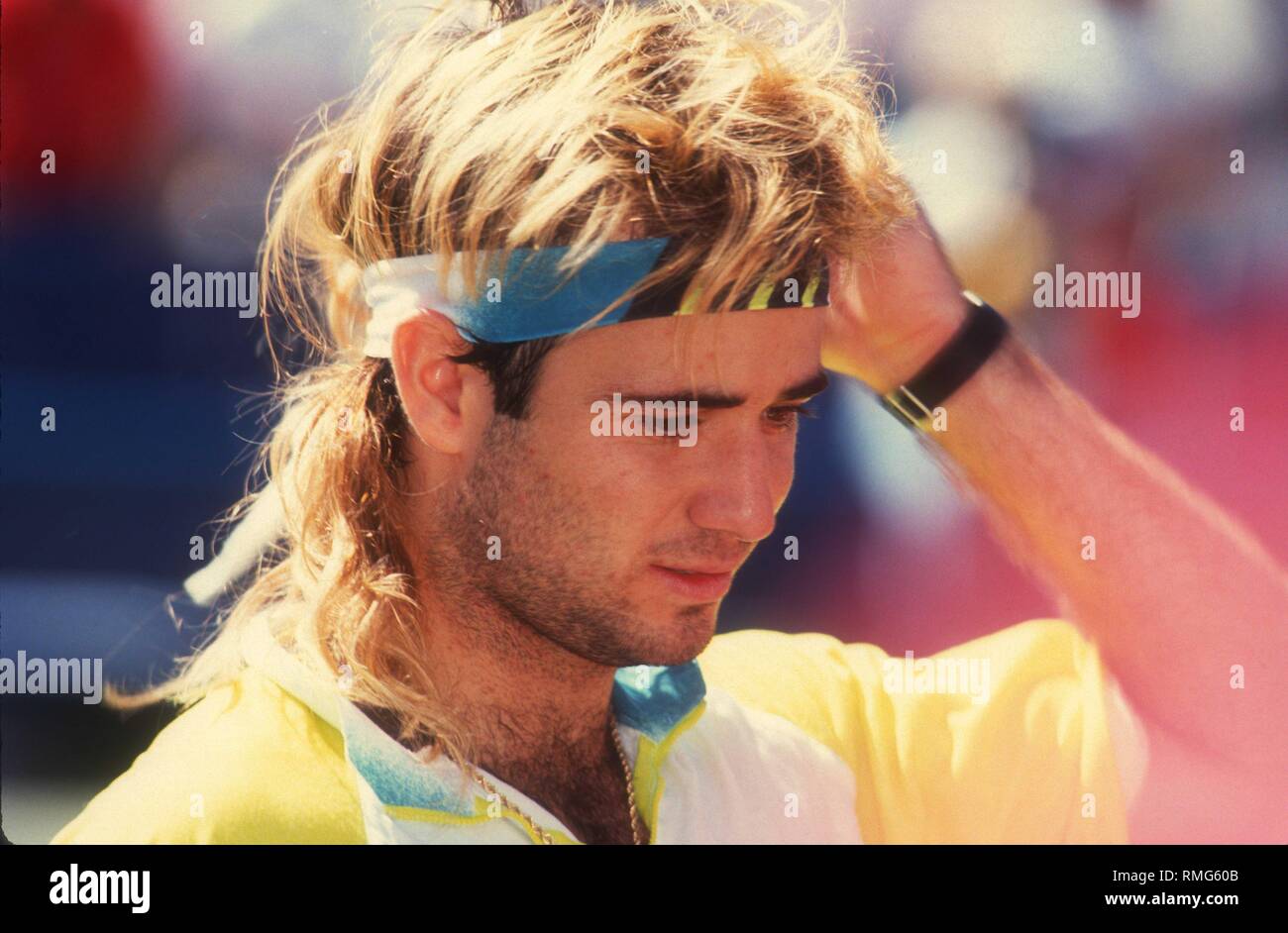
Andre Agassi revolutionized sports style in the late 1980s and 1990s by introducing neon color palettes, acid-wash denim shorts, compression spandex, and bold splatter graphics to tennis. Backed by Nike’s groundbreaking Challenge Court line, Agassi transformed traditional, country-club tennis attire into a global streetwear phenomenon, forever changing the relationship between athletic performance apparel and pop culture.
The Cultural Context: Tennis Conformity Meets Rock-and-Roll Rebellion
Before Andre Agassi made his professional debut in 1986, tennis attire was defined by strict adherence to tradition. For decades, the sport’s visual identity rested on clean, conservative aesthetics: crisp white polo shirts, pleated shorts, muted trim, and understated leather sneakers. While players like Björn Borg and John McEnroe had previously introduced subtle elements of personal flair—such as pinstripes, colored headbands, and fitted polos—tennis fashion remained largely bound to traditional country-club dress codes.
Agassi, hailing from Las Vegas, Nevada, disrupted this country-club framework completely. Arriving on the ATP Tour with long, frosted hair, denim shorts, and vivid neon tops, he brought an unvarnished rock-and-roll sensibility to a sport built on formality. His slogan for Nike's famous campaign, "Image is Everything," captured a broader cultural shift taking place in the late 1980s. Sports gear was no longer viewed merely as functional equipment; it became a medium for personal identity, youth culture, and visual rebellion.
Agassi's entry into professional tennis coincided with the explosive growth of music television, hip-hop, and skate culture. These subcultures embraced vibrant, non-conformist apparel. By translating that energy onto the tennis court, Agassi exposed the rigid visual standards of elite sports and proved that high-performance athletic apparel could spark major cultural conversations.
The Nike Challenge Court Era: Designing the Anti-Establishment Aesthetic
The defining engine behind Agassi’s aesthetic revolution was Nike's Challenge Court collection, primarily directed by legendary footwear and apparel designer Tinker Hatfield along with Nike’s design team. Launched in the late 1980s, Challenge Court was explicitly developed to break away from the traditional, all-white aesthetic enforced by traditional tennis clubs.
Nike Challenge Court Aesthetic
| Neon Splashes | Acid-Wash Denim | Spandex Compression |
|---|---|---|
| Hot Lava / Pink | Over-Short Layer | Black/Bright Trim |
Neon Palettes and Graphic Splatters
Rather than using accent colors sparingly, Nike placed high-visibility shades front and center. Colors like "Hot Lava" (a vivid neon pink-orange), electric yellow, turquoise, and violet dominated Agassi’s kits. The garments featured asymmetrical geometric shapes, ink-splatter prints, and brushstroke patterns that looked dynamic even when Agassi was standing still.
Layered Activewear and Denim Shorts
One of the most audacious design choices in tennis history was the introduction of denim on the court. Nike developed lightweight denim and acid-wash cotton shorts engineered specifically for athletic movement. Agassi famously layered these denim shorts over bright black or neon spandex compression shorts (Lycra liners). This layered look borrowed directly from cycling and street fashion, creating a layered silhouette never before seen on a Grand Slam court.
Synthetic Fabric Innovations
While the visual aesthetics generated headline news, the Challenge Court collection also pushed technical performance fabrics forward. Nike integrated moisture-wicking synthetic polyester blends, ventilated mesh paneling, and stretch fabrics that supported Agassi’s aggressive, baseline-grinding playstyle. The garments proved that bold design did not require sacrificing elite athletic performance.
Deconstructing Agassi's Most Iconic On-Court Outfits
Agassi’s career is punctuated by specific tournament appearances where his outfits made headline news alongside his match statistics.
The 1990 French Open: Denim and Hot Lava
At the 1990 French Open at Roland Garros, Agassi reached his first Grand Slam final wearing what remains one of the most famous tennis kits of all time. The outfit featured:
- A black and "Hot Lava" graphic polo shirt with a contrasting neon collar.
- Distressed acid-wash denim shorts cut above the knee.
- Exposed black Lycra compression shorts extending several inches below the denim hem.
- Matching Hot Lava Nike Air Tech Challenge II sneakers.
The look generated immense media attention, polarizing traditionalists while captivating younger fans. It served notice that tennis attire had entered a new, expressive era.
1990 Roland Garros Look:
- Hot Lava & Black Graphic Polo
- Acid-Wash Denim Shorts
- Exposed Black Lycra Cycling Shorts
- Nike Air Tech Challenge II ("Hot Lava")
The Wimbledon Controversy and All-White Compromise (1988–1992)
The All England Lawn Tennis Club (AELTC) enforces a strict dress code requiring players to wear almost entirely white clothing. Refusing to alter his vibrant style, Agassi skipped Wimbledon from 1988 through 1990.
When he returned to Wimbledon in 1991, Agassi accommodated the tournament rules without abandoning his signature style. Working with Nike, he presented an all-white version of his Challenge Court gear. The outfit retained his signature design elements—oversized silhouettes, layered compression shorts, graphic textures, and matching white headbands—all executed entirely in white fabrics. In 1992, Agassi won his first Grand Slam title at Wimbledon wearing this customized all-white Challenge Court kit, proving he could master both the traditional cathedral of tennis and its strict visual requirements.
The U.S. Open Night Matches and Denim Jackets
During night sessions at the U.S. Open in Flushing Meadows, Agassi leaned heavily into urban culture. He frequently stepped onto the court under the bright lights of Louis Armstrong Stadium in oversized nylon windbreakers, denim jackets with synthetic sleeves, and bandana-style head wraps. The electric atmosphere of New York City paired seamlessly with Agassi's high-octane visual branding.
The Footwear Legacy: Nike Air Tech Challenge Series
Agassi's impact on fashion extends directly into sneaker culture. His signature footwear line, the Nike Air Tech Challenge series, transformed performance tennis shoes into sought-after streetwear classics.
NIKE AIR TECH CHALLENGE TIMELINE:
- 1989: Air Tech Challenge I - High-top cut, bold heel graphics
- 1990: Air Tech Challenge II - External heel counter, "Hot Lava" colorway
- 1991: Air Tech Challenge III - Visible Air unit, neon splatter patterns
- 1992: Air Tech Challenge IV - Molded overlays, vibrant gradient panels
Nike Air Tech Challenge I (1989)
Designed by Tinker Hatfield, the Air Tech Challenge I broke away from the low-profile, white leather shoes that dominated tennis. Featuring a higher ankle collar for support, visible Air cushioning in the heel, and midfoot support straps, the shoe featured bright color accents that complemented Agassi's vibrant apparel line.
Nike Air Tech Challenge II (1990)
Widely considered one of the most influential athletic sneakers of all time, the Air Tech Challenge II achieved legendary status. Key technical and design features included:
- The "Hot Lava" Colorway: White leather base paired with black overlays and striking bright neon orange-pink paint splatter graphics near the midsole.
- External Heel Counter: Provided lateral stability for hard stops and fast directional changes on hard courts.
- Outsole Tooling: The durable rubber outsole provided optimal traction and inspired future sneaker designs across multiple sports.
The design footprint of the Air Tech Challenge II extended far beyond tennis. Decades later, Nike used the exact midsole and outsole tooling of the Air Tech Challenge II for the legendary Nike Air Yeezy II, designed in collaboration with Kanye West—solidifying the shoe's place in modern streetwear history.
Air Tech Challenge III and IV (1991–1992)
Subsequent iterations expanded on the bold aesthetic. The Air Tech Challenge III introduced a neon tennis ball logo on the heel and larger paint-splatter graphics. The Air Tech Challenge IV pushed color gradients even further, utilizing vibrant purples, teals, and hot pinks across molded synthetic overlays.
The Mullet, the Hairpiece, and the Shaved-Head Transformation
Agassi’s visual image was defined as much by his hair as by his apparel. Throughout the late 1980s and early 1990s, his voluminous, blonde-highlighted mullet was a core element of his brand identity, frequently held in place by neon bandanas and printed headbands.
In his 2009 autobiography, Open, Agassi made a surprising revelation: during the 1990 French Open final, his famous hair was actually a hairpiece attached with pins. Panicked that the toupee would fall off during the match, he attributed part of his loss to being distracted by his hairpiece.
AGASSI STYLE TRANSFORMATION:
- Late 1980s - Early 1990s
- Long Hair / Mullet
- Denim Shorts & Spandex
- Hot Lava / Neon Colors
- 1995 Shift
- Clean-Shaved Head
- Monochromatic Tops
- Tailored Athletic Fit
- 2000s Mature Era
- Technical Performance Wear
- Adidas / Nike Core Styling
- Minimalist Aesthetics
In 1995, at the suggestion of his then-wife Brooke Shields, Agassi decided to shave his head completely. This bold transformation coincided with a dramatic resurgence in his tennis career. The shaved head, paired with a cleaner, more streamlined wardrobe, marked a shift from teenage rebel to mature champion. This transition proved that Agassi’s cultural appeal was rooted in authentic self-expression rather than a single haircut.
Evolution of Agassi's On-Court Style Over Time
To understand how Andre Agassi's fashion evolved throughout his professional tour career, consider the key milestones across different decades:
| Era / Year Range | Primary Apparel Features | Key Footwear Models | Style Impact & Cultural Context |
|---|---|---|---|
| 1988–1990 | Denim shorts, neon spandex compression shorts, hot lava & neon yellow tees, printed headbands. | Air Tech Challenge I & II | Introduced rock-and-roll culture to tennis; challenged conservative country-club dress codes. |
| 1991–1992 | All-white Challenge Court gear with graphic textures at Wimbledon; bright geometric prints at hard court majors. | Air Tech Challenge III & IV | Demonstrated adaptability to traditional dress codes while maintaining an edgy, modern silhouette; won Wimbledon 1992. |
| 1994–1997 | Transition to looser, baggier polos, solid dark tones, striped tops, clean performance shorts. | Air Flare, Air Zoom Turf, Air Alarm | Shaved head era; focused on functional athletic performance over loud streetwear statements. |
| 1999–2006 | Streamlined crewneck shirts, moisture-wicking technical fabrics, classic black/white colorways, minimalist designs. | Air Zoom Beyond, Adidas Barricade (post-2005) | Established a mature, sophisticated athletic aesthetic; shifted from Nike to Adidas in 2005. |
| 2013–Present | Nike retro re-issues, Challenge Court archival drops, modern lifestyle crossover apparel. | Air Tech Challenge II Retro, NikeCourt retros | Re-established 1990s tennis fashion as a foundational pillar of modern streetwear culture. |
The Modern Legacy: How Agassi’s Aesthetic Shapes Contemporary Fashion
Agassi's style from the 1990s remains a major influence on modern sportswear and fashion.
1990s Challenge Court Aesthetic:
- Modern Tennis Kit Design (Bold prints, neon palettes, breathable compression gear)
- Streetwear & Sneaker Culture (Air Tech retros, Yeezy tooling, vintage sportswear styling)
Influence on Contemporary Tennis Kits
Modern athletic brands regularly draw inspiration from the Challenge Court archive. Brands like Nike, Adidas, Lacoste, and Wilson frequently release collections featuring 90s-inspired neon accents, color-blocking, oversized logos, and geometric patterns. Contemporary tennis players like Carlos Alcaraz, Frances Tiafoe, and Nick Kyrgios have stepped onto court wearing apparel that directly echoes Agassi's expressive style.
In 2020, to celebrate the 30th anniversary of the Challenge Court line, Nike released a modern NikeCourt collection featuring remastered versions of Agassi’s original splatter prints, denim-inspired pieces, and vibrant neon color schemes engineered with updated Dri-FIT performance fabrics.
Cross-over into Streetwear and Vintage Fashion
The original Challenge Court jackets, polos, and sneakers are prized items within vintage sportswear culture. Thrift enthusiasts and fashion collectors seek out original 1990s Nike Agassi pieces. Furthermore, high-fashion brands regularly reference Agassi’s pairing of activewear (compression shorts) with street garments (denim shorts) in modern luxury collections.
How to Style Vintage Agassi-Inspired Pieces Today
For fashion enthusiasts looking to incorporate 1990s Agassi inspiration into modern outfits, balancing retro elements with modern basics is key:
Pair Bold Retro Sneakers with Neutral StaplesLet retro shoes like the Nike Air Tech Challenge II "Hot Lava" serve as the focal point. Style them with clean selvedge denim, relaxed cargo trousers, or simple neutral shorts to avoid visual clutter.
Layer Graphics with Clean BasicsIf wearing a 90s neon paint-splatter windbreaker or Challenge Court polo, pair it with monochrome trousers or black athletic shorts to keep the look grounded and contemporary.
Incorporate Athleisure LayersChannel Agassi’s layered silhouette by pairing high-performance compression garments under relaxed, vintage-fit shorts. Choose modern, lightweight fabrics for comfort.
Embrace Retro AccessoriesSubtle accessories—such as classic terrycloth wristbands, printed bandanas, or vintage-inspired white athletic socks—add subtle retro flair without requiring a full on-court outfit.
Frequently Asked Questions
Why was Andre Agassi's fashion style so controversial in tennis?
Agassi's style clashed directly with the conservative, aristocratic tradition of tennis, which emphasized modesty, neatness, and predominantly white clothing. By wearing acid-wash denim shorts, neon spandex compression shorts, vibrant splatter prints, and maintaining a long mullet, Agassi challenged the quiet decorum of the sport. Traditionalists viewed his apparel as a distraction, while younger fans celebrated it as an expression of personal identity.
What were Andre Agassi's most famous signature sneakers?
Agassi's most famous footwear line was the Nike Air Tech Challenge series, designed by Tinker Hatfield. Among these, the Air Tech Challenge II in the "Hot Lava" colorway (1990) remains the most iconic due to its visible Air cushioning, micro-perforated leather, external heel counter, and vibrant neon splatter graphics.
Did Andre Agassi actually wear real denim shorts during professional tennis matches?
Yes. During the late 1980s and early 1990s—most notably at the 1990 French Open—Agassi wore specialized acid-wash denim shorts engineered by Nike. While styled like everyday streetwear denim, these shorts were crafted from lightweight, flexible cotton-poly fabrics and cut specifically to allow full athletic movement over compression shorts.
Why did Andre Agassi boycott Wimbledon from 1988 to 1990?
Agassi chose not to play Wimbledon between 1988 and 1990 largely because of the All England Lawn Tennis Club's strict dress code, which required players to wear almost entirely white apparel. Agassi was unwilling to compromise his signature neon aesthetic. He returned in 1991 wearing a customized all-white Nike Challenge Court collection, and went on to win the tournament in 1992.
How did Kanye West's Air Yeezy II connect to Andre Agassi's footwear?
Sneaker designer Nathan VanHook took direct inspiration from Agassi’s line when creating the Nike Air Yeezy II for Kanye West in 2012. The Air Yeezy II utilized the exact outsole and midsole tooling of the 1990 Nike Air Tech Challenge II, linking Agassi's 1990s tennis footwear directly to modern lifestyle sneaker history.
When did Andre Agassi change from Nike to Adidas?
Agassi wore Nike apparel and footwear for 17 years, from 1988 until 2005. In 2005, near the conclusion of his professional career, he signed an endorsement agreement with Adidas, focusing heavily on performance gear and his charitable foundation. In 2013, Agassi re-entered a long-term partnership with Nike to support retro footwear re-releases and youth sports initiatives.
Summary and Next Steps for Fans
Andre Agassi’s fashion legacy proved that sports performance apparel can extend far beyond function to shape broader pop culture. By breaking rigid dress codes, embracing vivid color palettes, and merging athletic wear with streetwear, Agassi opened the door for modern athletes to express their personal identities on and off the field.
To explore this iconic era further:
- Sneaker Collectors: Look out for re-issues of the Nike Air Tech Challenge II "Hot Lava" and related retro colorways through authorized Nike Sportswear retailers.
- Vintage Enthusiasts: Search reputable secondhand marketplaces using terms like "Vintage Nike Challenge Court 1990" or "Agassi Hot Lava Jacket" to find original archived apparel pieces.
- Modern Style: Incorporate 1990s performance elements—such as bold geometric prints, neon accents, and layered athletic fits—into your daily activewear rotation.