An Amazon product research tool is a specialized software application that provides data-driven insights into sales volume, keyword trends, and competitor behavior. In 2026, these tools are the foundation for identifying high-demand, low-competition niches, allowing sellers to validate product ideas before investing significant capital in inventory and marketing.
Product research is no longer a luxury for e-commerce entrepreneurs; it is a technical requirement for survival on the Amazon marketplace. With millions of active sellers globally, the margin for error has narrowed significantly. Relying on intuition or "gut feeling" often leads to overstocked inventory and financial losses. Modern research tools utilize the Amazon API and proprietary algorithms to scrape and interpret millions of data points, transforming raw information into actionable business intelligence.
The Evolution of Product Sourcing: Why Data Matters in 2026
In the early days of Fulfillment by Amazon (FBA), sellers could often find success by simply identifying a popular product and offering a slightly lower price. Today, the landscape is defined by brand building, intellectual property (IP) protection, and razor-sharp profit margins. A robust research tool serves as a diagnostic instrument, measuring the health and viability of a potential product category before a seller even contacts a supplier.
The primary function of these tools is to mitigate risk. By analyzing historical Best Sellers Rank (BSR) and pricing fluctuations, sellers can distinguish between a "fad" product with a short lifespan and a "staple" product with consistent year-round demand. In 2026, sophisticated tools also incorporate AI-driven forecasting to predict how market saturation might impact a new entry over the subsequent 12 to 18 months.
The Role of Best Sellers Rank (BSR)
Understanding BSR is fundamental to using any research tool. Amazon assigns a BSR to nearly every product in its catalog based on sales velocity relative to other items in the same category. A lower BSR indicates higher sales. Research tools track these numbers over time, allowing sellers to estimate exactly how many units a competitor is moving daily. Without a tool, a seller would have to use the "999 method"—manually adding items to a cart to check inventory levels—which is time-consuming and often blocked by Amazon’s inventory limits.
Core Features of Modern Amazon Research Tools
To provide value in 2026, a product research tool must offer more than just sales estimates. High-level technical suites now integrate multiple modules that handle everything from keyword extraction to supplier sourcing.
1. Database Filtering and Niche Identification
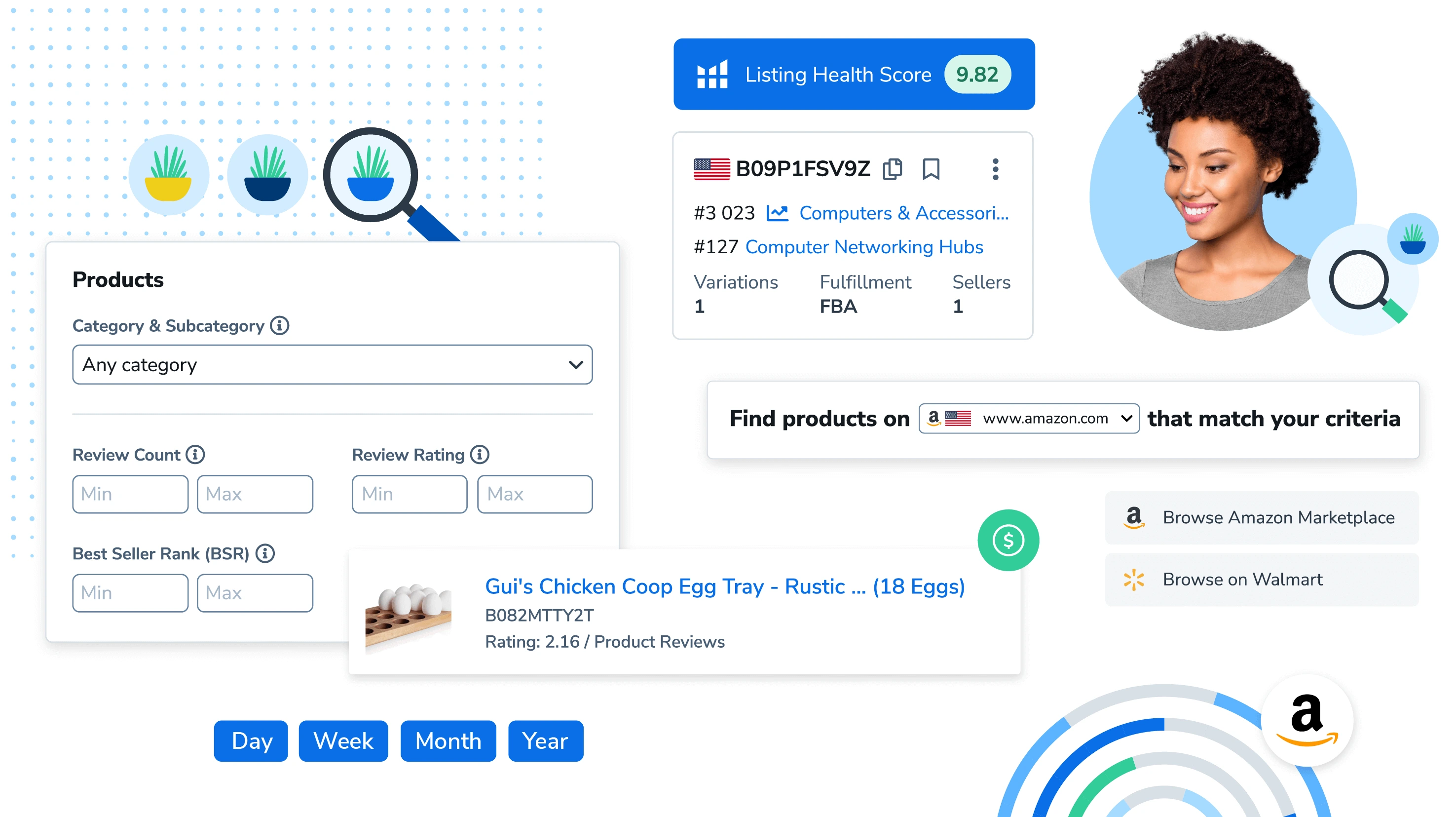
The "Black Box" or "Product Database" feature is usually the starting point. It allows sellers to apply granular filters such as:
- Monthly Revenue: Finding products making between $5,000 and $15,000 to avoid high-competition "gold rushes."
- Review Count: Targeting niches where the top sellers have fewer than 200 reviews, indicating a lower barrier to entry.
- Product Tier/Weight: Filtering for small, light items to minimize FBA shipping and storage fees.
- Rating Averages: Identifying products with 3.5 to 4 stars where a seller can improve the design to capture dissatisfied customers.
2. Chrome Extensions for Real-Time Analysis
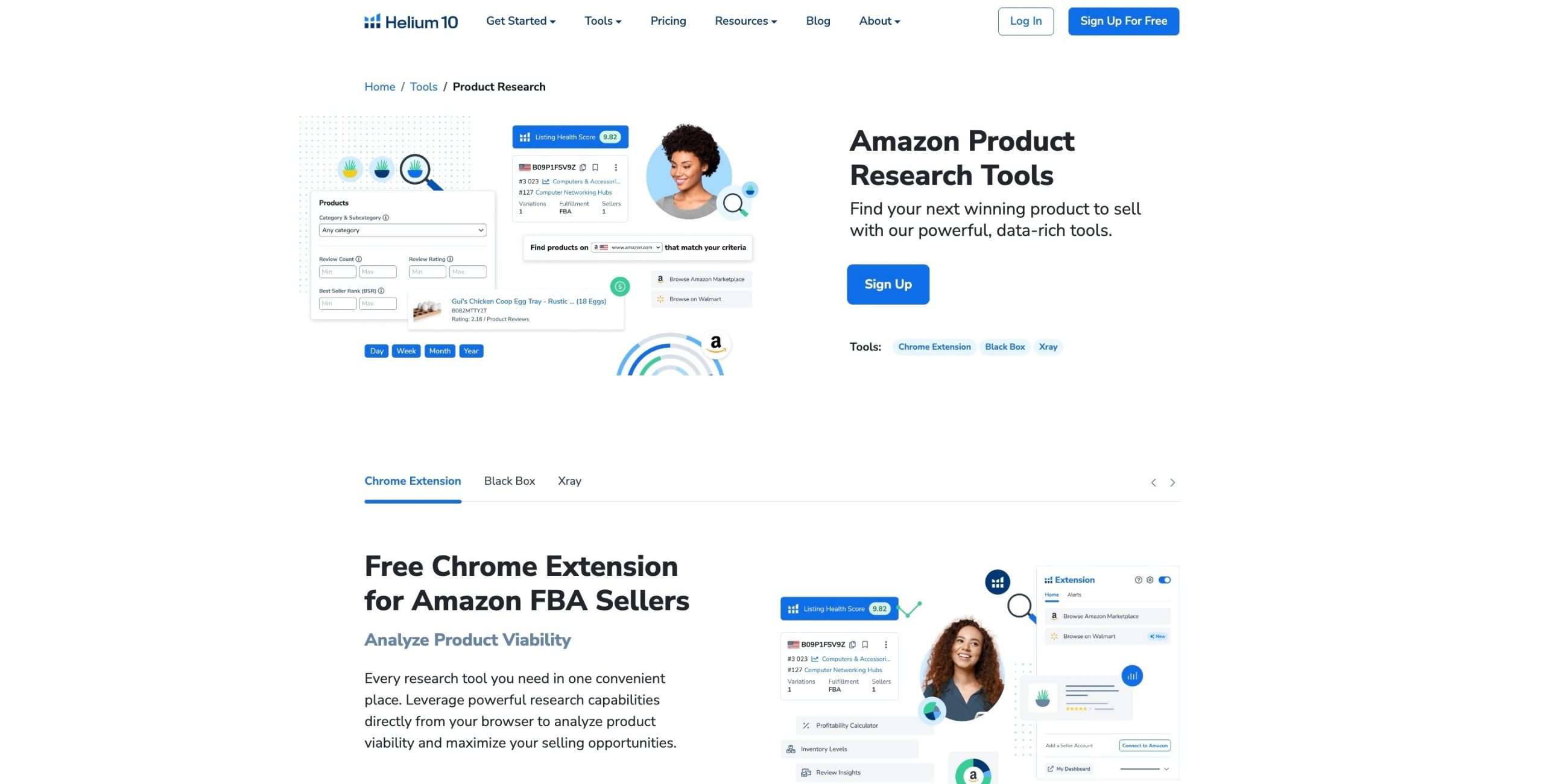
Most leading providers offer a browser extension that overlays data directly onto the Amazon search results page. This allows for "on-the-fly" validation. As you browse, the extension displays estimated monthly revenue, net profit after fees, and an "Opportunity Score." This score is a weighted average that considers demand versus competition level.
3. Competitor Intelligence and Reverse ASIN Lookup
Successful research involves deconstructing what your competitors are doing right. Reverse ASIN (Amazon Standard Identification Number) tools allow you to see exactly which keywords are driving organic and paid traffic to a specific listing. This level of transparency is vital for building a Launch Strategy that targets the most profitable search terms from day one.
Comparative Analysis of Leading Tools in 2026
While several boutique tools exist, the market is largely dominated by three major players who have consistently updated their infrastructure to match Amazon’s evolving API.
| Feature | Helium 10 | Jungle Scout | AMZScout |
|---|---|---|---|
| Primary Strength | Comprehensive "All-in-One" Suite | User Experience & Training | Budget-Friendly / Robust Extension |
| Database Size | Over 2 Billion Products | 500 Million+ Products | 600 Million+ Products |
| Key Innovation | AI-Powered "Adtomic" PPC Integration | Supplier Database & AI Assist | Sales Estimator Accuracy |
| Learning Curve | High (Steep, but powerful) | Moderate (Intuitive) | Low (Great for beginners) |
| Estimated Monthly Cost | $99 - $399 | $49 - $129 | $45 - $99 |
Helium 10: The Industrial Standard
Helium 10 remains the most technically advanced option for professional sellers. Its suite includes Cerebro (reverse ASIN), Magnet (keyword research), and Frankenstein (keyword processing). In 2026, its focus has shifted heavily toward automation, allowing sellers to set triggers for price changes or alert them when a competitor goes out of stock.
Jungle Scout: The Entrepreneur's Entry Point
Jungle Scout pioneered the product research space and continues to excel in data visualization. Its "Opportunity Finder" is particularly useful for identifying "blue ocean" niches. One of its standout features in 2026 is the integrated Supplier Database, which links high-performing products directly to verified manufacturers on platforms like Alibaba.
AMZScout: Efficiency and Accuracy
For sellers who prefer a streamlined workflow, AMZScout offers one of the most accurate sales estimators in the industry. It focuses on the core metrics—BSR history, price trends, and profit calculators—without the added complexity of full-scale business management software.
The Technical Methodology of Data Estimation
A common question among new sellers is: "How do these tools know how much a product is selling?" The process is a combination of data science and direct observation.
- API Data Retrieval: Amazon provides developers with access to the Selling Partner API (SP-API). This provides data on categories, rankings, and product details.
- Scraping and Tracking: Tools use distributed networks to scrape public-facing pages for price changes and review counts.
- Algorithmic Modeling: Since Amazon does not reveal exact sales figures for every ASIN, tools use "BSR-to-Sales" mapping. By tracking thousands of products where the actual sales data is known (through user-contributed data or "test" ASINs), the software creates a curve. If a product in the "Home & Kitchen" category has a BSR of 5,000, the algorithm compares it to known data points to estimate that it moves roughly 15 units per day.
Accuracy varies between tools, but industry leaders generally maintain a 10% to 15% margin of error, which is sufficient for making informed procurement decisions.
Financial Considerations: Calculating ROI on Research Software
Investing in a high-tier tool like Helium 10 or Jungle Scout can cost between $500 and $2,000 annually. To justify this expense, the tool must save the seller from a "bad buy."
Consider a typical private-label launch:
- Inventory Cost: $3,000
- Shipping: $800
- PPC/Marketing: $1,200
- Total Risk: $5,000
If a $100-a-month tool prevents you from launching a product that would have failed due to hidden competition or high return rates, the ROI is immediate. Furthermore, these tools often include profit calculators that factor in Amazon’s 15% referral fee and FBA pick-and-pack fees, ensuring that your "on-paper" profits translate to actual bankable cash.
Strategic Framework: How to Conduct Research in 2026
To find success, follow a structured workflow rather than searching randomly.
Step 1: The Broad Filter
Use a product database to find categories with a high "Revenue-to-Review" ratio. Look for niches where the average monthly revenue is over $8,000, but the average review count is under 150. This suggests customers are buying the product because they need it, not just because of the brand's established social proof.
Step 2: The Trend Validation
Once a product is identified, use a tool like Google Trends or the tool’s internal trend graph to check for seasonality. You do not want to launch a "snow shovel" in April or a "pool float" in October unless you have a specific off-season strategy.
Step 3: Profitability Stress-Testing
Input your estimated manufacturing costs into the tool's profit calculator. Ensure you have at least a 30% profit margin after all Amazon fees. In 2026, rising logistics costs mean that a 20% margin is often too thin to sustain a business during a price war.
Step 4: Competitive Gap Analysis
Read the 1-star and 2-star reviews of the top three competitors using a "Review Insights" feature. If customers consistently complain that a "garlic press" is hard to clean, your mission is to source a "dishwasher-safe, easy-clean" version. This is how you create a "Value Add" that justifies your listing.
Frequently Asked Questions
Can I do Amazon product research for free?
While you can use free tools like the Amazon Best Sellers list and manual inventory tracking, it is not recommended for serious sellers in 2026. Free tools lack the historical data and keyword depth required to compete with professional sellers using paid suites. However, some tools like AMZScout offer limited free versions or trial periods.
How accurate are the sales estimates in these tools?
Most top-tier tools are approximately 80% to 90% accurate. Accuracy is highest in high-volume categories (like Electronics or Kitchen) and lower in obscure sub-categories where data points are sparse. Always look for tools that update their sales estimates at least once every 24 hours.
Is Helium 10 better than Jungle Scout?
There is no objective "better" tool; it depends on your business stage. Helium 10 is often preferred by power users who need deep SEO and PPC tools. Jungle Scout is frequently cited as the better option for beginners due to its Academy training videos and more intuitive user interface.
Should I focus on high-volume or low-competition products?
In 2026, the most successful strategy is finding the "middle ground." High-volume products often lead to expensive PPC battles that erode margins. Low-competition products may not have enough demand to sustain a full-time business. Look for "hidden gems" where demand is steady (300-500 units a month) but the competition is fragmented.
Do I need a research tool if I am doing Retail Arbitrage?
While these tools are primarily designed for Private Label (creating your own brand), they are still useful for Retail Arbitrage or Wholesale. They allow you to quickly check the BSR and price stability of a brand-name item to ensure it doesn't "tank" in price by the time your inventory reaches the Amazon warehouse.
Final Recommendation for 2026 Sellers
For those just starting their Amazon journey in 2026, start with a Jungle Scout monthly subscription to utilize their "Opportunity Finder" and learn the ropes. For established sellers looking to scale multiple brands, Helium 10 remains the gold standard for its deep analytical capabilities and automation features. Regardless of the tool you choose, remember that software provides the data, but you provide the strategy. Always verify your findings by ordering competitor samples and conducting thorough quality control before committing to a large manufacturing order.