As of 2026, there are 27 registered life insurance companies operating in India, regulated by the Insurance Regulatory and Development Authority of India (IRDAI). This sector includes the state-owned Life Insurance Corporation of India (LIC) and 26 private sector insurers, many of which are joint ventures between Indian conglomerates and global financial institutions.
The Indian life insurance landscape has undergone a significant transformation leading into 2026. Driven by the IRDAI’s "Insurance for All by 2047" mission, the industry has seen a surge in digital-first providers, eased capital requirements for new entrants, and the successful implementation of the Bima Sugam platform—a centralized digital marketplace. Whether you are looking for pure protection through term insurance or wealth creation through Unit Linked Insurance Plans (ULIPs), understanding the current players is the first step toward financial security.
The Regulatory Framework: The Role of IRDAI in 2026
Every life insurance company in India must be registered and licensed by the Insurance Regulatory and Development Authority of India (IRDAI). Established under the IRDAI Act, 1999, the regulator ensures that companies maintain adequate solvency margins, treat customers fairly, and settle claims promptly.
In the 2025-2026 period, the regulatory focus has shifted toward "expense of management" (EoM) limits and increased flexibility in product filing. The "Use and File" procedure now allows companies to launch most products without prior approval, provided they adhere to established guidelines. This has led to a more competitive market with highly customized niche products catering to specific demographics, such as the gig economy and rural populations.
The solvency ratio remains a critical metric monitored by the IRDAI. Every insurer is required to maintain a minimum solvency ratio of 1.5 (or 150%) to ensure they have enough capital to pay out claims even in extreme economic scenarios. When choosing from the list of all life insurance companies in India, verifying their current solvency status on the IRDAI website is a non-negotiable step for consumer safety.
Comprehensive List of Life Insurance Companies in India
The following table provides the updated list of life insurance companies currently active in the Indian market as of 2026. This list includes the public sector giant and the private players that have helped expand insurance penetration across the country.
| Company Name | Sector | Headquarters | Key Strength/Focus |
|---|---|---|---|
| Life Insurance Corporation of India (LIC) | Public | Mumbai | Massive reach and sovereign guarantee |
| HDFC Life Insurance Co. Ltd. | Private | Mumbai | Innovative products and strong bancassurance |
| ICICI Prudential Life Insurance Co. Ltd. | Private | Mumbai | Digital integration and multi-channel reach |
| SBI Life Insurance Co. Ltd. | Private | Mumbai | Largest private sector market share |
| Max Life Insurance Co. Ltd. | Private | New Delhi | High Claim Settlement Ratio and customer service |
| Bajaj Allianz Life Insurance Co. Ltd. | Private | Pune | Flexible ULIPs and wealth management |
| Tata AIA Life Insurance Co. Ltd. | Private | Mumbai | Strong brand trust and protection focus |
| Aditya Birla Sun Life Insurance Co. Ltd. | Private | Mumbai | Diverse product portfolio |
| Kotak Mahindra Life Insurance Co. Ltd. | Private | Mumbai | Tailored corporate and individual plans |
| PNB MetLife India Insurance Co. Ltd. | Private | Bengaluru | Strong rural and semi-urban presence |
| Canara HSBC Life Insurance Co. Ltd. | Private | Gurugram | Pure bancassurance model |
| Reliance Nippon Life Insurance Co. Ltd. | Private | Mumbai | Large agency network |
| Aviva Life Insurance Co. India Ltd. | Private | Gurugram | Child education and savings plans |
| Sahara India Life Insurance Co. Ltd.* | Private | Lucknow | Limited operations/Regulatory oversight |
| Shriram Life Insurance Co. Ltd. | Private | Chennai | Focus on the underbanked segment |
| Bharti AXA Life Insurance Co. Ltd. | Private | Mumbai | Simplification of insurance processes |
| Future Generali India Life Insurance Co. Ltd. | Private | Mumbai | Innovative retail insurance |
| Ageas Federal Life Insurance Co. Ltd. | Private | Mumbai | Focus on digital transformation |
| Edelweiss Tokio Life Insurance Co. Ltd. | Private | Mumbai | Customer-centric design and niche products |
| Star Union Dai-ichi Life Insurance Co. Ltd. | Private | Navi Mumbai | Partnership with Bank of India and Union Bank |
| Pramerica Life Insurance Co. Ltd. | Private | Gurugram | Protection-led insurance solutions |
| IndiaFirst Life Insurance Co. Ltd. | Private | Mumbai | Bank-led distribution (Bank of Baroda) |
| Aegon Life Insurance Co. Ltd. | Private | Mumbai | Fully digital/Direct-to-consumer |
| Go Digit Life Insurance Ltd. | Private | Bengaluru | Tech-heavy, simplified documentation |
| Acko Life Insurance Ltd. | Private | Bengaluru | Embedded insurance and micro-policies |
| CreditAccess Life Insurance Ltd. | Private | Bengaluru | Micro-insurance for rural segments |
| Navi Life Insurance | Private | Bengaluru | App-based, instant policy issuance |
*Note: Sahara India Life has faced various regulatory restrictions regarding the procurement of new business in recent years. Always verify the current operational status through the Life Insurance Council.
Public vs. Private Sector: A Comparative Analysis
The Dominance of LIC
The Life Insurance Corporation of India (LIC) remains the only public sector insurer in the life category. Since its establishment in 1956, it has held a unique position due to the "sovereign guarantee" provided by the Government of India under Section 37 of the LIC Act. While private companies have eroded LIC’s market share in urban centers, the corporation still commands a vast majority of the "number of policies" sold, particularly in rural India where its agency force is unparalleled.
The Rise of Private Insurers
Private insurers, which were allowed to enter the market after 2000, have revolutionized the industry through technological adoption. Companies like HDFC Life, ICICI Prudential, and SBI Life have leveraged bancassurance—the partnership between banks and insurance companies—to sell policies to existing bank account holders.
In 2026, the distinction between public and private is narrowing in terms of service quality. While LIC has modernized its digital portals, private insurers have expanded their physical presence. The choice between them often comes down to the specific product features, such as the lower premiums usually offered by private term plans versus the perceived safety and traditional bonuses of LIC’s endowment plans.
Essential Metrics for Evaluating Insurers
When looking at the list of all life insurance companies in India, you should not judge them solely by their brand name. Three key metrics provide a factual basis for comparison:
1. Claim Settlement Ratio (CSR)
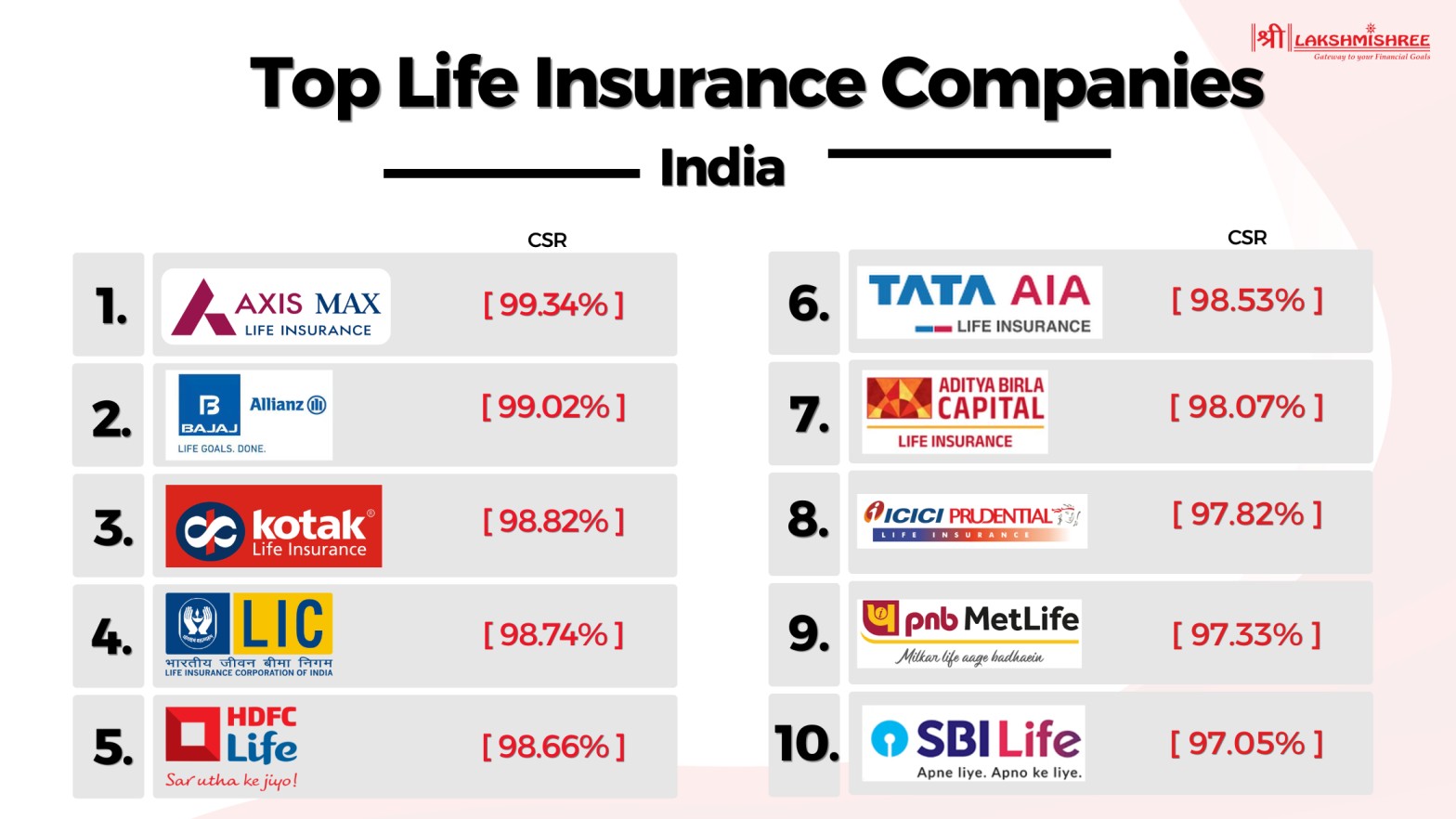
The Claim Settlement Ratio is the percentage of claims a company pays out out of the total claims received during a financial year. A CSR above 97% is generally considered excellent. For example, if an insurer has a CSR of 99%, it means they settled 99 out of every 100 claims filed. This data is published annually in the IRDAI Annual Report.
2. Solvency Ratio
As mentioned earlier, the solvency ratio measures an insurer's ability to meet its long-term liabilities. The IRDAI mandate is 1.5. A higher solvency ratio (e.g., 2.0 or 2.5) indicates a very strong financial cushion, suggesting the company is well-equipped to handle massive payouts during catastrophes or economic downturns.
3. Persistency Ratio
This metric indicates consumer trust and the quality of sales. It measures the percentage of policies that remain active (i.e., the policyholders continue to pay premiums) over a specific period, such as 13 months or 61 months. A high 61st-month persistency ratio suggests that customers are satisfied with the product and were not "missold" the policy through false promises.
Emerging Trends in the 2026 Insurance Market
The landscape of "all life insurance companies in India" has been fundamentally altered by two major developments:
The Bima Sugam Revolution
Bima Sugam is an electronic marketplace launched to act as a one-stop shop for all insurance needs. In 2026, it serves as a centralized platform where users can buy policies, request services, and settle claims across any of the 27 life insurers. This has significantly reduced the commission costs associated with intermediaries, leading to slightly lower premiums for the end consumer.
Digital-First and Insurtech Players
Companies like Go Digit Life, Acko Life, and Navi represent the new wave of "Insurtech." These companies do not rely on traditional armies of agents. Instead, they use AI-driven underwriting to assess risk instantly. For a healthy, young professional in 2026, these digital-first players often offer the fastest onboarding and most competitive rates for term insurance.
Common Types of Policies Offered
Regardless of which company you choose from the list, the product categories generally fall into the following:
- Term Insurance: Pure protection plans with no maturity benefit. They offer the highest life cover for the lowest premium.
- Unit Linked Insurance Plans (ULIPs): A hybrid product that combines insurance with investment in equity or debt markets.
- Endowment Plans: Traditional savings plans that offer a guaranteed sum assured plus bonuses upon maturity.
- Whole Life Insurance: Provides coverage until the age of 99 or 100, often including a cash value component.
- Child Plans: Specifically designed to fund a child's education or marriage, often featuring a "waiver of premium" if the parent passes away.
- Retirement/Pension Plans: Aimed at building a corpus to provide a steady income stream post-retirement.
How to Choose the Right Life Insurance Company
Selecting from all life insurance companies in India requires a systematic approach. Follow these steps to ensure you choose a provider that aligns with your long-term goals:
- Define Your Need: Do you need income replacement for your family (Term Insurance) or a disciplined savings tool (Endowment/ULIP)?
- Check the CSR and Solvency: Visit the IRDAI website to view the latest public disclosures. Prioritize companies with a CSR above 98% and a solvency ratio above 1.7.
- Evaluate Product Features: Look for specific riders (add-ons) like Critical Illness cover, Accidental Death Benefit, or Waiver of Premium. Some companies offer better rates for non-smokers or women.
- Analyze Digital Capabilities: In 2026, you should be able to manage your entire policy through a mobile app. Check user reviews for the insurer’s digital interface.
- Assess the Premium: While cost shouldn't be the only factor, compare the premiums for the same sum assured across 3-4 top-rated companies. Use the Bima Sugam portal for an unbiased comparison.
Frequently Asked Questions
Which life insurance company in India has the highest claim settlement ratio?
While rankings fluctuate annually based on IRDAI data, companies like Max Life, HDFC Life, and Tata AIA consistently report Claim Settlement Ratios exceeding 99%. LIC also maintains a very high ratio, though its sheer volume of claims makes its metrics distinct from smaller private players.
Is it safe to buy life insurance from new private companies?
Yes, provided they are licensed by the IRDAI. The regulatory framework in India is robust, requiring all insurers to maintain strict capital reserves. Furthermore, the IRDAI has a history of facilitating mergers (e.g., Exide Life merging into HDFC Life) to protect policyholders' interests if a company faces financial stress.
Can I change my life insurance company after buying a policy?
Unlike health insurance, life insurance does not currently support "portability" in the same way. If you are unhappy with your current insurer, you generally have to stop paying premiums on the old policy (making it lapsed or paid-up) and purchase a new one from a different provider. This is why choosing the right company initially is critical.
What is the minimum solvency ratio required by IRDAI?
The IRDAI mandates a minimum solvency ratio of 1.5. This ensures that the insurance company has 150% of the assets required to cover its liabilities. Most top-tier Indian insurers maintain a ratio between 1.8 and 2.5 for added stability.
What happens if an insurance company goes bankrupt?
In India, the IRDAI actively monitors the financial health of insurers. If a company's solvency falls below the required levels, the regulator can intervene to find a buyer or merge the distressed entity with a stronger insurer. The primary objective of the IRDAI is to ensure that the policyholders' claims are honored, regardless of the corporate entity's status.
Practical Recommendation
Before finalizing your policy, download the latest Public Disclosure document from the website of your chosen insurer. These documents, mandated by the IRDAI, provide a granular look at the company’s financial health, pending litigation, and claim aging (how long they take to pay a claim). For 2026, the most efficient way to start is by visiting the Bima Sugam portal to compare the 27 available insurers side-by-side without the influence of third-party commissions.