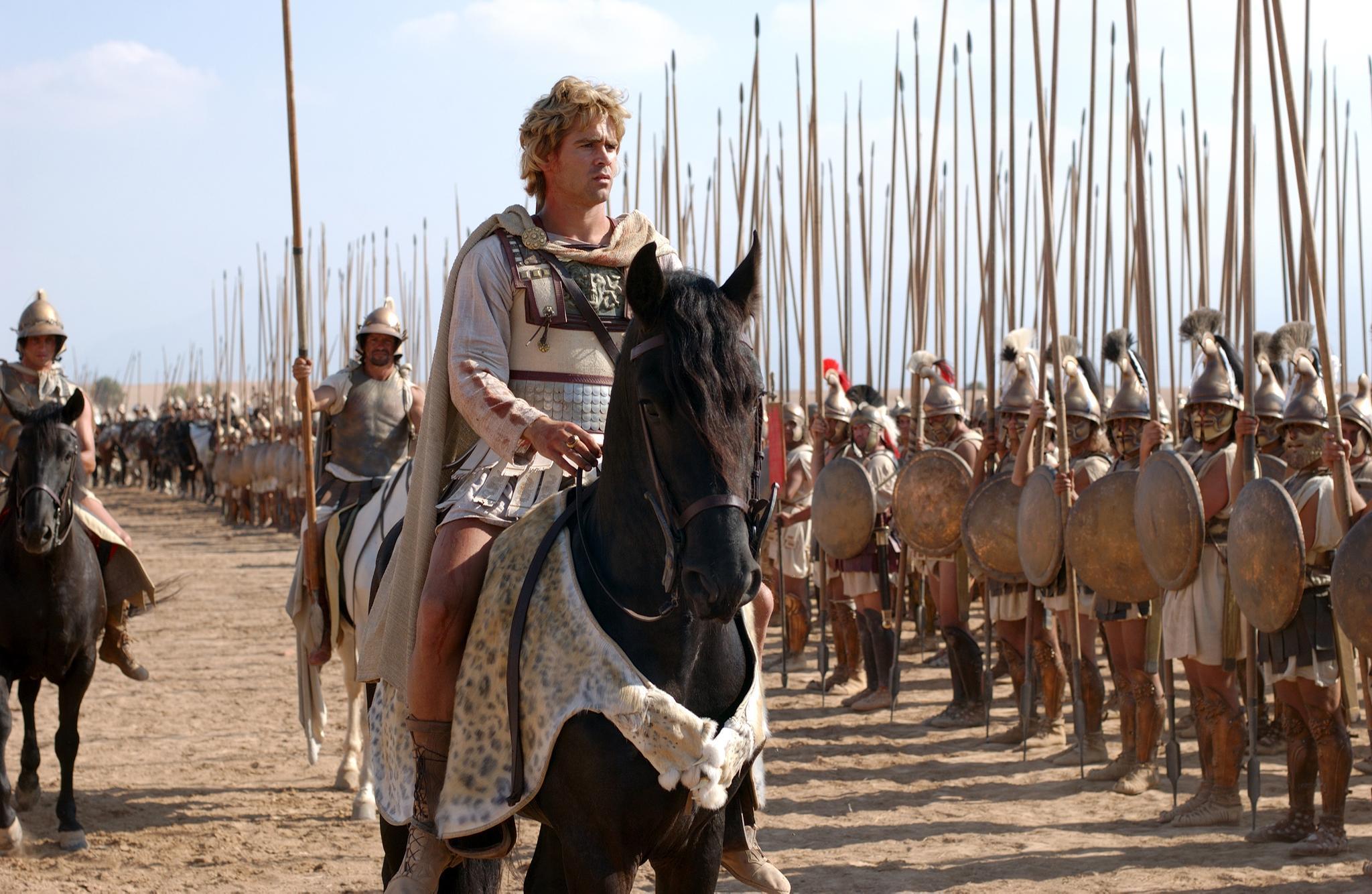
Oliver Stone’s Alexander (2004) is an ambitious epic biographical drama that explores the life of Alexander the Great, the Macedonian King who conquered the Persian Empire. Starring Colin Farrell, the film is renowned for its historical scale, psychological depth, and the release of four distinct versions that significantly alter the viewing experience.
Released during a resurgence of the "sword-and-sandal" genre in the early 2000s, Alexander remains one of the most polarizing films in modern cinema history. As of 2026, the film is frequently studied not only for its portrayal of Hellenistic history but also for its unique production journey and the tireless efforts of director Oliver Stone to refine his vision through multiple re-edits. Unlike the streamlined heroism of Gladiator or the stylized violence of 300, Alexander attempts a dense, psychological examination of a man driven by myth, parental trauma, and an insatiable desire for the unknown.
The Production Vision and Development
The journey to bring Alexander to the screen was as arduous as the King’s march into India. Oliver Stone, a director known for tackling complex historical figures in films like JFK and Nixon, spent years researching the Macedonian conqueror. His goal was to move beyond the "greatest hits" of Alexander’s battles and delve into the psyche of a man who believed he was a descendant of Achilles and Heracles.
Financial and Logistical Scale
With a production budget estimated at $155 million, Alexander was a massive financial undertaking for Intermedia and Warner Bros. Filming took place across multiple continents, including locations in Morocco, Thailand, and the United Kingdom. The production employed thousands of extras and utilized specialized military consultants to recreate Macedonian phalanx tactics.
Stone collaborated with world-renowned historian Robin Lane Fox, who served as a consultant on the film. In exchange for his expertise, Fox famously requested a place in the front of the cavalry charge during the filming of the Battle of Gaugamela. This commitment to historical detail—from the sarissa spears to the specific armor plating—remains one of the film’s most respected attributes among historians.
The Musical Score by Vangelis
One of the film's most enduring elements is the original soundtrack composed by Vangelis. Following his success with Chariots of Fire and Blade Runner, Vangelis created a score that blended traditional orchestral arrangements with subtle electronic textures and ancient Mediterranean motifs. The music serves as a narrative guide, transitioning from the soaring themes of conquest to the dissonant, haunting melodies that mirror Alexander’s eventual descent into paranoia and exhaustion.
Cast Performances and Character Dynamics
The casting of Alexander was central to Stone’s desire to create a "human" epic. While the film received criticism for its varied accents—ranging from Colin Farrell’s natural Irish lilt to Angelina Jolie’s stylized Eastern European inflection—the performances were intended to represent the diverse cultures clashing within the Macedonian empire.
Colin Farrell as Alexander
Colin Farrell took on the title role during a peak in his career. His portrayal of Alexander is far from the stoic warrior archetype. Instead, Farrell depicts Alexander as a vulnerable, often erratic leader burdened by the expectations of his parents and his own legend. This interpretation was controversial upon release but has been reappraised by critics who appreciate the nuance Farrell brought to Alexander’s emotional outbursts and his deep-seated loneliness.
The Parental Influence: Jolie and Kilmer
The film frames Alexander’s life through the toxic influence of his parents. Angelina Jolie plays Olympias, Alexander’s mother, as a cunning and fiercely protective figure who instills in her son the belief that he is divine. Val Kilmer delivers a transformative performance as King Philip II, portrayed here as a scarred, brilliant, but drunken father whose shadow Alexander can never quite escape. Their performances highlight the Freudian themes Stone weaves throughout the narrative, suggesting that the conquest of Asia was, in part, an attempt to outshine a father and please a mother.
Supporting Cast and Relationships
Jared Leto portrays Hephaistion, Alexander’s closest friend and general. The film’s inclusion of the romantic and physical nature of their relationship was a point of significant controversy in 2004, particularly in Greece, where some lawyers threatened to sue the production for misrepresenting history. Stone defended the portrayal, citing the historical context of Greek social norms. Rosario Dawson provides a powerful performance as Roxane, Alexander’s first wife, representing the clash between Alexander’s Macedonian roots and the cultures he integrated into his empire.
The Four Different Versions: A Technical Comparison
Perhaps the most unique aspect of Alexander (2004) is that the theatrical release was only the beginning. Oliver Stone famously felt that the original cut, pressured by studio demands for a linear and shorter runtime, did not capture his true vision. Over the next decade, he released three additional versions.
| Version Name | Release Year | Runtime | Primary Differences |
|---|---|---|---|
| Theatrical Cut | 2004 | 175 Minutes | Linear narrative, focuses on the "greatest hits" of his life. |
| Director’s Cut | 2005 | 167 Minutes | Shorter than the theatrical version; faster pacing but omitted some character scenes. |
| The Final Cut | 2007 | 214 Minutes | Re-structured narrative using non-linear flashbacks; includes more graphic violence and sensuality. |
| The Ultimate Cut | 2014 | 206 Minutes | A refinement of the Final Cut; restores the intermission and balances the pacing. |
Which Version is Best?
For modern viewers in 2026, The Ultimate Cut (2014) is widely considered the definitive version. It utilizes a non-linear structure that begins with Alexander’s death and uses Ptolemy’s narration to jump back and forth through time. This structure better reflects the "memory" of a great man rather than a standard chronological biography. The Final Cut is also highly regarded for its sheer scale, though its 3.5-hour runtime can be daunting for casual viewers.
Recreating Ancient Warfare: Gaugamela and the Hydaspes
Stone’s Alexander features two of the most technically accurate and visceral battle sequences ever put to film. These scenes were designed to show the "meat grinder" reality of ancient combat rather than stylized choreography.
The Battle of Gaugamela
The Battle of Gaugamela is the film’s centerpiece. Stone used a wide-angle perspective to show the tactical movements of the Macedonian phalanx against the massive Persian forces of Darius III. The cinematography by Rodrigo Prieto uses a dusty, golden palette to simulate the heat and chaos of the desert. The sequence is famous for its "eagle's eye view," where the camera follows an eagle soaring above the battlefield, providing the audience with a strategic understanding of the "hammer and anvil" tactic used by Alexander’s cavalry.
The Battle of the Hydaspes
In stark contrast, the Battle of the Hydaspes (the battle against the Indian King Porus) is filmed with a claustrophobic, blood-red filter. Set in the jungles of India, this sequence focuses on the terror of the Macedonian soldiers facing war elephants for the first time. The violence here is more intimate and horrific, signaling the mental and physical breaking point of Alexander’s army. The technical achievement in these scenes—combining practical effects, trained animals, and early 2000s CGI—remains impressive by 2026 standards.
Historical Accuracy and Creative License
When analyzing Alexander (2004), it is essential to distinguish between historical fact and Stone’s dramatization. While the film is praised for its visual accuracy regarding costumes and weapons, it condenses several years of history into a few hours.
- The Consolidation of Battles: The film focuses on Gaugamela and Hydaspes, skipping over other major conflicts like the Siege of Tyre or the Battle of Issus. This was a necessary narrative choice to prevent the film from exceeding four hours.
- The Depiction of the Persians: Some historians criticized the film for portraying the Persian army as a disorganized mass compared to the disciplined Macedonians. However, archaeological evidence suggests the Persian Immortals and cavalry were highly sophisticated.
- The Narrative of Ptolemy: Using an aged Ptolemy (played by Anthony Hopkins) as a narrator allows Stone to bridge historical gaps. While Ptolemy did write a history of Alexander, Stone uses him as a "unreliable narrator" to add a layer of myth-making to the story.
Critical Reception and Cultural Impact
Upon its initial release in November 2004, Alexander was met with harsh reviews and underwhelming box office performance in the United States, though it performed significantly better internationally. Critics at the time focused on the length, the accents, and the unconventional narrative structure.
However, the "life" of Alexander shifted dramatically with the advent of DVD and Blu-ray. The success of the "Final Cut" on home media turned the film into a cult classic for history enthusiasts. It became a case study in how the "Director's Cut" phenomenon could fundamentally change the legacy of a film. By 2026, the film is often cited in film school curricula as an example of how editing and structure can alter the tone and meaning of a story.
The "Gay Controversy"
The film’s exploration of Alexander’s bisexuality was a major talking point in 2004. While contemporary audiences in 2026 generally view the portrayal as a more accurate reflection of ancient Greek social structures, it was a source of friction in the early 21st century. Oliver Stone remained steadfast, arguing that to ignore Alexander’s relationship with Hephaistion would be to ignore a core motivation of the King's life.
Technical Specifications for Modern Viewing
For those looking to experience Alexander in 2026, the technical presentation is a vital consideration. The film was shot on 35mm film, which allows for stunning 4K restorations.
- Aspect Ratio: 2.39:1 (Anamorphic Widescreen).
- Audio: Most modern releases feature a DTS-HD Master Audio 5.1 or Dolby Atmos track, which is essential for experiencing the depth of Vangelis' score and the immersive sound design of the battle scenes.
- Visual Restoration: The 4K UHD versions of the Ultimate Cut provide significant improvements in color grading, particularly in the desert scenes of Gaugamela, which suffered from "crushed blacks" in earlier DVD releases.
FAQ: Common Questions About Alexander (2004)
Why are there so many versions of the movie Alexander?
Director Oliver Stone was dissatisfied with the 2004 theatrical cut, which he felt was edited too heavily for mainstream audiences. He used subsequent home video releases to experiment with pacing, narrative structure, and the inclusion of deleted scenes that he believed were essential to understanding Alexander’s psychology.
Is the movie Alexander (2004) historically accurate?
In terms of aesthetics—armor, weapons, and city layouts—the film is highly accurate. However, it takes creative liberties by condensing timelines and merging historical figures to create a more cohesive dramatic narrative. The portrayal of Alexander's sexuality and his relationship with his parents is supported by many historical accounts from the era.
Did Colin Farrell really have an Irish accent in the movie?
Yes, Colin Farrell used his natural Irish accent. Oliver Stone chose to have the Macedonian characters speak with Irish or British accents to differentiate them from the "civilized" Athenians and Persians, suggesting a more rugged, northern frontier identity for the Macedonians.
Was the movie a box office failure?
In the United States, Alexander earned approximately $34 million against a $155 million budget, making it a domestic disappointment. However, it earned over $133 million internationally and became a massive success on home media, eventually recouping much of its investment through DVD and Blu-ray sales of the various cuts.
Who composed the music for Alexander?
The soundtrack was composed by the Greek musician Vangelis. It is considered one of the best epic film scores of the 2000s, blending ancient sounds with modern synthesizers.
Final Recommendation: How to Watch Today
If you are approaching Alexander for the first time in 2026, avoid the original theatrical cut. Instead, seek out The Ultimate Cut (2014). This version represents Oliver Stone’s final word on the subject and provides the most balanced mix of action, history, and character study. It requires patience due to its length and non-linear storytelling, but it offers a rewarding, deeply immersive experience that captures the tragedy and triumph of one of history’s most enigmatic figures.