An alarm monitoring business provides 24/7 surveillance and response services for residential and commercial security systems. These companies utilize a central station to receive signals from onsite hardware—such as smoke detectors, motion sensors, and glass-break alarms—verifying threats and dispatching emergency services or private security when a verified breach or emergency occurs.
Starting or managing an alarm monitoring business in 2026 requires a sophisticated blend of hardware expertise, cloud-based software integration, and strict adherence to regulatory standards. As the industry shifts further away from traditional "bells-only" systems toward integrated AI-driven ecosystems, the business model has evolved from simple signal reception to proactive risk management.
The Core Architecture of Modern Alarm Monitoring
To understand the business, one must first understand the technical workflow. An alarm monitoring business operates as the critical link between a triggered sensor and an emergency responder.
The Signal Path
When a sensor at a protected premises is tripped, the alarm control panel transmits a signal via a secure communication path. In 2026, the industry has almost entirely phased out Plain Old Telephone Service (POTS) lines in favor of multi-path communication:
- Cellular (5G and LTE-M): The primary channel for most modern installations, offering high speed and immunity to wire-cutting.
- Internet Protocol (IP): Used as a secondary or primary path in commercial settings where high-bandwidth video data is required.
- Mesh Radio Networks: Often used in dense urban environments as a redundant, private communication frequency.
The Central Station
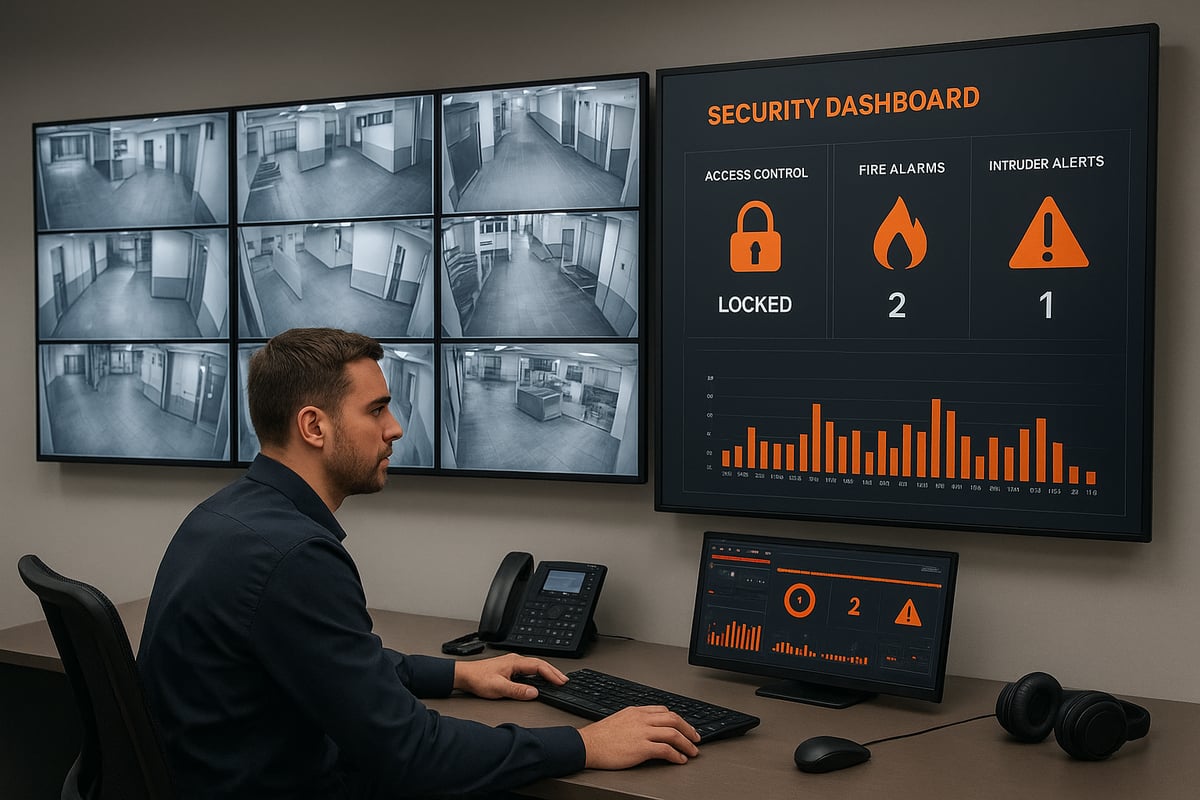
The heart of the business is the Central Station (also known as a Monitoring Center). This facility houses high-availability servers and receivers that decode incoming signals using protocols like SIA (Security Industry Association) or Contact ID. Professional operators monitor these signals through specialized automation software, which provides them with the customer’s data, site maps, and emergency contact instructions the moment an alarm arrives.
Strategic Business Models: In-House vs. Contract Monitoring
Entrepreneurs entering the alarm monitoring space must choose between two primary operational paths. The decision impacts capital expenditure (CapEx), staffing requirements, and long-term scalability.
1. The Full-Service Central Station
This model involves building and staffing your own monitoring facility. While this offers the highest profit margins per account and total control over the customer experience, the barrier to entry is high. You must invest in redundant power supplies, industrial-grade HVAC, high-tier cybersecurity, and a 24/7 rotation of certified operators. In 2026, a self-hosted station must typically meet UL 827 standards for Central-Station Alarm Services to be taken seriously by insurance providers and commercial clients.
2. The Dealer (Contract Monitoring) Model
Most small-to-medium security companies operate as "dealers." In this model, the business focuses on sales, installation, and local service, while outsourcing the actual 24/7 monitoring to a third-party "Wholesale Monitoring Center."
- Pros: Lower overhead, immediate 24/7 capability, and reduced liability.
- Cons: You pay a monthly "wholesale" fee per subscriber, which reduces your Recurring Monthly Revenue (RMR) margin.
Legal Requirements and Regulatory Compliance
The alarm monitoring industry is heavily regulated to ensure public safety and reduce the burden of false alarms on police and fire departments.
Licensing and Certifications
Before accepting a single client, a business must secure the necessary licenses. These often include:
- State Alarm Business License: Most jurisdictions require a specific license issued by a state board (e.g., the Texas Private Security Board). This usually involves background checks for all employees and a qualifying manager with years of documented experience.
- UL/FM Certification: Underwriters Laboratories (UL) or Factory Mutual (FM) certifications prove your facility and processes meet rigorous safety and reliability standards.
- TMA Five Diamond Designation: Provided by The Monitoring Association, this is a voluntary certification for centers that demonstrate a commitment to high-level operator training and industry best practices.
Insurance Obligations
General Liability insurance is insufficient for this niche. An alarm monitoring business requires Errors and Omissions (E&O) Insurance. This protects the company if a system fails to signal during a break-in or if an operator makes a mistake during the dispatch process that leads to property loss or injury.
Comparing Monitoring Tiers and Service Levels
The value of an alarm monitoring business in 2026 is often defined by its service tiers. Customers no longer want just a "siren in a box"; they want integrated intelligence.
| Service Tier | Features | Primary Target |
|---|---|---|
| Basic Monitoring | Intrusion, Fire, and Carbon Monoxide monitoring via cellular path. | Budget-conscious residential users. |
| Interactive Services | App-based control, remote arm/disarm, and real-time push notifications. | Standard modern households. |
| Video Verification | Operators view live clips triggered by alarms to confirm "eyes on" crime. | High-value residential & Small Business. |
| Managed Commercial | Access control integration, environmental monitoring (temp/flood), and daily heartbeat checks. | Industrial and Enterprise clients. |
| Video-as-a-Service (VaaS) | Proactive AI-driven perimeter monitoring with audio talk-down capabilities. | High-security sites and construction lots. |
Technological Trends Reshaping the Industry in 2026
The landscape of alarm monitoring is currently being redefined by three major technological shifts: AI verification, IoT standard adoption, and the sunsetting of legacy hardware.
AI and Video Verification
The "False Alarm" epidemic has led many police jurisdictions to adopt Verified Response policies, where they will not dispatch officers unless a human or an AI has confirmed a crime is in progress. Modern monitoring businesses use AI at the "edge" (on the camera) or in the cloud to filter out non-threats like swaying trees or roaming animals, only alerting the central station when a human presence is detected.
The Rise of Matter and Thread Protocols
With the stabilization of the Matter smart home standard, monitoring businesses are increasingly integrating with third-party devices. This allows a security company to monitor a system that might include a mix of professional-grade panels and off-the-shelf smart sensors, expanding the addressable market but increasing the complexity of technical support.
Cybersecurity as a Physical Security Necessity
In 2026, an alarm monitoring business is as much a cybersecurity firm as a physical security firm. If a client’s security cameras are hacked or their panel is bypassed via a network vulnerability, the monitoring company may be held liable. Implementing end-to-end encryption (AES-256) and secure VPN tunnels for all signal traffic is now a baseline requirement.
Financial Dynamics: The Power of RMR
The primary driver of value in an alarm monitoring business is Recurring Monthly Revenue (RMR). Unlike a construction company that must constantly find new projects, a security company builds a portfolio of subscribers who pay a monthly fee.
- Creation Cost: This is the cost to acquire a customer (marketing + equipment subsidy + installation labor).
- Attrition Rate: The percentage of customers who cancel their service annually. A healthy business maintains attrition below 8–10%.
- The Multiple: When an alarm monitoring business is sold, it is usually valued as a "multiple of RMR." For example, a company with $10,000 in monthly RMR might sell for 30x to 45x that amount ($300,000 to $450,000), depending on the quality of the contracts and the attrition rate.
Operational Challenges and Troubleshooting
The most common failure point in the monitoring chain is the False Alarm. High false alarm rates lead to:
- Fines from local municipalities.
- Reduced priority from emergency responders.
- Customer dissatisfaction ("The Boy Who Cried Wolf" effect).
Troubleshooting Strategies:
- Enhanced Call Verification (ECV): Operators must make at least two phone calls to site contacts before dispatching, which has been shown to reduce false dispatches by up to 50%.
- Cross-Zoning: Programming the system so that an alarm is only sent if two different sensors (e.g., a motion sensor and a door contact) are triggered within a specific timeframe.
- User Training: Providing comprehensive digital onboarding for clients to ensure they know how to disarm the system and use their "cancel" codes correctly.
Frequently Asked Questions
What is the difference between self-monitoring and professional monitoring?
Self-monitoring relies on the property owner to see a notification on their smartphone and call 911 themselves. Professional monitoring involves a UL-listed facility that receives the signal and takes action regardless of whether the owner is near their phone, asleep, or incapacitated. Most insurance companies only provide discounts for professional monitoring.
How much capital is needed to start a dealer-based alarm monitoring business?
A dealer-based model can be started with relatively low capital ($10,000–$50,000) focusing on tools, basic inventory, licensing, and marketing. However, building your own central station requires significantly more, often exceeding $250,000 to $500,000 for the necessary infrastructure, redundancy, and staffing.
Do alarm monitoring businesses need a physical office in every state they operate in?
Generally, no. You need a business license in each state where you have customers, but many states allow you to operate from a central headquarters or even a remote setup, provided you have a "Registered Agent" in that state. However, some jurisdictions require a physical "resident manager" to hold the license.
How does video verification work in a monitoring center?
When a camera-linked sensor is triggered, a short video clip (usually 5–10 seconds) is sent to the operator's screen along with the alarm signal. The operator reviews the clip to see if they spot an intruder. If a person is seen, they dispatch police with "priority one" status, informing them that a crime is confirmed and in progress.
What happens if the internet goes out at the protected property?
Modern alarm monitoring businesses utilize dual-path monitoring. If the primary internet connection fails, the system automatically switches to a cellular radio (5G/LTE) to send the signal. The central station will also receive a "Loss of Communication" signal, alerting them that the site is offline and needs investigation.
Next Steps for Prospective Business Owners
If you are looking to enter the alarm monitoring business in 2026, your first step should be to research the specific licensing requirements in your target jurisdiction. Because these requirements are often slow to process, securing your license is a prerequisite for any meaningful business activity.
Simultaneously, decide on your technological stack. Will you focus on high-end proprietary hardware, or will you embrace the open-ecosystem Matter/Thread devices that are becoming standard? Establishing a partnership with a reputable wholesale monitoring center can allow you to begin building your RMR portfolio without the massive overhead of building your own facility. Focus on a specific niche—such as small retail shops or high-end residential estates—to differentiate your service from the "big box" national providers.