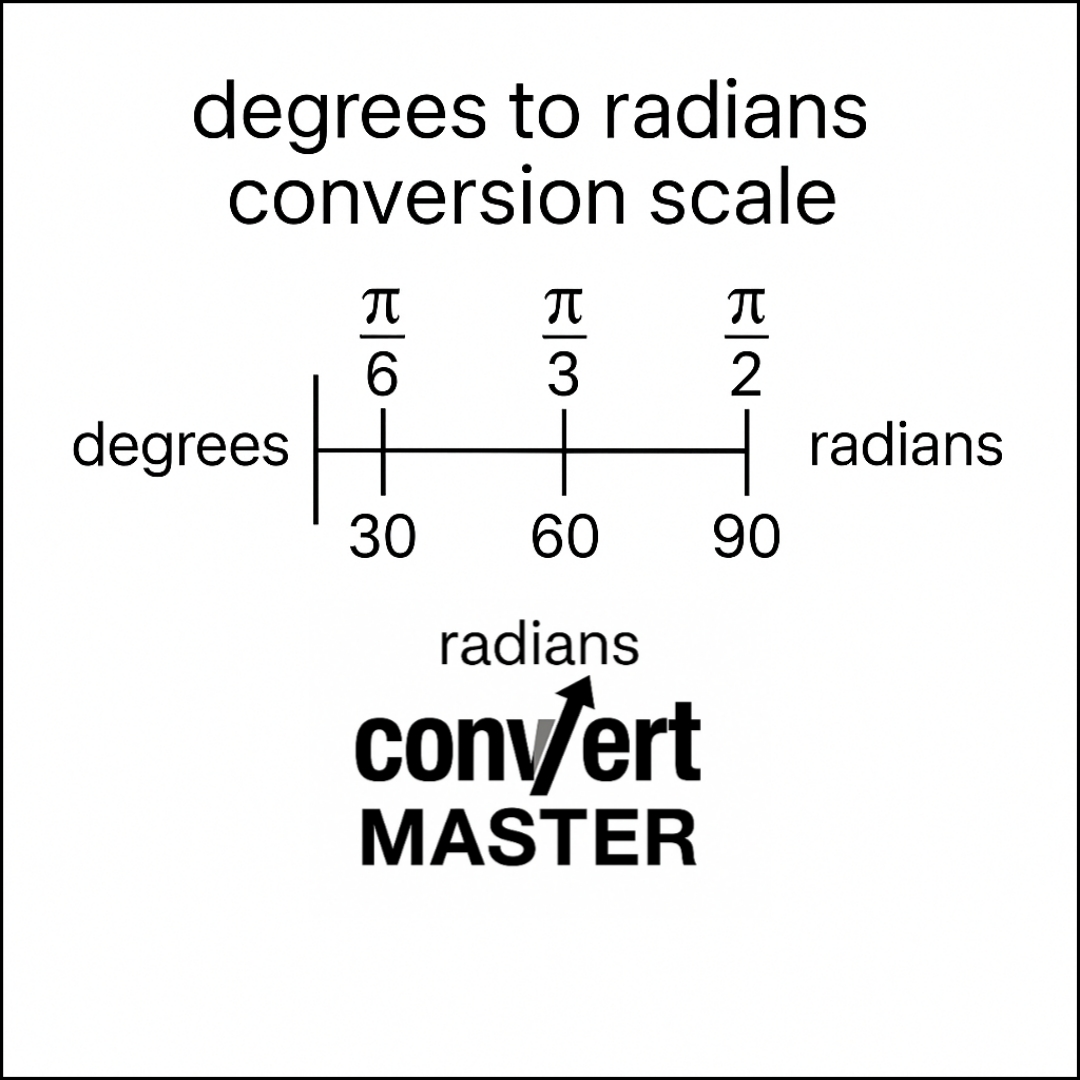
To convert 60 degrees to radians, you multiply the degree value by the conversion factor of $\pi/180$. Consequently, 60 degrees is exactly $\pi/3$ radians. In decimal form, this is approximately 1.04719755 radians. This specific angle is a cornerstone of trigonometry, forming the basis of equilateral triangles and hexagonal structures.
Understanding the Relationship Between Degrees and Radians
In the year 2026, while we continue to use degrees for everyday navigation and basic education, the radian remains the standard unit of angular measure in all scientific, engineering, and advanced mathematical contexts. To understand why 60 degrees is represented as $\pi/3$ radians, one must first understand the fundamental difference between these two systems of measurement.
The Origin of Degrees
The degree is a unit of measurement that dates back to ancient Babylonian mathematics. The Babylonians used a sexagesimal (base-60) system, which is why we have 60 seconds in a minute, 60 minutes in an hour, and 360 degrees in a circle. The choice of 360 was likely influenced by the approximate number of days in a year and the fact that 360 is a highly composite number, divisible by 2, 3, 4, 5, 6, 8, 9, 10, 12, and many others. A 60-degree angle, therefore, represents exactly one-sixth of a full rotation.
The Logic of Radians
Unlike degrees, which are somewhat arbitrary, radians are a "natural" unit of measurement. A radian is defined by the radius of a circle. If you take the radius of a circle and wrap it along the circumference, the angle subtended at the center is exactly 1 radian. Because the total circumference of a circle is $2\pi r$, there are $2\pi$ radians in a full 360-degree rotation. This relationship establishes the core conversion ratio: $360^\circ = 2\pi$ radians, which simplifies to $180^\circ = \pi$ radians.
Step-by-Step Conversion: 60 Degrees to Radians
The process of converting degrees to radians is a simple linear transformation. To move from the degree scale to the radian scale, we use the ratio of the two systems.
The Conversion Formula
The general formula to convert degrees to radians is: $$\text{Radians} = \text{Degrees} \times \left( \frac{\pi}{180^\circ} \right)$$
Applying the Formula to 60 Degrees
- Identify the Angle: We start with $60^\circ$.
- Set up the Equation: Multiply 60 by the fraction $\pi/180$. $$\text{Radians} = 60 \times \left( \frac{\pi}{180} \right)$$
- Simplify the Fraction: Divide both the numerator and the denominator by their greatest common divisor, which is 60. $$60 / 60 = 1$$ $$180 / 60 = 3$$
- Final Exact Result: The simplified result is $\pi/3$ radians.
Decimal Approximation
In many practical applications, such as numerical simulations or engineering software in 2026, an exact $\pi$ fraction may be converted to a floating-point decimal. Using the value of $\pi \approx 3.1415926535$: $$\pi / 3 \approx 1.0471975512 \text{ radians}$$
For most standard engineering purposes, rounding to four or five decimal places (1.0472) is sufficient, though high-precision fields like aerospace navigation or quantum computing calculations often require 15 or more decimal places of accuracy.
The Mathematical Significance of 60 Degrees ($\pi/3$)
The 60-degree angle is not merely a random point on a circle; it is one of the "special angles" in trigonometry. Its properties are used to define the coordinates of the unit circle and the behavior of periodic functions.
The Unit Circle and Trigonometric Ratios
On a unit circle (a circle with a radius of 1), an angle of 60 degrees ($\pi/3$) corresponds to a specific point $(x, y)$. Using the definitions of sine and cosine:
- $\cos(60^\circ)$ or $\cos(\pi/3)$: The x-coordinate is exactly 0.5 (or $1/2$).
- $\sin(60^\circ)$ or $\sin(\pi/3)$: The y-coordinate is $\sqrt{3}/2$, which is approximately 0.866.
- $\tan(60^\circ)$ or $\tan(\pi/3)$: The ratio of sine to cosine is $\sqrt{3}$, approximately 1.732.
These ratios are derived from the geometry of a 30-60-90 right triangle, which is formed by bisecting an equilateral triangle.
Why Calculus Prefers Radians
In 2026, students entering higher-level calculus quickly learn that the derivative of $\sin(x)$ is only $\cos(x)$ if $x$ is measured in radians. If $x$ were in degrees, the derivative would involve a messy conversion factor ($\pi/180$). This "cleanliness" of radians in power series and differential equations is why the conversion of 60 degrees to $\pi/3$ is a mandatory step in almost all physics and calculus problems involving rotation or oscillation.
Geometry and Real-World Context
The 60-degree angle is ubiquitous in both nature and human-made structures due to its inherent stability and symmetry.
The Equilateral Triangle
The most prominent geometric figure associated with 60 degrees is the equilateral triangle. In an equilateral triangle, all three internal angles are exactly 60 degrees ($\pi/3$ radians). Because all sides are equal and all angles are equal, this shape distributes stress evenly, making it a fundamental building block in structural engineering and truss design.
Hexagonal Tiling and Efficiency
A regular hexagon consists of six equilateral triangles meeting at a central point. Each interior angle of a regular hexagon is 120 degrees, but the central angles formed by its segments are 60 degrees. This geometry is seen in:
- Honeycombs: Bees use hexagonal cells because they provide the maximum storage volume with the minimum amount of wax (surface area).
- Crystal Structures: Many minerals and chemical bonds naturally form at 60-degree or 120-degree angles due to molecular optimization.
- Telescope Mirrors: Modern telescopes, including those being launched in the mid-2020s, often use hexagonal mirror segments (like the James Webb Space Telescope) because they can be tiled perfectly without gaps while maintaining a roughly circular overall shape for light collection.
Mechanical and Civil Engineering
In 2026, structural health monitoring and CAD (Computer-Aided Design) software rely heavily on radian-based calculations for "Finite Element Analysis." When engineers design bridges or skyscrapers, 60-degree bracing is often used to provide lateral stability. Converting these designs into radians is necessary for the software to calculate the tension and compression forces acting on each beam using trigonometric identities.
Comparative Table: Common Angles and Their Radian Equivalents
To provide context for where 60 degrees fits within the standard circle, the following table compares common angles.
| Degrees | Radians (Exact) | Radians (Decimal) | Sine Value | Cosine Value |
|---|---|---|---|---|
| 0° | 0 | 0.0000 | 0 | 1 |
| 30° | $\pi/6$ | 0.5236 | 0.5 | $\sqrt{3}/2$ |
| 45° | $\pi/4$ | 0.7854 | $\sqrt{2}/2$ | $\sqrt{2}/2$ |
| 60° | $\pi/3$ | 1.0472 | $\sqrt{3}/2$ | 0.5 |
| 90° | $\pi/2$ | 1.5708 | 1 | 0 |
| 120° | $2\pi/3$ | 2.0944 | $\sqrt{3}/2$ | -0.5 |
| 180° | $\pi$ | 3.1416 | 0 | -1 |
| 270° | $3\pi/2$ | 4.7124 | -1 | 0 |
| 360° | $2\pi$ | 6.2832 | 0 | 1 |
Computational Considerations in 2026
In modern programming languages—such as Python, C++, or specialized environments like MATLAB and R—the standard library trigonometric functions (e.g., sin(), cos(), tan()) almost exclusively expect inputs in radians.
Coding Example
If a developer in 2026 wants to calculate the height of a component at a 60-degree incline, they cannot simply input sin(60). Most compilers would interpret "60" as 60 radians, leading to a mathematically incorrect result. Instead, the developer must convert the angle:
import math # Correct way to handle 60 degrees angle_deg = 60 angle_rad = math.radians(angle_deg) # Result: 1.0471975511965976 result = math.sin(angle_rad) # Result: 0.8660254037844386
This requirement for radian input highlights why understanding the 60-to-$\pi/3$ conversion is essential for anyone working in software development, data science, or automation.
Common Pitfalls When Converting 60 Degrees
Even though the math is straightforward, several common errors occur during the conversion process.
- Inverting the Fraction: A common mistake is multiplying by $180/\pi$ instead of $\pi/180$. This results in "degrees squared per radian," a nonsensical unit. Always remember that because you want to "get rid" of degrees, the degree symbol ($180^\circ$) must be in the denominator.
- Miscalculating the Fraction: Some students simplify $60/180$ to $1/2$ or $1/4$ by mistake. It is helpful to remember that 60 fits into 180 exactly three times.
- Calculator Mode Errors: Many scientific calculators have a toggle between "DEG" and "RAD" modes. If a calculator is in Degree mode and you input $\pi/3$, it will treat the value as roughly 1.047 degrees rather than 60 degrees.
- Precision Loss: Using 3.14 as a value for $\pi$ is often insufficient for technical work. In 2026, the standard practice is to use the built-in $\pi$ constant provided by the system hardware or software library to ensure maximum floating-point precision.
Summary of 60 Degrees in Context
The value of 60 degrees ($\pi/3$ radians) is a fundamental constant across multiple disciplines. In geometry, it defines the equilateral triangle; in trigonometry, it provides clean, rational cosine values; in physics, it represents a common phase shift; and in engineering, it is a staple of efficient structural design.
Whether you are calculating the force on a bridge truss, programming a robotic arm's rotation, or simply solving a classroom math problem, the conversion of 60 degrees to $\pi/3$ radians serves as a bridge between the ancient sexagesimal system and the natural, elegant mathematics of the circle.
Frequently Asked Questions
Is 60 degrees exactly $\pi/3$?
Yes, 60 degrees is exactly $\pi/3$ radians. This is not an approximation but a precise mathematical identity. Because $180/60 = 3$, the relationship $180^\circ = \pi$ radians dictates that $60^\circ = \pi/3$ radians.
Why is 60 degrees so common in construction?
60 degrees is common because it is the internal angle of an equilateral triangle. Equilateral triangles are the most stable polygon because they are "rigid"—unlike a square, which can be deformed into a rhombus, a triangle's shape cannot be changed without changing the length of its sides. This makes 60-degree angles ideal for support structures.
How do I remember if I should multiply by $\pi/180$ or $180/\pi$?
A helpful tip is to look at the units. If you start with degrees, you want to "cancel out" degrees. Therefore, the value with the degree symbol ($180^\circ$) must be on the bottom (the denominator). This leaves the radian unit ($\pi$) on top.
What is 60 degrees in radians in terms of "milli-radians"?
In some military and optical contexts, angles are measured in milliradian (mrad). Since 60 degrees is approximately 1.0472 radians, it is equivalent to approximately 1047.2 milliradian.
Can 60 degrees be expressed in grads?
Yes. In the gradian system (where a right angle is 100 grads), 60 degrees is equal to approximately 66.67 grads. However, the gradian system is rarely used in 2026, having been largely replaced by the radian for technical work and the degree for general use.
What happens if I use 60 degrees instead of $\pi/3$ in a calculus formula?
If you use 60 (degrees) instead of $\pi/3$ (radians) in calculus—for example, when integrating or differentiating—the result will be incorrect by a factor of approximately 57.29 (which is $180/\pi$). Most calculus identities are derived specifically with the assumption that the input is in radians.
Final Recommendation
When working with 60-degree angles in any professional or academic capacity in 2026, always default to using the exact form ($\pi/3$) for as long as possible in your calculations. This prevents "rounding error propagation." Only convert to the decimal 1.04719755 at the final stage of your project or when required by hardware constraints.