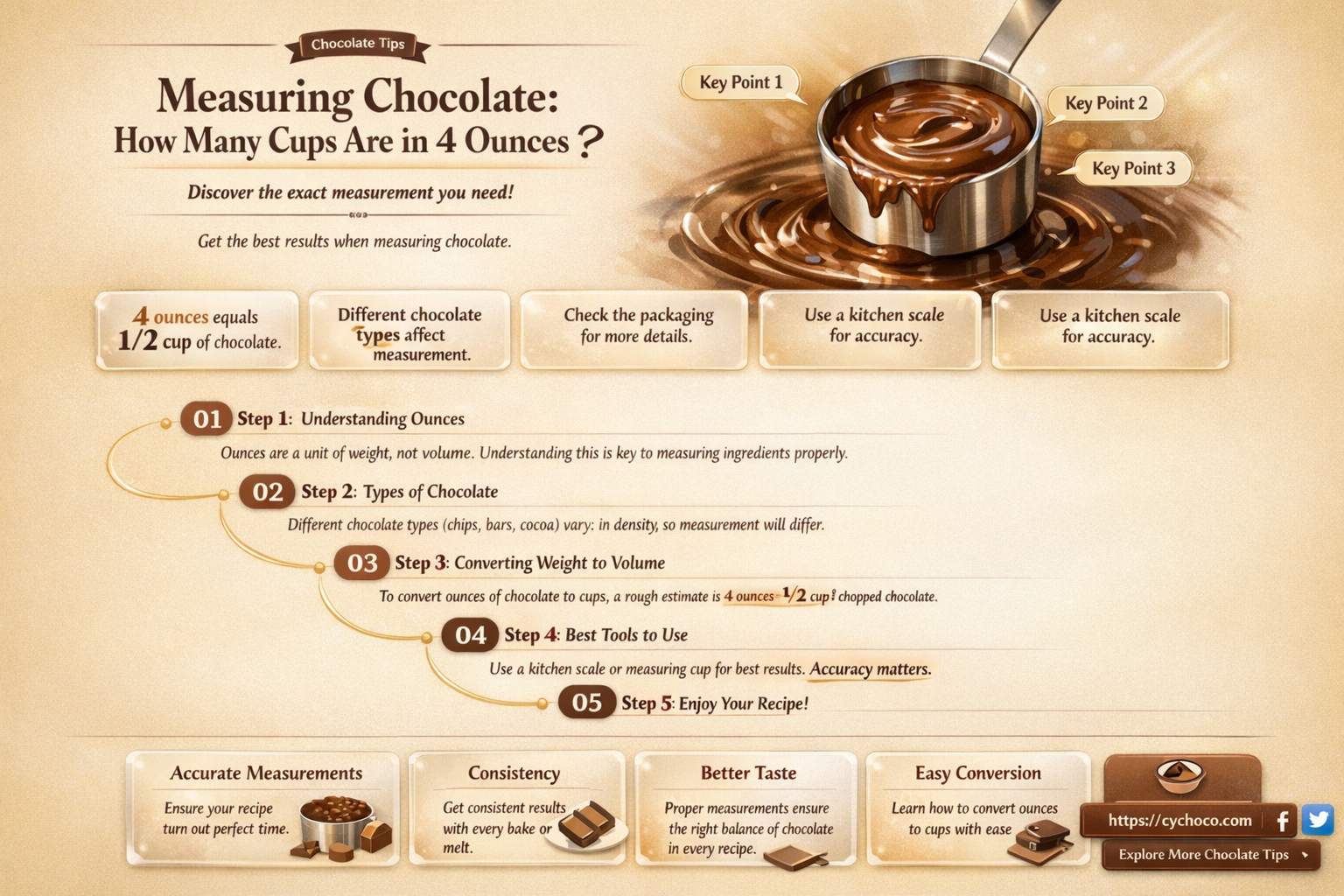
Four ounces of solid chocolate is generally equivalent to approximately three-quarters of a cup when chopped, or a standard half-cup when melted or measured as a dense liquid, though the exact conversion depends heavily on whether the chocolate is in chips, blocks, or cocoa powder.
In baking and confectionery, precise measurements are the foundation of structural and chemical success. When a recipe calls for an ingredient by weight—such as ounces—rather than volume—such as cups—home bakers often face a conversion challenge. This is particularly true for chocolate, an ingredient that comes in numerous forms, densities, and formats, ranging from solid baking bars and semi-sweet chips to rich cocoa powders and velvety melted pools. Understanding how to accurately translate 4 oz of chocolate into standard culinary cup measurements ensures your baked goods maintain their intended texture, moisture balance, and flavor profile.
The Weight-to-Volume Dilemma with Chocolate
To understand why converting 4 oz of chocolate into cups requires careful consideration, you must first recognize the fundamental difference between weight and volume. Weight measures the mass of an ingredient using a scale, providing an exact and unchangeable amount regardless of how the ingredient is packed. Volume, measured in cups and spoons, assesses the space an ingredient occupies.
Because solid chocolate can be whole, chopped, melted, or manufactured into various shapes like uniform chips, the air pockets trapped between pieces change the volume significantly. A measuring cup filled with small chocolate chips contains a high proportion of empty space between the pieces compared to a measuring cup filled with finely grated chocolate or smooth, melted liquid. Consequently, stating a universal cup equivalent for a specific weight of chocolate is inherently nuanced.
Why Weight (Ounces) is Preferred in Professional Baking
Professional bakers and pastry chefs heavily rely on weight measurements (ounces or grams) rather than volume. Baking is a precise chemical science. Flour, sugar, butter, and chocolate react in exact molecular ratios. When you use volume measurements, human error enters the equation:
- Scoop packing: Scooping flour or chocolate chips directly from a bag packs the ingredient down, delivering up to 30% more material than gently spooning it.
- Particle size: Coarsely chopped chocolate chunks leave massive air gaps in a measuring cup, whereas finely chopped chocolate settles more densely.
- Temperature changes: Chocolate expands slightly when warm and shrinks when cold, altering its physical dimensions.
Using a digital kitchen scale to measure 4 oz of chocolate eliminates these variables. However, when a recipe or kitchen setup necessitates volume measurements, having a reliable, context-aware conversion guide is essential for culinary success.
Standard Conversion Metrics for 4 oz of Chocolate
Depending on the physical state of your chocolate—whether it is solid, chopped, or melted—the cup measurement will shift. Below is a detailed breakdown of how 4 oz of chocolate translates into standard kitchen volume units across various common formats.
Chopped Chocolate and Baking Bars
When a recipe calls for 4 oz of baking chocolate (such as Baker’s unsweetened or semi-sweet squares) and asks you to chop it before melting or folding it into a batter, 4 oz generally yields about ¾ cup of coarsely chopped chocolate.
If the chocolate is finely chopped or grated into small, uniform flakes, it packs more densely into the measuring cup, bringing the total closer to ⅔ cup.
Chocolate Chips
Standard semi-sweet, dark, or milk chocolate chips are manufactured in uniform sizes and shapes, which creates a predictable amount of interstitial air space. For standard chocolate chips:
- 4 oz by weight equals approximately ¾ cup (or slightly more than ½ cup, depending on the brand and chip size).
- In standard U.S. baking terms, one 12-oz bag of chocolate chips contains roughly 2 cups, meaning 4 oz equates precisely to ⅔ cup.
Melted Chocolate
When chocolate is melted, all the internal air pockets are eliminated, transforming the ingredient into a dense liquid. Because liquid chocolate settles completely flat and fills every millimeter of a measuring vessel, 4 oz of solid chocolate, once melted, measures out to a slightly smaller volume:
- 4 oz of melted chocolate equals roughly ½ cup.
Unsweetened Cocoa Powder
If your recipe refers to dry cocoa powder rather than solid baking chocolate, the conversion rules change entirely due to the powder's ultra-fine, airy particle structure. While 4 oz of solid chocolate equals about ¾ cup, 4 oz of unsweetened cocoa powder is much lighter and fluffier:
- 4 oz of cocoa powder equals approximately 1 cup to 1 ⅓ cups, depending on how tightly packed the powder is in the container. (For most standard culinary applications, 4 oz of cocoa powder equals roughly 1 cup by weight, as 1 dry cup of cocoa powder weighs approximately 3 to 4 ounces depending on the brand and aeration).
Chocolate Form and Volume Conversion Reference
| Chocolate Format | Weight (Ounces) | Approximate Volume (Cups) | Culinary Notes |
|---|---|---|---|
| Standard Chocolate Chips | 4 oz | ⅔ to ¾ cup | Uniform shape creates predictable air gaps between pieces. |
| Coarsely Chopped Blocks | 4 oz | ¾ cup | Larger, uneven chunks leave significant air space in the cup. |
| Finely Chopped/Grated | 4 oz | ⅔ cup | Smaller particles settle tightly with minimal air gaps. |
| Melted Chocolate | 4 oz | ½ cup | Elimination of air pockets results in a denser liquid volume. |
| Unsweetened Cocoa Powder | 4 oz | 1 to 1 ⅓ cups | Highly aerated dry powder occupies more space by volume. |
Practical Impact on Baking Recipes
Understanding how 4 oz of chocolate translates into cups is vital because altering the amount of chocolate in a recipe affects structural integrity, moisture levels, and fat content. Chocolate contains two primary active components in baking: cocoa solids (which provide structure and dry bulk) and cocoa butter or added fats (which provide moisture, tenderness, and richness).
Brownies and Cakes
In dense, fudgy brownies or rich chocolate cakes, adding too much chocolate (by over-measuring volume) can make the final product heavy, greasy, or excessively dense, preventing it from rising properly. Conversely, under-measuring leaves the cake dry and lacking in deep, complex flavor. If a recipe calls for a 4-oz block of baking chocolate and you must substitute it with chocolate chips or cocoa powder, adjusting for the fat content is critical.
Ganache and Glazes
For recipes where chocolate is the star—such as a chocolate ganache, glaze, or mousse—precision is paramount. Ganache relies on precise ratios of chocolate to heavy cream (often a 1:1 ratio by weight for a standard pouring ganache). If you miscalculate your 4 oz of chocolate by relying on loose volume measurements instead of a scale, your emulsion can break, resulting in a grainy, greasy sauce rather than a smooth, glossy finish.
Common Mistakes to Avoid When Measuring Chocolate
Bakers frequently encounter frustrating kitchen mishaps simply due to improper measuring techniques. Avoiding these common pitfalls ensures your culinary projects turn out precisely as intended.
- Confusing Fluid Ounces with Dry Ounces: This is the most common mistake in American baking. Ounces (oz) measure weight, while fluid ounces (fl oz) measure volume. A 4-oz weight of solid chocolate does not equal 4 fluid ounces (which is ½ cup of liquid). Always verify whether a recipe uses weight or volume.
- Scooping Directly with Measuring Cups: Jamming a dry measuring cup directly into a bag of chocolate chips compacts the pieces, leading to up to 25% more chocolate than the recipe requires. Instead, use a spoon to transfer the chocolate chips into the measuring cup until it is level.
- Failing to Account for Added Ingredients in Chips: Standard baking chocolate blocks consist of 100% pure chocolate liquor and cocoa butter (in unsweetened varieties) or added sugar (in semi-sweet varieties). Commercial chocolate chips often contain lecithin, stabilizers, and emulsifiers designed to help them retain their shape during baking. Swapping solid baking blocks for chips cup-for-cup can subtly alter how a cookie spreads in the oven.
Troubleshooting Your Chocolate Measurements
If you have already started baking and realized you lack a kitchen scale, or if your measurements look incorrect, use these quick troubleshooting steps to save your recipe:
- Missing a Scale? Use Package Labels: Most commercial baking chocolate blocks are sold in 4-oz packages containing four individual 1-oz squares. If your recipe calls for 4 oz, simply use one entire package or four individual squares.
- Converting Bars to Chips: If a recipe calls for 4 oz of chopped baking chocolate but you only have chocolate chips, you can safely use ¾ cup of chips as a direct 1:1 substitute in most cookies, brownies, and muffins.
- Adjusting for Melted Requirements: If a recipe requires 4 oz of melted chocolate and you are melting chips, measure out ½ cup of chips before melting them, as the volume will compress as they liquefy.
Frequently Asked Questions
How many cups is 4 oz of baking chocolate?
4 oz of baking chocolate, when chopped, equals approximately ¾ cup. If it has already been melted, it reduces in volume to about ½ cup due to the elimination of air pockets between the solid pieces.
Can I substitute cocoa powder for 4 oz of baking chocolate?
Yes, but you must account for the lack of fat. To replace 4 oz of unsweetened baking chocolate, use 1 cup of unsweetened cocoa powder plus 3 tablespoons of melted butter or shortening to replicate the missing cocoa butter fat content.
Do chocolate chips measure the same as chopped baking bars?
They are very close, but not identical. Standard chocolate chips contain emulsifiers that help them keep their shape, and their uniform shape leaves consistent air gaps. 4 oz of chocolate chips typically measures out to about ¾ cup.
Is an ounce of chocolate the same as a fluid ounce?
No. An ounce is a unit of weight (mass), whereas a fluid ounce is a unit of volume (space). Because chocolate is denser than water, 4 oz of solid chocolate weighs 4 ounces on a scale but occupies less than 4 fluid ounces of space.
How many standard squares are in 4 oz of baking chocolate?
Most major brands of baking chocolate (such as Baker's) package their bars into 4-oz boxes containing four individually wrapped 1-oz squares. Therefore, 4 oz equals precisely one full box or four individual squares.
Conclusion and Next Actions
Mastering the conversion of 4 oz of chocolate into cups removes the guesswork from baking and ensures consistent, delicious results every time. Whenever possible, rely on a digital kitchen scale for ultimate accuracy, especially when working with expensive or delicate ingredients like fine chocolate. If you must use volume measurements, remember that chopped chocolate and chips measure out to roughly ¾ cup, while melted chocolate condenses to ½ cup. For your next baking project, double-check your recipe's format requirements, select the appropriate conversion metric outlined above, and enjoy crafting your homemade treats with absolute confidence.