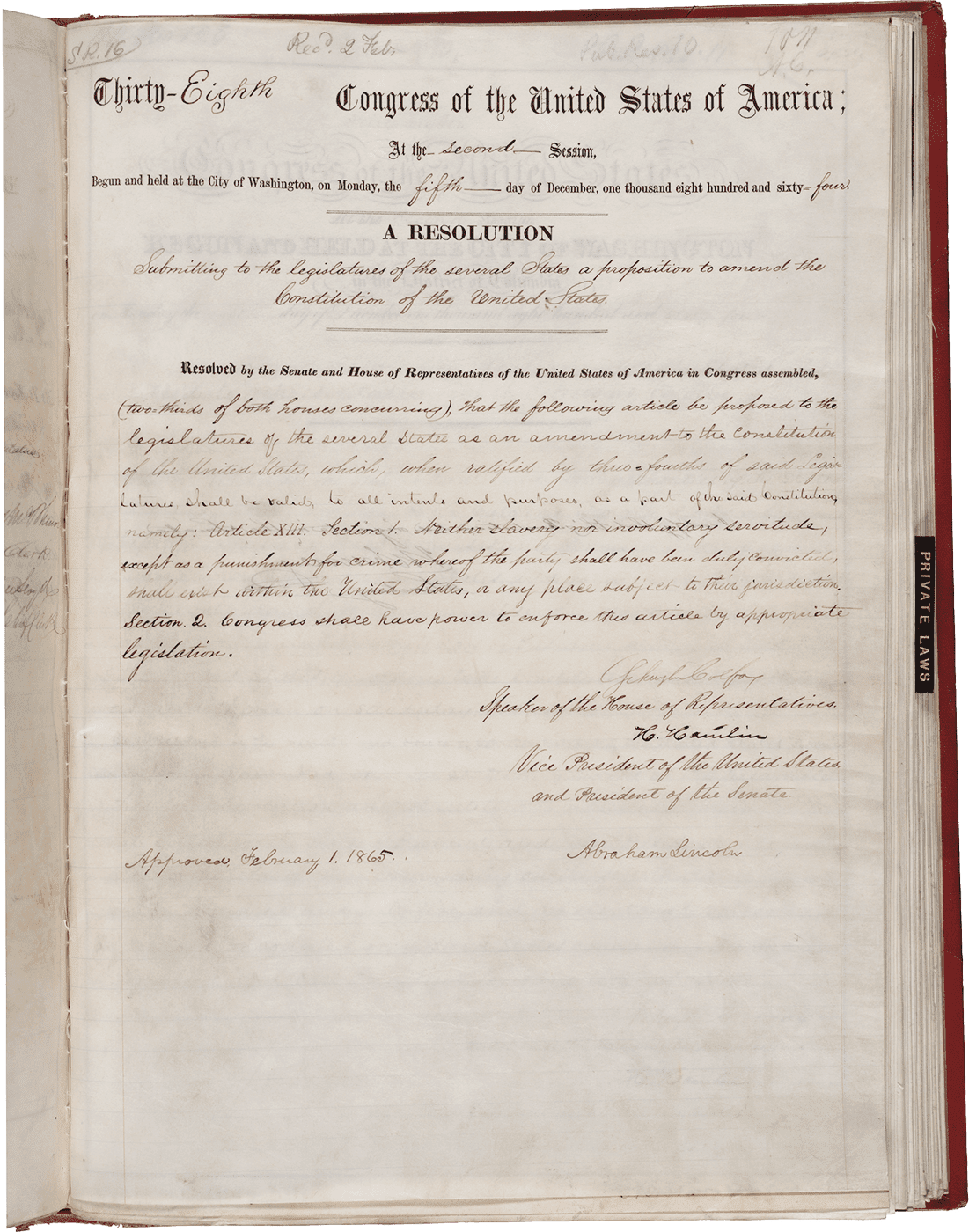
The 13th Amendment to the United States Constitution abolished slavery and involuntary servitude, except as punishment for a crime. Since its ratification in 1865, the Supreme Court has shaped its reach through landmark rulings that define "involuntary servitude" and determine whether Congress can use the amendment to combat the "badges and incidents" of slavery in private life.
The 13th Amendment is unique among the Reconstruction Amendments because it applies to both government actions and private individuals. While the 14th and 15th Amendments require "state action" to be triggered, the 13th Amendment empowers Congress to pass laws directly affecting private conduct if that conduct mirrors the conditions of slavery. However, the judicial history of this amendment has been a pendulum, swinging from extremely narrow interpretations in the late 19th century to a broader, more robust application during the Civil Rights Movement of the mid-20th century.
As of 2026, legal scholars and courts continue to grapple with the "punishment clause," which allows for forced labor in prisons, and the extent to which modern issues like human trafficking and systemic housing discrimination fall under the umbrella of "badges and incidents of slavery." Understanding the evolution of these Supreme Court cases is essential for comprehending the current legal landscape of civil rights in America.
The Early Era: Narrowing the Scope of Freedom
In the immediate aftermath of the Civil War, the Supreme Court was tasked with defining the boundaries of the newly ratified 13th Amendment. Initially, the Court took a restrictive view, often fearing that a broad interpretation would grant the federal government too much power over the states and private citizens.
The Slaughter-House Cases (1873)
While primarily known for its interpretation of the 14th Amendment’s Privileges or Immunities Clause, The Slaughter-House Cases provided early insight into the Court's view of the 13th Amendment. The plaintiffs argued that a state-granted monopoly on slaughterhouses in New Orleans created a form of involuntary servitude by preventing them from practicing their trade.
The Supreme Court rejected this, ruling that the 13th Amendment was specifically intended to abolish African slavery and the conditions inherent to it. Justice Samuel Miller’s majority opinion emphasized that the amendment’s "pervading purpose" was the freedom of the slave race. By tethering the amendment so closely to the historical context of chattel slavery, the Court effectively signaled that it would not be a general tool for economic or labor disputes.
The Civil Rights Cases (1883)
This remains one of the most consequential decisions in American constitutional history. In The Civil Rights Cases, the Supreme Court consolidated five cases where Black citizens were denied access to public accommodations (hotels, theaters, and trains) in violation of the Civil Rights Act of 1875.
The Court struck down the Act, ruling that the 13th Amendment only abolished slavery itself and did not give Congress the power to regulate private acts of racial discrimination. Justice Joseph P. Bradley famously wrote that a person's "rights as a citizen" were not the same as their freedom from slavery. He argued that being denied a hotel room was a "civil injury" but did not constitute a "badge of slavery." This decision effectively legalized private segregation and ushered in the Jim Crow era, significantly limiting the amendment's enforcement for nearly a century.
Combatting Debt Peonage and Forced Labor
By the early 20th century, the Court began to take a firmer stance against "debt peonage," a system where employers compelled workers to pay off debts through labor, often under threat of criminal prosecution. This was a common practice in the South used to circumvent the 13th Amendment.
Bailey v. Alabama (1911)
In Bailey v. Alabama, the Supreme Court addressed an Alabama statute that made it a criminal offense for an employee to breach a labor contract if they had received an advance on their wages. Alonzo Bailey, a Black laborer, had taken a $15 advance and then quit his job. Under the law, his failure to repay the money was treated as prima facie evidence of intent to defraud, leading to imprisonment.
Justice Charles Evans Hughes, writing for the majority, struck down the law. The Court held that the 13th Amendment prohibits "involuntary servitude" regardless of whether the servitude is created by a contract or by force. The Court famously declared that "what the state may not do directly it may not do indirectly." This case established that the threat of criminal prosecution to force a person to work constitutes involuntary servitude.
United States v. Reynolds (1914)
Expanding on the Bailey decision, United States v. Reynolds challenged the "surety system." Under this system, if a person was convicted of a crime and could not pay the fine, a private employer (the surety) could pay the fine for them. In exchange, the convicted person signed a contract to work for the employer for a specified time. If the worker left, they faced re-arrest and additional fines.
The Court found this system to be a clear violation of the 13th Amendment. It created a cycle of perpetual debt and labor that the Court deemed indistinguishable from slavery. These peonage cases demonstrated that the 13th Amendment could be used to strike down state laws that facilitated forced labor, even if the labor was ostensibly "voluntary" via contract.
The 20th Century Rebirth: Defining "Badges and Incidents"
The 1960s saw a revolutionary shift in how the 13th Amendment was applied. The Supreme Court revisited the "badges and incidents of slavery" doctrine that it had largely dismissed in 1883.
Jones v. Alfred H. Mayer Co. (1968)
This case is the modern cornerstone of 13th Amendment jurisprudence. Joseph Lee Jones, a Black man, sued a real estate developer for refusing to sell him a home in a specific community solely because of his race. Jones relied on the Civil Rights Act of 1866 (specifically 42 U.S.C. § 1982), which guarantees all citizens the same right to inherit, purchase, and sell property.
The Supreme Court ruled in favor of Jones, explicitly reversing the logic used in The Civil Rights Cases. The Court held that Congress has the power under Section 2 of the 13th Amendment to determine what constitutes the "badges and incidents of slavery" and to translate that determination into effective legislation. Justice Potter Stewart wrote: "At the very least, the freedom that Congress is empowered to secure under the Thirteenth Amendment includes the freedom to buy whatever a white man can buy, the right to live wherever a white man can live."
This ruling empowered Congress to ban private racial discrimination in housing, employment, and contracts, significantly expanding the federal government's reach in protecting civil rights.
Runyon v. McCrary (1976)
Building on the momentum of Jones, the Court in Runyon v. McCrary addressed whether private, commercially operated, nonsectarian schools could deny admission to Black students. The Court ruled that 42 U.S.C. § 1981 (another part of the 1866 Civil Rights Act) prohibited such discrimination.
The Court affirmed that the 13th Amendment reached private acts of discrimination because such exclusion from private education constituted a "badge" of the former slave system. This case solidified the principle that the amendment is a potent tool against private racial barriers in the commercial and educational sectors.
Landmark 13th Amendment Cases Comparison
The following table summarizes the evolution of the Supreme Court's stance on the 13th Amendment, highlighting the shift from narrow to broad interpretation.
| Case Name | Year | Primary Legal Issue | Court Ruling/Outcome | Impact on 13th Amendment |
|---|---|---|---|---|
| Slaughter-House Cases | 1873 | State monopolies on trade | Ruled against plaintiffs; interpreted 13th narrowly. | Limited the amendment to "African slavery." |
| Civil Rights Cases | 1883 | Private discrimination in public spaces | Struck down Civil Rights Act of 1875. | Denied federal power over private discrimination. |
| Bailey v. Alabama | 1911 | Criminalizing breach of labor contracts | Struck down Alabama peonage law. | Defined threat of jail as "involuntary servitude." |
| U.S. v. Reynolds | 1914 | Surety system for paying court fines | Struck down the surety-labor system. | Prohibited perpetual debt-based labor. |
| Jones v. Alfred H. Mayer Co. | 1968 | Private housing discrimination | Upheld ban on private racial housing bias. | Revived the "badges and incidents" doctrine. |
| Runyon v. McCrary | 1976 | Discrimination in private schools | Prohibited private schools from racial exclusion. | Applied 13th Amendment to private contracts. |
| United States v. Kozminski | 1988 | Definition of "involuntary servitude" | Limited servitude to physical or legal coercion. | Narrowed the definition of "coercion" for labor. |
Contemporary Challenges and the Punishment Clause
In 2026, the primary legal battleground for the 13th Amendment involves the Punishment Clause, which states: "Neither slavery nor involuntary servitude, except as a punishment for crime whereof the party shall have been duly convicted, shall exist within the United States."
The Prison Labor Debate
This exception has allowed for the continuation of forced labor within the American penal system. Advocates and legal scholars argue that this clause has been exploited to create a "new Jim Crow," where mass incarceration provides a pool of nearly free labor. Recent litigation has challenged the conditions of prison work, arguing that even with the exception, the labor must meet basic human rights standards and cannot be used as a form of torture or "servitude" that extends beyond the sentence itself.
Several states have recently passed amendments to their own state constitutions to remove this "punishment" language, and there is ongoing pressure for a federal constitutional amendment to close this loophole entirely. The Supreme Court has historically been reluctant to interfere with prison administration, but cases involving the adequacy of "wages" (often cents per hour) and the safety of work conditions are increasingly reaching higher courts.
Human Trafficking and United States v. Kozminski (1988)
While older cases focused on debt peonage, modern cases often focus on human trafficking. In United States v. Kozminski, the Court was asked to define "involuntary servitude" in the context of mentally disabled men held on a farm through psychological coercion rather than physical force.
The Court took a surprisingly narrow view, ruling that for the purposes of criminal statutes, "involuntary servitude" requires the threat of physical force or legal coercion (like being thrown in jail). This ruling made it harder to prosecute traffickers who use psychological manipulation, isolation, or the withholding of documents to keep victims in servitude. However, Congress responded by passing the Victims of Trafficking and Violence Protection Act of 2000, which expanded the definition of coercion to include non-physical means, effectively working around the Court’s narrow interpretation in Kozminski.
Frequently Asked Questions
Does the 13th Amendment only apply to Black Americans?
No. While the Supreme Court acknowledged in the Slaughter-House Cases that the amendment was born out of the struggle to end African slavery, its text is universal. It prohibits "slavery" and "involuntary servitude" for any person, regardless of race. Cases like Bailey v. Alabama and modern human trafficking cases protect individuals of all backgrounds from forced labor.
Why is the 13th Amendment different from the 14th Amendment?
The most significant difference is the State Action Doctrine. The 14th Amendment (Equal Protection and Due Process) only applies to actions taken by the government. The 13th Amendment applies to everyone—private individuals, corporations, and the government. This allows the federal government to prosecute a private citizen for holding another person in servitude without needing to prove the state was involved.
What are the "badges and incidents of slavery"?
This legal doctrine refers to the social and legal disabilities that were associated with the institution of slavery. This includes things like the inability to own property, the inability to sue in court, or being denied access to public services. Under the Jones v. Alfred H. Mayer Co. ruling, Congress has the power to identify these "badges" and pass laws (like the Fair Housing Act) to eliminate them.
Can the government force you to work during a national emergency?
Generally, yes. The Supreme Court has ruled in cases like Butler v. Perry (1916) that "public duties" such as jury duty, military service, and even required road maintenance work do not constitute involuntary servitude. These are viewed as duties a citizen owes to the state in exchange for the protection and benefits of citizenship.
Is prison labor legal under the 13th Amendment?
Yes, under the current text of the amendment. The "punishment clause" specifically exempts labor performed by those who have been "duly convicted" of a crime. However, this is a highly controversial area of law in 2026, with many legal challenges focusing on whether the labor becomes "unconstitutional" if it is performed under inhumane conditions or without any compensation whatsoever.
Next Actions for Legal Researchers
If you are researching 13th Amendment cases for academic or legal purposes, your next step should be to consult the United States Code, specifically 42 U.S.C. § 1981 and § 1982. These statutes are the legislative children of the 13th Amendment and are the primary tools used in modern litigation regarding private discrimination.
Furthermore, stay updated on state-level constitutional amendments. As of 2026, the movement to remove the punishment clause at the state level is creating a "laboratory of democracy" effect, where state courts may soon issue rulings that provide more protection than the federal Supreme Court currently offers. For primary source documents, the Library of Congress and National Archives provide the original records of the amendment's ratification and the early Congressional debates that define its intent.