One hundred basis points is equal to exactly 1.00%, or one full percentage point. Financial professionals use this term to describe small changes in interest rates, bond yields, and economic indicators, allowing them to discuss shifts precisely without confusing percentages with percentage points.
Introduction to Financial Measurement Language
In the world of finance, economics, and banking, precision matters immensely. When the Federal Reserve adjusts interest rates or a bank changes the rate on a mortgage, even a fractional shift can mean billions of dollars moving through the global economy. To discuss these shifts without confusion, financial experts rely on a specialized unit of measurement known as the basis point.
For everyday consumers, financial news reports frequently mention that central banks are raising rates by 50 basis points or cutting them by 25 basis points. Without a clear translation, these numbers can sound intimidating or overly academic. However, understanding what these units represent is remarkably straightforward once you learn the basic conversion rules. This guide explores the mechanics of basis points, why financial institutions use them instead of standard percentages, how they affect everyday borrowing and investing, and how to calculate them accurately.
(Note: While financial concepts apply broadly across global markets, readers should always consult qualified financial professionals or official institutional disclosures before making major borrowing, lending, or investment decisions.)
What Exactly Is a Basis Point?
A basis point (often abbreviated as bps, pronounced "bips") is a unit of measure used in finance to describe the percentage change in the value or rate of a financial instrument.
The fundamental rule of conversion is simple:
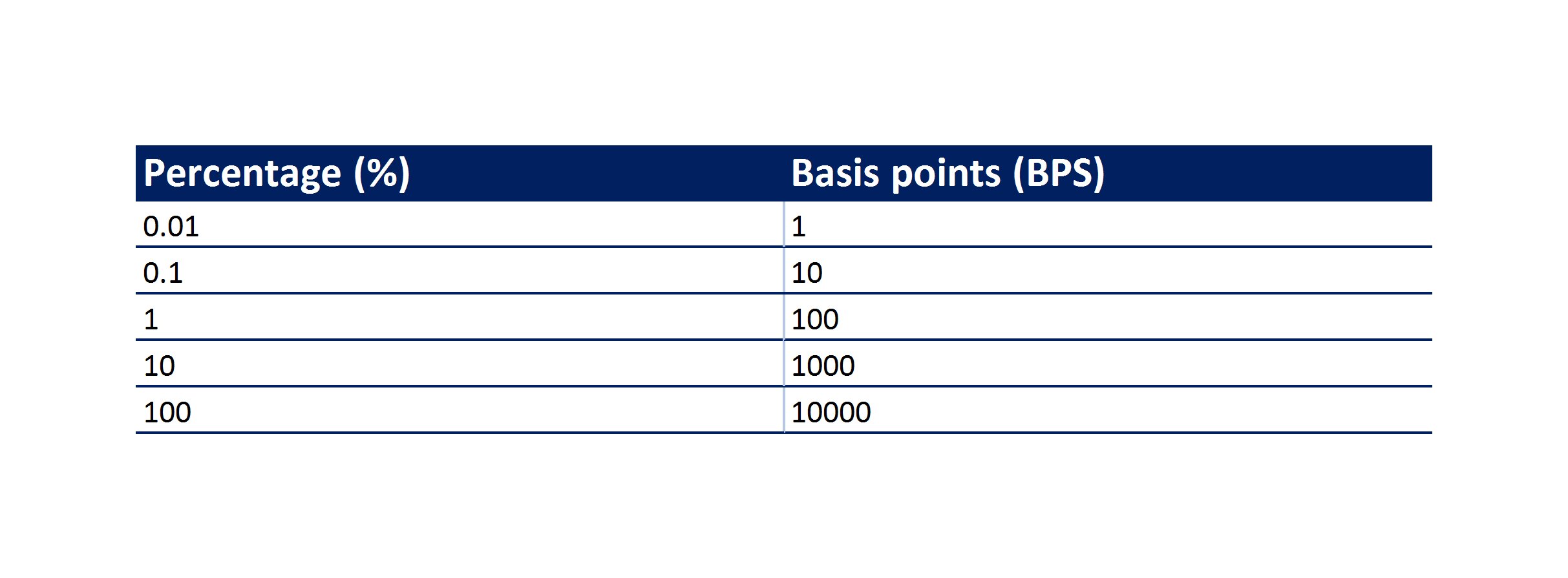
- 1 basis point = 0.01%
- 100 basis points = 1.00%
- 10,000 basis points = 100.00%
To transition from basis points to a standard percentage, you divide the number of basis points by 100. Conversely, to convert a percentage into basis points, you multiply that percentage by 100.
Why the Term Exists
You might wonder why financial analysts do not simply use regular percentages. The primary reason is to eliminate ambiguity when discussing changes in interest rates that are already expressed in percentages.
Consider a scenario where a savings account has an interest rate of 5.00%, and the bank increases that rate by 1%. Does that mean the new rate is 5.01% (a one percent increase of the existing rate), or does it mean the new rate is 6.00% (a one percentage point increase)?
In spoken and written financial communication, saying "a one percent increase" is notoriously ambiguous. By using basis points, this confusion vanishes entirely:
- If the bank raises the rate by 1 basis point, the new rate is 5.01%.
- If the bank raises the rate by 100 basis points, the new rate is 6.00%.
By reserving percentages for the absolute level of the rate and basis points for the change in that rate, financial professionals communicate with absolute clarity.
Breaking Down 100 Basis Points in Context
Because 100 basis points equal 1 percentage point, any movement of 100 bps represents a substantial shift in the financial landscape. Central banks rarely move interest rates by 100 bps at once unless they are responding to severe economic shocks, high inflation, or a major recession. Smaller increments, such as 25 basis points (0.25%) or 50 basis points (0.50%), are far more common during normal monetary policy adjustments.
To visualize how these increments scale, review the following conversion table:
| Basis Points (bps) | Percentage Equivalent | Decimal Equivalent | Common Financial Context |
|---|---|---|---|
| 1 bps | 0.01% | 0.0001 | Minor bond yield tick, mutual fund expense ratio adjustment |
| 10 bps | 0.10% | 0.0010 | Small adjustment in high-yield savings account rates |
| 25 bps | 0.25% | 0.0025 | Standard Federal Reserve rate cut or hike increment |
| 50 bps | 0.50% | 0.0050 | Moderate monetary policy adjustment |
| 100 bps | 1.00% | 0.0100 | Significant economic shift, full percentage point change |
| 200 bps | 2.00% | 0.0200 | Major tightening or easing cycle over time |
Real-World Applications: How 100 Basis Points Affect You
Understanding the math is only half the battle; seeing how 100 basis points impacts real financial products reveals why these numbers matter to everyday consumers. Whether you are paying off a mortgage, keeping cash in a high-yield savings account, or investing in bonds, a 100 bps shift changes your financial reality.
1. Mortgages and Loans
When interest rates rise or fall by 100 basis points, the cost of borrowing changes significantly. Suppose you take out a 30-year fixed-rate mortgage for $300,000.
- If your interest rate is 5.00%, your monthly principal and interest payment is roughly $1,610.
- If market rates jump by 100 basis points to 6.00%, your interest rate increases by a full percentage point, and your monthly payment rises to roughly $1,798.
That single 100 bps increase costs the borrower an extra $188 every month, translating to thousands of dollars over the lifetime of the loan.
2. High-Yield Savings Accounts and CDs
Conversely, savers benefit when rates climb. If a high-yield savings account or Certificate of Deposit (CD) pays a baseline yield of 3.50%, and the bank boosts yields by 100 basis points, the new yield becomes 4.50%. On a $20,000 balance, that 100 bps improvement increases annual interest earnings from $700 to $900.
3. Investment Portfolios and Expense Ratios
Investors encounter basis points when reviewing mutual fund and exchange-traded fund (ETF) management fees, often called expense ratios. If a fund manager charges an expense ratio of 0.25% (or 25 bps), they take $25 annually for every $10,000 invested. If a fund's fee drops by 10 basis points, investors keep more of their returns.
Common Mistakes and Misconceptions
Misunderstanding basis points can lead to poor financial planning or misinterpretation of economic news reports. Keep the following pitfalls in mind:
- Confusing Basis Points with Percentages: Remember that 100 bps is not 100%. It is 1%. Thinking of 100 bps as 100% would mean a loan rate jumping from 5% to 105%, which is mathematically impossible for standard interest rates.
- Assuming Linear Cost Increases Across All Loan Types: While a 100 bps rise on a fixed-rate loan has a predictable mathematical outcome, variable-rate loans and credit cards adjust automatically. A 100 bps increase in the prime rate pushes credit card APRs up by exactly 1 percentage point immediately.
- Overlooking Compounding Effects: A 100 basis point shift compounds over time, particularly in long-term investments and amortization schedules. Small changes accumulate into massive discrepancies over decades.
Frequently Asked Questions
What does a 50 basis point hike mean?
A 50 basis point hike equals a 0.50% increase in an interest rate. If a central bank's benchmark rate sits at 4.00% and implements a 50 bps hike, the new benchmark rate becomes 4.50%. This makes borrowing more expensive and encourages saving.
How do I convert basis points to a percentage?
To convert basis points to a percentage, divide the number of basis points by 100. For example, 75 basis points divided by 100 equals 0.75%. To go the other way, multiply the percentage by 100.
Why don't people just say "one percent"?
People do say "one percent," but financial professionals use basis points to avoid ambiguity. When discussing changes to existing percentages—such as an interest rate moving from 4.00% to 5.00%—saying "a 1% increase" could mistakenly imply a 1% increase of the 4% rate itself (which would be 4.04%) rather than a 1 percentage point rise to 5.00%.
Are basis points used for stock prices?
No. Basis points are primarily used for fixed-income securities, interest rates, bond yields, credit spreads, and fund fees. Stock prices fluctuate based on supply, demand, earnings, and valuation, and are tracked in direct currency amounts and standard percentage changes.
Conclusion and Next Actions
Mastering financial terminology removes the mystery from economic news and empowers you to make informed decisions. To put this knowledge into practice:
- Review your current loan and mortgage agreements to identify whether your interest rates are fixed or variable.
- Check the yields on your savings accounts and CDs to verify whether your bank is passing along recent rate changes.
- Examine the expense ratios on your investment portfolios to ensure you are not paying excessive fees measured in basis points.