Phishing continues to be the dominant vector for cyberattacks, evolving from simple mass emails into sophisticated, AI-driven social engineering campaigns. Analyzing current data reveals critical insights into how threat actors target organizations, the financial impact of these breaches, and the specific vectors that bypass traditional security perimeters.
As cybersecurity teams prepare for the threats facing organizations, understanding the quantitative reality of social engineering is essential for allocating resources, training employees, and implementing technical defenses. Below is an exhaustive breakdown of ten essential data points that define the current phishing threat environment.
1. The Pervasiveness of Phishing in Initial Access
Phishing remains the primary mechanism for external threat actors attempting to gain a foothold inside corporate networks. Industry telemetry consistently shows that social engineering accounts for a significant majority of security breaches. According to annual data compiled by the Verizon Data Breach Investigations Report (DBIR), social engineering—led primarily by phishing and pretexting—is involved in nearly 36% of all data breaches.
This statistic highlights a fundamental truth of information security: technical vulnerabilities in software are frequently bypassed in favor of human manipulation. When attackers can convince a user with valid credentials to hand over access or execute a malicious payload, the need for complex zero-day exploits diminishes. Consequently, organizations must treat human risk management with the same rigor applied to patch management and network architecture.
2. Business Email Compromise (BEC) and Financial Losses
While broad, untargeted phishing campaigns still exist, targeted attacks designed to manipulate financial transactions—commonly known as Business Email Compromise (BEC)—represent the most financially damaging subset of phishing. The Internet Crime Complaint Center (IC3) managed by the Federal Bureau of Investigation (FBI) regularly tracks these losses, reporting billions of dollars lost annually to BEC schemes globally.
BEC attacks do not always rely on malicious links or attachments. Instead, they frequently use compromised corporate email accounts or lookalike domains to impersonate executives, vendors, or legal counsel. Because these requests often bypass automated technical filters, they exploit internal trust relationships, resulting in fraudulent wire transfers, invoice redirection, and payroll diversion.
3. The Surge in AI-Generated Phishing Content
The integration of generative artificial intelligence and large language models into the cybercriminal ecosystem has fundamentally changed the production quality of phishing messages. Historically, security analysts could train employees to spot phishing emails by looking for telltale signs such as poor grammar, awkward syntax, and misspelled words.
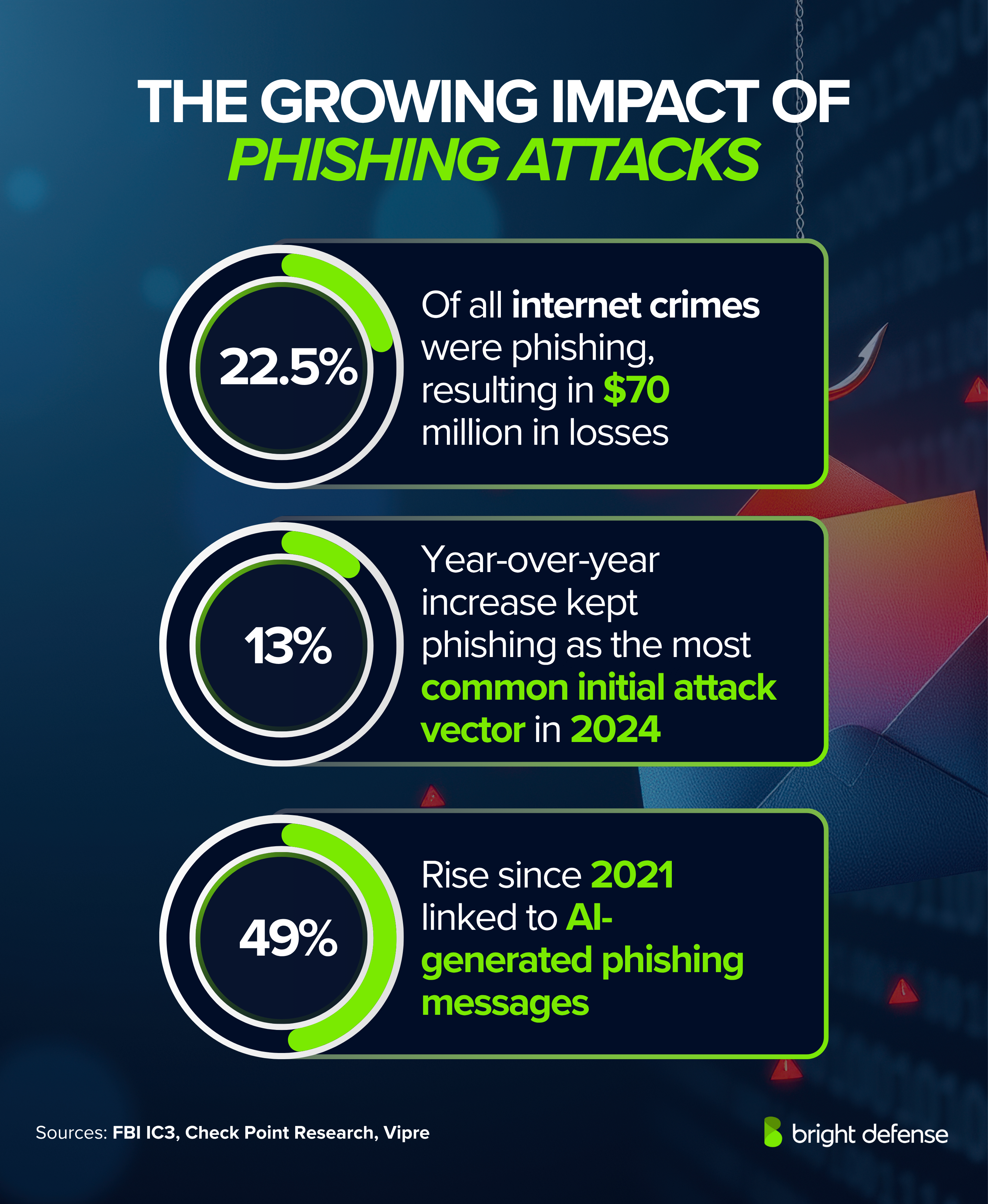
Modern metrics indicate that over 70% of security professionals have observed an increase in sophisticated, highly personalized phishing emails that exhibit flawless grammar and contextually accurate corporate terminology. Generative AI allows threat actors to scrape open-source intelligence, such as social media profiles and corporate press releases, to craft hyper-targeted spear-phishing campaigns at scale. This evolution renders traditional heuristic detection and spelling-based employee awareness training largely obsolete.
4. Credential Harvesting as the Primary Objective
Modern phishing campaigns have largely shifted away from destructive malware payloads toward credential harvesting. Threat intelligence reports indicate that approximately 60% to 70% of phishing emails are designed to direct users to lookalike authentication portals to capture usernames, passwords, and multi-factor authentication (MFA) session tokens.
Capturing credentials allows attackers to access cloud environments, SaaS applications, and internal networks using legitimate accounts. This tactic, often referred to as "living off the cloud," makes unauthorized access difficult to distinguish from normal user activity. Once inside, attackers can quietly exfiltrate sensitive data, establish persistence, or deploy ransomware without triggering traditional endpoint detection and response (EDR) alerts.
5. Multi-Factor Authentication (MFA) Fatigue and Bypass Techniques
As organizations have widely adopted multi-factor authentication to protect against credential theft, attackers have adapted by deploying advanced MFA bypass techniques, including Adversary-in-the-Middle (AiTM) proxy kits and MFA fatigue attacks.
Statistics from identity security providers show that a growing percentage of successful breaches involve compromised accounts that had traditional MFA enabled. Attackers use AiTM phishing pages to intercept session cookies in real-time, allowing them to bypass the second factor entirely. Alternatively, MFA fatigue—where an attacker bombards a user's mobile device with push notifications until the frustrated user accidentally or intentionally approves the login—succeeds in compromising accounts despite strong authentication policies.
6. The Mobile Attack Surface and SMS Phishing (Smishing)
Phishing has expanded beyond desktop email clients into mobile devices through SMS (smishing) and messaging applications like WhatsApp and Signal. Enterprise mobility reports highlight that mobile users are up to three times more likely to fall for a phishing link compared to desktop users.
Mobile devices present unique vulnerabilities: screen sizes are smaller, making it difficult to inspect full URLs, and users are often on the go, reducing their vigilance. Furthermore, personal mobile devices used for work (Bring Your Own Device policies) frequently lack enterprise-grade endpoint protection, providing a clear pathway for attackers to compromise corporate credentials via mobile messaging channels.
7. Industry-Specific Targeting Variances
Not all industries face the same risk profile when it comes to social engineering. Threat intelligence data from major security vendors demonstrates that certain sectors are targeted significantly more frequently due to the value and sensitivity of the data they hold.
| Industry Sector | Primary Phishing Focus | Dominant Attack Vector |
|---|---|---|
| Healthcare | Patient records, operational disruption | Ransomware delivery via credential theft |
| Financial Services | Direct financial gain, customer data | Spear-phishing executive impersonation |
| Manufacturing | Intellectual property, supply chain | Vendor invoice fraud and BEC |
| Government | Espionage, citizen PII | Targeted spear-phishing and watering hole attacks |
Understanding these industry-specific trends allows security leaders to tailor their defensive postures and security awareness training to address the exact threat vectors most likely to impact their operations.
8. Average Dwell Time Following Phishing Compromise
The time an attacker spends undetected inside a network after a successful phishing attack—known as dwell time—remains a critical metric for organizational resilience. While automated scanning and rapid incident response have shortened dwell times in recent years, unauthorized access initiated via stolen credentials often goes unnoticed for weeks.
According to incident response telemetry, the average dwell time for credential-based breaches can exceed 20 days before discovery. Because the initial access utilizes legitimate user credentials, security information and event management (SIEM) systems may not flag the activity as malicious until data exfiltration or lateral movement occurs.
9. Click-Through Rates and Vulnerable Demographics
Despite ongoing security awareness training, human error remains a persistent factor. Phishing simulation benchmarks across enterprise environments indicate that baseline click-through rates for unannounced phishing tests typically hover between 10% and 15% before intervention.
However, statistics also prove the value of continuous education. Organizations that conduct regular, targeted phishing simulations and provide immediate contextual micro-training see their click-through rates drop below 3% over a 12-month period. This demonstrates that while human error cannot be entirely eliminated, it can be systematically mitigated through consistent behavioral conditioning.
10. The Total Cost of a Phishing-Induced Data Breach
The financial consequences of a successful phishing attack extend far beyond immediate remediation costs. According to the Cost of a Data Breach Report published annually by IBM Security and the Ponemon Institute, the global average cost of a data breach sits near $4.45 million, with breaches initiated by compromised credentials or phishing ranking among the most expensive.
This total cost calculation includes regulatory fines, legal fees, forensic investigations, customer notification costs, intellectual property loss, and long-term reputational damage. Because phishing serves as the root cause for a substantial percentage of these costly incidents, investing in robust email security gateways and proactive defense yields a high return on investment.
Frequently Asked Questions
What is the most common type of phishing attack today?
Credential harvesting remains the most common objective, where attackers use deceptive emails or messaging to lure victims into entering their login credentials on fake authentication portals. This is closely followed by Business Email Compromise (BEC) and malware delivery via malicious attachments.
How effective is employee security awareness training against modern phishing?
Traditional annual compliance training has limited effectiveness against sophisticated attacks. However, continuous, automated phishing simulations paired with contextual, immediate feedback significantly lower user click-through rates and improve threat reporting behaviors.
Can multi-factor authentication stop all phishing attacks?
No. While standard multi-factor authentication blocks basic credential stuffing, modern threat actors utilize Adversary-in-the-Middle (AiTM) proxy frameworks and MFA fatigue techniques to intercept session tokens or trick users into approving fraudulent login prompts.
Why are mobile devices more vulnerable to phishing than desktop computers?
Mobile devices offer a more constrained user interface that makes it difficult to inspect shortened URLs or anomalous domain names. Additionally, mobile users are frequently distracted, and mobile operating systems often lack the comprehensive endpoint detection tools found on corporate desktops.
What technical controls should organizations implement to mitigate phishing risks?
Organizations should deploy advanced email authentication protocols (SPF, DKIM, DMARC), implement secure email gateways with AI-based content analysis, enforce phishing-resistant multi-factor authentication (such as FIDO2/WebAuthn hardware keys), and establish clear out-of-band verification processes for financial transactions.
Next Actions for Security Leaders
Organizations reviewing these statistics should immediately audit their current email security architecture and user training methodologies. Begin by verifying that DMARC enforcement is active across all domain names to prevent spoofing. Next, transition away from push-notification MFA toward phishing-resistant authentication methods. Finally, implement continuous, data-driven security awareness programs that reflect the realities of AI-generated social engineering.