An indexed universal life insurance policy utilizing a 1-year point-to-point crediting strategy ties cash value interest growth to the performance of a major external market index, such as the S&P 500, measured over a single 12-month period. This structure offers downside protection via a 0% floor alongside participation caps or rates that determine the ultimate credited interest.
Life insurance planning often requires balancing the security of guaranteed returns with the growth potential of equity markets. Permanent life insurance products have evolved to offer cash value accumulation engines that avoid direct market exposure while still participating in broad economic upside. Among these choices, indexed universal life (IUL) insurance stands out for its flexibility and crediting methods. Within an IUL policy, policyholders can select various crediting accounts, the most ubiquitous of which is the 1-year indexed account. Understanding how this specific mechanism operates, how interest is calculated, and what limitations apply is essential for anyone evaluating permanent coverage for wealth accumulation or estate planning.
Disclaimer: This article is for informational and educational purposes only and does not constitute financial, legal, or tax advice. Permanent life insurance products are complex financial instruments subject to underwriting, fees, surrender charges, and policy changes. Individuals should consult with a licensed financial professional and tax advisor before purchasing or modifying any insurance contract.
Foundational Mechanics of Indexed Universal Life Insurance
Indexed universal life insurance is a form of permanent life insurance. Unlike term life insurance, which provides a death benefit for a specified period and builds no cash value, permanent insurance remains active for the insured's entire life—provided sufficient premiums are paid—and features a cash value component.
In an IUL policy, premium payments are split after administrative and cost-of-insurance (COI) deductions. The remaining balance enters the policy's cash value account. Policyholders can choose to allocate this cash value to a fixed account, which earns a guaranteed minimum interest rate set by the insurer, or to one or more indexed accounts.
An indexed account does not invest directly in the stock market or purchase shares of underlying companies. Instead, the insurance company uses the performance of a market index as a benchmark to calculate interest credited to the cash value. If the index rises, interest is credited to the account based on specific policy parameters. If the index falls, the account typically receives a 0% return, protecting the principal from market losses.
Defining the 1-Year Indexed Account
The 1-year indexed account is the standard crediting duration found across almost all IUL platforms. In this structure, the measurement period for index performance spans exactly twelve months.
When funds are allocated to a 1-year indexed account, a specific segment or "bucket" is created. The starting value of the index is recorded at the beginning of that segment (the index point). Twelve months later, the ending value of the index is recorded. The insurer calculates the percentage change between these two points to determine the raw index return.
Because multiple monthly or daily allocations can occur over a calendar year, insurers often establish multiple 1-year segments within the same policy. For example, a premium paid in January opens a 1-year segment running from January to January, while a premium paid in July opens a segment running from July to July. Each segment operates independently regarding how interest is ultimately calculated and credited at the end of its 1-year term.
Key Design Parameters of 1-Year Crediting Strategies
The interest credited to a 1-year indexed account is rarely equal to the raw percentage gain of the underlying index. Insurers manage their risk and maintain policy solvency through several regulatory-compliant control mechanisms. Understanding these parameters is vital for analyzing historical or projected policy performance.
Caps, Participation Rates, and Spreads
Insurers apply limits to the amount of interest they will credit during a positive market year. These limits generally take one of three forms:
- Cap Rate: The maximum interest rate the insurer will credit to the account, regardless of how high the index climbs. If the index gains 18% over the 1-year period and the policy cap is 8%, the account is credited 8% (subject to participation rates). Caps can be adjusted by the insurance carrier annually, subject to guaranteed minimum caps stated in the contract.
- Participation Rate: The percentage of the index's gain that the policyholder receives. If a 1-year segment has a 100% participation rate, the account captures the full index gain up to the cap. If the participation rate is 80% and the index gains 10%, the credited rate is 8%.
- Spread/Asset Fee: A specific percentage subtracted from the index gain. For example, if the index gains 10% and the spread is 3%, the net credited rate is 7%.
The Floor and Downside Protection
The primary consumer appeal of the 1-year indexed account is the floor, which is typically set at 0%. When the underlying index experiences a negative return over the 12-month period—such as a 12% drop in a bear market—the raw return is overridden by the floor. The policy cash value does not decrease due to market performance. Instead, it receives a 0% return for that segment, though internal policy fees, insurance costs, and administrative expenses continue to be deducted from the cash value.
| Parameter | Function in a 1-Year Account | Typical Range / Behavior |
|---|---|---|
| Duration | Measures index change over a strict 12-month window. | Exactly 1 year per segment. |
| Floor | Protects cash value from negative market downturns. | Usually guaranteed at 0%. |
| Cap | Limits the maximum interest credited in strong market years. | Varies by carrier (historically 6% to 10%+). |
| Participation Rate | Determines what fraction of the index gain is credited. | Often 80% to 100%+. |
| Reset Feature | Locks in gains annually; previous losses or gains do not reset the base. | Applied at the end of each 12-month term. |
Mechanics of Annual Reset and Point-to-Point Calculation
A defining feature of the 1-year indexed account is the annual reset mechanism. This process separates IUL accounts from traditional long-term investments or structured products.
At the conclusion of the 12-month segment, any interest earned is credited directly to the cash value. Once credited, those gains are locked in. Even if a subsequent 1-year segment experiences a severe market downturn resulting in a 0% floor return, the previously locked-in gains are not lost (barring ongoing internal fee erosion).
Furthermore, the starting point for the next 1-year segment resets to the new, lower index value following a market dip. This means the policyholder benefits from market recoveries without having to "earn back" previous losses just to get back to even, unlike traditional equity portfolios that must recover from a peak-to-trough decline before making net new progress.
Point-to-Point Calculation Example
To visualize a standard 1-year point-to-point calculation:
- Start Date: January 1, 2026. Index value (e.g., S&P 500) is 5,000.
- End Date: December 31, 2026. Index value is 5,500.
- Raw Index Return: $(5,500 - 5,000) / 5,000 = 10%$.
- Policy Constraints: Cap is 8%, Floor is 0%, Participation Rate is 100%.
- Result: Because the raw return (10%) exceeds the cap (8%), the account is credited with the maximum cap rate of 8%.
If the index had dropped to 4,500 on December 31, 2026, the raw return would be $-10%$. Due to the 0% floor, the credited rate would be 0%, shielding the principal from the decline.
Strategic Advantages of 1-Year Indexed Accounts
When incorporated into a well-structured financial plan, 1-year indexed accounts offer several distinct benefits for conservative growth and supplemental retirement income planning.
Principal Protection and Volatility Mitigation
The elimination of negative index years from the cash value trajectory reduces sequence-of-returns risk. For individuals approaching or in retirement, avoiding large drawdowns in cash value prevents the permanent impairment of capital that can plague traditional equity-heavy portfolios during market corrections.
Tax Advantages of Life Insurance Cash Value
Cash value growth within a life insurance policy grows on a tax-deferred basis. Under current United States tax law (Internal Revenue Code Section 7702), policyholders can access this cash value via tax-free policy loans and withdrawals, provided the policy remains in force and does not become a Modified Endowment Contract (MEC). This tax-free liquidity stream makes IUL attractive for supplementing retirement income alongside taxable accounts or Roth IRAs.
Flexibility in Premium and Death Benefit Design
Indexed universal life policies allow policyholders to adjust premium payment amounts and frequencies within certain contractual limits. If cash flow tightens, a policyholder can temporarily reduce premiums, relying on accumulated cash value to cover internal costs, provided the net cash surrender value remains positive.
Structural Limitations and Risks
Despite their benefits, 1-year indexed account life insurance policies carry notable complexities and risks that require careful management by both agents and policyholders.
Carrier Discretion Over Caps and Spreads
Insurance companies retain the contractual right to change caps, participation rates, and spreads annually, subject to guaranteed minimum floors stated in the contract. If macroeconomic conditions shift—such as sustained low interest rates or high market volatility—carriers frequently lower caps. A policy that illustrated robust growth based on historical 8% caps could see those caps drop to 5% or 6% in subsequent years, dampening long-term accumulation.
Internal Fees and Cost of Insurance Increases
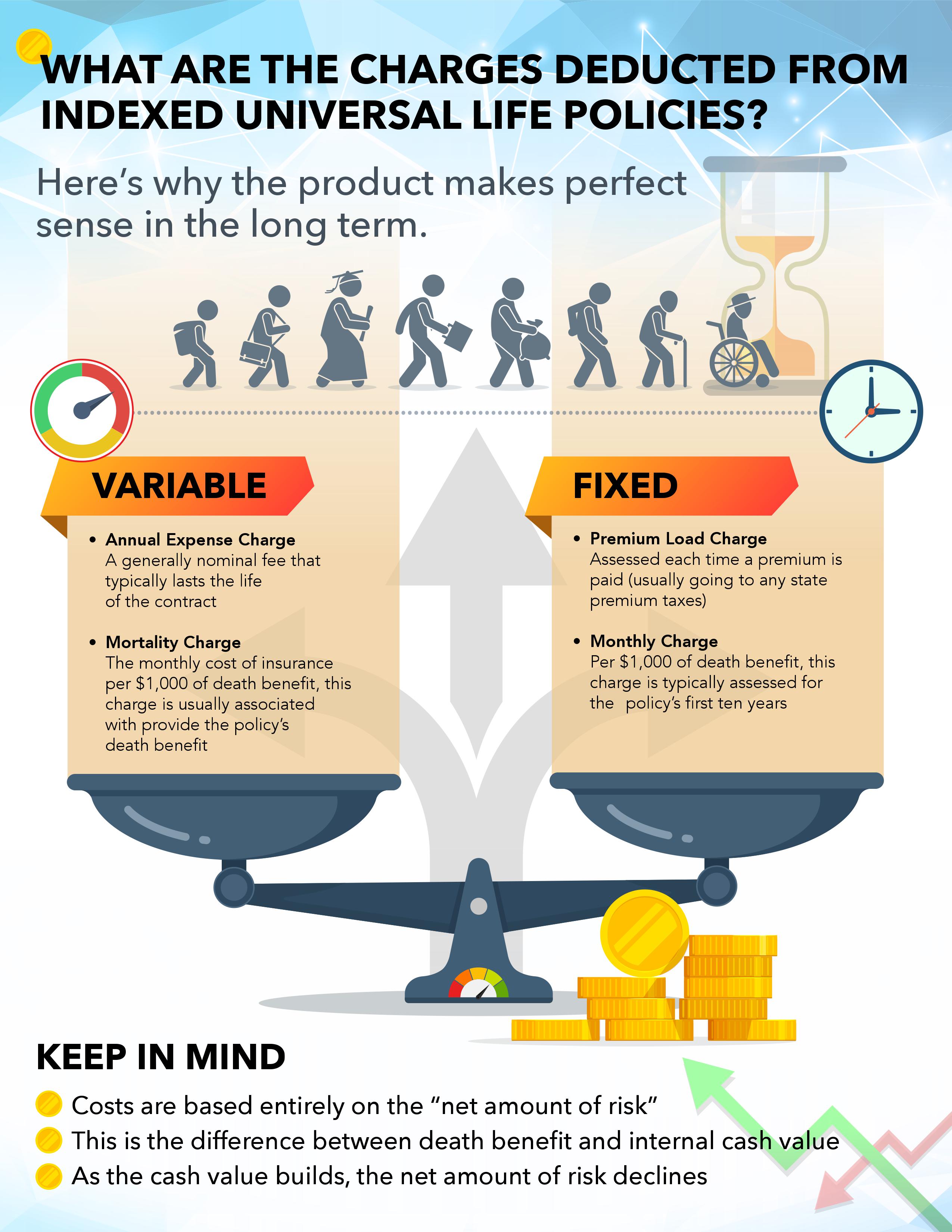
The cash value of an IUL policy is subject to numerous internal deductions. These include administrative fees, monthly per-unit charges, premium taxes, and—most significantly—the cost of insurance, which increases annually as the insured ages. If index returns hit the 0% floor repeatedly, internal fees continue to be deducted, which can erode the principal balance and potentially cause the policy to lapse if premium funding is insufficient.
The Risk of Policy Lapse
Because internal costs rise with age, an IUL policy requires active monitoring. If a policyholder underfunds the contract, relies too heavily on optimistic interest assumptions, or takes excessive policy loans without managing the loan balance, the policy can enter a lapse state. Reinstating a lapsed permanent policy or securing new coverage at an older age can be cost-prohibitive or impossible due to health changes.
Evaluating Suitability: Who Is This Product For?
Indexed universal life insurance with a 1-year indexed account is not a universal solution. It is a specialized financial instrument best suited for specific consumer profiles.
- High Earners Maximizing Traditional Accounts: Individuals who have already maximized contributions to qualified retirement plans (such as 401(k)s, IRAs, and health savings accounts) and seek an additional vehicle for tax-advantaged accumulation.
- Risk-Averse Accumulators: Investors who want exposure to equity market upside but have a low tolerance for direct stock market volatility or drawdowns.
- Estate and Legacy Planners: Individuals who prioritize leaving a tax-free death benefit to heirs while maintaining access to living benefits through cash value accumulation.
Conversely, individuals seeking short-term investment vehicles, those with irregular or low cash flows who cannot sustain ongoing premium obligations, or those looking for low-cost pure insurance protection are generally better served by term life insurance or traditional mutual funds.
Frequently Asked Questions
What happens if the stock market crashes during the 1-year segment?
When the underlying index experiences a negative return over the 1-year measurement period, the policy's 0% floor activates. Your cash value does not decrease due to market performance. However, internal policy fees and the cost of insurance are still deducted from the account balance at their scheduled intervals.
Can the insurance company change my cap rate after I buy the policy?
Yes. Insurance carriers generally reserve the right to adjust caps, participation rates, and spreads annually. While policies include contractual guaranteed minimum caps, prevailing market conditions, bond yields, and hedging costs influence how carriers set these rates year over year.
Are the gains in a 1-year indexed account taxed annually?
No. Interest credited to the cash value of a life insurance policy grows on a tax-deferred basis. You do not report or pay income tax on the credited interest annually, provided the policy maintains its status as life insurance under federal tax guidelines.
What is the difference between a 1-year point-to-point and a multi-year crediting strategy?
A 1-year point-to-point strategy measures index performance over a single 12-month cycle, resetting annually. Multi-year strategies—such as 2-year or 5-year accounts—lock in the measurement period over a longer horizon. Multi-year accounts sometimes offer higher caps or participation rates in exchange for locking up the allocation for a longer duration without annual resets.
Can I lose money in an indexed universal life insurance policy?
While your cash value cannot decline directly due to a negative stock market index return (thanks to the 0% floor), you can lose money or see your cash value decline if the internal fees, administrative costs, and mortality charges exceed the interest credited to the policy. Underfunding the policy or failing to pay required premiums can lead to policy lapse.
Next Actions and Professional Guidance
Evaluating a 1-year indexed account life insurance policy requires analyzing hypothetical policy illustrations, understanding carrier financial strength ratings, and reviewing the underlying fee structures. Because these products involve complex actuarial math and long-term commitments, request a full point-in-time policy illustration based on conservative, non-guaranteed interest rates rather than peak historical averages. Consult with an independent, licensed insurance broker or fiduciary financial planner to verify that the policy aligns with your broader estate, retirement, and cash-flow goals.