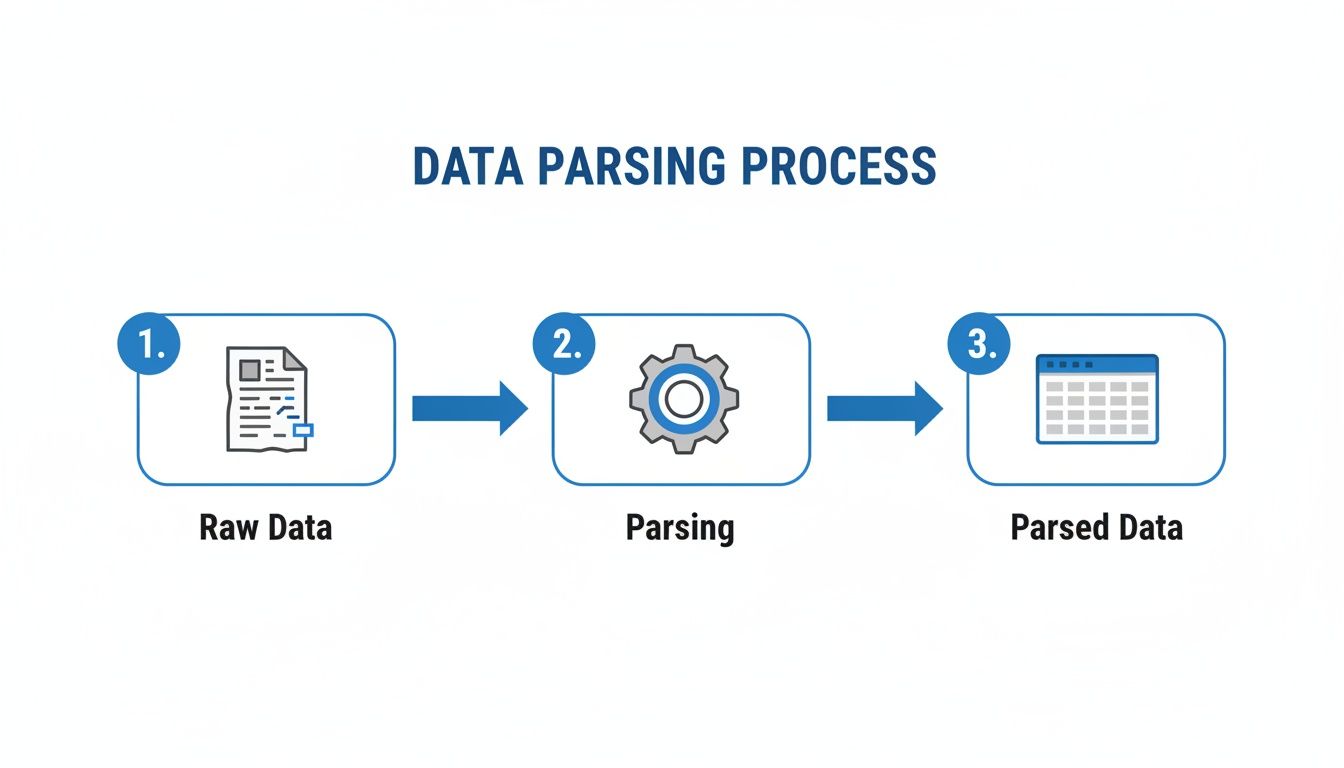
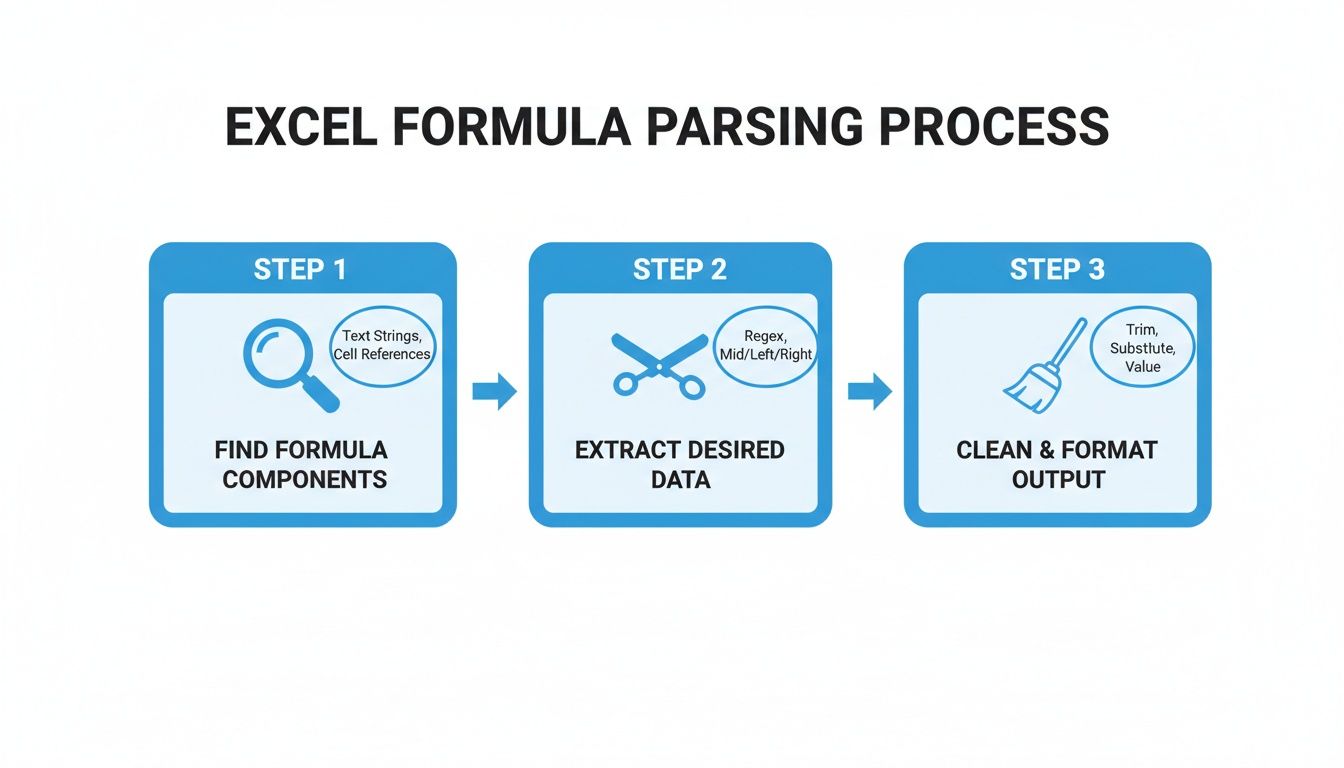
Data parsing is the fundamental computational process of converting a stream of sequential characters or unstructured text into a structured, machine-readable format that downstream applications can easily query, manipulate, and analyze. By dissecting inputs based on a specific set of grammatical rules or syntactic structures, data processing pipelines transform raw strings—such as log files, application payloads, configurations, and network telemetry—into reliable data objects like JSON trees, relational tables, or Abstract Syntax Trees.
The Core Concept of Parsing in Data Processing
At its foundational level, parsing bridges the gap between human-readable text and computer-executable structures. When an application receives raw data, it typically arrives as an unformatted byte stream or a continuous string of characters. Without structural boundaries, a computer cannot distinguish between a data field, a delimiter, or a literal string value. Parsing applies a defined grammar or schema to segment this continuous input into discrete tokens, analyze their relationships, and assemble them into a hierarchical tree or structured record.
This transformation pipeline generally consists of two primary phases: lexical analysis (tokenization) and syntactic analysis (parsing proper). During tokenization, a lexical analyzer scans the raw input character by character, grouping them into meaningful atomic units called tokens, such as keywords, identifiers, symbols, and literals. During the syntactic analysis phase, a parser consumes these tokens, checks them against the formal grammar of the data format, and constructs a hierarchical representation that preserves the logical context of the data.
- Raw Text/Log (Unstructured)
- Tokenization (Lexical Analysis)
- Syntactic Parser (Grammar Check)
- Structured Object (JSON/DOM Tree)
Why Data Parsing Matters
Modern software systems interact with hundreds of disparate data formats, ranging from standardized protocols like JSON, XML, and YAML to custom proprietary log configurations. Without robust parsers, applications would be unable to ingest configuration files, process web API payloads, execute database queries, or compile source code. Effective parsing ensures data integrity, prevents injection vulnerabilities, and lays the groundwork for clean, reliable data analytics.
Taxonomy of Parsers and Data Formats
Different types of data require different parsing strategies. Choosing the correct parser depends heavily on the structure of the input data, performance requirements, and memory constraints.
1. Document Object Model (DOM) Parsers
DOM parsers read an entire document into memory and build a complete, hierarchical tree structure. This approach allows developers to traverse the data in any direction, modify nodes, and query elements dynamically. However, DOM parsers are memory-intensive and can cause performance bottlenecks or out-of-memory errors when processing exceptionally large files.
2. Simple API for XML (SAX) and Streaming Parsers
Streaming parsers process data sequentially, reading the input stream chunk by chunk without loading the entire file into memory. As the parser encounters specific elements, it triggers callback functions or yields events (e.g., "start element," "end element," "character data"). This makes streaming parsers highly efficient for large data processing tasks, though they lack the random-access capabilities of DOM parsers.
3. Regular Expression (Regex) Parsers
For semi-structured or unstructured text—such as legacy log files or custom text reports—regular expression engines are frequently used to extract specific patterns. While regex is powerful and flexible for simple extractions, it struggles with deeply nested or context-sensitive grammars and can become difficult to maintain as data schemas evolve.
Detailed Data Processing Parse Examples
To fully understand how parsing operates in real-world data pipelines, examining concrete examples across different formats provides practical clarity. Below are detailed walkthroughs of three common parsing scenarios.
Example 1: Parsing a Semi-Structured Log File
System administrators and data engineers frequently process server log files to monitor application health and track user behavior. Consider the following raw Apache server log line:
192.168.1.50 - - [10/Mar/2026:14:32:10 +0000] "GET /api/v1/status HTTP/1.1" 200 512
To make this data queryable in a database or analytics platform, a parser must break it down into its constituent fields:
- IP Address:
192.168.1.50 - Timestamp:
10/Mar/2026:14:32:10 +0000 - HTTP Method:
GET - Request URI:
/api/v1/status - Protocol:
HTTP/1.1 - Status Code:
200 - Response Size:
512bytes
A regular expression or dedicated log parser processes this string by matching patterns—such as grouping characters enclosed in brackets [...] for the timestamp and quotes \"...\" for the HTTP request. Once extracted, the parser maps these values into a structured JSON object:
{ "client_ip": "192.168.1.50", "timestamp": "2026-03-10T14:32:10Z", "method": "GET", "endpoint": "/api/v1/status", "protocol": "HTTP/1.1", "status_code": 200, "response_bytes": 512 }
Example 2: Parsing JSON API Payloads
JSON (JavaScript Object Notation) is the ubiquitous standard for web APIs. When an application receives a nested JSON payload, the parser translates text brackets and key-value pairs into native programming language data structures (such as dictionaries, maps, or objects).
Consider this raw incoming webhook payload:
{ "event": "order.completed", "data": { "order_id": "ORD-98421", "customer": { "id": "CUST-441", "email": "alex@example.com" }, "items": [ {"sku": "WIDGET-A", "qty": 2, "price": 19.99} ], "total": 39.98 } }
The JSON parser scans the character stream, validates the syntax (ensuring quotes are closed, commas separate elements correctly, and brackets match), and constructs an in-memory tree. Downstream processing functions can then safely access nested attributes, such as extracting order["data"]["total"], without worrying about string manipulation errors.
Example 3: Parsing Custom Configuration Files (INI/YAML)
Applications frequently rely on configuration files to initialize operational parameters. YAML parsers, for instance, rely heavily on indentation and whitespace to determine hierarchical relationships.
server: host: 0.0.0.0 port: 8080 database: connection_pool: 20 timeout_ms: 5000
An indentation-sensitive parser evaluates leading spaces to determine parent-child relationships. It converts this block into a structured configuration dictionary, allowing the application to execute config['database']['timeout_ms'] reliably at startup.
Comparison of Common Parsing Approaches
| Parsing Method | Primary Use Case | Memory Efficiency | Speed | Flexibility |
|---|---|---|---|---|
| DOM Parser | Small-to-medium JSON/XML documents requiring random access | Low (loads entire tree) | Moderate | High (allows traversal and mutation) |
| Streaming/SAX | Gigabyte-scale XML or JSON log ingestion | High (processes chunk-by-chunk) | Fast | Low (unidirectional, event-driven) |
| Regex / String Split | Flat files, CSVs, simple log lines | High | Very Fast | Low (breaks on schema changes) |
| Grammar-Based Parsers | Compilers, domain-specific languages (DSLs) | Moderate | Moderate | Extremely High |
Prerequisites and Operational Requirements
Before implementing a data parsing pipeline in a production environment, engineers must establish clear technical prerequisites to ensure stability, security, and performance.
1. Schema Definition and Validation
Parsing without a defined schema invites runtime errors. Whether using JSON Schema, XML Schema Definition (XSD), or strict database typing, engineers must establish explicit rules defining expected data types, mandatory fields, and boundary values. Validating incoming data immediately after parsing prevents malformed payloads from corrupting downstream databases.
2. Character Encoding Standardization
Mismatched character encodings are a primary source of parsing failures. Modern data pipelines should enforce UTF-8 encoding universally. Ingesting files encoded in legacy formats like ISO-8859-1 without explicit conversion headers will cause tokenizers to misinterpret byte sequences, resulting in corrupted strings or syntax exceptions.
3. Error Handling and Dead-Letter Queues
Real-world data is inherently messy. Network glitches, truncated files, and unexpected user inputs will inevitably cause parser exceptions. Production data pipelines must incorporate robust error-handling mechanisms, such as:
- Graceful Degradation: Skipping corrupted records while logging the error and continuing batch processing.
- Dead-Letter Queues (DLQ): Diverting unparseable payloads to a secondary storage bucket for manual inspection and debugging without crashing the primary processing pipeline.
Common Parsing Mistakes and Troubleshooting
Even experienced developers encounter subtle pitfalls when designing data parsing workflows. Anticipating these issues minimizes debugging time.
Ignoring Memory Limits with Large Files
- The Mistake: Using a DOM-based JSON parser to ingest a 10GB audit log file.
- The Consequence: The application exhausts available system RAM, triggering an Out-Of-Memory (OOM) crash.
- The Solution: Switch to a streaming parser or implement file chunking to process records incrementally.
Over-Reliance on Fragile Regular Expressions
- The Mistake: Using complex regular expressions to parse nested HTML or deeply recursive JSON structures.
- The Consequence: Regex engines struggle with arbitrary nesting, leading to catastrophic backtracking, high CPU utilization, and missed edge cases.
- The Solution: Always use purpose-built lexical and syntactic parsers for structured formats like JSON, XML, or YAML.
Failing to Handle Escape Characters
- The Mistake: Neglecting to account for escaped quotes, backslashes, or unicode sequences within string literals.
- The Consequence: The parser prematurely terminates a string token, resulting in syntax errors or data truncation.
- The Solution: Ensure the tokenizer properly interprets escape sequences according to the format's formal specification.
Frequently Asked Questions
What is the difference between parsing and data extraction?
Parsing is the structural translation of raw text into a machine-readable format based on syntax rules. Data extraction is a broader term that often refers to pulling specific values or business intelligence from already parsed documents. Parsing is almost always a necessary precursor to effective data extraction.
Why do parsers fail on large files?
Parsers often fail on large files because traditional DOM parsers load the entire document tree into RAM. When file sizes exceed available memory, the system crashes. Utilizing streaming or incremental parsers solves this limitation by processing data in fixed-size blocks.
Can regular expressions be used for all parsing tasks?
No. While regular expressions are excellent for tokenizing flat strings and simple pattern matching, they cannot parse context-free grammars or deeply nested hierarchies reliably. Attempting to parse complex nested formats with regex alone results in brittle, unmaintainable code.
How do I handle missing fields in a parsed data stream?
Robust parsers should be paired with schema validation libraries. When an optional field is missing, the parser should assign a default null or fallback value. When a mandatory field is missing, the validation layer should flag the record as invalid and route it to an error-handling queue.
What is tokenization in the context of data processing?
Tokenization is the first phase of parsing where a continuous stream of raw characters is broken down into meaningful discrete units, known as tokens. These tokens include identifiers, keywords, operators, and literal values, which are then passed to the syntactic parser.
Practical Next Actions
To apply these principles effectively:
- Audit Existing Pipelines: Review current data ingestion scripts to identify whether memory-intensive DOM parsers are being used on large files.
- Implement Schemas: Introduce strict schema validation (such as JSON Schema) immediately following the parsing phase to catch malformed data early.
- Establish Monitoring: Set up alerts for parser exceptions and configure a dead-letter queue to capture unparseable payloads securely.