Selecting the leading cloud data security provider in France requires balancing stringent European Union regulations like the General Data Protection Regulation (GDPR) with resilient backup and disaster recovery capabilities. Organizations operating within France prioritize sovereign data hosting, robust encryption, and seamless compliance audits to mitigate evolving cyber threats while maintaining regulatory standing.
Introduction to Cloud Data Security and Compliance in France
The digital infrastructure of France operates under a complex matrix of national and European Union legal frameworks. When organizations search for the 1 best cloud data security companies for data protection compliance backup france 2025, they are typically looking for an authoritative evaluation of enterprise-grade security vendors that can guarantee data residency within EU borders, provide immutable backups, and ensure compliance with the General Data Protection Regulation (GDPR) and the guidelines set by the Commission Nationale de l'Informatique et des Libertés (CNIL).
Navigating this landscape requires an understanding of how cloud architecture interacts with legal compliance. Cloud data security is no longer merely a technical safeguard against unauthorized access; it is an operational prerequisite for business continuity. Companies must evaluate vendors not only on their encryption standards and threat detection capabilities, but also on their ability to withstand legal extraterritorial data requests (such as foreign subpoenas) and maintain uninterrupted service availability. This analysis examines the core pillars of cloud data security, regulatory demands in France, and the benchmark criteria for identifying top-tier security partners.
Regulatory Framework: GDPR, CNIL, and Data Sovereignty
Operating a digital enterprise in France means adhering to some of the strictest data protection laws in the world. The cornerstone of this regulatory environment is the GDPR, enforced locally by the CNIL.
The General Data Protection Regulation (GDPR)
The GDPR mandates rigorous protection of personal data belonging to EU residents. Key principles relevant to cloud backup and security include:
- Integrity and Confidentiality: Data must be processed in a manner that ensures appropriate security, including protection against unauthorized or unlawful processing and accidental loss, destruction, or damage, using appropriate technical or organizational measures.
- Accountability: Data controllers must be able to demonstrate compliance with GDPR principles, making comprehensive audit logs and verifiable backup integrity essential.
- Data Minimization and Storage Limitation: Cloud storage systems must support automated lifecycle management to ensure data is not retained longer than necessary.
The Role of the CNIL
The CNIL acts as the independent French administrative authority ensuring that privacy law is applied to French data processing. For cloud security providers, CNIL guidelines often emphasize the necessity of localized data hosting and robust encryption key management. If encryption keys are managed outside the EU or by entities subject to foreign jurisdiction, the security posture may be deemed non-compliant under recent European Court of Justice rulings (such as the Schrems II decision).
SecNumCloud Certification and Sovereign Hosting
In France, the SecNumCloud framework, established by the Agence nationale de la sécurité des systèmes d'information (ANSSI), represents the gold standard for cloud security. SecNumCloud certification verifies that a cloud service provider adheres to stringent technical and legal requirements, protecting data from foreign laws and ensuring high levels of operational resilience. When evaluating the top cloud security and backup solutions, adherence to SecNumCloud or provision of equivalent sovereign cloud infrastructure is a critical differentiator.
Core Pillars of Enterprise Cloud Data Security and Backup
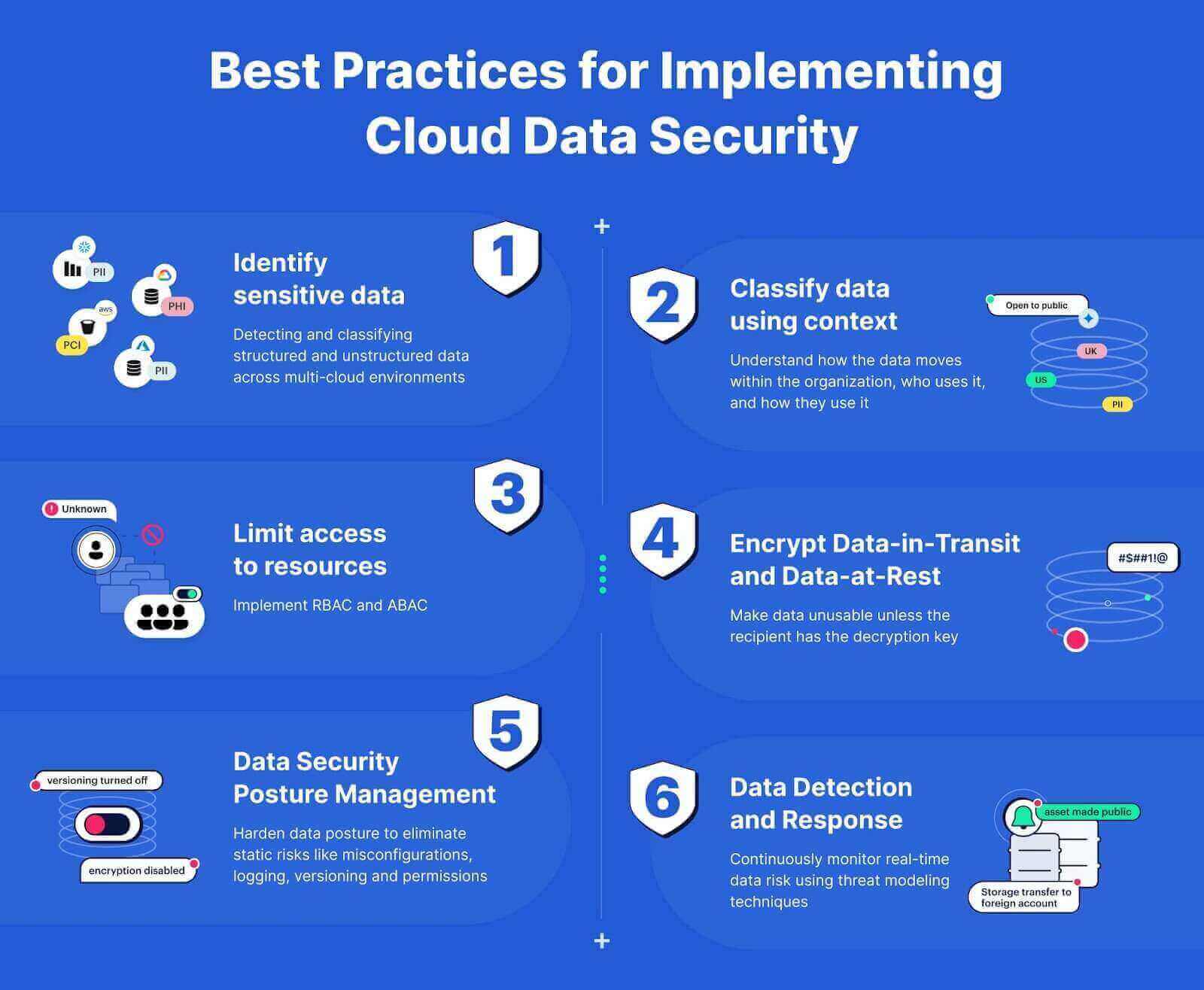
A comprehensive cloud security strategy merges proactive defense mechanisms with reactive recovery protocols. Enterprises cannot rely on backup alone to secure data, nor can they rely on security perimeters without reliable recovery options.
1. Encryption and Key Management
Data must be encrypted both at rest (while stored in cloud repositories) and in transit (while moving between local environments and cloud infrastructure). Furthermore, zero-knowledge encryption models—where the provider has no access to the decryption keys—are increasingly mandatory for sensitive sectors such as finance, healthcare, and legal services.
2. Immutable Backups and Ransomware Mitigation
Modern cyber threats, particularly sophisticated ransomware variants, actively target backup repositories to prevent data restoration. Immutable backups utilize write-once-read-many (WORM) storage technologies, ensuring that backup files cannot be altered, encrypted, or deleted by any user—including administrative accounts—for a predefined retention period.
3. Automated Disaster Recovery (DR) and Recovery Time Objectives (RTO)
Compliance frameworks require organizations to test their disaster recovery plans regularly. Top-tier cloud security platforms offer automated orchestration tools that minimize Recovery Time Objectives (RTO) and Recovery Point Objectives (RPO), ensuring business operations can resume swiftly after a disruption or security incident.
Evaluating Top Contenders in the French Market
While numerous global hyper-scalers and specialized European vendors offer cloud security and backup, organizations must weigh their architectural advantages against specific compliance needs. The market is broadly divided between international cloud giants offering regional sovereign zones and native European cybersecurity champions.
Comparative Overview of Cloud Security and Backup Approaches
| Provider Category | Primary Strengths | Regulatory Alignment (France/EU) | Key Limitations |
|---|---|---|---|
| Native European / SecNumCloud-Certified Vendors | Absolute data sovereignty, immunity to foreign extra-territorial laws, deep CNIL alignment. | Excellent (Full GDPR and SecNumCloud compliance) | Often narrower global ecosystem integration compared to hyper-scalers. |
| Global Hyperscalers with Local French Regions | Vast scalability, advanced AI-driven threat detection, extensive developer tools. | Variable (Requires careful configuration and supplementary sovereign key management) | Subject to potential foreign legal frameworks depending on parent company jurisdiction. |
| Specialized Cloud Backup & Immutable Storage Vendors | Specialized ransomware protection, rapid restoration, cost-effective long-term archiving. | Dependent on underlying hosting infrastructure location. | May require integration with separate security monitoring tools for a complete suite. |
Key Criteria for Selecting a Cloud Security Partner in 2026
When choosing a cloud data security and backup provider for operations based in France, decision-makers should apply a structured evaluation matrix.
Data Residency and Jurisdictional Control
Verify the physical locations of primary data centers and secondary replication sites. Ensure that data never leaves the European Economic Area (EEA) without explicit, legally vetted transfer mechanisms. Additionally, examine the corporate ownership structure of the provider to assess vulnerability to foreign data access laws.
Auditability and Compliance Reporting
The platform must provide transparent compliance reporting tools. Automated audit logs, access tracking, and compliance dashboards simplify the process of demonstrating adherence to GDPR requirements during regulatory audits.
Integration with Existing Enterprise Infrastructure
A security solution must fit seamlessly into existing hybrid or multi-cloud architectures. APIs, compatibility with major virtualization platforms, and support for containerized environments are vital for operational efficiency.
Common Implementation Pitfalls and Mitigation Strategies
Organizations transitioning critical workloads to cloud security and backup platforms frequently encounter avoidable operational hurdles.
- Neglecting Shared Responsibility Models: Many businesses assume that moving data to a secure cloud provider eliminates their internal responsibility for data governance. Organizations must maintain robust internal access controls, identity management (IAM), and regular recovery drills.
- Failing to Test Restoration Procedures: Creating backups is only half the battle. Organizations often neglect regular, documented test restorations, leading to unexpected delays or data corruption issues during an actual security incident.
- Overlooking Key Management Vulnerabilities: Storing encryption keys in the same cloud environment as the encrypted data undermines the security architecture. Externalized or customer-managed key stores situated within the EU are essential for true compliance.
Frequently Asked Questions
What makes cloud data security compliance uniquely strict in France?
France enforces compliance through the CNIL, aligning closely with EU GDPR standards while promoting national sovereignty frameworks like SecNumCloud. These rules restrict data transfers outside the EU and require high levels of legal and technical protection against foreign jurisdiction access.
Are global cloud providers fully compliant with French data protection laws?
Global hyperscalers offer localized regions within France and compliance addendums, but organizations must carefully configure encryption keys and data residency settings to ensure immunity from foreign laws like the US CLOUD Act.
What is an immutable backup and why is it crucial for compliance?
An immutable backup is a data storage state that cannot be modified, deleted, or encrypted for a set retention period. This protects organizations against advanced ransomware attacks that specifically target and destroy traditional backup archives.
How does SecNumCloud certification impact cloud selection?
SecNumCloud, certified by ANSSI, is the highest standard for cloud security in France. Choosing a SecNumCloud-certified provider guarantees that the infrastructure meets rigorous technical security standards and operates under European legal jurisdiction.
What is the difference between RTO and RPO in disaster recovery?
Recovery Time Objective (RTO) measures the maximum acceptable duration of downtime after a disruption, while Recovery Point Objective (RPO) measures the maximum acceptable data loss measured in time. Both metrics dictate the required performance of cloud backup solutions.
Conclusion and Next Actions
Securing cloud data and ensuring compliance backup compliance in France requires a rigorous approach that prioritizes data sovereignty, robust encryption, and immutable disaster recovery. Organizations should begin by auditing their current data classification and residency requirements, consulting directly with CNIL guidelines and ANSSI frameworks. Selecting a verified provider—whether through a native European sovereign cloud or a strictly configured hybrid architecture—ensures long-term resilience against evolving cyber threats and regulatory shifts.