Modern ransomware attacks have evolved from simple screen-locking trojans into sophisticated, multi-stage cyber campaigns that combine data theft, extortion, and operational disruption. Examining a typical ransomware incident reveals how threat actors infiltrate networks, bypass legacy security controls, weaponize administrative tools, and disrupt critical business functions. Understanding this tactical progression enables organizations to transition from reactive recovery to proactive resilience.
The Evolution of Ransomware: From Simple Locks to Multi-Layered Extortion
Early ransomware variants operated primarily on local endpoints. A user would inadvertently execute a malicious attachment or visit a compromised website, prompting the malware to encrypt local files and demand a cryptocurrency payment for the decryption key. While disruptive for individuals, these attacks rarely crippled enterprise operations unless critical local backups were missing.
Over the past decade, the threat landscape shifted dramatically. Modern ransomware operations are predominantly orchestrated by organized cybercriminal syndicates utilizing a business model known as Ransomware-as-a-Service (RaaS). In this ecosystem, core developers build sophisticated encryption software and management panels, while specialized affiliates—often referred to as initial access brokers—handle the infiltration phase.
Furthermore, modern attacks rarely rely solely on encryption. Threat actors recognized that organizations with robust backup and recovery solutions could simply restore their systems without paying a ransom. To counter this, attackers introduced multi-layered extortion tactics:
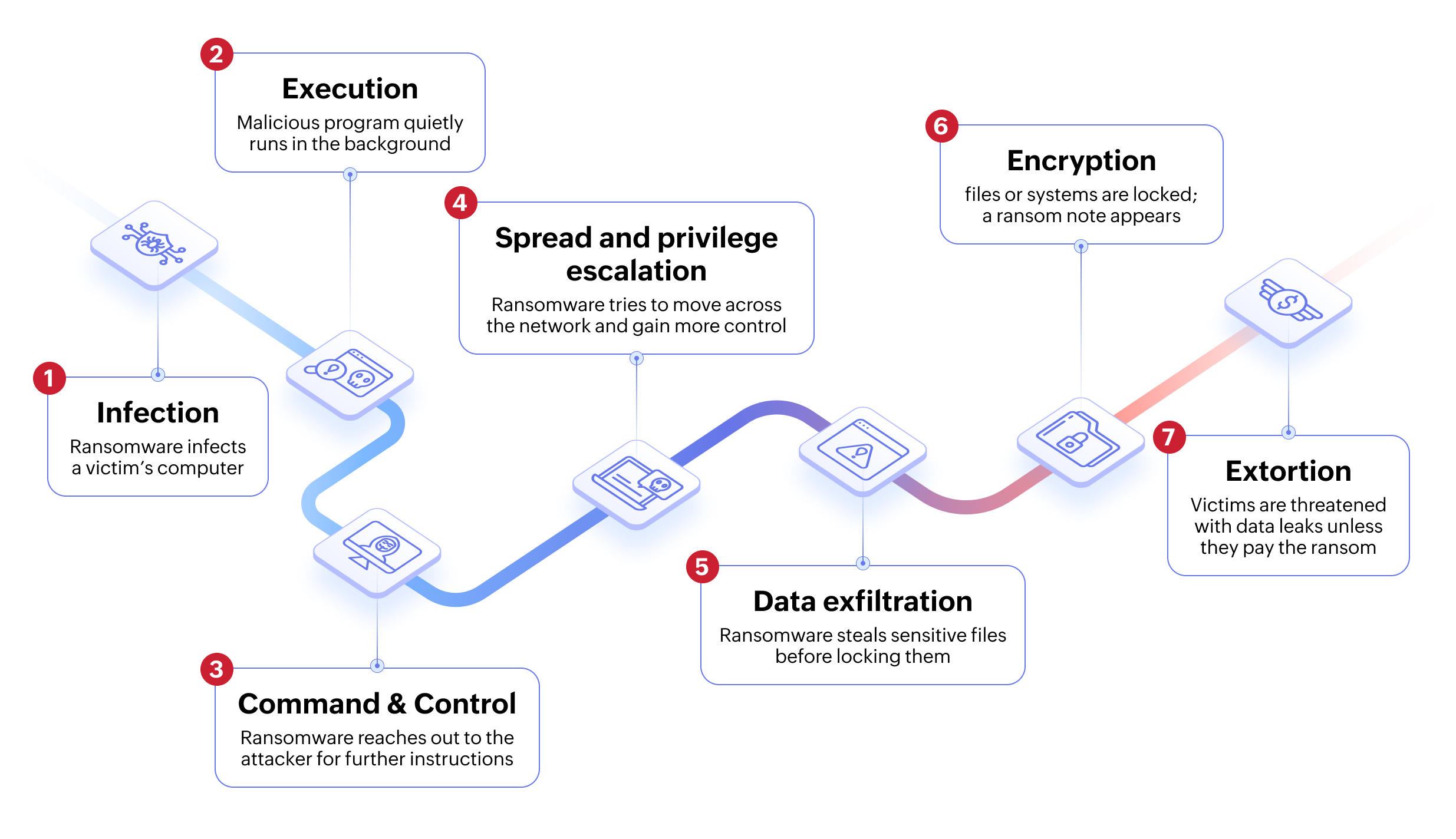
- Exfiltration Extortion: Threat actors steal sensitive corporate data, proprietary source code, or personally identifiable information (PII) before deploying encryption, threatening to leak it publicly if the ransom is unpaid.
- Distributed Denial of Service (DDoS): Attackers bombard the victim's external web properties or customer portals with traffic to compound the operational pressure.
- Third-Party Harassment: Cybercriminals directly contact clients, partners, or media outlets to announce that the victim's network has been breached, forcing internal panic.
Anatomy of a Modern Ransomware Incident
To understand how these campaigns unfold in practice, security analysts trace attacks through structured frameworks such as the MITRE ATT&CK matrix. A standard modern ransomware campaign follows a predictable lifecycle from initial compromise to final payload execution.
- Initial Access
- Execution & Persistence
- Privilege Escalation
- Lateral Movement
- Impact & Extortion
Initial Access and Execution
Threat actors typically gain entry into a corporate network through a limited number of vectors:
- Compromised Credentials: Stolen usernames and passwords acquired via infostealer malware, credential stuffing, or phishing campaigns.
- Exposed Remote Access Services: Vulnerable Remote Desktop Protocol (RDP) servers, VPN endpoints, or unpatched edge devices facing the public internet.
- Software Vulnerabilities: Exploitation of unpatched zero-day or known vulnerabilities in enterprise firewalls, email servers, or file transfer applications.
Once inside, attackers execute initial payloads, often utilizing legitimate administrative tools already present in the environment—a technique known as "living off the land." This minimizes the noise generated by custom malware and evades signature-based detection mechanisms.
Reconnaissance and Privilege Escalation
After establishing a foothold, the threat actor moves horizontally and vertically to map the network. They search for Active Directory configurations, domain controllers, backup servers, and cloud storage repositories. Using tools like Mimikatz or built-in Windows utilities, attackers dump memory credentials to escalate privileges, eventually capturing Domain Administrator credentials. This grants them unfettered control over the entire enterprise network.
Evasion of Defenses and Backup Destruction
Before initiating encryption, attackers systematically disable or uninstall endpoint detection and response (EDR) agents, antivirus software, and local monitoring tools. Crucially, they target corporate backups. Attackers delete Volume Shadow Copies (VSS) via command-line utilities, compromise network-attached storage (NAS) devices, and alter cloud backup configurations to ensure the victim has no rapid recovery pathway.
Payload Deployment
With defenses neutralized and backups destroyed, the ransomware payload—often packed into a custom script or distributed via Group Policy Objects (GPO)—is deployed simultaneously across thousands of endpoints and servers. The ransomware utilizes robust cryptographic algorithms, such as a combination of AES and RSA, to lock critical files, appending custom extensions to the affected assets and dropping ransom notes in every directory.
Comparative Overview of Ransomware Tactics
The shift in threat actor methodology requires security professionals to understand how traditional and modern attacks differ across critical vectors.
| Vector | Traditional Ransomware (Pre-2018) | Modern Ransomware Attacks (Current) |
|---|---|---|
| Primary Goal | Local file encryption and immediate ransom | Data theft, systemic paralysis, and multi-stage extortion |
| Infection Scope | Single endpoints or unsegmented local drives | Entire enterprise networks, cloud assets, and subsidiaries |
| Entry Point | Malicious email attachments and drive-by downloads | Stolen credentials, exposed RDP/VPNs, and software exploits |
| Dwell Time | Minutes to hours | Days, weeks, or months of stealthy lateral movement |
| Extortion Method | Pay for the key to unlock files | Pay to prevent data leaks, DDoS attacks, and public shaming |
Key Technical Indicators and Vulnerabilities
Analyzing actual incidents highlights specific technical weaknesses that organizations frequently overlook. Threat actors capitalize on systemic gaps in network hygiene and identity management.
Identity and Access Management Gaps
The absence of mandatory multi-factor authentication (MFA) across all user accounts—particularly for remote access, virtual private networks (VPNs), and cloud management consoles—remains a primary catalyst for modern breaches. Furthermore, excessive user permissions allow attackers who compromise a single standard employee account to escalate privileges rapidly.
Patch Management Deficiencies
Organizations often struggle to maintain visibility over external-facing assets. When a critical vulnerability is disclosed in software like enterprise VPN gateways or collaboration platforms, the window between public disclosure and active exploitation by ransomware affiliates can be measured in hours. Failing to apply patches promptly provides an open door for automated exploit frameworks.
Network Segmentation Failures
Flat enterprise networks—where corporate IT systems, industrial control systems, and guest Wi-Fi share the same internal routing architecture—allow attackers to move effortlessly from an initial phishing victim to core financial or operational databases. Effective segmentation limits the blast radius of a breach, containing the threat before it achieves enterprise-wide encryption.
Mitigation Strategies and Defensive Frameworks
Defending against sophisticated ransomware campaigns requires a defense-in-depth strategy that addresses every phase of the attack lifecycle. Organizations must implement robust technical controls aligned with established frameworks such as the National Institute of Standards and Technology (NIST) Cybersecurity Framework.
Strengthening Identity and Access Controls
- Enforce phishing-resistant multi-factor authentication (MFA), such as FIDO2-compliant hardware keys, across all corporate portals and administrative logins.
- Implement the principle of least privilege, ensuring employees and service accounts possess only the permissions strictly necessary to perform their roles.
- Regularly audit Active Directory and Azure AD environments for stale accounts, unconstrained delegation, and misconfigured access control lists (ACLs).
Implementing Immutable and Isolated Backups
To defeat modern extortion tactics, backups must be protected from administrative deletion:
- Maintain offline or immutable backups (write-once, read-many) that cannot be altered or deleted by any user account, even with administrative privileges.
- Test restoration procedures frequently to verify that data can be recovered within acceptable Recovery Time Objectives (RTO) and Recovery Point Objectives (RPO).
- Segment backup infrastructure physically or logically from the primary production network.
Proactive Detection and Response
- Deploy modern Extended Detection and Response (EDR) solutions that monitor behavioral anomalies rather than relying solely on static file signatures.
- Establish 24/7 security monitoring through an internal Security Operations Center (SOC) or a managed detection and response (MDR) provider.
- Conduct regular internal and external vulnerability assessments alongside adversarial simulation exercises (penetration testing and red teaming).
Frequently Asked Questions
What makes modern ransomware attacks different from older malware?
Modern ransomware attacks prioritize stealth, lateral movement, and data theft over immediate encryption. Threat actors spend weeks inside a network mapping infrastructure, disabling backups, and stealing sensitive data before deploying the ransomware payload, utilizing multi-layered extortion to pressure victims into paying.
Should organizations pay the ransom during an attack?
Law enforcement agencies, including the FBI, strongly advise against paying ransoms. Payment does not guarantee that data will be decrypted or that stolen information will not be leaked or resold. Furthermore, payments often fund criminal enterprises and may violate legal sanctions depending on the threat group involved.
How do attackers typically gain initial access to a corporate network?
Initial access is most commonly achieved via compromised credentials obtained through phishing or infostealer malware, exploited vulnerabilities in public-facing edge devices like VPNs and firewalls, and misconfigured remote desktop services.
What is the 3-2-1 backup rule, and is it still sufficient?
The 3-2-1 rule dictates maintaining three copies of data across two different media types, with one copy stored offsite. While foundational, modern attacks require this rule to be upgraded to include immutability—ensuring backup data cannot be modified or deleted by network-connected management tools.
What is "living off the land" in the context of cyberattacks?
"Living off the land" refers to threat actors utilizing legitimate administrative tools, scripting languages, and utilities already installed on the victim's operating system (such as PowerShell, WMI, or remote management utilities) to execute malicious actions, making their activity difficult to distinguish from normal administrative work.
Next Actions and Operational Recommendations
Organizations seeking to evaluate their security posture against modern ransomware threats should begin by conducting a comprehensive inventory of all external-facing assets, remote access points, and cloud service integrations. Verify that multi-factor authentication is universally enforced without exceptions for legacy protocols. Next, audit existing backup repositories to confirm the existence of offline, immutable copies and schedule a complete data restoration drill. Engaging an independent third party to perform a rigorous penetration test can further uncover hidden vulnerabilities before they are exploited by real-world threat actors.