Selecting the right gear from an ATV accessories store requires matching equipment to your vehicle's specific make, model, and intended use—whether for agricultural utility, technical trail riding, or winter snow clearance. Key upgrades include recovery winches, protective skid plates, specialized tires, and auxiliary lighting. Verifying bolt patterns, electrical stator capacities, and mounting tolerances ensures seamless installation, optimal vehicle safety, and reliable performance.
Categorizing ATV Accessories: Functional Upgrades vs. Rider Comfort
Outfitting an all-terrain vehicle (ATV) involves balancing mechanical enhancements, cargo utility, protective armor, and rider comfort. Navigating an ATV accessories store—whether an online catalog or a brick-and-mortar retailer—can be overwhelming due to the sheer volume of products available. Grouping accessories by their primary function helps prioritize modifications based on workload, terrain, and safety requirements.
- ATV ACCESSORY CATEGORIZATION
- RECOVERY & PROTECTION
- Winches
- Skid Plates
- Brush Guards
- UTILITY & CARGO
- Cargo Boxes
- Rack Extenders
- Hitch Receivers
- TRAIL & SEASONAL
- Mud/Sand Tires
- Snow Plows
- Windshields
- ELECTRICAL & LIGHTING
- Light Bars
- Heated Grips
- Dual Batteries
- RECOVERY & PROTECTION
Recovery and Protection Gear
Off-road environments expose the underside and bodywork of a quad to rocks, stumps, rutted mud, and steep inclines. Protective accessories safeguard critical engine components and structural frame members from severe impact damage.
- Electric Winches: Considered essential for self-recovery, a winch provides the pulling capacity needed to extract a stuck vehicle or move heavy obstacles. Winches are rated by line pull capacity, typically ranging from 2,500 lbs to 4,500 lbs for standard quads. Synthetic ropes are widely preferred over traditional steel cables due to their lightweight properties, lack of sharp fraying wires, and reduced recoil energy if a line snaps.
- Skid Plates and A-Arm Guards: Factory plastic bash plates provide minimal defense against sharp rocks and logs. Heavy-duty aftermarket skid plates made from high-density polyethylene (HDPE) or 3/16-inch aircraft-grade aluminum cover the entire belly of the machine. HDPE offers smooth sliding over obstacles without denting, while aluminum delivers maximum impact resistance in rocky terrain.
- Bumper Extensions and Brush Guards: Front and rear steel bumpers absorb collisions with brush and debris, protecting plastic fairings, radiators, and headlights. Many designs incorporate integrated mounting plates for auxiliary lights or winch fairleads.
Utility and Cargo Solutions
For agricultural work, hunting, or long-distance expeditions, factory metal racks often lack sufficient tiedown points or surface area. Expanding cargo capacity requires modular storage units designed for secure attachment.
- Composite Storage Boxes: Weatherproof rear and front trunk boxes protect tools, electronics, and extra gear from dust and moisture. High-end storage boxes feature key-lock latches, weather-stripping seals, and quick-attach mounting hardware compatible with factory rack systems.
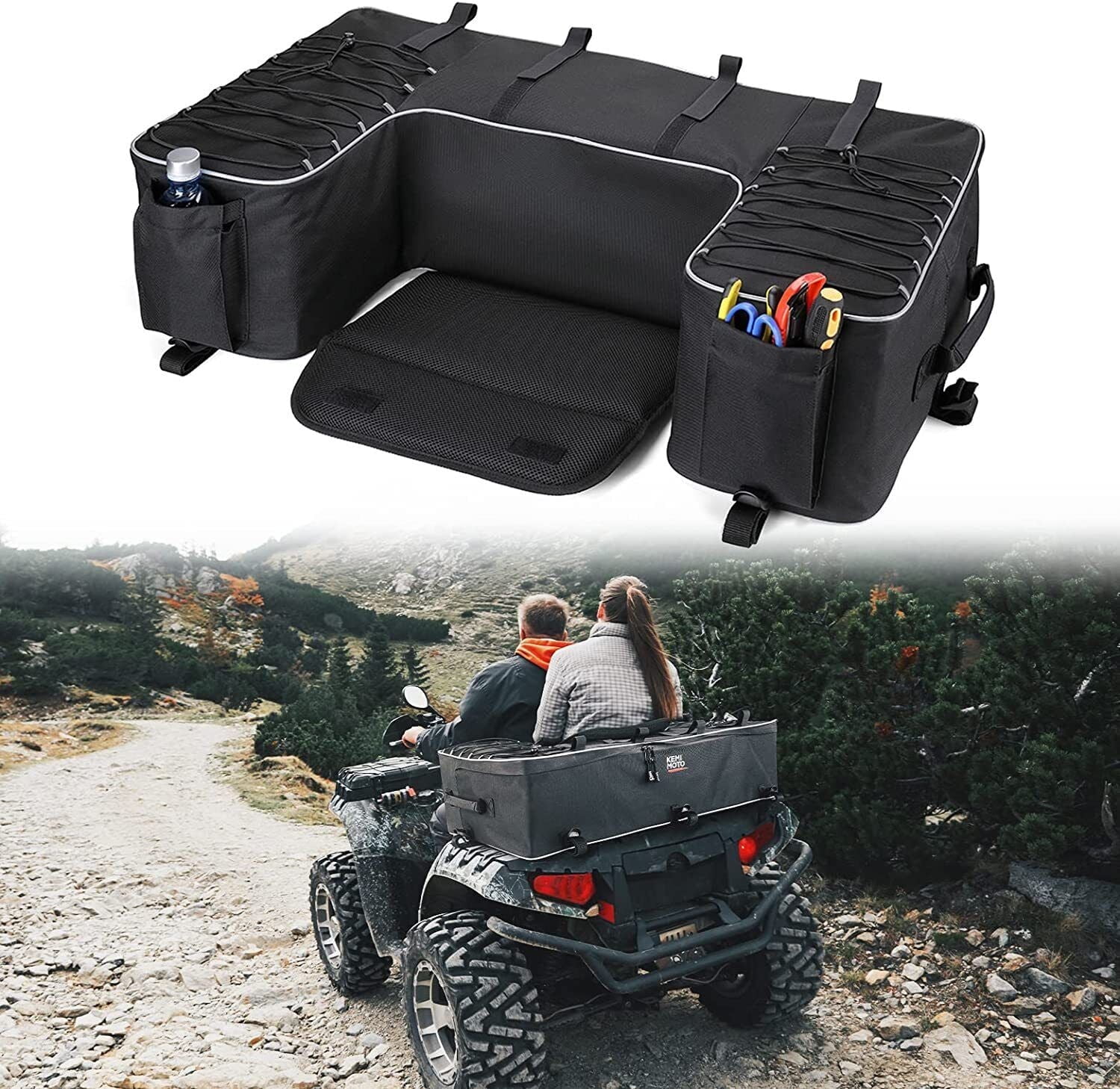
- Rack Extenders and Bags: Steel or aluminum tubular rack extenders add perimeter walls to flat factory racks, preventing gear from sliding off on steep gradients. Heavy-duty canvas or Denier nylon rack bags provide flexible storage with padded compartments.
- Tow Hitches and Implements: Converting an ATV into a workhorse requires receiver hitches (1.25-inch or 2-inch standard sizing). These accept ball mounts, dump carts, seeders, disk harrows, and log haulers used in farming and property management.
Trail and Seasonal Performance
Enhancing traction, cabin ergonomics, and seasonal capability allows riders to adapt their machines to specific environments.
- Terrain-Specific Tires: Factory tires are designed as all-around compromises. Upgrading to aggressive mud tires with deep directional lugs, hardpack radial tires with tighter tread spacing, or reinforced 8-ply desert tires significantly improves traction, steering response, and puncture resistance.
- Snow Plow Systems: Front-mounted plow blades (typically 48 to 60 inches wide) convert an ATV into a snow-clearing machine. Complete plow kits require a vehicle-specific mount plate, a push tube assembly, a steel or poly blade, and a winch to control blade elevation.
- Windshields and Handguards: Flexible polycarbonate windshields deflect wind, roost, and cold air, reducing rider fatigue. Armored handguards protect control levers and hands from branches and flying debris.
Electrical and Lighting Upgrades
Stock halogen headlights often fail to provide adequate illumination during night rides or low-visibility operations.
- LED Light Bars and Pods: Light-emitting diode (LED) lighting offers high lumen output with significantly lower power draw than traditional halogen bulbs. Spot beams project light far down straight trails, while flood beams illuminate wide peripheral areas.
- Heated Accessories: Heated handlebar grips and thumb warmers keep control hands functional in freezing temperatures. These systems draw continuous electrical power, requiring clear understanding of the vehicle's electrical output.
- Dual Battery Systems: High-draw accessories like heavy winches, stereo systems, and multiple light bars can drain a single battery quickly. Auxiliary battery kits with smart isolators prioritize the primary starting battery while running powered accessories off a secondary power source.
Evaluating ATV Accessories Stores: Retailer Options
When shopping for upgrades, choosing the right retailer impacts product selection, fitment support, warranty backing, and pricing. Buyers generally choose between original equipment manufacturer (OEM) dealerships, specialized aftermarket powersports stores, and general online marketplaces.
| Store Category | Primary Strengths | Common Drawbacks | Ideal Purchase Scenarios |
|---|---|---|---|
| OEM Dealership Stores | Guaranteed factory fitment; retains vehicle warranty compliance; exact color matching. | Higher retail prices; limited aftermarket design choices; conservative styling. | Replacement body panels, original electrical switches, factory cab enclosures, standard maintenance parts. |
| Specialized Aftermarket Outlets | Extensive brand selection; high-performance upgrades; expert technical support staff. | Fitment verification requires research; varying warranty terms per manufacturer. | Specialized tires, heavy-duty suspension, performance exhausts, custom winch mounts, skid plates. |
| General Off-Road Retailers | Competitive pricing; broad inventory range; fast consumer shipping networks. | Customer service lacks specialized technical expertise; high risk of counterfeit or generic items. | Universal accessories, basic tiedowns, cargo nets, general riding gear, cleaning supplies. |
How to Ensure Proper Product Fitment and Vehicle Compatibility
Installing incompatible parts on an ATV can result in mechanical failure, electrical overload, or physical damage during operation. Before purchasing from an ATV accessories store, verify four key technical specifications.
FITMENT VERIFICATION CHECKLIST
- WHEEL BOLT PATTERN
- Example: 4/110 or 4/137
- ELECTRICAL STATOR LOAD
- Total Wattage - Base Load
- RECEIVER & MOUNTING
- 1.25" vs. 2" Hitch & Winch Mount
1. Wheel Bolt Patterns and Offset
When ordering aftermarket wheels or wheel spacers, understanding pitch circle diameter (PCD) is critical. ATV bolt patterns are expressed as the number of lug nuts followed by the distance between opposite lugs in millimeters (e.g., 4/110, 4/137, or 4/156).
- Wheel Offset: Measured as the distance from the wheel's center mounting surface to the inner edge. An incorrect offset can cause wide mud tires to rub against tie rods, shock absorbers, or plastics, or unacceptably widen the machine's overall stance, making it illegal for width-restricted trails.
2. Electrical Stator Output and Wattage Draw
An ATV’s charging system relies on a stator that produces a finite amount of electrical current (measured in watts or amps). Small-to-midsize ATVs often produce between 300W and 500W total output at cruising RPM.
$$\text{Available Surplus Wattage} = \text{Stator Total Output} - \text{Base Engine Operations}$$
If base engine operations (ignition, fuel pump, instrument cluster, stock lights) consume 200W of a 350W system, only 150W remains for add-ons.
- A 120W LED light bar combined with 40W heated grips totals 160W, exceeding the charging system's surplus output. This results in net battery discharge during slow-speed trail riding.
- Always calculate cumulative accessory wattage before wiring multiple electronics into the stock harness.
3. Receiver Sizes and Winch Mounting Plates
Not all frame designs accept standardized accessories out of the box:
- Hitch Sizes: Smaller utility quads often feature a 1.25-inch receiver, whereas full-size adult quads feature a 2-inch receiver. Using adapter sleeves can reduce tongue weight capacity and create unwanted slop or rattling.
- Winch Mounting: Electric winches rarely bolt directly to an ATV frame without a model-specific winch mount plate. The mount plate acts as a bridge, transferring pulling force directly to the structural frame rails rather than cosmetic bumper supports.
Safety, Legal, and Environmental Standards
Modifying an ATV carries operational risks and legal obligations, particularly when riding on public forestry roads, state parks, or regulated trail networks.
Trail Compliance and Forest Service Standards
Public land management agencies enforce strict environmental rules to prevent wildfires and soil degradation.
- Spark Arrestors: The United States Forest Service (USFS) mandates that all internal combustion off-road vehicles operating on public lands be equipped with a qualified spark arrestor adhering to USDA Forest Service Standard 5100-1c. Aftermarket performance exhaust systems must include a USFS-approved spark arrestor screen to prevent hot carbon embers from escaping into dry vegetation.
- Decibel Limits: Many public trail systems enforce maximum sound pressure levels (often 96 dBA measured at a fixed distance using standard SAE J1287 sound test procedures). High-flow aftermarket mufflers that exceed local noise thresholds risk citations and trail access revocation.
- Vehicle Width Restrictions: Standard federal and state seasonal trails often enforce a maximum vehicle width (typically 50 inches for standard ATV/UTV classifications). Installing wide-offset wheels, long-travel suspension kits, or ultra-wide rack extensions can make the vehicle ineligible for narrow gated trails.
Load Ratings and Suspension Dynamics
Adding heavy accessories alters an ATV's center of gravity, braking distance, and handling characteristics.
- Gross Vehicle Weight Rating (GVWR): Every manufacturer specifies maximum weight capacities for front racks, rear racks, and towing limits. Exceeding front rack capacity with heavy snow plows or steel bumper guards can cause bottoming out, heavy steering, and premature suspension bushing wear.
- Suspension Adjustment: When mounting heavy front accessories like a plow or a 4,500 lb winch, adjust the vehicle's spring pre-load collars to stiffen the front shocks. This counteracts front-end sag and maintains proper ground clearance.
Common Mistakes When Buying ATV Accessories
Avoid these widespread purchasing and installation errors when outfitting your vehicle:
- Over-Sizing Winch Capacities without Frame Support: Installing a heavy-duty 4,500 lb winch on a lightweight 300cc quad can strain the electrical system and bend light-duty mounting brackets during maximum pulls. Stick to the standard formula: $$\text{Target Winch Pull Capacity} = \text{Vehicle Operating Weight} \times 1.5 \text{ to } 2.0$$
- Splicing Directly into Main Wiring Harnesses: Cutting and twisting accessory wires into the primary ignition harness leads to corrosion, voltage drops, and blown fuses. Always use isolated, relay-switched wiring harnesses connected directly to the battery or dedicated accessory bus bars.
- Ignoring Weight Distribution: Concentrated heavy items (such as fully loaded steel toolboxes or fuel cans) placed far behind the rear axle lighten the front tires, reducing steering traction on steep inclines and increasing roll-over risk.
- Neglecting Hardware Grade Requirements: Using low-grade (Class 4.8 or Grade 2) hardware to attach snow plows, hitches, or winch plates risks bolt shearing under shock loads. High-stress applications require minimum Grade 8 (SAE) or Class 8.8 / 10.9 (Metric) zinc-plated steel fasteners.
Frequently Asked Questions
How do I choose the correct winch size for my ATV?
Calculate your vehicle's total wet weight (including factory weight, fuel, mounted accessories, and rider). Multiply that total weight by 1.5 to 2.0. For example, a 700 lb ATV carrying 100 lbs of gear and a 200 lb rider has a operational weight of 1,000 lbs. A winch rated between 2,500 lbs and 3,500 lbs provides an adequate safety margin for stuck recoveries.
Will installing aftermarket accessories void my manufacturer warranty?
Under the U.S. Magnuson-Moss Warranty Act (and similar international consumer protection laws), a dealer cannot automatically void an entire vehicle warranty simply because aftermarket parts are installed. However, if an aftermarket accessory directly causes a mechanical or electrical failure—such as an oversized light bar destroying a stator—the manufacturer can deny coverage for that specific repair.
What is the difference between synthetic winch rope and steel cable?
Synthetic rope is significantly lighter, floats on water, does not store kinetic energy (making it safer if it breaks), and will not develop sharp wire burrs. Steel cable is more resistant to abrasive rubbing against sharp, jagged rocks and is generally less expensive, but it requires careful handling with thick leather gloves and stores dangerous whip energy under tension.
Can I run an LED light bar on my standard ATV battery?
Yes, provided the light bar's total wattage draw does not exceed your stator's surplus output. LED light bars are energy-efficient compared to halogen bulbs. However, if you run multiple high-draw accessories simultaneously (e.g., light bar, heated grips, and stereo), monitor your voltage level to ensure it stays above 12.6V while idling.
What tire size can I fit without a lift kit?
Most standard ATVs can accommodate a tire diameter 1 to 2 inches larger than the stock tire size without clearance issues or mechanical interference. Going beyond a 2-inch increase typically requires a suspension lift kit, wheel spacers, or clutch re-gearing to compensate for lost low-end torque and prevent tire rubbing against full suspension compression.
Next Steps for Outfitting Your Vehicle
To ensure a seamless upgrade process, approach your purchases with a clear plan:
- Define Primary Machine Duties: Determine whether your vehicle requires work-focused additions (plows, hitches, storage trunks) or trail-focused performance items (skid plates, upgraded tires, auxiliary lights).
- Audit Your Vehicle's Current Specs: Record your machine's exact year, make, model, displacement (cc), wheel bolt pattern, and stator wattage output. Keep these figures handy when browsing an ATV accessories store.
- Review Power and Weight Limits: Calculate total power consumption for electronic upgrades and total static weight for rack additions to ensure your vehicle stays within safe manufacturer operating parameters.
- Source Quality Components: Select reputable retailers providing verified fitment databases, clear hardware material specifications, and solid manufacturer warranties.