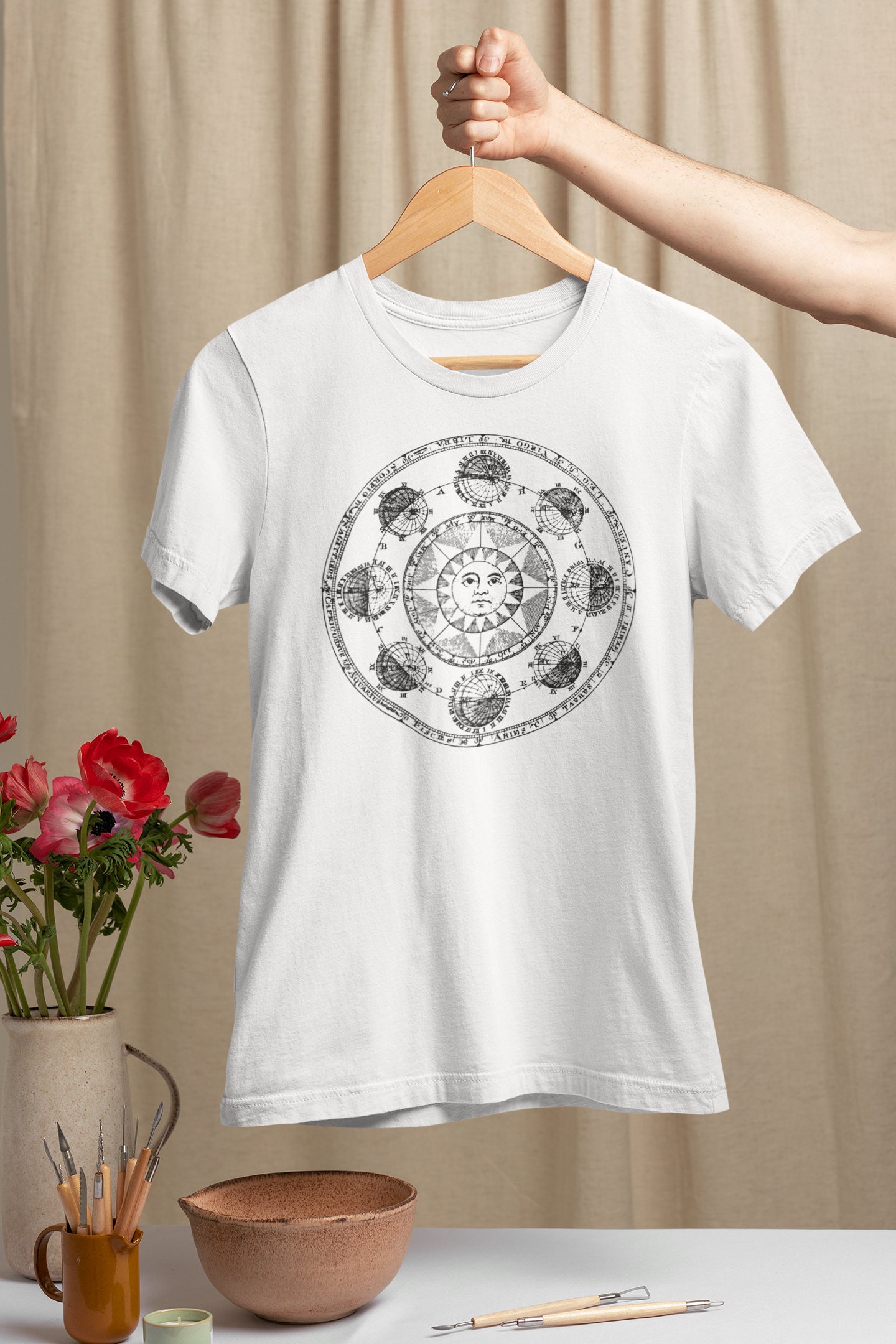
Astrology t-shirts have evolved from symbolic tools of ancient identity into powerful vehicles for modern self-expression, blending 1970s counterculture aesthetics with the data-driven "digital spirituality" of the 2020s. Today, they serve as personal branding, community markers, and high-fashion statements that allow individuals to signal their personality traits and cosmic alignments at a glance.
The Historical Roots: Astrology as a Visual Language
Before the advent of the printed t-shirt, astrology was primarily a visual language reserved for manuscripts, architectural reliefs, and high-end tapestries. For centuries, the twelve signs of the zodiac served as a universal shorthand for the passage of time and the human condition. However, the translation of these symbols onto wearable textiles for the masses required two significant developments: the invention of the screen-printed t-shirt and a massive cultural shift toward individualism.
In the early 20th century, the t-shirt was considered an undergarment. It wasn't until the 1950s and 60s that it emerged as a canvas for political and personal expression. As the "Age of Aquarius" dawned in the late 1960s, the counterculture movement embraced astrology as an alternative to traditional religious structures. The first wave of "astrology t-shirts" appeared in head shops and at music festivals, often featuring psychedelic fonts and hand-drawn illustrations of lions, crabs, and water-bearers. These garments were more than just clothing; they were badges of a burgeoning "New Age" identity that prioritized cosmic connection over societal conformity.
By the mid-1970s, the commercialization of the zodiac had begun. Major retailers realized that consumers were eager to purchase items that felt personalized. This led to the mass production of simple graphic tees featuring the name of a zodiac sign accompanied by a stylized icon. These early iterations were often rudimentary, yet they established the core appeal of astrology fashion: the ability to categorize oneself within a larger, meaningful framework.
The 1990s and Early 2000s: Minimalism and Kitsch
The evolution of the astrology t-shirt took a sharp turn during the late 1990s and early 2000s. During this era, the "Y2K" aesthetic introduced a mix of high-tech optimism and playful kitsch. Astrology shirts became ubiquitous in suburban malls, often found in stores like Claire’s or Delia's. These versions were frequently adorned with glitter, rhinestones (rhinestudding), and baby-tee silhouettes.
Technically, this period saw an advancement in textile printing. Heat transfer vinyl and improved plastisol inks allowed for more vibrant, durable graphics. The messaging also shifted; while the 70s were about "universal love," the 90s were about "girl power" and individual "vibes." Wearing a "Sassy Scorpio" or "Dreamy Pisces" shirt was a way for teenagers and young adults to experiment with identity archetypes.
However, as the decade progressed, astrology fashion faced a period of oversaturation and was briefly dismissed as "dated" or "low-brow." The symbols became so common on cheap, mass-produced merchandise that the deeper cosmic meaning was temporarily lost to the aesthetics of fast fashion. It wasn't until the rise of the "digital astrology" era in the late 2010s that the category would undergo its most significant transformation.
The Digital Renaissance: Astrology in the 2020s
The resurgence of astrology in the 2020s, leading into our current year of 2026, is inextricably linked to the "Big Data" approach to spirituality. The rise of sophisticated astrology apps like Co-Star and The Pattern transformed how people interacted with their charts. No longer was a person "just a Leo"; they were a Leo Sun with a Scorpio Moon and a Capricorn Rising.
This shift in knowledge complexity had a direct impact on the design of astrology t-shirts. The "Sun sign only" shirt became a relic of the past. Modern consumers in 2026 demand apparel that reflects their entire "Big Three" or even their full natal chart. This evolution from general symbols to hyper-personalized data has been facilitated by three main factors:
- Algorithmic Culture: Social media platforms like TikTok and Instagram created niche communities where "zodiac roasting" and "astro-literacy" became social currency.
- Sophisticated Typography: The aesthetic moved away from literal illustrations toward minimalist typography and abstract celestial maps.
- Irony and Meme Culture: A new category of "ironic" astrology shirts emerged, featuring phrases like "I’m not mean, I’m just a Gemini" or "Mercury is in retrograde and it’s everyone’s problem but mine."
This era also saw the rise of "Dark Academia" and "Celestial Goth" aesthetics, which integrated astrological symbols into more sophisticated, muted color palettes—blacks, deep navies, and metallic golds—moving the category into the realm of "lifestyle luxury" rather than just casual wear.
Technological Drivers of the 2026 Astrology Apparel Market
As we navigate 2026, the technology behind the creation of astrology t-shirts has reached a point of seamless integration between consumer data and physical production. The "cultural evolution" is now being driven by the ability to manufacture "markets of one."
Print-on-Demand (POD) and Personalization
The most significant technical driver is the perfection of Print-on-Demand (POD) systems. In 2026, AI-driven design tools allow customers to input their birth date, time, and location directly into a retailer's website. The system then generates a unique, aesthetically pleasing birth chart design that is printed instantly onto a high-quality organic cotton tee. This eliminates the need for massive inventories of "Taurus" shirts while satisfying the consumer's desire for a product that is literally unique to their soul’s blueprint.
Sustainability and Fabric Innovation
The cultural evolution of these shirts is also marked by a shift in material. In 2026, the "conscious consumer" does not just care about what is on the shirt, but what the shirt is made of. We see a dominance of hemp blends, recycled cotton, and carbon-neutral manufacturing processes. Astrology, with its focus on the connection between the earth and the heavens, aligns naturally with the environmental movements of the mid-2020s.
The Psychology of Wearing the Zodiac
To understand why astrology t-shirts have remained culturally relevant for over sixty years, one must examine the psychology of the "Barnum Effect" and "Social Identity Theory." The Barnum Effect describes the phenomenon where individuals believe that generic personality descriptions apply specifically to them. When someone wears a "Virgo" t-shirt, they are essentially opting into a set of positive traits—precision, intelligence, loyalty—and broadcasting those traits to the world.
Furthermore, astrology t-shirts serve as a low-stakes social filter. In a world that is increasingly digital and disconnected, wearing a zodiac sign provides an immediate conversation starter. It signals a shared interest in "cosmic psychology" and allows for instant community building. In 2026, this is particularly important for Gen Z and Gen Alpha, who use fashion as a primary means of navigating social hierarchies and finding "their tribe."
| Era | Primary Design Aesthetic | Technical Method | Cultural Driver |
|---|---|---|---|
| 1970s | Psychedelic, Hand-drawn, Bold | Screen Printing | Counterculture & "New Age" |
| 1990s | Baby Tees, Glitter, Kitsch | Heat Transfer / Vinyl | Fast Fashion & Pop Music |
| 2010s | Minimalist, Vector Icons | Direct-to-Garment (DTG) | Early Social Media / Tumblr |
| 2026 | Data-driven, AI-Personalized | AI-POD / Sustainable Bio-inks | Digital Spirituality & Eco-Consciousness |
Contemporary Trends in Astrology Fashion (2026 Perspective)
The current landscape of 2026 shows several distinct sub-trends within the astrology t-shirt market. These trends reflect the maturation of the niche from a "hobby" into a legitimate fashion category.
The "Astro-Minimalist"
This trend focuses on subtle, line-art constellations or planetary symbols positioned discreetly on the chest or cuff. It appeals to professionals who want to carry their cosmic identity into the workplace without the "loudness" of 1970s graphics. These shirts are often high-thread-count Pima cotton in neutral tones like sand, charcoal, and olive.
The "Zodiac Satire"
Driven by the "Post-Ironic" movement, these shirts use the zodiac to poke fun at human flaws. Designs often feature "Red Flags of the Zodiac" or humorous lists of why a certain sign is "impossible to date." This trend is heavily influenced by meme accounts that have millions of followers, demonstrating how digital content translates directly into physical apparel.
The "Full Natal" Statement
The most prestigious tier of astrology shirts in 2026 involves the "Full Natal" print. These are often oversized, high-fashion tees that feature a complex, accurate map of the solar system at the wearer's moment of birth. These items are frequently marketed as "Celestial Portraits" rather than just t-shirts, often fetching higher price points due to their customized nature.
Frequently Asked Questions
Why did astrology t-shirts become popular again in the 2020s?
The resurgence was largely fueled by economic and social uncertainty. Astrology provides a sense of order and meaning in a chaotic world. Additionally, the integration of astrology into social media (TikTok/Instagram) made it a visual language that was perfectly suited for fashion and "OOTD" (Outfit of the Day) content.
Is there a difference between "Zodiac" shirts and "Astrology" shirts?
While often used interchangeably, "Zodiac" shirts typically focus on the twelve Sun signs (Aries through Pisces). "Astrology" shirts is a broader category that can include planetary movements (like Mercury Retrograde), house placements, aspects, and lunar phases. In 2026, the trend has moved heavily toward the broader "Astrology" definition.
How can I tell if an astrology shirt is sustainably made?
In 2026, look for certifications such as GOTS (Global Organic Textile Standard) or labels indicating "Cradle to Cradle" manufacturing. Most reputable astrology fashion brands now include a QR code on the tag that allows you to trace the garment's supply chain from the cotton field to the printing house.
Are astrology t-shirts considered "fast fashion"?
They can be, but there is a massive movement toward "Slow Astrology." This involves purchasing high-quality, personalized pieces that are meant to be kept for years rather than cheap, disposable shirts with generic "retro" prints. The personalized nature of modern astrology shirts naturally discourages the "disposable" mindset of traditional fast fashion.
What is the "Big Three" trend in astrology clothing?
The "Big Three" refers to your Sun sign, Moon sign, and Rising (Ascendant) sign. In 2026, many shirts are designed with three distinct sections or icons to represent these three core components of a person's astrological identity, offering a more nuanced "snapshot" of their personality than a single sign could.
Conclusion and Next Actions
The cultural evolution of astrology t-shirts is a testament to the human desire for self-understanding and connection. From the psychedelic symbols of the 1970s to the AI-generated natal maps of 2026, these garments have remained a consistent way for individuals to wear their "inner heavens" on their sleeves.
For those looking to participate in this trend today, the best approach is to look beyond generic "Sun sign" graphics. Seek out creators who offer personalized data integration or sustainable materials. By choosing a shirt that reflects your full astrological profile, you aren't just following a fashion trend; you are participating in a multi-generational tradition of using the stars to tell your own story. Whether you are a skeptical Capricorn or a visionary Aquarius, your choice of cosmic apparel is a powerful statement of who you are—and who you are becoming in the eyes of the universe.