Artificial intelligence (AI) is a branch of computer science dedicated to creating systems capable of performing tasks that typically require human intelligence. In 2026, AI centers on machine learning, deep learning, and agentic workflows, providing scalable solutions in sectors ranging from predictive healthcare and autonomous logistics to advanced creative synthesis and climate management.
Foundational Concepts: What Defines Artificial Intelligence?
Artificial intelligence has evolved from a theoretical branch of mathematics into the primary engine of global digital infrastructure. At its core, AI refers to the ability of a digital computer or computer-controlled robot to perform tasks commonly associated with intelligent beings. These tasks include the ability to reason, discover meaning, generalize, or learn from past experience.
The hierarchy of modern AI is often misunderstood. To navigate the landscape in 2026, one must distinguish between the broad field and its specialized subsets:
- Artificial Intelligence (AI): The overarching field focused on creating systems that simulate human intelligence.
- Machine Learning (ML): A subset of AI that uses statistical techniques to enable computers to "learn" from data without being explicitly programmed for every specific task.
- Deep Learning (DL): A specialized form of ML utilizing multi-layered artificial neural networks to process data in complex ways, inspired by the biological structure of the human brain.
In 2026, the industry has moved beyond "Narrow AI" (systems designed for a single task) toward more "Generalist" architectures. While we have not yet reached Artificial General Intelligence (AGI)—the point where a machine matches human cognitive ability across all domains—current systems demonstrate high-level reasoning and cross-domain utility through multimodal processing.
The Technical Pillars: How AI Functions
Understanding AI requires a look at the mechanisms that allow these systems to perceive, process, and act upon information. The current state of the art relies on several critical technical pillars.
Neural Networks and Backpropagation
The backbone of modern deep learning is the artificial neural network (ANN). These are computational models composed of interconnected "neurons" organized in layers: the input layer, multiple hidden layers, and the output layer.
Learning occurs through a process called backpropagation. When a model makes a prediction, the error (the difference between the prediction and the actual result) is calculated. This error is then sent backward through the network to adjust the "weights" and "biases" of the connections. By repeating this millions of times, the model minimizes its error rate, effectively learning the underlying patterns in the data.
Natural Language Processing (NLP)
NLP allows machines to understand, interpret, and generate human language. By 2026, NLP has transitioned from the Transformer architectures that dominated the early 2020s to more efficient models like State Space Models (SSMs) and hybrid architectures. These advancements allow for "long-context" understanding, where an AI can analyze thousands of pages of documentation simultaneously without losing track of the initial premise.
Computer Vision
Computer vision enables AI to interpret and act on visual information from the world. This involves image recognition (identifying objects), image segmentation (outlining the boundaries of objects), and motion analysis. In 2026, computer vision is no longer just about identifying a "cat" in a photo; it is used in real-time for autonomous drone navigation, robotic surgery, and automated industrial quality control where defects are measured at the micron level.
The 2026 Shift: Agentic AI and Multimodality
The most significant developments in recent years involve the shift from passive tools to active agents.
Agentic AI refers to systems that do not just provide information but take action to complete a goal. For example, a 2026 AI agent can be given the instruction to "organize a business trip to Tokyo." The agent will then autonomously browse flights, check calendar availability, book hotels within a specified budget, and draft briefing documents for the meetings, only prompting the user for final approval or payment authorization.
Multimodality is now the standard for all flagship models. A single model can natively process text, images, audio, and video stream data simultaneously. This allows for more natural human-computer interaction. A user can point a smartphone camera at a broken engine component and ask the AI, "What is wrong with this part, and how do I fix it?" The AI analyzes the visual feed, identifies the mechanical failure, and provides spoken instructions while overlaying augmented reality (AR) markers on the screen.
Comparison of Modern AI Paradigms
To choose the right approach for a specific problem, it is essential to compare the primary AI paradigms currently in use.
| Paradigm | Core Mechanism | Primary Use Case | Complexity |
|---|---|---|---|
| Supervised Learning | Training on labeled datasets with known outcomes. | Fraud detection, medical diagnosis, email filtering. | Moderate |
| Unsupervised Learning | Finding hidden patterns or clusters in unlabeled data. | Customer segmentation, anomaly detection in logs. | High |
| Reinforcement Learning | Learning through trial and error via a reward system. | Robotics, game playing, autonomous vehicles. | Very High |
| Generative AI | Creating new content (text, image, code) based on patterns. | Content creation, synthetic data, rapid prototyping. | High |
| Agentic AI | Goal-oriented execution using tools and reasoning loops. | Workflow automation, personal assistants, research. | Maximum |
Core Applications Across Major Industries
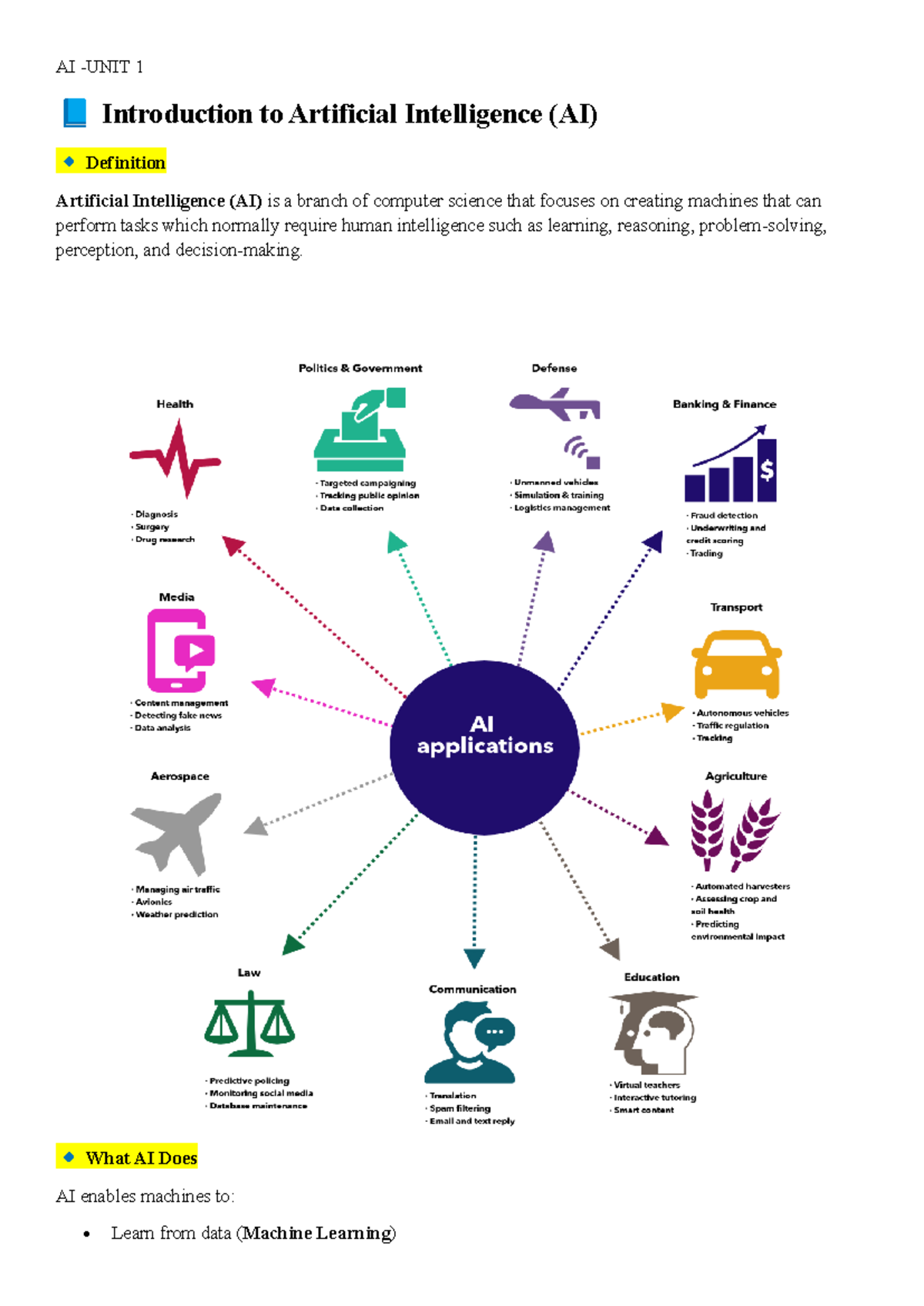
AI is no longer a localized phenomenon; it is an integrated utility across all economic sectors.
Healthcare and Biotechnology
AI's impact on healthcare is transformative, particularly in drug discovery and personalized medicine. By 2026, AI-driven simulations have reduced the time required to identify viable drug candidates from years to weeks.
- Predictive Diagnostics: AI models analyze Electronic Health Records (EHR) and genomic data to predict the onset of chronic conditions like Type 2 diabetes or cardiovascular disease years before clinical symptoms appear.
- Precision Oncology: Tailoring cancer treatment plans based on the specific genetic mutations of a patient's tumor, maximizing efficacy while minimizing side effects.
Finance and Global Markets
The financial sector utilizes AI for both micro-level customer service and macro-level market stability.
- Algorithmic Trading: High-frequency trading systems execute millions of orders per second, reacting to global news and market shifts faster than any human operator.
- Regulatory Compliance: AI systems monitor transactions in real-time to detect money laundering and ensure compliance with international financial regulations, significantly reducing the "false positive" rates that plagued earlier systems.
Manufacturing and Industry 5.0
Industry 5.0 emphasizes the collaboration between humans and smart systems.
- Predictive Maintenance: Sensors on factory floors feed data into AI models that predict when a machine is likely to fail. This allows for repairs to be scheduled during planned downtime, saving billions in lost productivity.
- Generative Design: Engineers input performance requirements (e.g., "minimum weight, maximum 500kg load") and AI generates thousands of design iterations that a human might never conceive, often resulting in organic, highly efficient structures.
Environmental Science and Energy
AI has become a critical tool in the fight against climate change.
- Smart Grids: AI optimizes the distribution of electricity from renewable sources, predicting peaks in demand and adjusting the flow from battery storage or wind farms to prevent outages.
- Climate Modeling: Advanced AI models provide hyper-local weather and climate predictions, helping cities prepare for extreme weather events with unprecedented accuracy.
Ethical Frameworks and Regulatory Compliance
As of 2026, the regulatory landscape for AI has matured significantly. The EU AI Act has set a global precedent, categorizing AI applications by risk level.
- Unacceptable Risk: Systems that manipulate human behavior or perform social scoring are strictly prohibited.
- High Risk: AI used in critical infrastructure, education, or law enforcement must undergo rigorous auditing, ensure human oversight, and maintain high standards of data security.
- Transparency Requirements: Generative AI systems must clearly disclose that content is machine-generated to prevent misinformation and "deepfake" deception.
Explainable AI (XAI) has also become a technical requirement in many jurisdictions. It is no longer sufficient for a model to provide an answer; it must be able to explain the "logic" or the data points that led to that specific conclusion, especially in sensitive areas like credit lending or criminal justice.
Challenges and Technical Limitations
Despite its rapid advancement, AI in 2026 still faces several hurdles:
- Compute and Energy Consumption: Training and running massive models requires immense electrical power. This has led to a surge in research into "Green AI" and more efficient hardware like neuromorphic chips.
- Data Scarcity and Quality: Most high-quality human-generated data has already been used for training. The industry is currently grappling with the "model collapse" problem, where models trained on AI-generated data begin to degrade in quality.
- Hallucinations: While significantly reduced, models can still "hallucinate" or confidently state false information. This necessitates the use of Retrieval-Augmented Generation (RAG) to anchor AI responses in verified, real-world databases.
Getting Started: Prerequisites for AI Implementation
For organizations or individuals looking to integrate AI, the following steps are foundational:
- Data Infrastructure: AI is only as good as the data it accesses. Establishing clean, centralized, and secure data pipelines is the first requirement.
- Strategic Alignment: Identify specific problems that AI is uniquely qualified to solve. Avoid "AI for the sake of AI."
- Governance and Ethics: Before deployment, establish a framework for how the AI will be monitored, who is responsible for its outputs, and how data privacy will be maintained.
- Talent and Literacy: Successful implementation requires a mix of technical experts (Data Scientists, Prompt Engineers) and AI-literate business leaders who understand the limitations and potential of the technology.
Frequently Asked Questions
What is the difference between Generative AI and Agentic AI?
Generative AI focuses on creating content, such as writing an essay or generating an image. Agentic AI, however, is designed to perform actions and complete multi-step tasks autonomously. While Generative AI provides a "product," Agentic AI provides a "service" or "outcome" by interacting with other software and tools.
Is AI going to replace human jobs in 2026?
AI is primarily a tool for augmentation rather than total replacement. While it automates repetitive and data-heavy tasks, it creates a higher demand for roles involving critical thinking, emotional intelligence, and complex problem-solving. The focus has shifted from "replacing humans" to "humans with AI replacing humans without AI."
How can I ensure my AI usage is compliant with 2026 regulations?
Compliance generally requires maintaining detailed documentation of your AI models, ensuring the data used for training is ethically sourced, and implementing a "human-in-the-loop" system for high-stakes decisions. You should consult the specific guidelines provided by your regional regulator, such as the EU's AI Office or the NIST AI Risk Management Framework in the United States.
What are the "compute costs" associated with AI?
Compute costs refer to the financial and hardware resources required to process AI algorithms. For large-scale models, this includes the cost of specialized GPUs (Graphics Processing Units) or NPUs (Neural Processing Units), as well as the electricity needed to run them. Many organizations now use "API-based" AI to minimize these capital expenses.
Can AI learn on its own without new data?
Traditional AI cannot "learn" in a vacuum; it requires new data or feedback to improve. However, Reinforcement Learning allows models to improve by interacting with an environment and receiving rewards for successful actions, which can look like autonomous learning.
Practical Recommendation
To successfully navigate the AI landscape in 2026, prioritize AI Literacy and Data Governance. Before investing in complex custom models, utilize existing high-performance APIs to prototype solutions and validate your business case. Always implement a "Transparency First" policy, ensuring that both employees and customers know when they are interacting with an AI system and how their data is being processed.