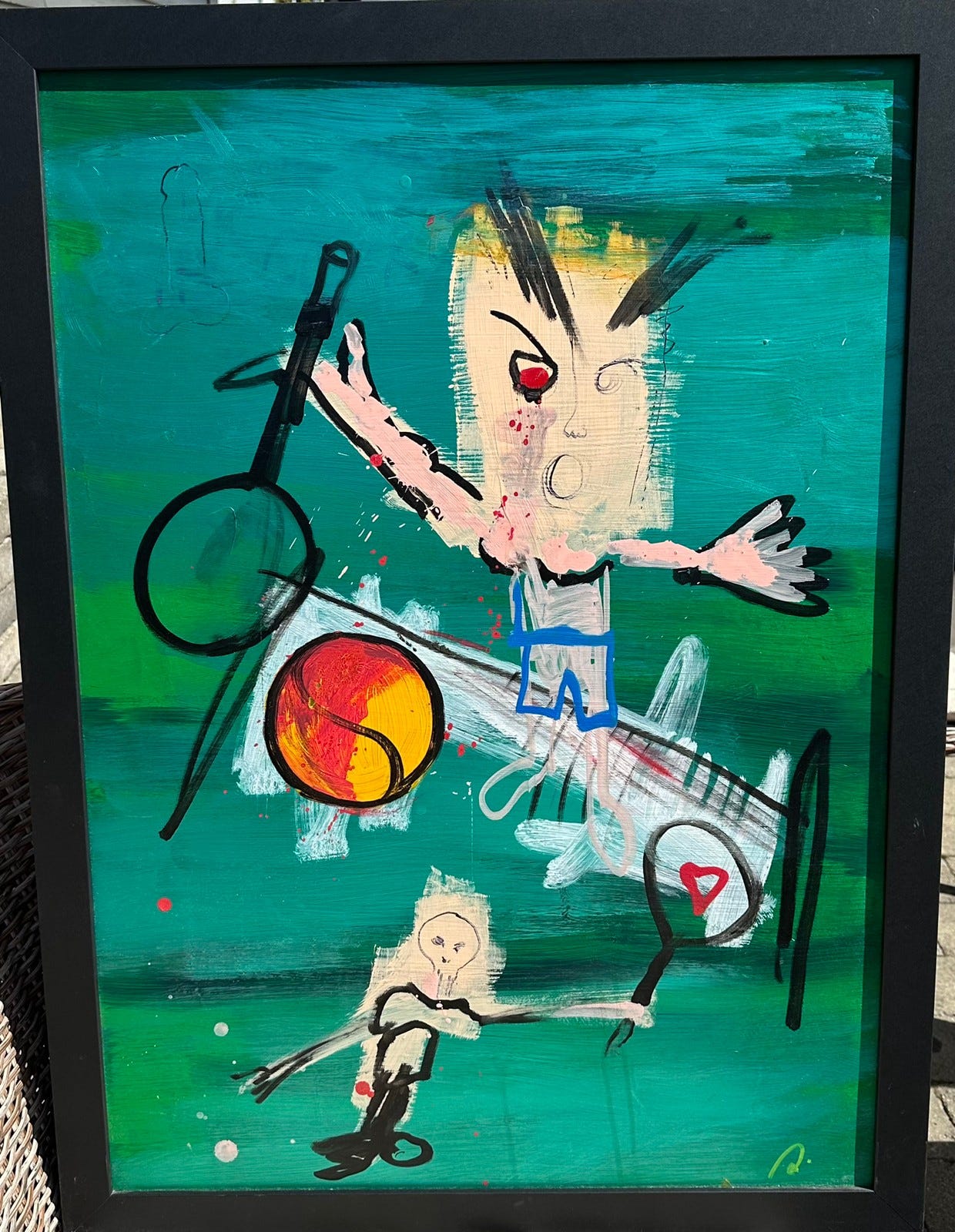
Ari Behn’s transition from a celebrated and controversial literary figure to a dedicated visual artist represents a complex chapter in contemporary Scandinavian culture. While initially renowned in Norway and internationally for his prose, including his breakthrough 1999 short story collection Trist ပါ (Trist ပါ), Behn spent the latter years of his life establishing a prolific career as a painter and sculptor. Examining Ari Behn in the context of modern art requires looking past the sensationalism of his public persona to evaluate his bold, expressionistic canvases, his distinct use of color and texture, and the ways his visual works fit into broader traditions of Nordic modernism and contemporary neo-expressionism.
The Evolution from Literature to Visual Art
To understand Ari Behn as a modern artist, one must first trace his creative origins. Born Ari Mikael Bjørshol in 1972, Behn grew up in a household with a strong creative and alternative-education background. He studied history and religion at the University of Oslo before achieving literary fame with Trist ပါ, which sold tens of thousands of copies and established him as a provocative voice in Norwegian literature.
However, writing proved to be only one medium for his restless creative impulses. Over the decades, Behn gravitated increasingly toward the physical and immediate nature of visual art. Painting offered him a direct outlet that literature’s structured syntax could not always accommodate. His transition was not a sudden pivot, but a gradual immersion into studio work, where he developed a signature style characterized by raw emotion, thick impasto textures, and vibrant, clashing color palettes.
This shift mirrors a historical lineage of writers, actors, and public figures who turned to the visual arts to transcend the limitations of language. In Behn's case, painting became a psychological landscape. His works often reflect the internal tensions of a man living under intense media scrutiny, navigating high-profile marriage, divorce, and personal struggles with mental health.
Stylistic Analysis: Neo-Expressionism and Nordic Roots
In the context of modern art, Behn’s paintings are most frequently aligned with neo-expressionism and outsider-adjacent art. He was largely self-taught in the formal techniques of painting, a characteristic that lent his work an unpolished, urgent vitality. Rather than adhering to classical proportions or academic realism, Behn prioritized psychological resonance and emotional truth.
Key Characteristics of Behn’s Visual Work
- Heavy Impasto and Texture: Behn frequently applied paint with thick, aggressive strokes, sometimes using his hands or palette knives rather than traditional brushes. This created a three-dimensional surface where paint ridges cast real shadows across the canvas.
- Vibrant, High-Contrast Palettes: His color choices were unapologetically bold. Electric blues, searing yellows, deep blood reds, and stark blacks clashed against one another, creating visual tension that forced the viewer to confront the emotional climate of the piece.
- Figurative Abstraction: While many of his works feature human faces and bodies, these figures are frequently distorted, elongated, or fractured. Faces melt into backgrounds, and eyes stare with haunting intensity, recalling the stylistic anxieties found in the works of Edvard Munch and German expressionists like Ernst Ludwig Kirchner.
This unmistakable Nordic melancholy runs through his entire oeuvre. Like Munch, who looms large over the Norwegian artistic psyche, Behn explored themes of existential dread, isolation, love, and human vulnerability. Yet, where Munch often utilized a muted, hauntingly atmospheric palette, Behn’s work was frequently explosive and chaotic, mirroring the rapid-fire media landscape of the 21st century in which he lived.
Reception and the Critique of Celebrity Art
Evaluating Ari Behn’s artistic output requires navigating a well-known cultural friction: the reception of art created by a celebrity. When figures from literature, television, or royalty enter the fine art world, institutional galleries and high-art critics often react with skepticism. Behn’s high-profile marriage to Princess Märtha Louise of Norway from 2002 until their divorce in 2017 meant that his art exhibitions were guaranteed massive media attention—a double-edged sword in the art market.
On one hand, his fame ensured packed vernissages, high attendance figures, and strong commercial sales. His works were exhibited in various galleries across Norway and Europe, attracting collectors who appreciated his raw, uncompromised style. On the other hand, some traditional art critics initially dismissed his paintings as "celebrity hobbyism," arguing that his commercial success relied more on his name than his technical mastery.
As time passed and his body of work expanded, a critical reassessment began to take shape. Art historians and curators started to look past the tabloid headlines, evaluating the canvases on their own aesthetic merits. They noted that Behn’s lack of formal academic training actually preserved a naive authenticity that many contemporary artists spend years trying to artificially recapture. His paintings were increasingly recognized not as the vanity projects of a celebrity, but as genuine expressions of a tortured, sensitive creative spirit.
Key Themes Explored in Behn’s Oeuvre
Behn’s artwork consistently returned to a core set of psychological and philosophical motifs. Understanding these themes provides deeper insight into his place within contemporary European art.
- Identity and the Public Mask: Having spent decades in the blinding glare of the public eye, Behn’s portraits frequently explore the duality of human identity. Faces are split, masked, or bleeding into their surroundings, symbolizing the fracture between the private self and the public facade.
- The Complexity of Human Relationships: Love, heartbreak, and familial bonds formed the narrative core of many canvases. Figures are often depicted locked in intense embraces or drifting apart in vast, desolate color fields.
- Mortality and Transcendence: In his later years, Behn’s work took on a deeper, more reflective gravity. Skulls, skeletal structures, and fading light motifs appeared with greater frequency, reflecting an ongoing philosophical meditation on life, death, and spiritual release.
Comparison with Contemporary Nordic Counterparts
To contextualize Behn’s output, it is helpful to compare his trajectory with other modern and contemporary Scandinavian creators who blurred the lines between different media or challenged traditional institutional boundaries.
| Artist / Figure | Primary Medium | Artistic Movement | Critical Reception |
|---|---|---|---|
| Edvard Munch | Painting / Printmaking | Expressionism / Symbolism | Universally canonized as a pioneer of modern psychological art. |
| Ari Behn | Painting / Literature | Neo-Expressionism | Polarizing due to celebrity status; valued for raw, emotional authenticity. |
| Magne Furuholmen | Mixed Media / Sculpture | Conceptual / Pop Art | Respected international career bridging music (a-ha) and visual installation. |
| Kari Traa | Design / Sport | Applied Arts / Fashion | Celebrated commercial success transitioning from elite sports to design. |
As demonstrated in the comparison above, Scandinavian culture has a rich tradition of multidisciplinary polymaths—figures like Magne Furuholmen of the band a-ha, who successfully transitioned into high-profile visual arts and large-scale public sculpture. Behn shared this restless creative ambition, though his medium remained firmly rooted in the visceral, tactile tradition of painting.
Legacy and Posthumous Impact
Following his tragic death by suicide on Christmas Day in 2019, the cultural perception of Ari Behn underwent a profound transformation. The shockwaves of his passing prompted an open national conversation in Norway about mental health, male vulnerability, and the hidden pressures faced by public figures.
In the wake of his death, exhibitions of his art took on a commemorative and retrospective gravity. Galleries that had once viewed his work through the lens of celebrity gossip began curating formal retrospectives, cementing his status as a legitimate, if tragic, figure in modern Nordic art history. His paintings, once collected as curiosities by fans of his literary and public life, are now increasingly viewed as poignant historical artifacts of a modern expressionist who painted his own psychological state with unfiltered honesty.
For contemporary collectors and art historians, Behn’s portfolio serves as a reminder of the thin line between creation and torment. His canvases do not offer easy comfort or passive decoration; instead, they demand an emotional investment from the viewer, echoing the raw vulnerability that defined his entire artistic existence.
Frequently Asked Questions
When did Ari Behn begin painting seriously?
While Behn engaged with creative arts throughout his life as a writer, he began focusing intensely on visual art and painting during the late 2000s and 2010s, utilizing his studio practice as a primary channel for his creative expression following his literary successes.
What art style best describes Ari Behn’s work?
Behn's paintings are best classified as neo-expressionist. They feature heavy impasto textures, distorted figures, intense psychological themes, and a vivid, often clashing color palette that recalls early 20th-century European expressionism.
How was Ari Behn’s art received by critics during his lifetime?
His reception was initially polarized. While the public and collectors embraced his exhibitions due to his high celebrity profile, some traditional art critics were initially skeptical, viewing his work through the lens of celebrity art before later recognizing its authentic emotional power.
Where can Ari Behn’s artwork be viewed today?
His works are held in various private collections and have been featured in posthumous and retrospective gallery exhibitions across Norway and Europe, curated to celebrate his contributions to contemporary visual culture.
What are the main thematic elements in Behn’s paintings?
His work frequently explores human identity, the pressures of public life versus private reality, existential anxiety, romantic heartbreak, mortality, and deep emotional vulnerability.
Conclusion and Next Actions
Evaluating Ari Behn in the context of modern art reveals an artist who defied neat categorization. He was neither a mere celebrity dabbling in paint nor a detached academic theorist; he was an impassioned neo-expressionist who channeled his inner turmoil directly onto the canvas. For those looking to explore his legacy further, seeking out exhibition catalogs, examining high-resolution images of his impasto works, or reading his collected literary works provides a comprehensive view of a restless, creative life. Engaging with his art requires looking past the noise of his public biography to appreciate the raw, enduring power of his visual voice.