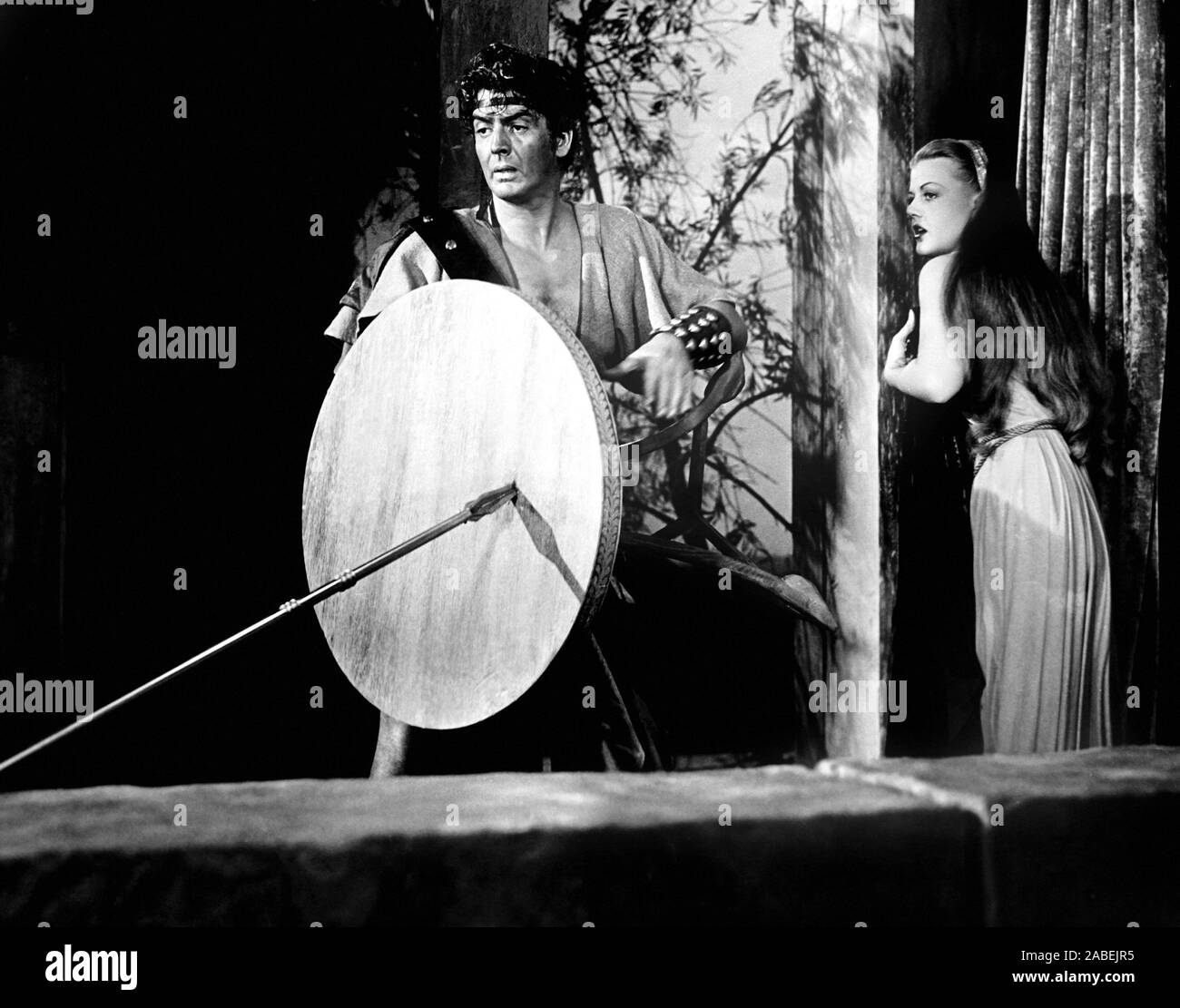
During the pre-production of Cecil B. DeMille’s 1949 Technicolor epic Samson and Delilah, British screen star Phyllis Calvert was originally cast as Semadar, Samson’s first love and Delilah’s elder sister. However, after Calvert suffered a severe injury prior to filming, Paramount Pictures negotiated a loan-out deal with Metro-Goldwyn-Mayer to cast 23-year-old Angela Lansbury as her replacement.
Historical Background of Cecil B. DeMille’s Biblical Epic
In the late 1940s, Paramount Pictures approved one of the most expensive and ambitious film projects in its history: a massive Technicolor adaptation of the biblical story of Samson, found in the Book of Judges. Directed and produced by legendary filmmaker Cecil B. DeMille, Samson and Delilah was envisioned as a cinematic spectacle designed to draw post-World War II audiences back into movie theaters. DeMille relied on screenplays developed by Frederic M. Frank, Jesse L. Lasky Jr., and Harold Lamb, who drew structural inspiration from both biblical texts and Vladimir Jabotinsky’s 1927 novel Samson the Nazarite.
Executing a project of this scale required major financial investment and strict production schedules. The film featured elaborate set pieces—including a colossal Philistine temple destruction sequence—and intricate three-strip Technicolor photography directed by George Barnes. Because DeMille insisted on a star-studded cast to match the grand visual design, casting became a multi-studio endeavor.
While Victor Mature was chosen to play Samson and Hedy Lamarr secured the coveted role of Delilah, the supporting role of Semadar presented immediate casting challenges. Semadar, the proud Philistine noblewoman whose marriage to Samson triggers the film's central tragedy, required an actress who could project aristocratic elegance, poise, and tragic drama. DeMille looked to international talent to fill the role, initially turning to one of the United Kingdom’s top box-office attractions.
- Paramount Pictures Production Plan (1948)
- Lead Roles Cast
- Samson: Victor Mature
- Delilah: Hedy Lamarr
- Saran of Gaza: George Sanders
- Supporting Role: Semadar
- Originally: Phyllis Calvert (Withdrew due to injury)
- Recast via MGM Loan: Angela Lansbury
- Lead Roles Cast
The Original Casting of Phyllis Calvert as Semadar
In 1948, Phyllis Calvert was a major star in the British film industry. She had achieved widespread acclaim through her leading roles in Gainsborough Pictures' melodramas, including The Man in Grey (1943) and Fanny by Gaslight (1944). Recognized for her expressive dramatic style and sophisticated screen persona, Calvert attracted strong interest from Hollywood executives looking to bring British talent across the Atlantic.
Paramount Pictures signed Calvert to play Semadar, viewing her international reputation as an ideal asset for selling Samson and Delilah to European and global markets. The role was integral to the narrative structure of the film's first half: Semadar is the elder daughter of Tubal, a wealthy Philistine nobleman, and the object of Samson’s initial romantic devotion. Her character’s choice to reject Samson in favor of the Philistine prince Ahtur sets off a chain of violent conflicts that leads to her tragic death, driving her younger sister Delilah to seek vengeance against Samson.
Preparations for Calvert’s Hollywood arrival were already underway in mid-1948. Costume designers Edith Head, Ralph Jester, and Dorothy Jeakins began creating wardrobe concepts specifically tailored to Calvert’s proportions and posture. However, just as pre-production reached its final stages, an unpredicted setback halted these plans.
Circumstances Surrounding Calvert’s Departure
Shortly before principal photography was scheduled to begin in October 1948, Phyllis Calvert suffered a serious injury—reported in contemporary trades as a severe spinal injury combined with recurring health complications—that prevented her from undertaking prolonged physical work or international travel.
Because DeMille’s shooting schedule for Samson and Delilah was bound by strict studio deadlines, high daily Technicolor rental costs, and contract availability for stars like Victor Mature and George Sanders, Paramount could not delay production. Calvert was forced to relinquish the role of Semadar and return to England to recover, leaving DeMille without a crucial supporting lead weeks before cameras were set to roll.
Enter Angela Lansbury: The MGM Loan-Out to Paramount
Faced with an imminent filming deadline, DeMille and Paramount production executives began searching Hollywood contract lists for a replacement. They quickly identified 23-year-old Angela Lansbury, who was under contract at Metro-Goldwyn-Mayer (MGM).
Although young, Lansbury was already an accomplished character actress. She had earned two Academy Award nominations for Best Supporting Actress before turning twenty-one—first for her debut as the conniving maid Nancy in Gaslight (1944), and second for her poignant performance as Sibyl Vane in The Picture of Dorian Gray (1945). Despite her proven talent, MGM often struggled to find suitable leading roles for Lansbury, frequently casting her in supporting parts mature beyond her actual years.
Executing the Studio Loan-Out System
During the Golden Age of Hollywood, major studios held exclusive contracts with performers, dictating which projects actors could accept. If a rival studio wanted to borrow a performer, executives had to negotiate a formal "loan-out" agreement.
Paramount approached MGM head Louis B. Mayer to negotiate temporary access to Lansbury. MGM agreed to loan Lansbury to Paramount for Samson and Delilah, recognizing that working with a high-profile director like DeMille in a major epic would raise the young actress’s public profile without costing MGM production capital.
- MGM Studio Contract
- Negotiated Loan-Out Agreement
- Paramount Pictures Production
- Angela Lansbury cast as Semadar (1948)
Lansbury accepted the role of Semadar with enthusiasm. Although the character was scheduled to die midway through the film, the part offered high-visibility screen time alongside major stars, beautifully designed costumes, and direction from one of Hollywood's iconic filmmakers.
Comparing the Casting Profiles: Phyllis Calvert vs. Angela Lansbury
The transition from Phyllis Calvert to Angela Lansbury brought distinct stylistic shifts to the character of Semadar. The table below outlines the key professional and production differences between the two actresses at the time of the replacement in 1948:
| Feature / Factor | Phyllis Calvert | Angela Lansbury |
|---|---|---|
| Contract Studio (1948) | Independent / Paramount Deal | Metro-Goldwyn-Mayer (MGM) |
| Nationality | British (United Kingdom) | British-American |
| Age at Production Start | 33 years old | 23 years old |
| Industry Background | British Gainsborough Melodramas | Hollywood Studio System (MGM) |
| Prior Oscar Nominations | None | 2 Nominations (Gaslight, Dorian Gray) |
| Casting Selection Basis | Established European star power | Versatile dramatic range & studio availability |
| Production Impact | Original selection; withdrew due to injury | Fast recast via studio loan-out agreement |
| Screen Time / Outcome | Replaced prior to filming | Played Semadar in finished 1949 film |
Character Analysis: The Role of Semadar in Samson and Delilah
In the dramatic framework of Samson and Delilah, Semadar serves as the structural catalyst for the entire tragedy. Although Hedy Lamarr’s Delilah is the title character and primary antagonist, Delilah’s hatred toward Samson stems directly from the events surrounding Semadar’s marriage.
Semadar is portrayed as the elder, favored daughter of Tubal. She possesses a cool, regal detachment that contrasts sharply with Delilah’s passionate and tempestuous nature. When Samson wins the right to marry Semadar by slaying a lion with his bare hands, Semadar accepts his courtship, yet remains fiercely loyal to her Philistine heritage and noble standing.
- Samson Slays Lion
- Wins Semadar's Hand
- Wedding Riddle Dispute
- Philistine Betrayal
- Death of Semadar
- Delilah Vows Vengeance
Key Dramatic Sequences
Lansbury’s performance centers around three major narrative movements:
- The Royal Hunt and Introduction: Semadar accompanies the Philistine court, establishing her high social standing and poise in front of the Saran of Gaza (George Sanders).
- The Wedding Feast and Riddle: During the wedding celebration, Samson poses a riddle to the thirty Philistine guests. When the guests threaten Semadar and her family, she cajoles Samson into revealing the answer, unintentionally setting up the betrayal that ruins the feast.
- The Battle and Tragic Death: Enraged by the Philistine trickery, Samson leaves, and Semadar’s father marries her off to Ahtur to preserve family honor. When Samson returns to claim her, a violent riot breaks out between Samson and the Philistine guard. In the chaos, Semadar and her father are killed as their estate burns, an event that drives Delilah to swear revenge against Samson.
Lansbury delivered a layered performance, capturing both the aristocratic arrogance of the Philistine ruling class and the vulnerability of a woman caught between warring factions.
Studio System Dynamics: Recasting Under Production Deadlines
Recasting a supporting lead shortly before principal photography introduced complex operational logistics for Paramount’s production departments.
Wardrobe Adjustments by Edith Head
One of the immediate operational challenges involved the film’s elaborate costumes. Costume designer Edith Head and her team had already crafted several detailed gowns for Phyllis Calvert. When Lansbury stepped into the role, the costume department had to quickly alter these garments.
- Height and Silhouette: Lansbury was slightly taller than Calvert and possessed a different posture, requiring waistline repositioning and shoulder adjustments on several hand-embroidered gowns.
- Color Palette Integration: Technicolor three-strip photography required careful color coordination between costumes and set design. Because Lansbury possessed a fair complexion and light hair, Head adjusted color accents on Semadar’s silk and satin robes to ensure she stood out distinctly alongside Hedy Lamarr’s dark-haired Delilah.
- Original Wardrobe Designed for Calvert
- Emergency Department Alteration
- Adjusted Waistlines, Hemlines, & Color Accents
- Final Technicolor Wardrobe for Lansbury
DeMille’s Directorial Adaptation
Cecil B. DeMille was famous for his rigorous discipline on set. He demanded absolute professionalism and precision from his actors. Despite Lansbury’s young age, her theatrical training and experience at MGM allowed her to adapt instantly to DeMille’s exacting style of direction. Lansbury later recalled that working with DeMille was an intense learning experience, noting his command over every detail of the set, from background extras to complex lighting arrangements.
Impact on the Actresses' Subsequent Careers
The recasting of Semadar had lasting effects on the career paths of both Phyllis Calvert and Angela Lansbury.
Angela Lansbury's Career Trajectory
Samson and Delilah was a massive commercial success upon its release in December 1949, becoming the highest-grossing film of 1950 by bringing in over $11 million in domestic rentals. Appearing in such a widely seen film consolidated Lansbury’s reputation as one of Hollywood's most reliable dramatic performers.
Although MGM continued to place her in supporting parts throughout the 1950s, her work in Samson and Delilah demonstrated her ability to share the screen with major international stars. Lansbury eventually transitioned to Broadway, earning broad acclaim in musicals such as Mame and Sweeney Todd, before achieving world renown as Jessica Fletcher in the long-running television series Murder, She Wrote. Lansbury's career spanned nearly eight decades, earning her an Honorary Academy Award in 2013 and a Damehood in 2014, until her passing in 2022.
- Angela Lansbury Career Milestones
- 1944: Oscar nomination for "Gaslight"
- 1945: Oscar nomination for "The Picture of Dorian Gray"
- 1948: Cast as Semadar in "Samson and Delilah" (Released 1949)
- 1962: Oscar nomination for "The Manchurian Candidate"
- 1966–1979: Broadway Stardom ("Mame", "Sweeney Todd")
- 1984–1996: "Murder, She Wrote"
- 2013: Honorary Academy Award for Lifetime Achievement
Phyllis Calvert's Career Trajectory
After recovering from her injury, Phyllis Calvert focused her talents primarily on the British film industry and stage productions in London’s West End. She starred in successful British films such as Mandy (1952) and The Net (1953), retaining her status as a revered figure in British cinema. While she appeared in select Hollywood-backed productions shot in Europe—such as Indiscreet (1958)—Calvert maintained her base in the UK, building a respected legacy that extended through her final television roles in the 1990s until her death in 2002.
Viewing and Researching Classic Hollywood History Today
For film scholars, classic cinema enthusiasts, and cultural historians, the story of how Angela Lansbury replaced Phyllis Calvert offers a clear window into how the studio loan-out system and pre-production casting changes operated during Hollywood’s Golden Age.
Accessing the Film
- Streaming Platforms: Samson and Delilah is widely available on major digital rental and streaming platforms under license from Paramount Pictures.
- Physical Media Restorations: High-definition Blu-ray editions showcase the restored three-strip Technicolor print, allowing viewers to inspect the detailed costume craftsmanship executed by Edith Head and her team.
Archival Research Resources
To explore contemporary documentation regarding the casting and loan-out agreements for Samson and Delilah, researchers can consult:
- The Margaret Herrick Library (Academy of Motion Picture Arts and Sciences): Houses official Cecil B. DeMille production files, including casting notes, loan agreements, and correspondence regarding Phyllis Calvert and Angela Lansbury.
- Trade Publications Archives: Issues of Variety and The Hollywood Reporter from late 1948 document the production timeline, Calvert's injury, and Paramount's negotiations with MGM.
Frequently Asked Questions
Who originally played Semadar in Samson and Delilah before Angela Lansbury?
British actress Phyllis Calvert was originally cast as Semadar in Cecil B. DeMille’s 1949 film Samson and Delilah. Calvert was signed by Paramount Pictures during pre-production in 1948 but had to vacate the role before filming started due to an unexpected injury and health issues.
Why did Phyllis Calvert drop out of Cecil B. DeMille’s Samson and Delilah?
Phyllis Calvert suffered a severe spinal injury and associated health complications shortly before principal photography was scheduled to begin in October 1948. Because Paramount could not delay the fixed production schedule of the Technicolor epic, Calvert withdrew and returned to England to recover.
How did Metro-Goldwyn-Mayer (MGM) allow Angela Lansbury to film at Paramount?
Angela Lansbury was under exclusive contract with Metro-Goldwyn-Mayer (MGM) in 1948. Paramount negotiated a formal studio "loan-out" agreement with MGM studio head Louis B. Mayer. Under this system, Paramount paid MGM a contract fee to use Lansbury for the duration of her scenes in Samson and Delilah.
What role did Angela Lansbury play in Samson and Delilah?
Angela Lansbury played Semadar, the elder daughter of the Philistine nobleman Tubal. Semadar is Samson's initial romantic interest and the sister of Delilah (played by Hedy Lamarr). Her tragic death during a violent riot serves as the catalyst for Delilah's quest for revenge against Samson.
Who designed the costumes for Angela Lansbury in Samson and Delilah?
The wardrobe for Angela Lansbury and the rest of the cast was designed by iconic costume designer Edith Head, alongside Ralph Jester and Dorothy Jeakins. Head's team had to rapidly modify the existing costumes originally designed for Phyllis Calvert to fit Lansbury's height and frame before filming began.
Was Samson and Delilah a commercial success upon its release?
Yes, Samson and Delilah was a massive box-office hit. Released in December 1949, it became the highest-grossing film of 1950, generating over $11 million in domestic theatrical rentals. It earned five Academy Award nominations and won two Oscars, including Best Art Direction and Best Costume Design.
Key Recommendations for Classic Cinema Historians
When studying casting shifts and studio production workflows during the Golden Age of Hollywood, consider the following research methods:
- Analyze Loan-Out Agreements in Studio Archives: Examine contracts held in public studio collections (such as the Cecil B. DeMille papers at Brigham Young University or the Margaret Herrick Library) to understand how financial terms and screen credit stipulations were arranged between studios like MGM and Paramount.
- Examine Costume Adaptation Techniques: Compare pre-production costume sketches with the finished film to see how designers like Edith Head altered silhouettes, neckline cuts, and color schemes when recasting occurred.
- Trace Career Impact via Contemporary Trade Papers: Use digitized historical archives of Variety, Motion Picture Daily, and The Hollywood Reporter to trace how casting changes were reported to exhibitors and investors during pre-production.