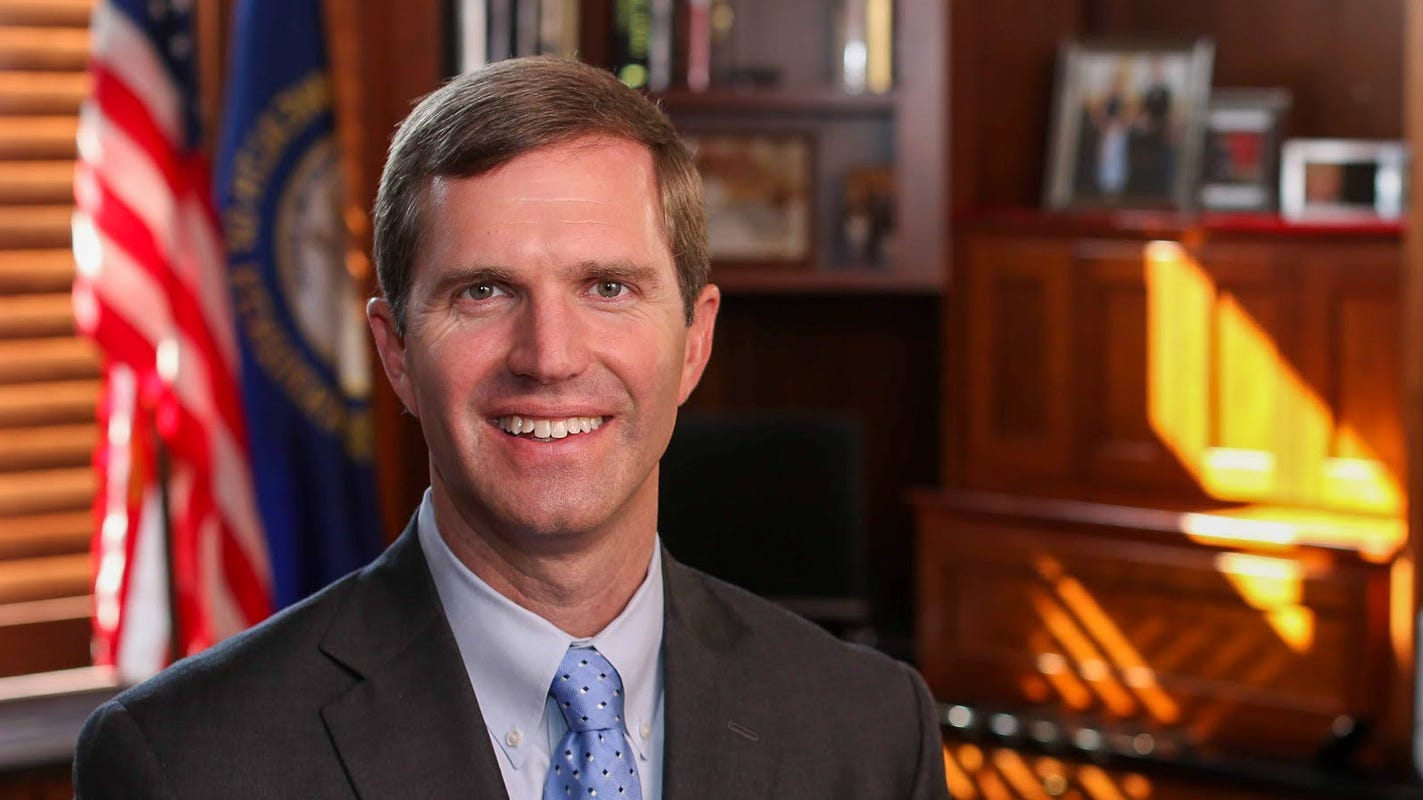
Andy Beshear’s gubernatorial victories in both 2019 and 2023 represent one of the most notable examples of a Democrat winning executive office in a deeply conservative state. His administration as the 63rd Governor of Kentucky has focused on public education investment, record-setting economic development deals, major infrastructure modernizations, and high-visibility crisis response following major natural disasters.
Background and Political Origins
Andy Beshear entered Kentucky state politics with significant name recognition, being the son of Steve Beshear, who served two terms as Kentucky Governor from 2007 to 2015. However, the younger Beshear built his political career primarily through legal public service and consumer advocacy.
After earning his undergraduate degree from Vanderbilt University and a Juris Doctor from the University of Virginia School of Law, Beshear worked in private legal practice in Washington, D.C., and Louisville, Kentucky. His legal work concentrated on white-collar defense, corporate litigation, and administrative law, with a notable focus on representing consumer interests in public utility rate cases.
- Steve Beshear (61st Governor)
- Andy Beshear (Attorney General 2016–2019)
- Andy Beshear (63rd Governor 2019–Present)
In 2015, Beshear ran for statewide elective office as Attorney General of Kentucky, defeating Republican nominee Whitney Western by a narrow margin of approximately 2,000 votes. During his tenure as Attorney General from 2016 to 2019, Beshear positioned the office as a constitutional check on executive authority. He initiated several high-profile legal challenges against the administration of then-Governor Matt Bevin.
These legal actions included lawsuits over executive budget cuts to public universities, unilateral changes to state pension boards, and public education funding mechanisms. These court battles elevated Beshear’s profile among public school educators, state workers, and organized labor unions, creating the organizational foundation for his eventual gubernatorial campaign.
The 2019 Gubernatorial Campaign: Defeating an Incumbent
The campaign for Governor of Kentucky in 2019 took place against a backdrop of intense political polarization in the Commonwealth. Incumbent Republican Matt Bevin faced declining approval ratings due to public controversies surrounding proposed public pension reforms and contentious public remarks regarding educators.
Beshear launched his campaign with a platform centered heavily on public education, healthcare access, and executive decorum. He selected Jacqueline Coleman—a high school assistant principal, varsity basketball coach, and founder of an educational non-profit—as his lieutenant governor running mate. This choice underscored the campaign’s emphasis on public school advocates as a core constituency.
2019 Kentucky Gubernatorial Election Results:
- Andy Beshear (Democrat): 709,890 votes (49.20%)
- Matt Bevin (Republican): 704,801 votes (48.84%)
- John Hicks (Libertarian): 28,433 votes (1.96%)
Key elements of the 2019 Beshear campaign platform included:
- Public Education Infrastructure: Pushing for across-the-board pay raises for public school teachers, protecting traditional public pension plans, and restoring funding for higher education.
- Healthcare Preservation: Reversing efforts to impose work requirements on Medicaid recipients under federal waivers and committing to restore the state-based health insurance exchange, Kynect.
- Pensions and State Workers: Securing the solvency of the Kentucky Employees Retirement System (KERS) and the Teachers' Retirement System (TRS) through dedicated revenue streams rather than benefit cuts.
- Economic Development: Shifting state focus toward attracting manufacturing investments and improving rural infrastructure.
Beshear won the election on November 5, 2019, receiving 709,890 votes (49.20%) to Bevin’s 704,801 votes (48.84%). The margin of just 5,089 votes demonstrated the power of strong turnout in urban centers such as Jefferson County (Louisville) and Fayette County (Lexington), combined with notable swings in suburban and traditional coal-producing counties in Eastern Kentucky.
The 2023 Re-Election Campaign: Validation of the Model
Entering the 2023 gubernatorial election, national political observers viewed Kentucky as a critical test of whether a moderate Democrat could maintain executive control in a state that voted overwhelmingly for Republican presidential candidates and maintained veto-proof Republican supermajorities in the state legislature.
The Republican nominee, Daniel Cameron, served as Kentucky Attorney General and held the endorsement of former President Donald Trump. Cameron’s campaign emphasized alignment with national conservative policies, social issues, public safety, and critiques of federal economic strategies.
Beshear’s re-election campaign avoided national partisan disputes, running on what his team termed a "jobs, roads, and schools" framework. The campaign highlighted several key achievements:
- Economic Momentum: Emphasizing historic state revenue surpluses and major corporate commitments, including electric vehicle battery plant announcements.
- Crisis Management: Highlighting executive leadership during the COVID-19 pandemic, the December 2021 tornadoes in Western Kentucky, and the catastrophic July 2022 floods in Eastern Kentucky.
- Bipartisan Infrastructure Wins: Securing federal matching funds for major regional projects without relying on tolling mechanisms.
2023 Kentucky Gubernatorial Election Results:
- Andy Beshear (Democrat): 694,482 votes (52.45%)
- Daniel Cameron (Republican): 630,016 votes (47.55%)
On November 7, 2023, Beshear secured a second term by a wider margin than in 2019, defeating Cameron by over 64,000 votes (52.45% to 47.55%). Beshear carried key suburban areas surrounding Northern Kentucky (Kenton and Campbell counties) while retaining significant support across both urban centers and rural coalfield communities.
Executive Record and Key Policy Pillars
Governing Kentucky requires navigating a distinct constitutional framework. In Kentucky, a gubernatorial veto can be overridden by a simple majority of elected members in each chamber of the General Assembly (51 votes in the House of Representatives and 20 votes in the Senate), rather than the two-thirds threshold required in the U.S. Congress and most other states. Because the Republican Party holds supermajorities in both legislative chambers, Governor Beshear’s administration relied heavily on executive orders, administrative appointments, emergency management powers, and targeted economic deal-making.
1. Economic Development and Industrial Growth
The Beshear administration prioritized large-scale manufacturing projects, positioning Kentucky as a hub for the emerging battery technology and electric vehicle (EV) supply chain.
- BlueOval SK Battery Park: The administration partnered with local officials to land a $5.8 billion joint venture between Ford Motor Company and SK On in Glendale (Hardin County), representing one of the largest single economic development investments in Kentucky's history.
- AESC Gigafactory: A $2 billion investment in Bowling Green to construct an electric vehicle battery manufacturing facility to supply global automakers.
- General Economic Indicators: During Beshear's tenure, Kentucky achieved consecutive record-low annual unemployment rates and logged private-sector investment totals exceeding tens of billions of dollars.
2. Infrastructure and Transportation
A cornerstone of Beshear's administration was securing long-delayed transportation infrastructure projects by combining state transportation funds with federal allocations from the federal Bipartisan Infrastructure Law.
- Brent Spence Bridge Companion Project: Working alongside Ohio Governor Mike DeWine, Beshear secured $1.63 billion in federal grant funding to construct a new companion bridge over the Ohio River between Covington, Kentucky, and Cincinnati, Ohio, while updating the existing structure—notably achieving this without introducing tolls.
- Mountain Parkway Expansion: Accelerating the four-laning of the Mountain Parkway to fully connect Eastern Kentucky to the interstate highway system.
- Interstate 69 Corridor: Progressing on key sections of the I-69 expansion, including the Ohio River Crossing between Henderson, Kentucky, and Evansville, Indiana.
- High-Speed Internet Expansion: Directing federal and state broadband grant funds to expand high-speed fiber internet access to unserved and underserved rural communities across the state.
3. Healthcare Access and Public Health
Health policy under Beshear saw a immediate pivot back to expanded coverage access. On his first full day in office in 2019, Beshear signed an executive order directing the Cabinet for Health and Family Services to relaunch Kynect, the state-based health insurance exchange original built during his father's tenure as governor.
Beshear Executive Health Actions:
- Dec 2019: Directs Relaunch of Kynect
- Restores Adult Dental, Vision, Hearing
- Expands Medicaid Outreach
Additionally, the administration:
- Rescinded proposed work requirements for Medicaid recipients.
- Expanded Medicaid benefits to cover dental, vision, and hearing care for eligible adult beneficiaries.
- Extended postpartum coverage under Medicaid from 60 days to 12 months following childbirth.
4. Disaster Emergency Management and Response
Beshear’s governorship was marked by major natural disasters that reshaped state emergency management practices:
- December 2021 Tornado Outbreak: Devastating EF4 tornadoes swept through Western Kentucky, destroying large portions of Mayfield, Dawson Springs, and surrounding areas. Beshear established the Team Western Kentucky Tornado Relief Fund, which raised tens of millions in private donations to support long-term housing rebuilds and direct aid.
- July 2022 Eastern Kentucky Flooding: Historic rainfall triggered catastrophic flash flooding across several Appalachian counties. The administration created the Team Eastern Kentucky Flood Relief Fund, coordinating immediate search-and-rescue operations with the Kentucky National Guard and establishing high-ground housing developments for displaced residents.
Policy and Legislative Executive Summary
The following table summarizes the primary policy domains of Andy Beshear’s gubernatorial tenure, contrasting executive actions with legislative outcomes and implemented programs.
| Policy Domain | Primary Objective | Executive Action Taken | Legislative Outcome / Current Status |
|---|---|---|---|
| Public Education | Increase teacher compensation; implement universal pre-K. | Proposed budget allocations for across-the-board pay raises and state-funded early childhood education. | The General Assembly declined universal pre-K but increased base SEEK funding and left pay raise decisions to local school districts. |
| Economic Development | Attract advanced manufacturing and clean-energy supply chains. | Authorized state economic development incentives; targeted site development grants. | Enacted with bipartisan support; record private investments secured (e.g., BlueOval SK, AESC). |
| Healthcare Expansion | Re-establish state insurance portal; expand coverage options. | Issued Executive Orders restoring Kynect exchange and expanding Medicaid adult benefits. | Kynect successfully fully operational; adult dental/vision expanded despite legislative pushback. |
| Infrastructure | Modernize critical bridges, corridors, and rural broadband. | Partnered with neighboring states; allocated federal infrastructure grant funding. | Fully funded Brent Spence Bridge (no tolls) and ongoing expansion of Mountain Parkway and rural fiber networks. |
| Disaster Recovery | Provide relief and long-term housing reconstruction following disasters. | Established Team Western and Team Eastern Kentucky funds; deployed National Guard. | State funds allocated for high-ground infrastructure and long-term community recovery grants. |
| Tax & Fiscal Policy | Maintain fiscal stability while building state reserve funds. | Managed federal relief funds; submitted balanced executive budget requests. | General Assembly enacted phased reductions in individual income tax rates; state built record Budget Reserve Trust Fund ("Rainy Day Fund"). |
The Mechanics of a Democratic Executive in a Red State
Analyzing how Andy Beshear maintained strong personal approval ratings in a state where voters consistently support conservative candidates highlights several structural and strategic factors:
1. "Kitchen Table" Messaging Strategy
Beshear’s public communications consistently prioritized tangible economic and quality-of-life issues over national ideological debates. By focusing on job creation figures, highway openings, water utility infrastructure grants, and local public school funding, the administration minimized touchpoints with national partisan divisions.
2. High-Frequency Executive Communication
During the onset of the COVID-19 pandemic in 2020, Beshear conducted daily televised briefings titled "Team Kentucky." These briefings established direct public contact with households across the state. While certain public health restrictions drew strong political opposition from the Republican legislature, the daily communications built lasting personal familiarity and established a reputation for steady executive oversight during emergencies.
| Beshear Governing Framework |
|---|
| Targeted Local Infrastructure Projects |
| Direct Crisis Executive Communication |
| Separation from National Party Debates |
3. Strategic Use of Veto Power
Given the constitutional setup in Kentucky, where a simple legislative majority can override executive vetoes, Beshear used his veto pencil primarily as a messaging and positioning tool. By vetoing bills related to social policy controversies, tax policy restructuring, and restrictions on executive authority, Beshear signaled clear policy boundaries to his political base while forcing the legislative majority to repeatedly vote to enact contested measures.
At the same time, on non-ideological operational bills—such as annual state transportation plans, economic incentive packages, and emergency relief appropriations—Beshear worked directly with legislative leadership in the House and Senate to negotiate compromise language.
Constitutional Term Limits and Future Outlook
Under Article 71 of the Kentucky Constitution, a governor is eligible to serve two consecutive four-year terms, after which they are constitutionally barred from seeking immediate re-election to a third consecutive term.
Beshear Gubernatorial Timeline:
- Term 1: December 10, 2019 – December 12, 2023
- Term 2: December 12, 2023 – December 14, 2027 (Term-limited)
Because Beshear was re-elected in 2023, his second term runs until December 2027. He cannot run for Governor of Kentucky again in the 2027 election cycle, though he remains eligible to run for non-consecutive terms in future election cycles or seek federal office.
As a high-profile Democratic governor who won two consecutive statewide elections in a state carried by conservative presidential candidates, Beshear’s political future and governing model remain subjects of national analysis. His second term focuses on completing major infrastructure projects, executing economic site construction, and overseeing long-term housing completion in flood- and tornado-damaged regions.
Frequently Asked Questions
What year was Andy Beshear elected Governor of Kentucky?
Andy Beshear was first elected Governor of Kentucky on November 5, 2019, taking office on December 10, 2019. He was re-elected for a second term on November 7, 2023.
Can Andy Beshear run for Governor of Kentucky again in 2027?
No. Under the Kentucky Constitution, a governor may serve only two consecutive four-year terms. Because Beshear won re-election in 2023, he is term-limited and cannot run for governor in 2027.
Who is Andy Beshear’s Lieutenant Governor?
Jacqueline Coleman serves as the Lieutenant Governor of Kentucky. She was selected as Beshear’s running mate prior to the 2019 election and was re-elected alongside him in 2023. Coleman also serves as Secretary of the Education and Workforce Development Cabinet.
How does the Kentucky governor’s veto power work?
Unlike the U.S. President or governors in most other states who require a two-thirds vote to override a veto, the Kentucky General Assembly can override a gubernatorial veto with a simple majority of elected members in both chambers (51 votes in the House and 20 votes in the Senate).
What were Andy Beshear's primary policy focuses during his campaigns?
Beshear’s campaigns focused on increasing investment in public education, raising teacher pay, expanding healthcare coverage through Medicaid and Kynect, securing economic development projects in battery and automotive manufacturing, modernizing state highways and bridges, and providing crisis response leadership.
Practical Resources for Following Kentucky Executive Governance
Citizens and political analysts seeking to monitor the ongoing policies, executive orders, and legislative interactions of the Kentucky executive branch can utilize official state transparency tools:
- Office of the Governor Official Portal: Access executive orders, policy announcements, public appointments, and official proclamations issued by the governor.
- Kentucky General Assembly Legislative Record: Track bills passed by the House and Senate, review executive veto messages, and monitor legislative veto override votes during annual sessions.
- Kentucky Cabinet for Economic Development: Review announced corporate expansion projects, state tax credit allocations, and regional employment statistics.
- Kentucky Transportation Cabinet (KYTC): Access progress reports on major transportation projects, including the Brent Spence Bridge Companion Project, Mountain Parkway expansion, and rural paving programs.