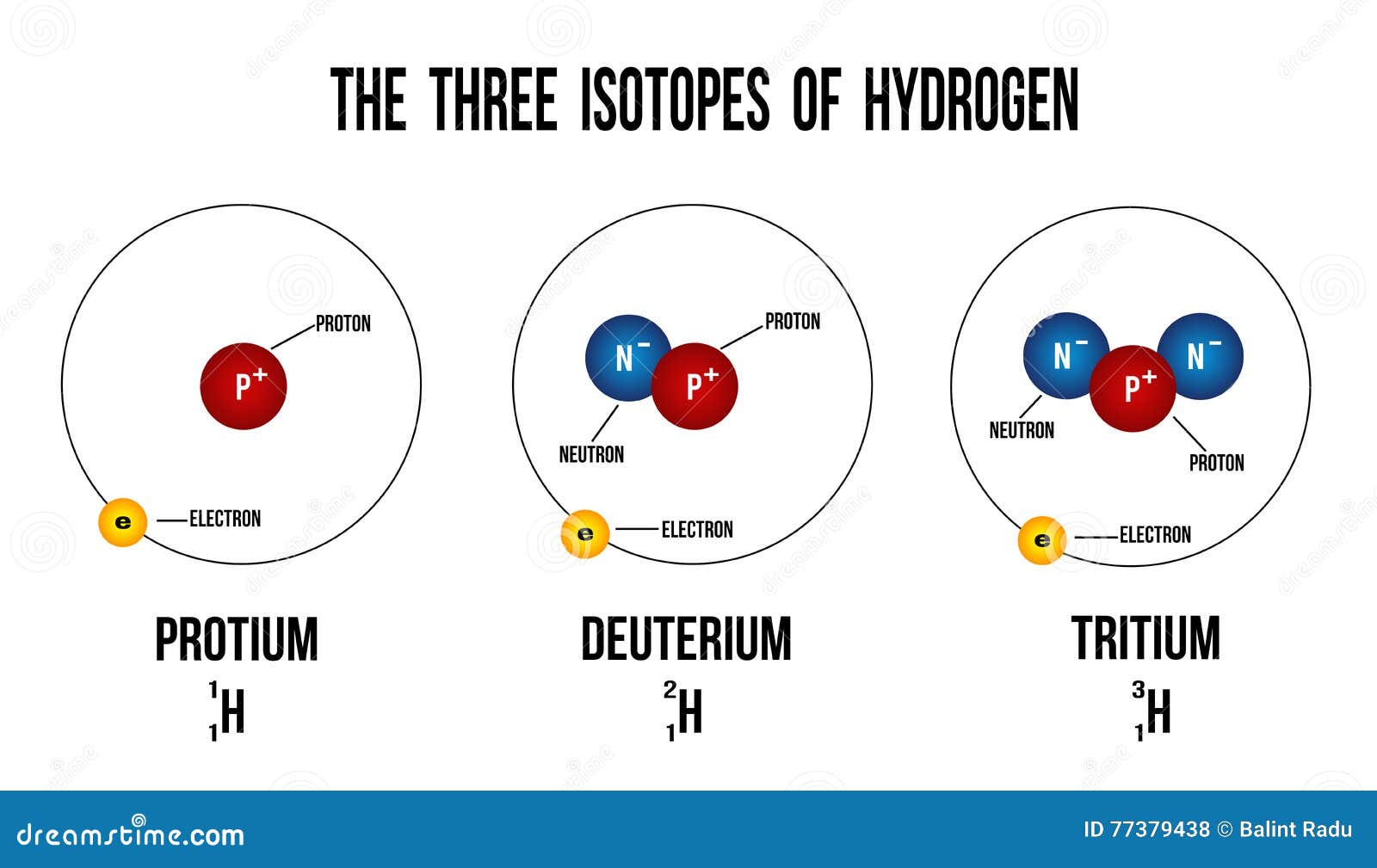
All isotopes of hydrogen contain exactly one proton in their atomic nucleus. This single proton determines the element’s identity as hydrogen, defining its atomic number as one. While the number of neutrons varies among these isotopes—resulting in differences in mass and stability—the presence of this solitary proton is the constant that defines every form of hydrogen.
Defining the Atomic Identity of Hydrogen
In the study of chemistry and nuclear physics, an element is defined by the number of protons residing within its nucleus, a value known as the atomic number. Hydrogen sits at the very beginning of the periodic table with an atomic number of 1. This means that for an atom to be classified as hydrogen, it must possess precisely one proton.
When we discuss the isotopes of an element, we are referring to variants of that element that have the same number of protons but a different number of neutrons. Because the chemical properties of an atom are dictated primarily by the configuration of its electrons—which in a neutral atom equals the number of protons—all isotopes of hydrogen exhibit nearly identical chemical behavior. They form the same types of bonds and participate in the same chemical reactions. However, the varying number of neutrons alters the nuclear mass and, in some cases, the nuclear stability of the atom, leading to the distinct physical characteristics observed in hydrogen’s three primary isotopes.
The Three Natural Isotopes of Hydrogen
While hydrogen is the simplest element, it exists in nature in three distinct isotopic forms. Understanding these forms requires looking past the common proton and examining the varying neutron counts that give each isotope its unique identity.
Protium (Hydrogen-1)
The most common isotope of hydrogen is protium, often simply referred to as "hydrogen." Its nucleus consists solely of a single proton; it contains zero neutrons. Approximately 99.98% of all naturally occurring hydrogen on Earth is in the form of protium. Because it lacks neutrons, it is the lightest and most abundant isotope, serving as the foundation for the chemistry of life, water, and organic compounds.
Deuterium (Hydrogen-2)
Deuterium, sometimes called "heavy hydrogen," contains one proton and one neutron in its nucleus. The addition of this single neutron doubles the atomic mass of the atom compared to protium. Deuterium is a stable isotope and exists in trace amounts in nature, usually found in the form of heavy water (D₂O). It is a vital tool in nuclear magnetic resonance (NMR) spectroscopy and is used as a tracer in biological and chemical research due to its unique mass properties.
Tritium (Hydrogen-3)
Tritium is the rarest of the three, containing one proton and two neutrons. Unlike protium and deuterium, tritium is radioactive. It has a half-life of approximately 12.3 years, meaning it eventually decays into helium-3 through beta decay. Because of its instability, tritium is not found in significant quantities in nature; it is primarily produced synthetically in nuclear reactors for use in specialized lighting, medical labeling, and research into fusion energy.
Comparative Properties of Hydrogen Isotopes
The differences between these isotopes go beyond their names and neutron counts. The following table highlights the physical variations that arise from the addition of neutrons to the hydrogen nucleus.
| Isotope | Symbol | Protons | Neutrons | Mass (approx. amu) | Stability |
|---|---|---|---|---|---|
| Protium | ¹H | 1 | 0 | 1.0078 | Stable |
| Deuterium | ²H or D | 1 | 1 | 2.0141 | Stable |
| Tritium | ³H or T | 1 | 2 | 3.0160 | Radioactive |
As seen in the table, the mass increases significantly with each added neutron. While the number of protons (1) remains fixed, the mass of the nucleus increases by nearly a full atomic mass unit (amu) for each neutron. This mass difference is the primary factor used by scientists to separate these isotopes during specialized industrial and laboratory processes.
Why the Single Proton is the Defining Factor
The centrality of the proton in hydrogen's identity cannot be overstated. In nuclear physics, the proton acts as the anchor for the atom's electronic structure. Because hydrogen has one proton, it attracts one electron to maintain charge neutrality. This single electron in the 1s orbital governs how hydrogen interacts with other elements, such as oxygen to form water or carbon to form hydrocarbons.
If an atom were to have two protons, it would no longer be hydrogen; it would be helium. If it had zero protons, it would not be an atom at all, as protons provide the essential positive charge necessary to hold an electron in orbit. Thus, regardless of how many neutrons are packed into the nucleus, the "hydrogen-ness" of the atom is locked in by that solitary proton. This ensures that even though deuterium and tritium are physically heavier and possess different nuclear decay properties, they remain chemically hydrogen.
Practical Applications of Isotopes
The study of hydrogen isotopes is not merely a theoretical exercise; it has profound practical applications across multiple industries.
- Heavy Water (D₂O): Deuterium is essential in nuclear power plants that utilize heavy water reactors. Because deuterium has a lower probability of absorbing neutrons than protium, it acts as an effective moderator, slowing down neutrons to sustain a chain reaction without capturing them.
- Medical Diagnostics: Tritium is used extensively in biochemistry as a radioactive tracer. By replacing a protium atom in a molecule with a tritium atom, researchers can track the movement of that molecule through a biological system, providing insights into metabolism, drug efficacy, and cellular processes.
- Fusion Research: The reaction between deuterium and tritium is the most promising candidate for future nuclear fusion energy. This reaction releases a massive amount of energy, which scientists are working to harness for clean, near-limitless power generation.
- Isotopic Labeling: By using deuterium in place of hydrogen, chemists can study the mechanisms of chemical reactions. Because deuterium reacts at a slightly different rate than protium—an effect known as the Kinetic Isotope Effect—scientists can determine the specific steps of complex chemical transformations.
Challenges in Handling Hydrogen Isotopes
Working with these isotopes presents distinct challenges, particularly regarding safety and separation. Separating isotopes is notoriously difficult because, as noted, they behave identically in chemical reactions. Traditional chemical purification methods like filtration or distillation do not work because the chemical bonds formed by protium, deuterium, and tritium are essentially the same.
Separation typically requires physical methods that exploit the mass difference, such as gas centrifugation or thermal diffusion. These processes are energy-intensive and expensive. Furthermore, while protium and deuterium are non-radioactive and safe to handle, tritium presents a biological hazard. As a radioactive isotope, tritium can replace hydrogen in water molecules within the human body, potentially exposing internal tissues to low-energy beta radiation. Stringent safety protocols are required in facilities that process or use tritium.
Common Misconceptions
A frequent point of confusion involves the confusion between isotopes and ions. It is important to remember that an ion is an atom that has gained or lost an electron. A hydrogen ion (H⁺), which is essentially just a proton, is what remains when hydrogen loses its only electron. This is distinct from an isotope, which describes the composition of the nucleus itself. Another common misconception is that all isotopes are radioactive. As shown by protium and deuterium, this is false; radioactivity is a property of the specific nuclear configuration (the neutron-to-proton ratio), not the element itself.
Conclusion and Next Actions
Every isotope of hydrogen is defined by its single proton, a fact that serves as the basis for its chemical identity while allowing for physical variation through added neutrons. Whether you are exploring the role of deuterium in nuclear engineering or the use of tritium in biological tracers, understanding this fundamental structure is the first step toward advanced mastery of atomic theory.
To further your understanding of this topic:
- For Academic Research: Consult the International Union of Pure and Applied Chemistry (IUPAC) records for definitive data on isotopic mass and abundance.
- For Laboratory Application: Review safety data sheets (SDS) if you are working with deuterated solvents or tritium-labeled compounds to ensure proper handling of radioactive materials.
- For Energy Studies: Explore the current 2026 reports from national laboratories regarding progress in magnetic confinement fusion to see how hydrogen isotopes are being utilized for the energy grid of the future.