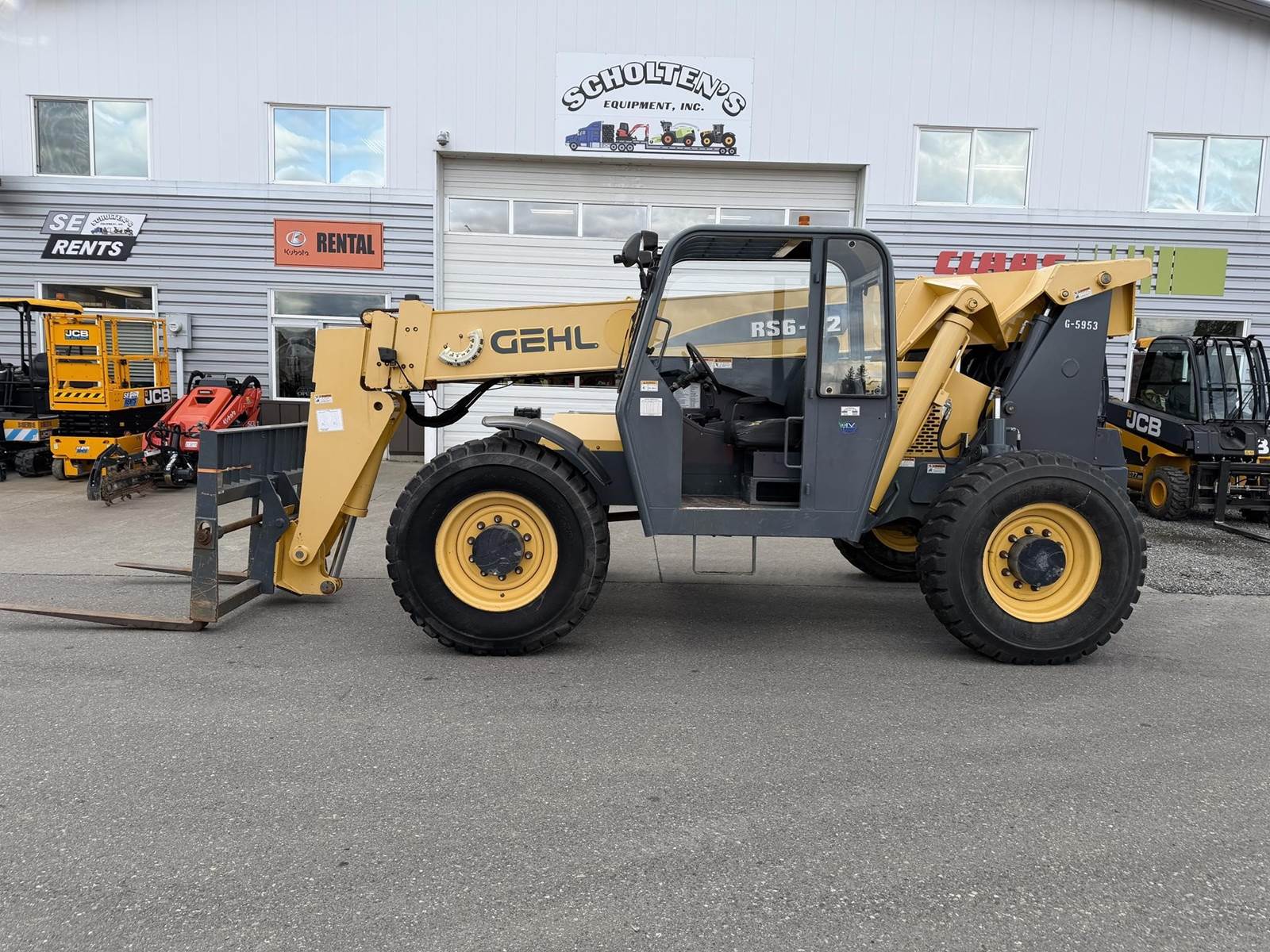
The Gehl RS6-42 is a highly versatile telescopic handler designed to balance a 6,600 lb maximum lift capacity with a 42-foot reach, making it a staple in medium-duty construction and masonry. Engineered for stability and maneuverability, this RS (Radial Stack) series machine utilizes a robust boom design and a high-clearance chassis to perform in demanding off-road environments.
Core Performance: Lifting Capacity and Reach Dynamics
The defining characteristic of the Gehl RS6-42 is its lifting profile. While the "6,600 lb" figure represents the maximum capacity, telehandler performance is governed by a load chart that accounts for boom extension and angle. Understanding these dynamics is critical for safe operation and site planning.
Maximum Lift and Height Parameters
The RS6-42 provides a maximum lift height of 42 feet (12.8 meters). At this height, the machine maintains a significant portion of its lifting capacity, provided the load is kept close to the front tires. The 6,600 lb (2,994 kg) peak capacity is typically achievable when the boom is retracted and at a high angle.
As the boom extends forward, the leverage exerted by the load increases, requiring the internal hydraulic systems and the machine’s counterweight to work harder to maintain equilibrium. This is why the capacity at maximum forward reach is significantly lower than the peak rating.
Forward Reach and Load Distribution
The maximum forward reach of the Gehl RS6-42 is approximately 28 feet 3 inches (8.6 meters). At this full extension, the lift capacity drops to approximately 1,000 lbs (454 kg), depending on the specific configuration and tire ballast. This "reach-to-capacity" ratio is a vital specification for contractors who need to place materials across trenches or over obstacles.
Operators must rely on the Load Moment Indicator (LMI) or the physical load charts located inside the cab. These charts provide a grid-based visualization of the safe working envelope, ensuring the machine does not tip forward or lose rear-axle contact with the ground.
Engine and Powertrain Specifications
In 2026, the Gehl RS6-42 continues to rely on high-torque diesel power plants that meet current emission standards while providing the raw force necessary for Gradeability—the ability to climb slopes under load.
Horsepower and Torque
Most iterations of the RS6-42 are powered by a 74 hp (55 kW) or an optional 120 hp (89 kW) turbocharged diesel engine, often sourced from manufacturers like Deutz or Yanmar. The 74 hp version is particularly popular in rental fleets because it typically does not require Diesel Exhaust Fluid (DEF), simplifying maintenance and reducing operating costs.
The engine is mated to a powershift transmission, providing at least three forward and three reverse speeds (some models offer four). This allows the machine to reach travel speeds of approximately 15–20 mph, facilitating quick movement between different areas of a large job site.
Drivetrain and Steering Modes
The RS6-42 features a full-time 4-wheel drive system with planetary reduction axles. This setup provides the high ground torque needed to push into dirt piles or navigate deep mud. The machine also offers three distinct steering modes, selectable via a switch in the operator’s cab:
- Two-Wheel Steering: Best for high-speed road travel or transport.
- Four-Wheel Steering: Reduces the turning radius for tight construction sites.
- Crab Steering: Allows the machine to move diagonally, which is essential for lining up with a pallet in narrow aisles or against a wall.
Dimensions and Maneuverability
For logistics managers, the physical footprint of the RS6-42 determines how it will be transported and where it can fit on a crowded site.
| Specification Category | Metric / Imperial Measurement |
|---|---|
| Maximum Lift Capacity | 6,600 lbs (2,994 kg) |
| Maximum Lift Height | 42' 0" (12.8 m) |
| Max Forward Reach | 28' 3" (8.6 m) |
| Overall Height (Stowed) | 7' 10" (2.38 m) |
| Overall Width | 8' 0" (2.44 m) |
| Overall Length (Less Forks) | 19' 1" (5.82 m) |
| Ground Clearance | 14" (355 mm) |
| Turning Radius | 13' 10" (4.22 m) |
| Operating Weight | Approx. 20,000 - 22,000 lbs |
| Fuel Capacity | 35 Gallons (132 L) |
Chassis Leveling and Stability
A critical technical feature of the RS6-42 is its frame leveling capability. The machine can tilt the upper chassis up to 10 degrees in either direction relative to the axles. This allows the operator to maintain a level boom and load even when the tires are on uneven or sloped ground. This feature is not just for convenience; it is a primary safety mechanism to prevent side-loading of the boom, which can lead to structural failure or tipping.
Hydraulic System and Attachments
The versatility of the RS6-42 is driven by its hydraulic performance. A gear-driven or axial piston pump provides the flow necessary for boom functions and auxiliary attachments.
Hydraulic Flow and Pressure
The system typically delivers around 20 to 30 gallons per minute (GPM) at pressures exceeding 3,000 PSI. This high-pressure flow allows the boom to raise, extend, and tilt simultaneously without a significant drop in cycle times. The "Radial Stack" design of the boom ensures that hydraulic hoses are protected within the boom structure or along the sides to prevent snagging during operation.
The Dynattach System
Gehl utilizes the Dynattach Quick-Attach system, which allows the operator to switch between various tools rapidly. Common attachments for the RS6-42 include:
- Standard Pallet Forks: For general material handling.
- Side-Tilt Carriages: For placing loads on uneven surfaces.
- Swing Carriages: Allowing 90-degree rotation of the forks to maneuver in tight spots.
- Truss Booms: Transforming the telehandler into a light crane for setting rafters.
- Work Platforms: (Where permitted by local regulations and equipped with proper safety interlocks).
Operator Environment and Safety Systems
The 2026 Gehl RS6-42 is designed with a focus on operator visibility and ergonomic control. The low-profile boom mounting point is a specific design choice intended to give the operator a 360-degree view, particularly over the right rear shoulder, which is a common blind spot in many telehandlers.
Cab Configurations
The machine comes in either an Open Canopy (ROPS/FOPS certified) or a Fully Enclosed Cab. The enclosed version typically includes a heater, defroster, and optional air conditioning. Control is managed via a single multi-function joystick, which governs boom extension, retraction, lift, and tilt. This intuitive layout reduces operator fatigue and improves precision when placing heavy loads at maximum height.
Integrated Safety Features
Modern RS6-42 units are equipped with several layers of safety technology:
- Automatic Parking Brake: Engages when the engine is shut off or the operator leaves the seat.
- Load Moment Indicator (LMI): Provides visual and audible warnings as the machine approaches its stability limits.
- Boom Angle and Extension Indicators: Physical markers on the boom that correspond to the load chart.
- Standard Lighting: Includes front and rear work lights and roading lights for low-light conditions.
Maintenance and Long-Term Durability
Gehl has designed the RS6-42 with a "no-nonsense" approach to serviceability. The engine side-cover opens wide, providing ground-level access to the oil filter, air cleaner, and coolant reservoir.
Service Intervals and Longevity
In current 2026 fleet operations, the RS6-42 is praised for its 500-hour oil change intervals. The use of self-lubricating boom sliders reduces the frequency of manual greasing, though regular inspection of the wear pads is still required to ensure smooth boom movement. The steel plating used in the chassis is heavy-duty, designed to resist the torsional stresses of lifting 6,600 lbs at high angles.
Telematics and Fleet Management
Newer models often come standard with Manitou Group's "Easy Manager" telematics. This system allows owners to track the machine’s location, fuel consumption, and error codes remotely. For rental houses and large contractors, this data is essential for predictive maintenance and minimizing downtime.
Frequently Asked Questions
What is the difference between the Gehl RS6-42 and the Gehl RS5-19?
The primary difference lies in capacity and reach. The RS6-42 can lift 6,600 lbs to a height of 42 feet, whereas the RS5-19 is a compact "super-sub" model designed for tighter spaces, with a 5,500 lb capacity and a much lower 19-foot lift height. The RS6-42 is a full-sized construction telehandler, while the RS5-19 is intended for parking garages and small residential sites.
Does the Gehl RS6-42 require outriggers?
Standard Gehl RS6-42 models do not typically require outriggers (stabilizers) to achieve their rated 6,600 lb capacity. The machine is designed with a wide wheelbase and heavy counterweight to maintain stability on its tires. However, some specialized versions or older "DL" series machines might have different configurations. Always check the specific load chart on the unit being operated.
Can the RS6-42 be used on public roads?
Yes, the RS6-42 is equipped with roading lights (headlights, turn signals, and tail lights) and a maximum travel speed of roughly 20 mph, making it "roadable" for short distances between job sites. However, local jurisdiction laws regarding slow-moving vehicles and wide loads must be followed, and a "Slow Moving Vehicle" (SMV) sign is typically required.
What is the fuel consumption of the 74 hp engine?
While fuel consumption varies based on the duty cycle (idling vs. constant lifting), the 74 hp engine in the RS6-42 is noted for its efficiency. On average, users report between 2.0 to 3.5 gallons per hour during standard construction use. The 35-gallon fuel tank is usually sufficient for a full 8-to-10-hour work shift.
What tire options are best for the RS6-42?
The machine typically comes with 13.00 x 24 pneumatic tires. For sites with high puncture risks (like demolition), foam-filled tires are the preferred option. While foam-filling increases the machine's weight and improves stability, it does result in a stiffer ride for the operator. In 2026, many fleets also utilize "solid-deal" tires which eliminate flats entirely while maintaining a proprietary aperture design for some shock absorption.
Practical Recommendation for Users
If you are considering the Gehl RS6-42 for your 2026 projects, ensure your primary lift requirements fall within the 4,000–6,000 lb range for the most efficient operation. While it can handle 6,600 lbs, operating at the absolute limit of the machine's capacity increases wear on the hydraulic seals and reduces the speed of the cycle.
For projects requiring the placement of heavy masonry pallets (often weighing around 3,000 lbs) onto a third-story scaffolding, the RS6-42 is an ideal choice. It provides the necessary height and enough capacity margin to ensure safe placement even if the machine cannot get perfectly flush with the building. Always verify the weight of your attachments (like a truss boom or heavy bucket), as these must be subtracted from the machine's rated lifting capacity to determine the net payload.