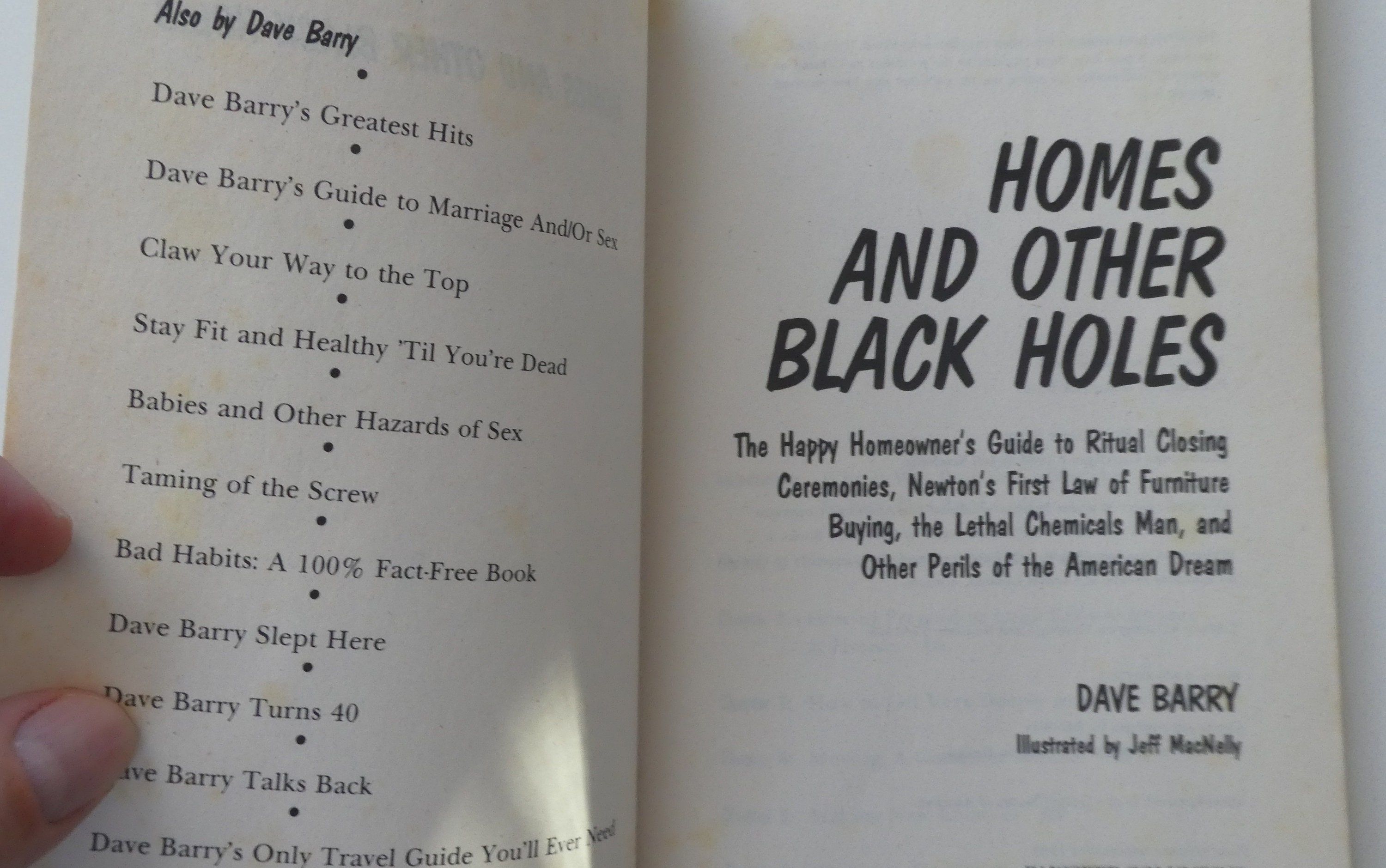
To experience the definitive humor of Dave Barry, the three top picks are Big Trouble for fast-paced comedic fiction, Dave Barry's Complete Guide to Guys for classic observational essays, and Peter and the Starcatchers for imaginative young adult adventure. These titles represent the breadth of his Pulitzer Prize-winning wit and literary versatility.
For over four decades, Dave Barry has defined a specific brand of American humor: one part self-deprecating everyman, one part absurdist observer, and one part sharp-eyed satirist of the mundane. While he gained national fame through his long-running syndicated column for The Miami Herald, his transition into full-length books allowed his comedic timing to breathe across complex plots and thematic explorations. As of 2026, Barry’s body of work remains a foundational text for anyone studying the evolution of modern satire.
Selecting the "best" book from a bibliography that spans dozens of titles is a challenge, but the following three selections provide the most comprehensive look at his talent. They cover his entry into the world of the novel, his mastery of the humorous essay, and his successful foray into collaborative world-building.
1. Big Trouble: The Definitive Florida Farce
Published in 1999, Big Trouble marked Dave Barry’s debut as a fiction writer, and it remains his most celebrated novel. Set in the humid, chaotic landscape of South Florida, the book serves as a precursor to the "Florida Man" internet phenomenon, capturing the strange, high-stakes incompetence that Barry often highlighted in his columns.
The Mechanics of the Plot
The novel features an ensemble cast that only Dave Barry could assemble. The story begins with a seemingly simple high school game of "Killer," where students hunt each other with water pistols. However, this innocent prank intersects with a much darker, though equally incompetent, plot involving a suitcase containing a nuclear device, a group of bumbling hitmen, a corrupt businessman, and a pair of lovable drifters living in a tree.
What makes Big Trouble a top pick is Barry's ability to manage a "comedy of errors" structure. Every character is driven by a specific, often misguided motivation, and as their paths cross, the narrative tension ratchets up alongside the absurdity. The pacing is relentless, echoing the style of other Florida-centric crime writers like Carl Hiaasen, but with a lighter, more overtly comedic touch.
Why It Stands Out
- Ensemble Dynamics: Barry excels at creating distinct voices. From the weary police officers to the confused teenagers, every character feels like a lived-in resident of his specific, wacky version of Miami.
- Satire of Corporate Greed: Through the character of Arthur Herk, Barry skewers the mid-level executive ego and the lengths to which a small man will go to feel powerful.
- The "Florida Factor": The book is a love letter to the weirdness of the Sunshine State. Barry uses the environment—the heat, the bugs, the traffic—not just as a backdrop, but as a catalyst for the chaos.
In 2002, the book was adapted into a major motion picture directed by Barry Sonnenfeld. While the film had its own following, the prose version remains superior for its internal monologues and the specific, rhythmic wit that characterizes Barry’s writing.
2. Dave Barry’s Complete Guide to Guys
If Big Trouble represents Barry’s skill in narrative construction, Dave Barry’s Complete Guide to Guys (1995) is the quintessential example of his observational non-fiction. This book expanded on the themes of his columns to create a "pseudo-scientific" exploration of the male psyche.
The Distinction Between "Men" and "Guys"
The central thesis of the book is the fundamental difference between a "man" and a "guy." According to Barry, a "man" is a serious, responsible being who understands international trade agreements and knows how to change a tire. A "guy," on the other hand, is someone who likes to see things explode, spends hours debating sports statistics, and is biologically incapable of finding the mustard in the refrigerator even when it is right in front of him.
This distinction allows Barry to explore male behavior with a mix of affection and relentless mockery. He touches on historical "guys," the evolution of guy-ness, and the specific rituals that define the gender, such as the inability to ask for directions or the obsession with high-tech gadgets that serve no practical purpose.
Essential Humorous Concepts
- The "Booger" Factor: Barry famously leans into "low" humor, arguing that guys never truly outgrow a fascination with the gross and the juvenile. He defends this not as a lack of intellect, but as a core component of the guy identity.
- Sports Obsession: One of the book’s strongest sections analyzes why men feel a deep, spiritual connection to sports teams composed of strangers who would not recognize them if they were on fire.
- The Domestic Sphere: Barry chronicles the hilarious failures of guys attempting to navigate household chores, child-rearing, and romantic communication.
Dave Barry’s Complete Guide to Guys is more than just a collection of jokes; it is a time capsule of 1990s gender discourse, delivered with a lightness that prevents it from feeling dated or mean-spirited. It is the perfect entry point for readers who want to understand the "voice" that won Barry a Pulitzer Prize for Commentary in 1988.
3. Peter and the Starcatchers (with Ridley Pearson)
The third pick represents Barry’s range. Peter and the Starcatchers, co-authored with suspense novelist Ridley Pearson and published in 2004, is a reimagining of the origins of Peter Pan. While it is technically a young adult (YA) novel, its wit and adventurous spirit have earned it a permanent place in the libraries of adult readers as well.
A New Origin Story
The book departs from J.M. Barrie’s original work to explain how Peter became the boy who wouldn't grow up. It introduces "Starstuff," a magical substance that falls from the sky and must be protected from falling into the wrong hands. Peter, an orphan aboard a ship called the Never Land, finds himself tasked with guarding a trunk of this substance alongside Molly Aster, a "Starcatcher" in training.
The collaboration between Barry and Pearson is seamless. Pearson brings the sense of peril and tight plotting necessary for an adventure novel, while Barry provides the levity and the whimsical characterizations.
Impact and Legacy
- The Character of Black Stache: Before he was Captain Hook, he was Black Stache, a villain whose incompetence and theatrical flair are pure Dave Barry. The character’s evolution from a feared pirate to the frustrated, handless antagonist we know is handled with brilliant comedic timing.
- World-Building: The book provides creative explanations for classic elements of the Peter Pan mythos, such as the mermaids, the ticking crocodile, and the origins of Neverland itself.
- Broadway Success: The book’s popularity led to a highly successful Broadway play, which won five Tony Awards. This cross-media success cemented the book’s status as a modern classic.
Peter and the Starcatchers proves that Dave Barry’s humor isn't limited to snarky commentary on suburban life. He is a master of "play," and this book captures the pure joy of storytelling.
Comparison of the Top 3 Dave Barry Books
| Feature | Big Trouble | Guide to Guys | Peter and the Starcatchers |
|---|---|---|---|
| Primary Genre | Humorous Fiction / Crime | Essay / Satire | Young Adult Adventure |
| Key Theme | Florida chaos and incompetence | Evolutionary psychology of "guys" | The origin of the Peter Pan myth |
| Original Publication | 1999 | 1995 | 2004 |
| Writing Style | Multi-perspective ensemble | First-person observational | Collaborative narrative |
| Best For | Fans of Carl Hiaasen or Elmore Leonard | Readers of humor columns/memoir | Families and fantasy fans |
| Notable Adaptation | 2002 Feature Film | 2004 Television Sitcom | 2012 Broadway Play |
The "Barry-isms": Understanding His Literary Style
To truly appreciate why these three books are the best, one must understand the stylistic hallmarks that Dave Barry brought to the page. His writing is built on several "pillars" of humor that he refined over decades.
Hyperbole as a Weapon
Barry rarely describes a situation as merely "bad." Instead, he uses escalating hyperbole to paint a picture of total disaster. If a character is stuck in traffic, they aren't just late; they are undergoing a geological event where continents will drift before the light turns green. This exaggeration creates a sense of shared frustration with the reader, making the humor feel inclusive.
The Everyman Persona
Despite his massive success and Pulitzer Prize, Barry’s narrator is almost always a "bumbling guy." He portrays himself as someone who is constantly confused by technology, terrified of his wife's superior organizational skills, and unable to perform basic manual labor without causing a neighborhood-wide power outage. This persona makes his satire of others feel less like an attack and more like a self-reflective observation.
The "Booger" Jokes and High-Low Balance
Barry is famous for his "low" humor—jokes about bodily functions, exploding toilets, and the inherent funniness of the word "weasel." However, he often pairs this with surprisingly sophisticated linguistic play and sharp political insights. This balance allows his books to appeal to a wide demographic, from teenagers to literary critics.
Honorable Mentions and Further Reading
While the top three picks provide a comprehensive overview, Dave Barry’s bibliography is vast. For readers who enjoy the specific sub-genres he explores, these titles are also worth considering:
- Best. State. Ever.: A Florida Man Defends His Homeland (2016): A non-fiction deep dive into why Florida is the weirdest, and therefore best, state in the union. It is a spiritual successor to the themes found in Big Trouble.
- Dave Barry Turns 40 (1990): A classic look at the anxieties of aging, delivered with his trademark wit. It resonates with anyone facing a milestone birthday.
- I'll Mature When I'm Dead (2010): A later collection of essays that shows his humor remained sharp as he transitioned into "senior" guy status.
- Tricky Business (2002): His second novel, set on a gambling ship during a storm. It follows the high-energy ensemble format established in Big Trouble.
Frequently Asked Questions
Why did Dave Barry win a Pulitzer Prize?
Dave Barry won the Pulitzer Prize for Commentary in 1988. The jury cited his "consistently effective use of humor as a device for presenting fresh insights into serious concerns." While he is known for jokes, his ability to strip away the pretension of modern life and reveal the underlying absurdities of human behavior is what earned him the highest honor in American journalism.
Is Dave Barry still writing in 2026?
Dave Barry officially retired his weekly syndicated column in 2005, but he has continued to write books, annual year-end summaries, and various freelance pieces. As of 2026, he remains an active figure in the literary community, often appearing with the "Rock Bottom Remainders," a charity rock band composed of famous authors including Stephen King and Amy Tan.
Which Dave Barry book should I read first?
For most readers, Big Trouble is the best starting point. It provides a structured narrative that showcases his humor within a compelling plot. If you prefer short-form reading, Dave Barry's Complete Guide to Guys offers the best introduction to his essay style without requiring a significant time commitment.
Are his books suitable for children?
While his non-fiction and novels for adults often contain mild profanity and "guy-centric" humor that might fly over a child's head, the Peter and the Starcatchers series was specifically written for a middle-grade and young adult audience. It is an excellent choice for family reading or for children aged 10 and up.
How does Dave Barry’s humor compare to Mark Twain?
Critics have often compared Barry to Mark Twain because both used humor to comment on the American character. While Twain focused on 19th-century social structures and hypocrisy, Barry focuses on 20th and 21st-century domestic life and the "weirdness" of modern convenience. Both share a reliance on the "unreliable narrator" and a deep-seated skepticism of authority.
Final Recommendation
If you are looking for a single book that captures the essence of Dave Barry's genius, start with Big Trouble. It is the perfect synthesis of his Florida-born madness and his gift for comedic timing. Once you have finished that, move on to Dave Barry's Complete Guide to Guys to understand the man behind the prose. Whether you are a long-time fan or a new reader in 2026, Barry’s work offers a timeless reminder that the world is a ridiculous place, and the only sane response is to laugh at it.