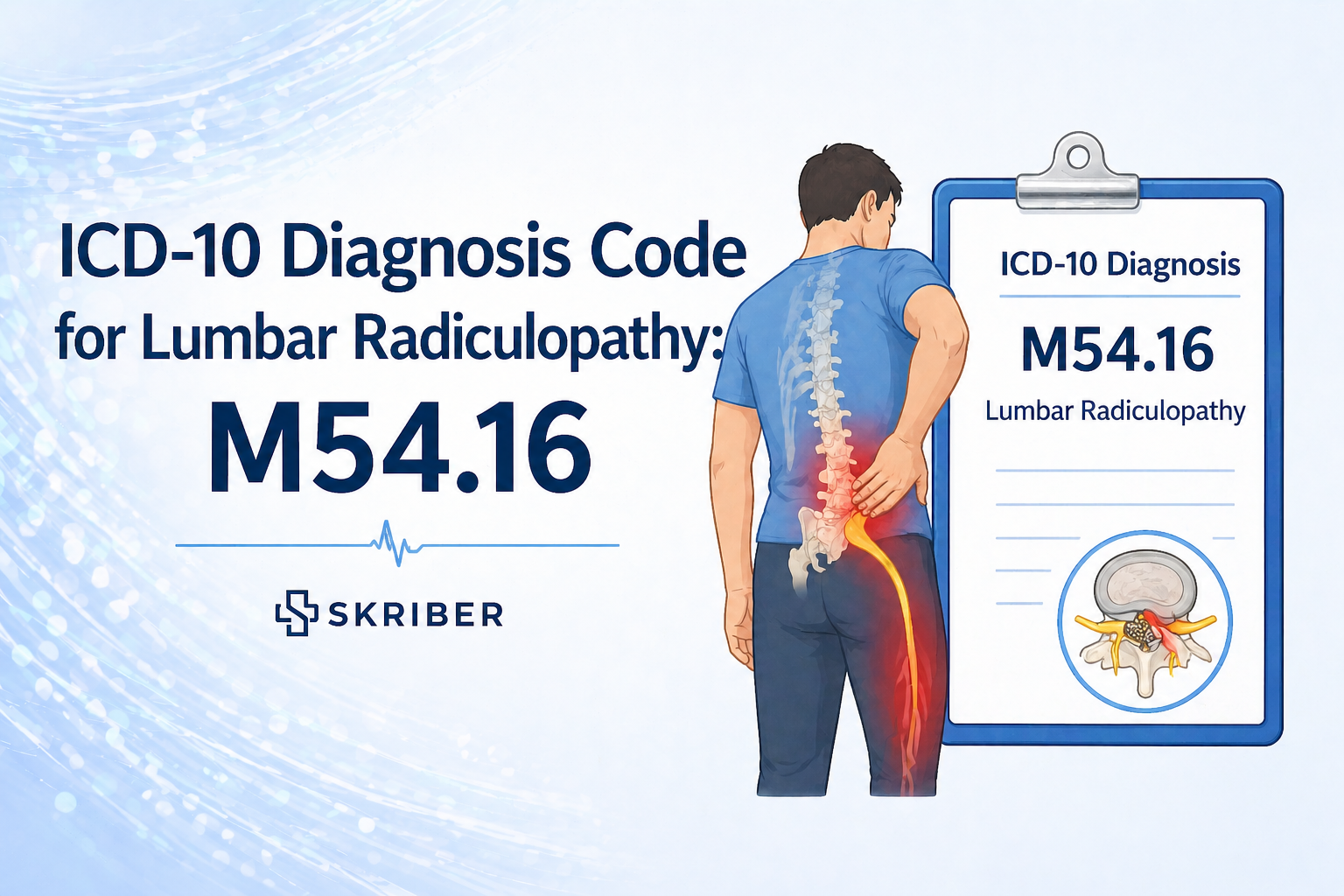
ICD-10 code M54.50 is the specific medical billing and diagnostic code designated for low back pain, unspecified. It is used by healthcare providers to document patients presenting with pain in the lumbar region when a more specific diagnosis—such as sciatica, disc displacement, or spondylosis—cannot be confirmed through clinical evaluation, imaging, or physical examination during the 2026 reporting period.
The Role of M54.50 in Clinical Documentation
In the landscape of modern medicine, accurate diagnostic coding is the foundation of the administrative healthcare system. ICD-10, or the International Classification of Diseases, 10th Revision, serves as the global standard for recording health information. Within this framework, M54.50 falls under the "Dorsalgia" category (M54), which encompasses various forms of back pain.
The "M54.50" designation specifically denotes "Low back pain, unspecified." The inclusion of the "0" at the end is a crucial detail, indicating the non-specific nature of the condition. For clinicians, this code acts as a necessary placeholder when a patient exhibits symptoms of back pain that do not meet the criteria for more definitive classifications. It is important to recognize that coding M54.50 is not an admission of medical ignorance, but rather a reflection of the reality that many musculoskeletal conditions present with generalized pain that may resolve with conservative management before a precise anatomical cause is identified.
Clinical Context and Diagnostic Prerequisites
Before a physician applies M54.50, they typically conduct a series of clinical assessments to rule out "red flag" conditions. These include checking for signs of cauda equina syndrome, malignancy, infection, or fracture. The clinical workflow for a patient presenting with low back pain usually involves:
- Patient History: Evaluating the duration, intensity, and nature of the pain, as well as any history of trauma or systemic symptoms such as fever or unexplained weight loss.
- Physical Examination: Assessing range of motion, neurological function, muscle strength, and reflexes.
- Red Flag Screening: Determining if the patient exhibits symptoms that require immediate intervention, which would necessitate different, more specific coding.
When these screenings are completed and the provider determines the pain is mechanical or idiopathic without clear evidence of localized pathology like a herniated disc, M54.50 becomes the appropriate billing code. In 2026, healthcare facilities are under strict requirements to ensure that the medical record (the SOAP note) supports the diagnostic code provided. If the documentation does not describe a localized or specific cause for the lumbar pain, the biller relies on the unspecified nature of the condition to maintain accurate statistical reporting.
Distinguishing M54.50 from Related Codes
It is common for healthcare providers to confuse M54.50 with other codes related to lumbar pain. The primary reason for this confusion is the overlap in symptoms. However, ICD-10 guidelines are rigorous regarding the hierarchy of coding. If a provider finds evidence of a specific condition, they are required to use the more precise code.
| ICD-10 Code | Description | Clinical Context |
|---|---|---|
| M54.50 | Low back pain, unspecified | Generalized lumbar pain without specific diagnosis. |
| M54.51 | Vertebrogenic low back pain | Pain originating from the vertebral structures. |
| M54.59 | Other low back pain | Pain attributed to other specified, non-vertebrogenic causes. |
| M54.3x | Sciatica | Pain radiating along the sciatic nerve. |
| M51.x | Thoracic, thoracolumbar, and lumbosacral IVD disorders | Diagnosed disc herniation or degeneration. |
As of 2026, the distinction between M54.50 and M54.51 (vertebrogenic) is particularly relevant. The Centers for Medicare & Medicaid Services (CMS) and other private payers increasingly look for clinical specificity. Using M54.50 when a more specific diagnosis is supported by imaging (such as an MRI) can lead to claims processing delays or requests for additional documentation.
The Impact on Insurance Claims and Reimbursement
For the patient and the healthcare provider, the selection of M54.50 has direct financial implications. Insurance companies use these codes to determine "medical necessity" for treatments such as physical therapy, chiropractic care, or specialized imaging like lumbar spine MRIs.
When M54.50 is used, payers may be more cautious. Because the diagnosis is "unspecified," the insurance carrier might require the provider to demonstrate that they have attempted conservative care—such as physical therapy or anti-inflammatory medication—before authorizing expensive diagnostic procedures. Providing clear documentation alongside the M54.50 code is essential. For instance, documenting the patient’s inability to perform activities of daily living (ADLs) or the failure of initial conservative treatment plans provides the context needed to justify the diagnostic pathway.
Documentation Requirements for 2026
In 2026, the push for high-quality, high-fidelity documentation remains a priority for audit protection. To ensure that an encounter coded with M54.50 withstands a potential audit, the clinician should include:
- Chronicity: Whether the condition is acute, chronic, or recurrent.
- Functional Limitations: Specific descriptions of how the pain limits the patient’s mobility.
- Treatment Plan: A clear outline of the intended management, whether it be pharmaceutical, therapeutic, or a watchful waiting strategy.
- Negative Findings: Explicitly noting that common, more specific causes were evaluated and ruled out based on the current clinical findings.
Failure to include these details can lead to claim denials. If a chart reflects only the code M54.50 without supporting clinical narrative, the provider may face "insufficient documentation" notices from billing intermediaries.
Addressing Common Patient Questions
Patients often wonder why their physician uses an "unspecified" code. It is useful to explain that this is a standard industry practice designed for billing transparency, not a reflection of the severity of the patient's condition.
Frequently Asked Questions
1. Does using M54.50 mean my condition is not serious? Not necessarily. It simply means that at the time of the visit, the healthcare provider did not find a specific structural cause (like a fracture or disc protrusion) that requires a more granular label. Many patients with severe, disabling pain are coded as M54.50 because their pain is muscular or ligamentous in origin, which is often difficult to visualize on standard scans.
2. Why do insurance companies ask for more information after I am given this code? Because M54.50 is broad, insurance companies often want to ensure that the treatment requested (like an MRI or a referral to a specialist) is truly necessary. They are looking for evidence that the provider has explored the condition thoroughly and is acting in the patient's best interest.
3. Will my coverage change if my doctor changes the code later? Yes, it is common for codes to change as a diagnosis becomes more refined. If your condition is later identified as a specific lumbar issue, your doctor will update your record to a more precise code. This does not impact your overall coverage eligibility, but it may affect how your insurance processes specific claims for advanced imaging or physical therapy.
4. Is M54.50 the same as "chronic back pain"? Not exactly. M54.50 refers to the location and lack of specificity of the pain. Chronicity is usually documented by the physician in the narrative of the note or by adding an additional code to indicate the duration of the pain, separate from the diagnostic code itself.
5. Can I ask my doctor to change the code if I disagree with it? You should always discuss your diagnosis with your healthcare provider. If you feel that your pain is being mischaracterized, ask your doctor to explain the diagnostic process and why they chose a specific code. They can provide clarification on what the medical record indicates and how they arrived at that classification based on their clinical findings.
Expert Recommendations for Patients and Providers
For healthcare providers, the recommendation for 2026 remains constant: prioritize clinical specificity. While M54.50 is a valid and useful code, it should be the final option after a thorough clinical assessment. Regularly reviewing the medical record to ensure that the narrative justifies the chosen code will minimize the administrative burden of claim denials.
For patients, understand that the billing code is a tool for administrative organization. If you are experiencing persistent back pain, focus your dialogue with your physician on the nature of your symptoms, your physical limitations, and your goals for recovery. By focusing on the clinical reality of the pain, you ensure that even if the code used is "unspecified," your health record remains a comprehensive and accurate reflection of your medical needs.
The integrity of medical billing relies on the clear communication between clinical observation and administrative categorization. By adhering to the standards surrounding ICD-10 code M54.50, providers can ensure they remain compliant while continuing to provide necessary care to patients experiencing low back pain.