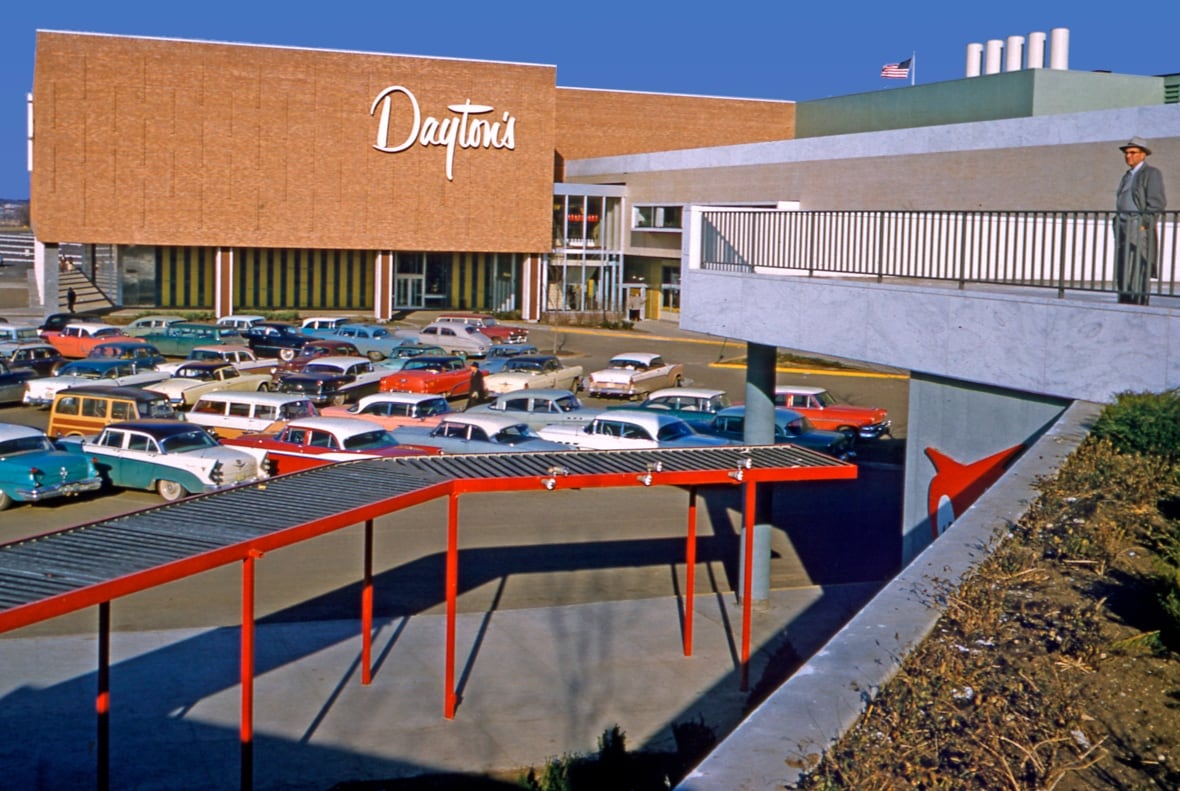
Southdale Center, which opened on October 8, 1956, in Edina, Minnesota, is the first fully enclosed, climate-controlled shopping mall in the United States. Designed by architect Victor Gruen, it revolutionized American retail by moving the traditional "Main Street" experience indoors, providing a temperature-controlled environment that shielded shoppers from the harsh Minnesota climate.
The debut of Southdale Center was not merely the opening of a large building; it was the birth of a new architectural typology that would redefine the American landscape for over half a century. To understand the significance of Southdale’s historic debut, one must look beyond the storefronts and into the social, economic, and architectural philosophies that converged in a suburb of Minneapolis during the mid-1950s.
The Visionary Philosophy of Victor Gruen
The architect behind Southdale, Victor Gruen, was an Austrian-born immigrant who viewed the burgeoning American suburban sprawl of the 1940s and 50s with a mixture of fascination and horror. Gruen believed that the car-centric design of U.S. suburbs was isolating and lacked the "social engine" of European town squares. His vision for Southdale was not intended to be a temple of consumerism, but rather a holistic community center.
Gruen’s original master plan for the Southdale site was incredibly ambitious. It included not just retail space, but also a medical center, a post office, a library, apartment buildings, and a school. He hoped that by concentrating these services in one walkable, enclosed area, he could curb the chaotic sprawl of the suburbs and provide a "third place" for people to gather outside of work and home.
While the retail component became the dominant legacy of Southdale, the concept of the integrated community hub remains a foundational principle in modern urban planning. Gruen’s focus on the pedestrian experience within the mall—using art, light, and greenery to create a pleasant atmosphere—is what eventually became known as the "Gruen Effect," a psychological state where shoppers lose track of time and their original shopping intent due to the immersive environment.
Breaking Ground: The Economic and Regional Context
The development of Southdale was spearheaded by the Dayton family, owners of the prominent Dayton’s Department Store in Minneapolis. They recognized that as their customer base moved to the suburbs, the traditional downtown shopping model was under threat. By partnering with Gruen, the Daytons sought to create a "downtown in the suburbs."
The choice of Edina, Minnesota, was strategic. Edina was a rapidly growing, affluent suburb that represented the ideal demographic for a high-end retail experiment. However, the Minnesota climate posed a significant challenge. Outdoor shopping centers, like the Country Club Plaza in Kansas City (opened in 1923), worked well in milder climates, but they were impractical during a Minneapolis winter.
The solution was a $20 million investment (a massive sum in 1956) to build a structure that could maintain a constant temperature of 72 degrees Fahrenheit year-round. This required an unprecedented HVAC system and a structural design that could support a massive roof while still feeling open and airy.
The Architectural Innovation of the Garden Court
The heart of Southdale’s historic debut was the Garden Court. This central atrium was a radical departure from any previous commercial architecture. Spanning two levels, the court was designed to simulate the outdoors while remaining indoors.
Key features of the original Garden Court included:
- Natural Lighting: A massive skylight system allowed sunlight to reach the live plants and trees.
- Art and Sculpture: The mall featured commissioned works, including Harry Bertoia’s famous "Golden Trees" screens and a 21-foot-tall birdcage filled with exotic birds.
- Vertical Circulation: Southdale was the first shopping center to utilize escalators and split-level parking to encourage shoppers to visit both levels of the mall equally.
- Acoustics and Ambiance: Fountains were installed to provide white noise, masking the sounds of thousands of shoppers and creating a serene environment.
By placing the two main anchor stores—Dayton’s and Donaldson’s—at opposite ends of the mall, Gruen forced shoppers to walk past the smaller "specialty" stores, a layout that has since become the industry standard for mall design worldwide.
Comparing Early Shopping Center Milestones
To understand why Southdale is uniquely credited as the "first" mall despite earlier shopping centers, it is helpful to compare it to its predecessors and contemporaries.
| Feature | Country Club Plaza (1923) | Northland Center (1954) | Southdale Center (1956) |
|---|---|---|---|
| Location | Kansas City, MO | Southfield, MI | Edina, MN |
| Enclosure | Fully Outdoor | Semi-Enclosed (Walkways) | Fully Enclosed |
| Climate Control | None | Limited to Stores | Total Mall Environment |
| Architect | Edward Buehler Delk | Victor Gruen | Victor Gruen |
| Primary Goal | Automobile Convenience | Regional Retail Hub | Suburban Social Center |
| Layout | Street Grid | Cluster | Integrated Atrium |
While Country Club Plaza was the first planned suburban shopping center and Northland (also designed by Gruen) was a massive regional success, Southdale was the first to achieve the "introverted" design—turning its back on the parking lot and creating a private, controlled universe inside.
The Social Impact of the 1956 Debut
When Southdale opened on October 8, 1956, an estimated 40,000 people attended the grand opening. The press hailed it as a "pleasuredome" and a "monument to the 20th century." For the first time, Americans could shop, eat, and socialize in a pristine, weather-proof environment.
The mall quickly became a cultural touchstone. It provided a safe, supervised space for teenagers—giving rise to the "mall rat" culture decades later—and a climate-controlled exercise space for "mall walkers." However, the success of Southdale had unintended consequences. As regional malls proliferated across the country, they often drained the economic life out of traditional downtown districts.
Victor Gruen himself eventually became disillusioned with his creation. By the 1970s, he famously disowned the mall concept, lamenting that developers had stripped away the community elements (the libraries, the housing, the post offices) and replaced them with "land-wasting seas of parking" and pure commercialism.
Southdale in 2026: Survival and Evolution
As of 2026, Southdale Center stands as a testament to both the peak and the resilience of the American mall. While many 20th-century malls have fallen victim to the "retail apocalypse" driven by e-commerce, Southdale has survived by returning to Victor Gruen’s original vision of a multi-use community hub.
In the early 2020s and continuing through 2026, the mall underwent a massive transformation. The loss of traditional department stores led to a diversification of the space:
- Health and Wellness: The addition of massive Life Time fitness centers and medical clinics (like the Hennepin County Service Center) has brought non-retail traffic back to the site.
- Luxury Housing: Apartment complexes have been built on the periphery of the parking lots, finally fulfilling Gruen's wish for a "live-work-play" environment.
- High-End Dining and Entertainment: The focus has shifted from "buying goods" to "experiencing services," with luxury cinemas and chef-driven restaurants replacing smaller retail stalls.
Southdale remains a vital piece of Minnesota’s economy, not just as a shopping destination, but as a historic landmark. It was added to the National Register of Historic Places, ensuring that its mid-century modern architectural bones are preserved for future generations to study.
Technical Legacy: The Blueprint for a Global Phenomenon
The technical specifications of Southdale served as the blueprint for thousands of malls globally. The use of a "double-loaded mall" (stores on both sides of a central corridor) and the "dumbbell" anchor store placement are architectural standards that originated here.
Furthermore, the integration of public art into commercial spaces, a hallmark of the 1956 debut, paved the way for the "shoppertainment" seen in modern mega-structures like the Mall of America (also located in Minnesota). Engineers still look to Southdale’s original HVAC and structural load-bearing designs as a pioneering example of how to manage massive indoor air volumes efficiently.
Frequently Asked Questions
Was Southdale Center the first shopping mall in the world?
Southdale is recognized as the first fully enclosed, climate-controlled shopping mall. Earlier examples like the Grand Bazaar in Istanbul or the Burlington Arcade in London were "enclosed" or covered, but Southdale was the first to use modern HVAC technology to create a completely artificial, year-round environment on a regional scale.
Why did Victor Gruen eventually hate shopping malls?
Victor Gruen envisioned malls as central hubs for communities that would include housing, schools, and parks. He was disappointed when developers only focused on the retail and parking aspects, which he believed contributed to the very "suburban sprawl" he was trying to prevent.
Is Southdale Center still open in 2026?
Yes, Southdale Center is still operational in 2026. It has successfully transitioned into a mixed-use facility, incorporating luxury apartments, fitness centers, and high-end dining alongside traditional retail stores like Macy’s.
How did Southdale affect the design of other malls?
Southdale introduced the "Garden Court" concept and the use of anchor stores at opposite ends of a corridor to maximize foot traffic. It also pioneered the use of escalators in a non-department store setting to move shoppers between levels.
What happened to the original art and sculptures at Southdale?
Many of the original pieces, including the Harry Bertoia "Golden Trees," have been preserved or restored. While the birdcage is no longer present in its 1956 form, the mall maintains a commitment to public art as part of its historic preservation efforts.
Practical Recommendations for Visitors and Researchers
For those interested in the history of American retail or urban planning, a visit to Southdale Center in 2026 offers a unique look at "adaptive reuse" in action.
- For Architects and Students: Visit the Minnesota Historical Society to view the original blueprints and Gruen’s master plan. Contrast the original 1956 photos with the current 2026 layout to see how retail space has been reclaimed for residential and medical use.
- For General Visitors: Look for the historical markers within the mall that detail its status as the first enclosed mall. Pay special attention to the central court, which, despite renovations, still echoes the verticality and light-filled vision of the original 1950s design.
- For Urban Planners: Study Southdale’s integration with the surrounding Edina medical district and the "walkability" scores of the new residential developments on the mall's campus. It serves as a prime example of how to densify suburban land.