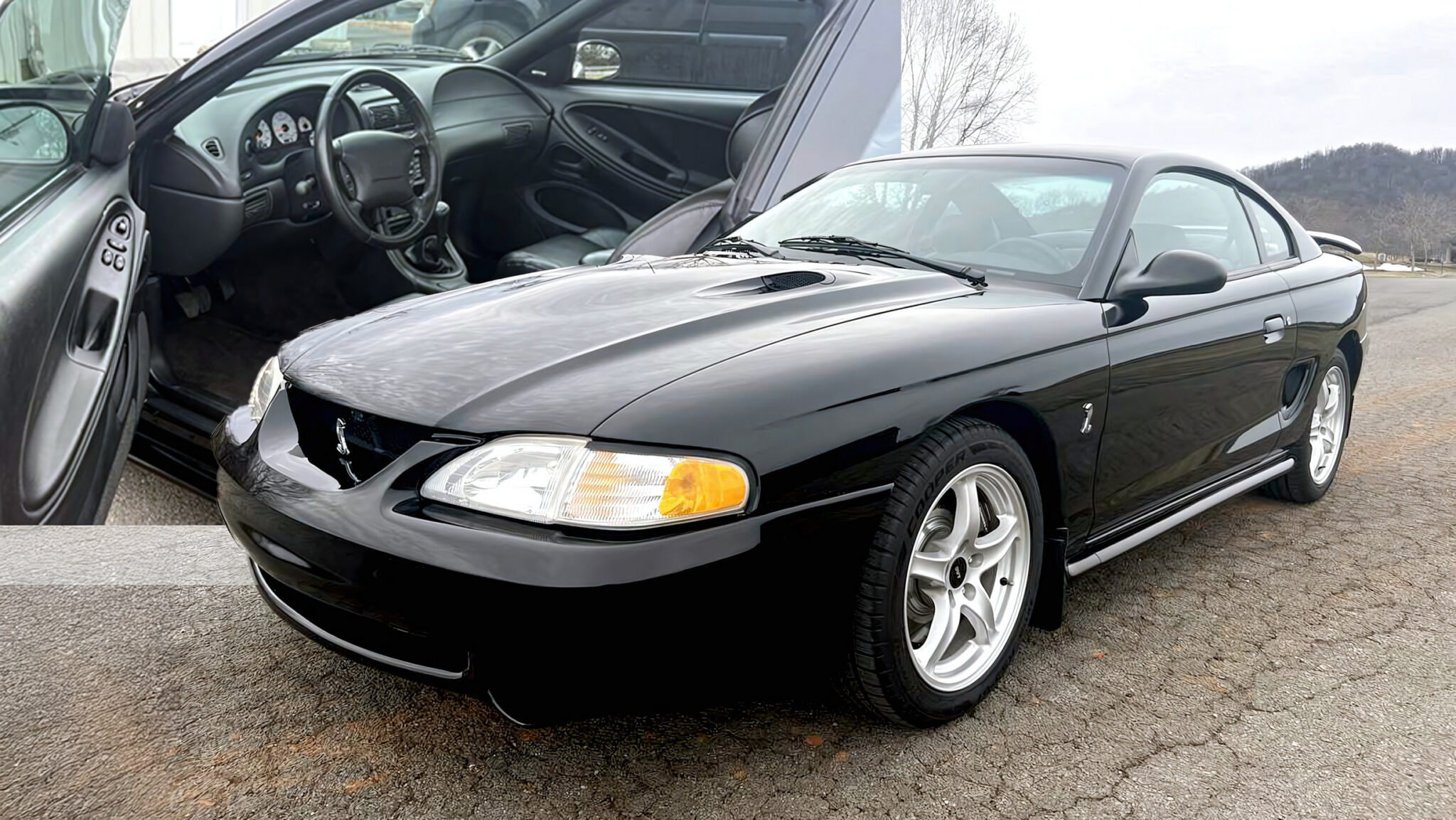
The 1996 Ford Mustang SVT Cobra produced a factory-rated 305 horsepower at 5,800 rpm and 300 lb-ft of torque at 4,800 rpm. This output represented a massive 65-horsepower increase over the previous year’s pushrod 5.0L model, signaling Ford’s definitive shift toward high-revving, double-overhead-cam (DOHC) "Modular" engine technology.
The year 1996 remains one of the most significant pivot points in the history of the Ford Mustang. It was the year the "venerable 5.0"—the small-block pushrod V8 that had defined the pony car for decades—was officially retired in favor of the 4.6L Modular V8. For the Special Vehicle Team (SVT) Cobra, this wasn't just a change in displacement; it was a total philosophical shift in how American muscle generated power. As we look back from 2026, thirty years after its debut, the 1996 Cobra stands as the bridge between the analog era of the Fox-body and the high-tech, high-RPM performance of the modern Coyote era.
The Technical Shift: From Pushrods to Dual Overheads
To understand the 1996 Mustang Cobra's horsepower in context, one must first understand the engine that produced it. Codenamed the "Modular" V8 because of its shared tooling and manufacturing processes, the 4.6L unit was a significant departure from the 302-cubic-inch V8 it replaced. While the base GT model received a 2-valve (SOHC) version, the SVT Cobra was granted the "crown jewel" of the lineup: the 4-valve DOHC variant.
The Hand-Built Heart
Every 1996 Cobra engine was hand-assembled by a two-person team at Ford’s Romeo Engine Plant. These technicians signed a small metal plaque affixed to the passenger-side valve cover—a tradition that added an element of exotic prestige to a mass-produced American car. The engine featured a high-strength aluminum block cast in Italy by Teksid, a company known for supplying Ferrari's engine castings. This "Teksid block" remains legendary in the performance community in 2026 for its ability to withstand upwards of 1,000 horsepower with the right internal upgrades.
The Power Curve
The 1996 Cobra's 305 horsepower was achieved through high-revving efficiency rather than raw displacement. Unlike the 5.0L V8, which produced peak torque very low in the RPM range, the 4.6L DOHC engine thrived at high engine speeds.
- Bore and Stroke: 90.2 mm x 90.0 mm (nearly "square")
- Compression Ratio: 9.85:1
- Valvetrain: 4 valves per cylinder, 32 valves total
- Redline: 6,800 RPM (with fuel cutout at 7,000 RPM)
This high-strung nature meant that drivers had to adjust their habits. While the old 5.0 felt "punchy" off the line, the 4.6L Cobra felt somewhat soft at low speeds, only truly coming alive once the needle passed 3,500 RPM. This characteristic was further influenced by the "B-code" cylinder heads and the Intake Manifold Runner Control (IMRC) system.
The Role of IMRC and Variable Airflow
A critical component in the 1996 Cobra’s power delivery was the Intake Manifold Runner Control (IMRC) system. Because the engine used large intake ports designed for high-RPM flow, low-end torque would have suffered significantly without intervention.
Ford engineers implemented a set of secondary butterflies in the intake runners. Below approximately 3,250 RPM, these butterflies remained closed, forcing air through a smaller primary port to maintain high air velocity and improve low-end combustion. When the engine reached the 3,250 RPM threshold, the EEC-V computer signaled the IMRC actuators to open the secondary ports, allowing the engine to breathe fully and pull hard toward its 6,800 RPM redline.
In the decades since its release, the IMRC system has become a primary point of maintenance. Carbon buildup can cause the butterflies to stick, leading to a "lazy" engine feel or check engine lights. In 2026, many owners opt for "IMRC deletes" when modifying the car, though this usually requires a tuner to prevent a loss in low-end drivability.
1996 Mustang Cobra vs. The Competition
To truly appreciate the 305 horsepower of the 1996 Cobra, we must look at what else was on the showroom floor in the mid-90s. The horsepower wars were beginning to heat up again after the stagnation of the 1980s.
| Specification | 1996 SVT Cobra | 1995 SVT Cobra | 1996 Camaro Z28 | 1996 Corvette (LT1) |
|---|---|---|---|---|
| Engine | 4.6L DOHC V8 | 5.0L OHV V8 | 5.7L LT1 V8 | 5.7L LT1 V8 |
| Horsepower | 305 hp | 240 hp | 285 hp | 300 hp |
| Torque | 300 lb-ft | 285 lb-ft | 325 lb-ft | 340 lb-ft |
| 0-60 MPH | ~5.5-5.9 sec | ~6.2 sec | ~5.7 sec | ~5.1 sec |
| 1/4 Mile | ~13.9 @ 102 | ~14.6 @ 96 | ~14.1 @ 99 | ~13.7 @ 103 |
The 1996 Cobra was a significant statement from Ford. It was the first time in years that the Mustang had a higher factory horsepower rating than the base Corvette (which sat at 300 hp for the standard LT1 engine, though the optional LT4 produced 330 hp). However, the Chevrolet Camaro Z28, with its 5.7L LT1, still held a torque advantage (325 lb-ft vs 300 lb-ft), which often made the Camaro feel faster in "stoplight-to-stoplight" racing despite the Cobra's higher peak horsepower.
Real-World Performance and Dyno Realities
While 305 horsepower was the "crank" rating provided by Ford, the power that actually reached the pavement was lower due to drivetrain loss. On a chassis dynamometer, a healthy, stock 1996 Cobra typically produces between 260 and 275 rear-wheel horsepower (RWHP).
In terms of straight-line performance, the 1996 Cobra was a consistent 13-second car in the hands of a skilled driver with good tires. Its 0-60 mph time of roughly 5.7 seconds was considered world-class for an affordable performance car in 1996. For context, as of 2026, these numbers are comparable to a modern turbocharged four-cylinder sports sedan, but the visceral experience of the high-revving V8 and the Borg-Warner T-45 5-speed manual transmission remains unique to the SN95 Cobra.
The "Mystic" Cobra and Aesthetic Context
Horsepower wasn't the only story in 1996. This was also the year of the legendary "Mystic" Cobra. Ford offered a limited run of 2,000 units featuring a color-shifting paint developed by BASF. Depending on the angle of the light, the car shifted between green, purple, blue, and gold.
The Mystic paint added a level of exclusivity that complemented the high-tech 4.6L DOHC engine. It was the first time color-shifting technology had been used on a production vehicle in North America. This aesthetic choice reinforced the idea that the 1996 Cobra was not just another Mustang, but a laboratory for Ford's most advanced technologies.
Common Modifications and Potential
In the thirty years since its release, the performance aftermarket has thoroughly explored the limits of the 1996 Cobra's 305-hp engine. Because the car is naturally aspirated and features a high-volume intake, it responds well to "the basics":
- Gears: Swapping the factory 3.27 rear-end gears for 3.73 or 4.10 gears is the most popular modification. This helps the engine get into its power band faster, compensating for the 4.6L's lack of low-end torque.
- Exhaust: The factory mid-pipe is highly restrictive. Replacing it with a high-flow X-pipe or H-pipe typically yields 10–15 RWHP and unlocks the signature "Modular" scream.
- Forced Induction: The Teksid block is a favorite for supercharging. A modest 6-8 psi of boost from a centrifugal supercharger (like a Vortech or ProCharger) can easily push a 1996 Cobra to 400-450 horsepower on stock internals.
Reliability and Longevity in 2026
If you are looking to purchase or restore a 1996 Cobra in 2026, the engine is remarkably robust, but it does have specific requirements. The DOHC valvetrain is complex and requires high-quality synthetic oil and regular changes to protect the four camshafts and the timing chains.
The most common "failure" isn't mechanical breakage, but rather cooling issues. The 1996–1998 Cobras were known for having a cooling system that was marginally sized for the heat generated by the high-revving 4-valve heads. Many owners upgrade to the larger radiator from the 2003-2004 "Terminator" Cobra or an aftermarket aluminum unit to ensure longevity, especially in warmer climates.
Frequently Asked Questions
Is the 1996 Cobra faster than a modern Mustang GT?
No. In 2026, even a base-model Mustang with a four-cylinder EcoBoost engine or a 2011+ GT with the 5.0L Coyote engine will significantly outperform a stock 1996 Cobra. The modern Coyote engine (480+ hp) is effectively the spiritual successor to the 1996's 4.6L DOHC, using the same basic architecture but with vastly superior head flow and variable valve timing. The 1996 Cobra is valued today more for its historical significance and driving "feel" than its raw speed.
Why is the 1996 engine called a "Modular" V8?
The name does not mean the engine parts are easily interchangeable like Lego blocks. Instead, it refers to the "modular" nature of the manufacturing tooling at the Romeo and Windsor plants. This tooling allowed Ford to quickly change the production line to build different versions (V6, V8, SOHC, DOHC) using the same basic machinery.
How many 1996 Mustang Cobras were produced?
Ford produced a total of 10,003 Cobras for the 1996 model year. This included 7,496 coupes and 2,507 convertibles. Of the coupes, 2,000 were the special Mystic edition, making them highly sought after by collectors in 2026.
What is the difference between the 1996 and 1995 Cobra engines?
The 1995 Cobra used a 5.0L (302ci) OHV pushrod V8 producing 240 hp. The 1996 Cobra used the 4.6L (281ci) DOHC V8 producing 305 hp. The 1996 model moved the camshafts from the block to the heads, doubled the number of valves, and moved the redline from 5,000 RPM to nearly 7,000 RPM.
Final Recommendation for Owners and Enthusiasts
The 1996 Mustang Cobra’s 305-horsepower rating was a benchmark that helped transition the American muscle car into the modern era of high-efficiency, overhead-cam performance. If you are operating or purchasing one in 2026, focus on the "health of the revs."
Ensure the IMRC system is clean and functioning to preserve the dual-nature of the power band. While it may not win many drag races against modern electric or twin-turbocharged vehicles, the 1996 Cobra offers a mechanical purity and a 7,000 RPM soundtrack that few modern cars can replicate. For those seeking more power, the "Teksid" block provides one of the strongest foundations in Ford history for aftermarket builds. Maintaining the cooling system and using high-quality lubricants will ensure this 30-year-old milestone continues to perform for years to come.