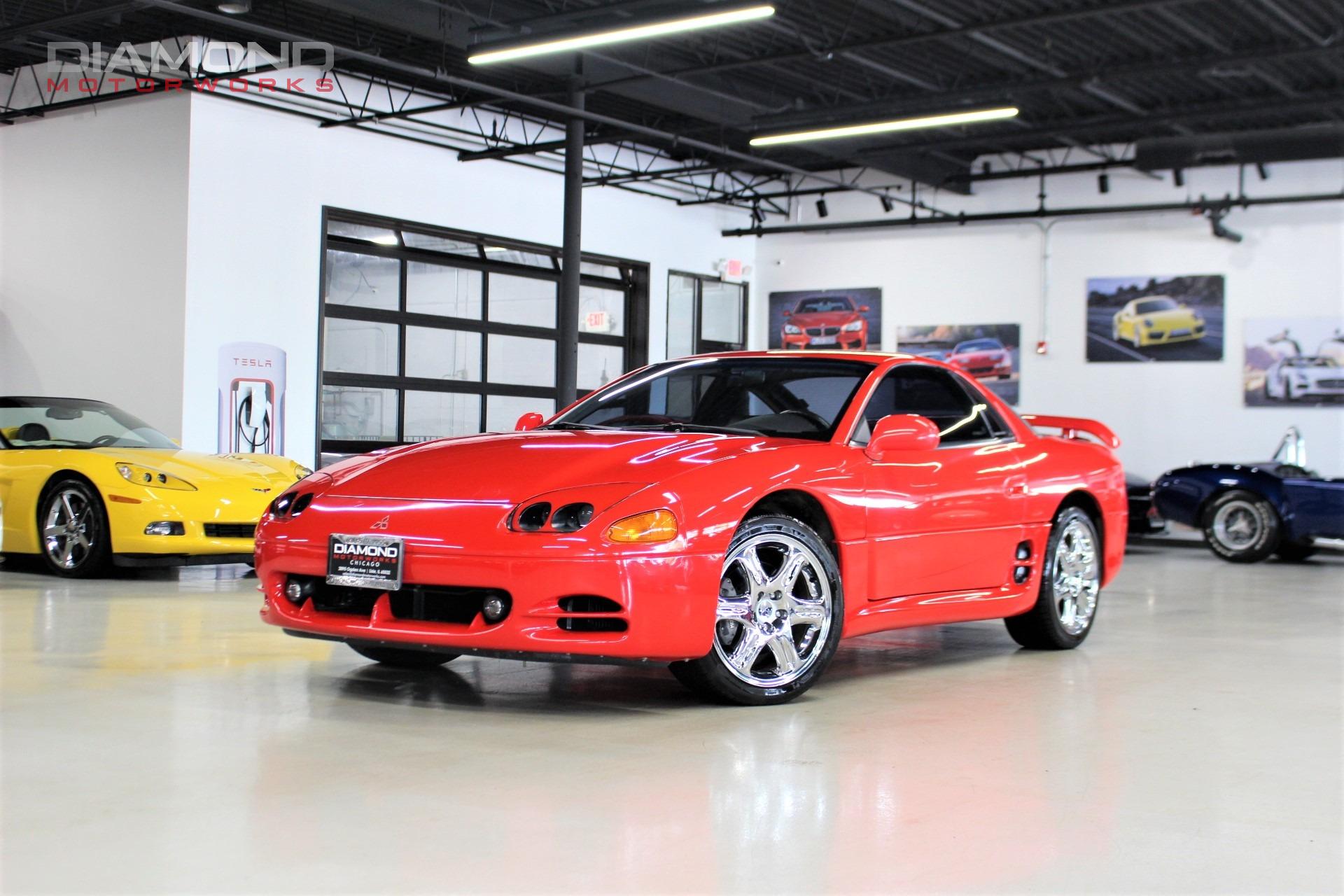
The 1995 Mitsubishi 3000GT VR-4 is a flagship sports coupe featuring a 3.0-liter DOHC 24-valve twin-turbocharged V6 engine (6G72) delivering 320 horsepower and 315 lb-ft of torque. It is equipped with a 6-speed Getrag manual transmission, full-time all-wheel drive, four-wheel steering, and "Active Aero" aerodynamics, representing the pinnacle of 1990s Japanese automotive technology.
The Engineering Philosophy of the 3000GT VR-4
To understand the 1995 Mitsubishi 3000GT VR-4, one must look at the "Bubble Economy" era of Japan, which birthed a generation of "techno-titans." While the Toyota Supra focused on raw engine strength and the Mazda RX-7 on lightweight purity, Mitsubishi took the path of maximum technological density. By 1995, the 3000GT VR-4 (known as the GTO in Japan) had matured into its second generation, refining the complex systems that made it a futuristic outlier upon its debut.
The 1995 model year is particularly significant because it sits in the sweet spot of the car's production run. It features the updated "Series 2" styling—replacing the earlier pop-up headlights with fixed projector units—and benefits from the power increase and transmission upgrades introduced in 1994. In 2026, these vehicles are viewed as sophisticated collector pieces that require a deep understanding of mechanical and electronic integration.
Powertrain and Engine Specifications: The 6G72 Heart
The centerpiece of the 1995 VR-4 is the 6G72 engine. This 3.0-liter (2,972 cc) 60-degree V6 features dual overhead camshafts (DOHC) and four valves per cylinder. Unlike the naturally aspirated base models, the VR-4 utilizes a twin-turbocharged induction system.
Turbocharging and Induction
Mitsubishi employed two small TD04-09B turbochargers, one for each cylinder bank. The choice of smaller turbos was intentional; it allowed for rapid spooling and a broader torque curve, reducing the "turbo lag" that plagued many of its contemporaries. These turbos feed through dual side-mounted intercoolers located behind the front bumper vents. In 1995, the factory boost pressure was set at approximately 9 to 11 psi, though the engine was famously overbuilt, allowing tuners to extract significantly more power with basic modifications.
Output and Performance
The 1995 VR-4 produced a formidable 320 horsepower at 6,000 rpm and 315 lb-ft of torque at 2,500 rpm. This was a 20-horsepower increase over the 1991–1993 models, achieved primarily through increased boost and a more efficient exhaust system. The flat torque curve meant the VR-4 felt exceptionally muscular in the mid-range, making it a superior grand tourer for high-speed highway cruising.
Drivetrain: Power to All Four Wheels
While many sports cars of the era were rear-wheel drive, Mitsubishi committed to a sophisticated All-Wheel Drive (AWD) system to manage the VR-4's power.
The 6-Speed Getrag Transmission
By 1995, the VR-4 was equipped with a heavy-duty 6-speed manual transmission designed by Getrag. This was a significant upgrade over the earlier 5-speed units, providing tighter gear ratios for better acceleration and a taller sixth gear for fuel-efficient cruising. This transmission is renowned for its durability, though the synchronizers require high-quality GL-4 fluid to maintain smooth shifts.
All-Wheel Drive and Torque Split
The AWD system features a center differential with a viscous coupling. Under normal driving conditions, the torque split is roughly 45% front and 55% rear, giving the car a slight rear-bias feel while maintaining the immense grip characteristic of AWD. This system allows the VR-4 to launch with incredible violence compared to its RWD rivals, often achieving 0-60 mph times in the sub-5-second range in optimal conditions.
The Four-Wheel Steering (4WS) System
One of the most complex features of the 1995 3000GT VR-4 is its Active Rear Steer system. At speeds above 30 mph, the rear wheels can turn up to 1.5 degrees in the same direction as the front wheels.
This is a hydraulic system, not electronic, tied into the power steering pump. The purpose is not to assist with tight parking maneuvers (which would require opposite-phase steering) but to increase stability during high-speed lane changes and cornering. By turning the rear wheels in phase with the front, the car effectively "glides" laterally, reducing the centrifugal force felt by the driver and keeping the chassis more composed during aggressive transitions.
Active Aero and Electronic Suspension
The 3000GT VR-4 was one of the first production cars to feature functional, speed-activated aerodynamics.
Active Aero
The system consists of two main components:
- Front Venturi Skirt: A motorized air dam under the front bumper that lowers at 50 mph to reduce under-car airflow and lift.
- Rear Spoiler: The rear wing tilts its angle of attack by 15 degrees at the same 50 mph threshold to increase downforce on the rear axle.
When the vehicle slows below 30 mph, the components retract to their "touring" positions. Drivers can also manually activate these features via a switch on the center console.
Electronically Controlled Suspension (ECS)
The VR-4 features ECS, which allows the driver to choose between "Tour" and "Sport" damping modes. The system uses sensors to monitor throttle position, steering angle, and braking force, automatically adjusting the stiffness of the struts in milliseconds to prevent brake dive and body roll. In 2026, maintaining this system is a common challenge for owners, as OEM replacement struts have become increasingly difficult to source.
1995 Visual and Exterior Refinements
The 1995 model year falls within the "Series 2" designation, which began in 1994. The most notable change was the abandonment of the pop-up headlights in favor of fixed projector-beam lamps. This change was partly due to aerodynamics and partly to meet evolving pedestrian safety regulations.
The 1995 VR-4 also features:
- 18-inch Chrome or Silver Alloy Wheels: These were a significant upgrade over the 17-inch wheels of the first generation, allowing for larger brake rotors.
- Revised Front Bumper: Larger air intakes for the intercoolers and oil cooler.
- Side Skirts and Rear Fascia: A more rounded, integrated look compared to the boxier early 90s aesthetic.
The Spyder VR-4 Variant
1995 was the inaugural year for the 3000GT Spyder VR-4, an incredibly rare and ambitious convertible. Developed in partnership with American Specialty Cars (ASC), it featured a fully retractable power hardtop—the first of its kind in the U.S. market since the late 1950s. While technically impressive, the Spyder conversion added nearly 400 lbs to the already heavy chassis, making it more of a luxury cruiser than a track-day weapon.
Interior Technology and Ergonomics
The interior of the 1995 VR-4 was designed to feel like a fighter jet cockpit. High-bolstered leather seats with power adjustments (including side bolsters and lumbar support) were standard.
Key interior features included:
- Automatic Climate Control: A digital display that was highly advanced for 1995.
- Active Exhaust Switch: This allowed the driver to toggle the exhaust note between "Tour" (quiet) and "Sport" (louder/free-flowing) via a butterfly valve in the muffler.
- Steering Wheel Controls: Integrated audio controls were standard, a luxury feature at the time.
- Boost Gauge: A factory mechanical boost gauge was integrated into the center triple-gauge pod, though it was known for being somewhat imprecise compared to aftermarket units.
Technical Specifications Summary
The following table outlines the critical technical data for the 1995 Mitsubishi 3000GT VR-4 (Coupe).
| Feature | Specification |
|---|---|
| Engine Type | 3.0L V6 DOHC 24V Twin-Turbo (6G72) |
| Horsepower | 320 hp @ 6,000 rpm |
| Torque | 315 lb-ft @ 2,500 rpm |
| Compression Ratio | 8.0:1 |
| Turbochargers | Twin Mitsubishi TD04-09B |
| Transmission | 6-Speed Getrag Manual |
| Drivetrain | Full-time AWD w/ Viscous Center Diff |
| 0-60 mph | 4.8 – 5.2 seconds |
| Top Speed | 159 mph (Electronically Limited) |
| Curb Weight | 3,737 lbs (Coupe) / 4,120 lbs (Spyder) |
| Brakes (Front) | 4-Piston Calipers, 12.3-inch Vented Rotors |
| Brakes (Rear) | 2-Piston Calipers, 11.7-inch Vented Rotors |
| Wheel Size | 18" x 8.5" |
| Fuel Tank Capacity | 19.8 Gallons |
Common Maintenance and Reliability in 2026
As these vehicles pass the 30-year mark, prospective owners and collectors in 2026 must be aware of specific maintenance requirements. The 3000GT VR-4 is a reliable car if maintained, but "deferred maintenance" is the enemy of its complex systems.
The 60k/120k Service
The most critical maintenance item is the timing belt service. This must be performed every 60,000 miles or 5 years. Because the 6G72 is an interference engine, a timing belt failure will result in catastrophic valve and piston damage. This service typically includes replacing the water pump, tensioners, and idler pulleys.
The Transfer Case Recall
Early 3000GT VR-4s were subject to a recall regarding the transfer case oil. The seals could leak, leading to the transfer case seizing and potentially locking the wheels while driving. Owners should verify that the transfer case is topped with the correct heavy-duty gear oil and check for any signs of seepage around the output shaft.
Capacitor Failure in ECUs
A common issue across 90s Mitsubishi vehicles is the leaking of electrolytic capacitors in the Engine Control Unit (ECU) and the ECS computer. Over time, these capacitors leak acid onto the circuit board, causing erratic idling, engine stalls, or the suspension defaulting to a permanent "Hard" setting. Many owners in 2026 opt for proactive "recapping" or upgrading to modern standalone ECU solutions like a Haltech or AEM.
Frequently Asked Questions
Is the 1995 3000GT VR-4 reliable for daily driving?
While the VR-4 is built with high-quality materials, its complexity makes it a challenging daily driver in 2026. The vacuum lines for the Active Aero and turbo systems, the hydraulic 4WS, and the aging electronics require frequent inspection. It is best enjoyed as a weekend performance car or a high-end collector vehicle.
How does the VR-4 compare to the 1995 Toyota Supra Turbo?
The Supra is lighter and its 2JZ-GTE engine is more famous for achieving 1,000+ horsepower on stock internals. However, the 3000GT VR-4 offers a much more sophisticated driving experience with AWD and 4WS. In wet or poor conditions, the VR-4 is significantly faster and more stable than the RWD Supra.
Why is the 1995 model year preferred by collectors?
The 1995 model is favored because it includes all the "Series 2" mechanical upgrades (320hp, 6-speed) while retaining most of the "active" features. By 1996 and 1999, Mitsubishi began removing features like Active Exhaust and Active Aero to reduce production costs and weight, making the 1995 one of the most "complete" versions of the original vision.
Can the Active Aero system be repaired?
Yes, but it is often expensive. Common failure points include the motor gears stripping or the limit switches corroding. There are specialist vendors who provide metal replacement gears to replace the factory plastic ones, which significantly increases the system's longevity.
What is the 1995 3000GT VR-4 Spyder worth in 2026?
Due to their extreme rarity (fewer than 1,000 produced across 1995-1996), Spyder VR-4s command a significant premium. In 2026, well-maintained examples often sell for double the price of the coupe, especially if the complex hardtop mechanism is in perfect working order.
Practical Recommendation for Buyers
If you are looking to acquire a 1995 Mitsubishi 3000GT VR-4 in 2026, prioritize documented maintenance history over low mileage. A car that has been driven regularly and serviced at 60,000-mile intervals is often more reliable than a "garage queen" with original 30-year-old belts and dried-out seals.
Before purchasing, perform a "boost leak test" and inspect the color of the transfer case fluid. If the Active Aero and ECS systems are still functional, it is a sign that the previous owner took the necessary steps to preserve the car’s technological heritage. These cars are no longer just "old Mitsubishis"; they are foundational pillars of the Japanese performance era and deserve a level of care commensurate with their engineering complexity.