A 1/2" BSPP (British Standard Pipe Parallel) thread, technically designated as G 1/2, has a major diameter of 20.955 mm (0.825 inches) and a thread pitch of 14 threads per inch (TPI). Because it is a parallel thread, it does not taper; it requires a bonded seal, O-ring, or washer to create a pressure-tight joint.
Understanding the 1/2" BSPP Standard in 2026
The 1/2" BSPP thread remains one of the most vital standards in global fluid power, pneumatic systems, and plumbing. Despite the push for universal metrication in some sectors, the British Standard Pipe system, specifically the parallel variant, is the dominant standard across Europe, Asia, and the Commonwealth. As of 2026, it is governed primarily by the ISO 228-1 standard, which superseded the original BS-21 standards.
A common point of confusion for those new to mechanical engineering or plumbing is the nomenclature. A "1/2 inch" BSPP thread does not actually measure 0.5 inches in any dimension. The name refers to the internal diameter (ID) of the steel pipe the thread was originally designed to fit in the 19th century. Modern 1/2" BSPP male threads actually have an outer diameter of nearly 21 millimeters.
The Whitworth Thread Profile
The 1/2" BSPP thread utilizes the Whitworth profile. This design features a 55-degree V-angle between the threads, with rounded roots and crests. This contrasts with the American NPT (National Pipe Taper) or Unified Thread Standard (UTS), which uses a 60-degree angle and flat roots/crests. The rounded nature of the Whitworth profile makes it particularly resistant to "galling" (the cold welding of threads) and provides excellent vibration resistance in hydraulic applications.
1/2" BSPP Dimensional Data Table
The following table provides the precise technical specifications for 1/2" BSPP threads. These measurements are critical for machining, identifying, or verifying fittings in industrial environments.
| Specification Parameter | Metric (mm) | Imperial (inches) |
|---|---|---|
| Nominal Size | 1/2" | 0.500" |
| Major Diameter (Outer) | 20.955 mm | 0.8250" |
| Minor Diameter (Internal) | 18.631 mm | 0.7335" |
| Pitch Diameter | 19.793 mm | 0.7793" |
| Threads Per Inch (TPI) | 1.814 (Pitch) | 14 TPI |
| Thread Angle | 55 Degrees | 55 Degrees |
| Recommended Tap Drill | 19.00 mm | 0.748" (approx. 47/64") |
| Effective Thread Length | 13.20 mm | 0.520" |
Technical Characteristics and Designations
In technical drawings and catalogs in 2026, you will rarely see "1/2 BSPP" written out. Instead, standardized codes are used to define the fit and the type.
The "G" Designation
BSPP threads are officially known as "G" threads. Therefore, 1/2" BSPP is labeled as G 1/2. If you see a drawing calling for a "G 1/2 A" or "G 1/2 B," it refers to the tolerance classes:
- Class A: Tighter tolerances for high-precision applications.
- Class B: Standard tolerances for general plumbing and hydraulic use.
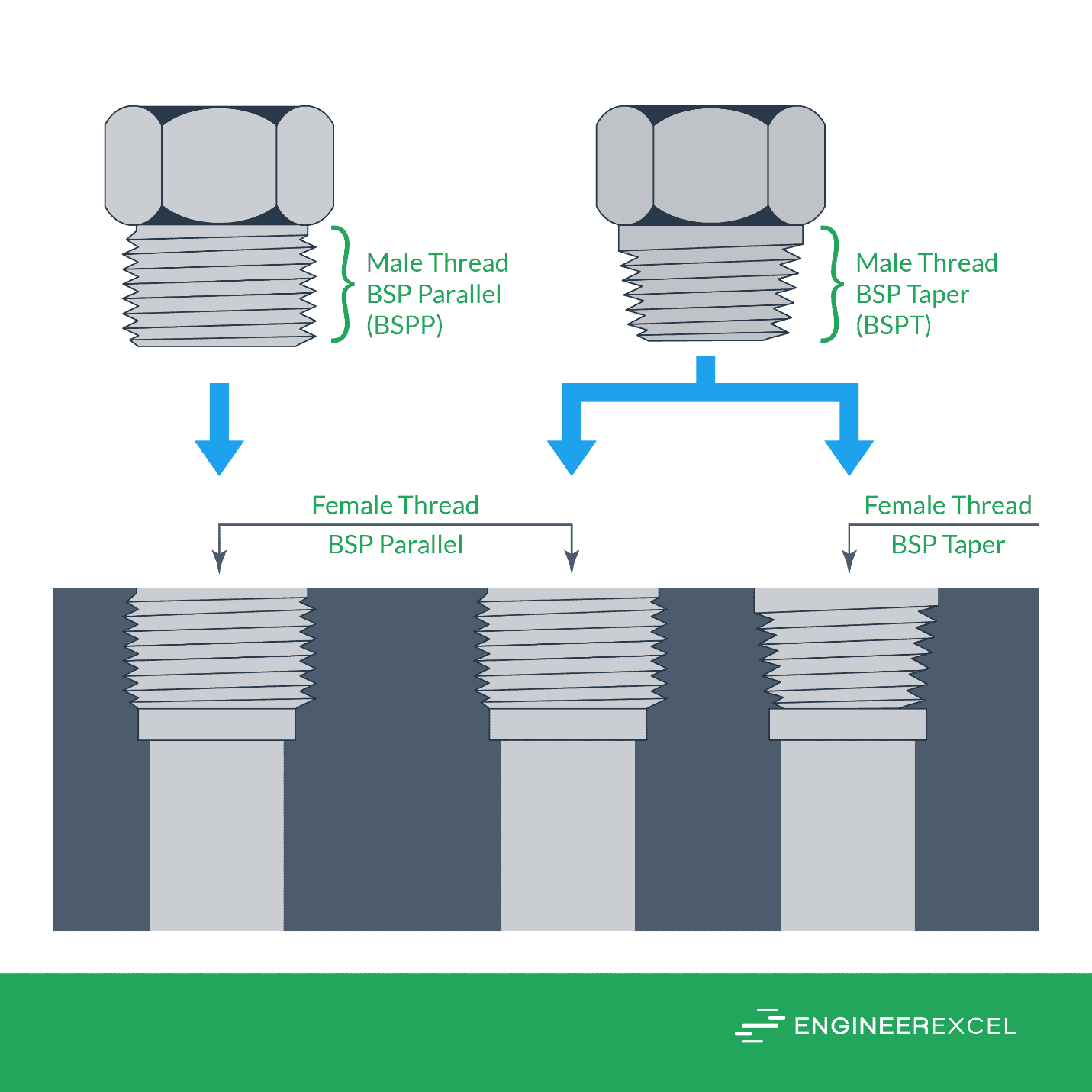
Parallel vs. Tapered (BSPP vs. BSPT)
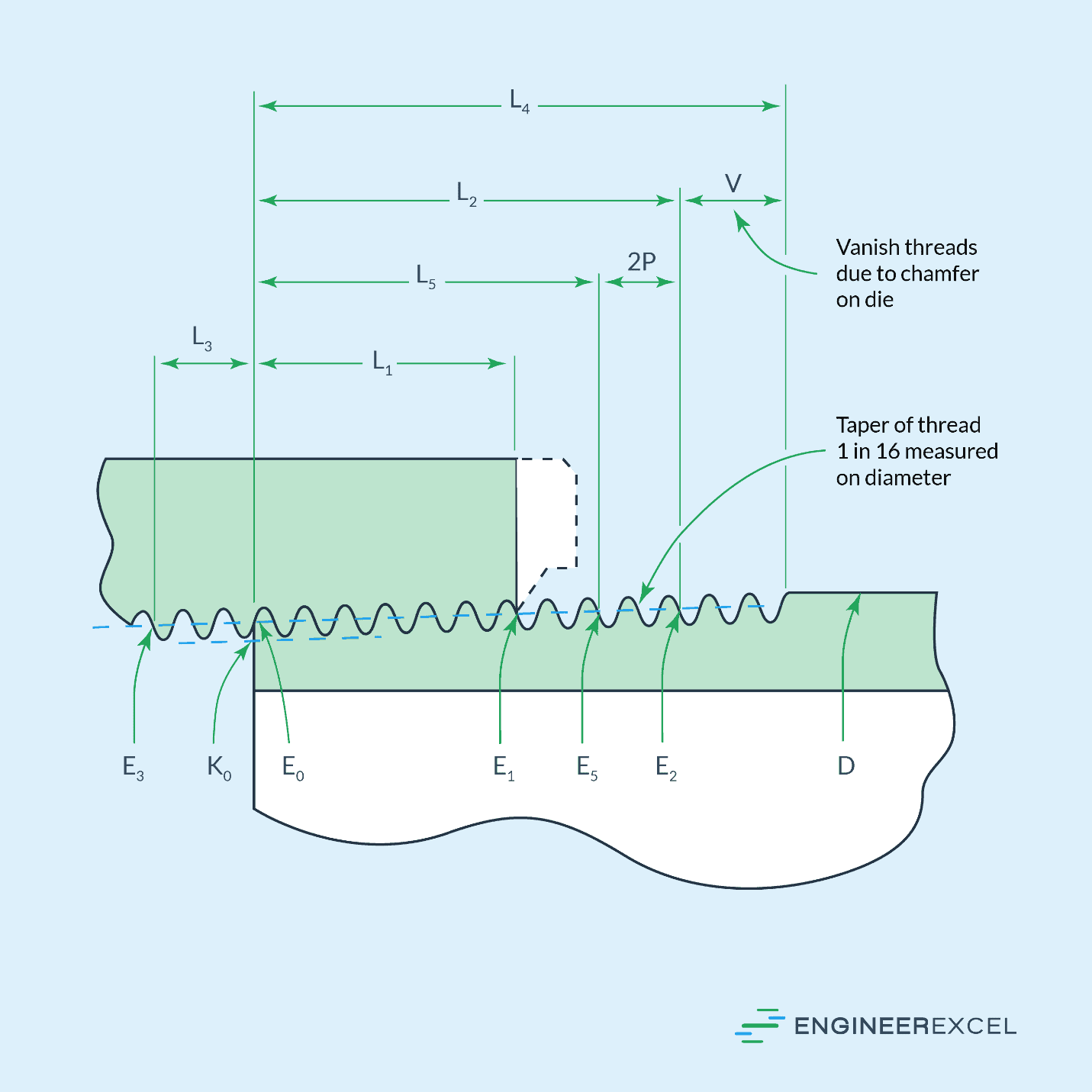
It is critical to distinguish 1/2" BSPP from 1/2" BSPT (British Standard Pipe Tapered). While both share the same 14 TPI and 55-degree angle, BSPT threads (designated as R or Rc) get narrower toward the end of the fitting. A BSPP male thread will screw into a BSPP female port until it bottoms out on a seal. A BSPP male should never be forced into a BSPT female port unless a specific adapter is used, as the sealing mechanisms are fundamentally different.
How to Identify and Measure a 1/2" BSPP Thread
If you are in the field and need to verify if a fitting is 1/2" BSPP, follow this systematic approach using a caliper and a thread pitch gauge.
Step 1: Measure the Outer Diameter
Using a digital caliper, measure the outside diameter (OD) of the male thread. If the reading is approximately 20.9 mm to 21.0 mm, you are likely looking at a 1/2" nominal pipe size. If the measurement is significantly smaller (around 16.6 mm) or larger (around 26.4 mm), it is likely a 3/8" or 3/4" BSP thread, respectively.
Step 2: Verify the Pitch
Use a thread pitch gauge to confirm the TPI. For a 1/2" BSPP thread, the gauge must be the 14 TPI leaf. Ensure the teeth of the gauge seat perfectly into the valleys of the thread without any light showing through. Because 1/2" NPT (American) uses 14 TPI as well, the pitch alone is not enough to distinguish them; you must also check the thread angle (55° for BSPP vs 60° for NPT) and the lack of taper.
Step 3: Check for Taper
Run the calipers down the length of the thread. In a BSPP thread, the diameter will remain constant from the start to the end. If the diameter decreases toward the tip, you have a BSPT (Tapered) thread.
Sealing Mechanisms for 1/2" BSPP
Because BSPP is a parallel thread, the threads themselves do not form a seal. They merely provide the mechanical force necessary to compress a sealing element. There are four primary ways to seal a G 1/2 connection:
- Bonded Seals (Dowty Washers): This is the most common method in hydraulics. A metal ring with an internal rubber lip is placed over the male thread. When tightened, the rubber compresses against the flat face of the female port.
- O-Rings with Retaining Rings: Often used in high-pressure blocks, an O-ring sits in a machined groove or is held by a washer to prevent extrusion.
- Copper or Aluminum Washers: Common in automotive and low-pressure fluid systems. The soft metal deforms to fill imperfections between the two flat surfaces.
- Cutting Face (Type E): Some male fittings have a sharp edge machined into the shoulder that "bites" into the face of the female port to create a metal-to-metal seal.
Pro-Tip: Never use PTFE (Teflon) tape on BSPP threads. Unlike tapered threads where the tape helps seal the thread interface, tape on a parallel thread can interfere with the mechanical seating of the actual seal (the washer or O-ring) and can lead to fragments entering the hydraulic system.
Applications and Industry Usage
In 2026, the G 1/2 thread size is ubiquitous across several specialized sectors:
- Hydraulic Power Units (HPUs): Used for medium-flow return lines and pressure ports on valves.
- Pneumatic Manifolds: 1/2" BSPP is a standard size for air preparation units (filters, regulators, and lubricators).
- Industrial Cooling: Used in water-cooled machinery for plastic injection molding and server room heat exchangers.
- Commercial Food Equipment: Found in espresso machines, large-scale steamers, and brewery plumbing due to the ease of sanitation provided by the parallel thread and flat-face seals.
Manufacturing and Material Standards
The performance of a 1/2" BSPP thread is heavily dependent on the material from which it is machined. According to current ISO standards, these threads are typically produced in:
- Carbon Steel (11SMnPb30): Usually zinc-plated or zinc-nickel plated to prevent corrosion.
- Stainless Steel (316L): Preferred in marine environments and chemical processing to prevent rust and chemical degradation.
- Brass: Standard for low-pressure water and pneumatic systems where weight and cost are factors.
When machining these threads, the "Tapping Drill" size is vital. While the theoretical minor diameter is 18.631 mm, a 19.0 mm drill is the standard industry recommendation. This allows for approximately 75% to 80% thread engagement, which provides maximum strength without putting excessive stress on the tap or risking "chip-clogging" during the machining process.
1/2" BSPP vs. 1/2" NPT: The Danger of Interchanging
One of the most dangerous mistakes in mechanical assembly is attempting to force a 1/2" NPT male into a 1/2" BSPP female (or vice versa).
- Pitch Conflict: Both use 14 TPI, which makes them feel like they might fit initially.
- Angle Conflict: The 60-degree NPT thread will not seat correctly in the 55-degree BSPP valley.
- The "Cross-Thread" Trap: You might get 2 or 3 turns in before the threads jam. If forced with a wrench, the threads will deform, destroying the fitting and potentially causing a catastrophic failure under pressure.
Always use a thread adapter (e.g., a "G 1/2 Male to 1/2 NPT Female" adapter) if you must bridge these two standards.
Frequently Asked Questions
Is G 1/2 the same as 1/2 BSPP?
Yes. "G" is the ISO 228-1 designation for British Standard Pipe Parallel threads. The "1/2" refers to the nominal size. Therefore, G 1/2 and 1/2" BSPP are identical.
What is the major diameter of a 1/2 BSPP thread in mm?
The major diameter (the widest part of the male thread) is 20.955 mm. In practical field measurements with a caliper, you will typically see readings between 20.85 mm and 20.96 mm.
Can I use a 1/2 BSPP male in a 1/2 BSPT female?
Generally, no. A BSPP male thread is designed to bottom out on a seal. A BSPT female port is designed to get tighter as the male thread goes deeper. If you put a parallel male into a tapered female, it may only engage a few threads and will likely leak because there is no flat surface for a bonded seal to press against.
Why is it called 1/2 inch if the diameter is 21mm?
The "1/2 inch" refers to the historical internal diameter of the pipe. Because old pipes had thick walls, the outside diameter had to be much larger (around 0.825 inches) to maintain a 0.5-inch flow path. Modern pipes have thinner walls, but the thread standard remains unchanged to ensure backward compatibility.
What size drill bit do I need for a 1/2 BSPP tap?
For most industrial applications, a 19.0 mm drill bit is recommended. If you are working with very soft materials or require a very high-strength thread with more engagement, an 18.8 mm bit can be used, but this increases the risk of tap breakage.
Final Recommendations for Implementation
When working with 1/2" BSPP threads in 2026, verification is your best defense against system failure.
- Standardize Your Tools: Ensure your maintenance team has dedicated Whitworth thread gauges separate from their Metric or Unified gauges.
- Inspect the Sealing Face: Since BSPP relies on the face of the port for sealing, any scratches or burrs on the flat surface of the female port will cause a leak, regardless of how tight the fitting is.
- Check the Tolerance Class: For high-vibration aerospace or hydraulic systems, always specify Class A tolerances to ensure the most secure fit possible.
- Use Correct Torque: Unlike tapered threads, which are tightened until they "feel" tight, parallel threads should be tightened to specific torque values based on the type of bonded seal used. Over-tightening can crush the seal and cause it to fail prematurely.
By adhering to these dimensions and mechanical principles, you ensure the longevity and safety of your fluid systems, maintaining the high standards expected in modern engineering.