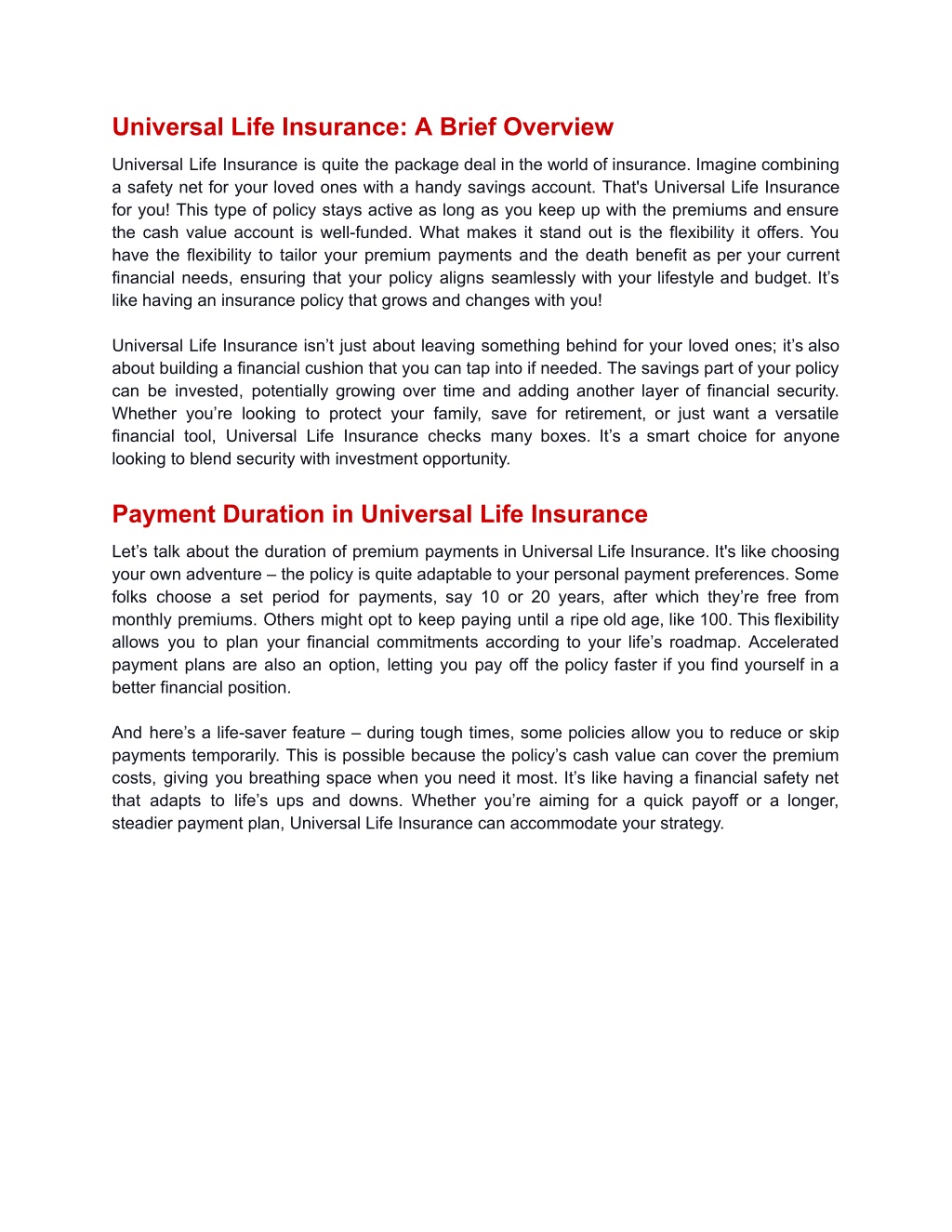
A universal life insurance policy is a form of permanent life insurance that offers the twin benefits of a death benefit and a cash value accumulation component. Unlike traditional whole life insurance, universal life provides significant flexibility, allowing policyholders to adjust their premium payments and death benefits over time to suit their changing financial circumstances.
As we navigate the financial landscape of 2026, universal life (UL) insurance remains a cornerstone of sophisticated financial planning. It is often described as an "unbundled" policy because it separates the protection element (the cost of insurance) from the savings element (the cash value). This transparency allows you to see exactly how your premiums are being allocated—how much is going toward the death benefit, how much is being swallowed by administrative fees, and how much is being invested to grow your wealth.
Understanding the Core Mechanics of Universal Life Insurance
To grasp what a universal life insurance policy means for you, it is essential to understand its internal engine. Most life insurance products are rigid; you pay a set premium for a set benefit. Universal life breaks this mold by introducing a flexible structure built on three main pillars: the premium, the cash value, and the death benefit.
When you pay a premium into a universal life policy, the insurance company first deducts the "cost of insurance" (COI) and various administrative fees. The COI is the minimum amount required to keep the death benefit active and is based on your age, health, and the net amount at risk to the insurer. The remaining portion of your premium is credited to the policy's cash value account.
This cash value account then earns interest based on the specific type of UL policy you own. Some policies offer a fixed interest rate declared by the insurer, while others link growth to market indexes or sub-accounts. Over time, the interest earned on the cash value is credited back to the account, where it grows on a tax-deferred basis. This means you do not pay taxes on the gains as long as they remain within the policy, a significant advantage for long-term wealth accumulation.
The Flexibility of Premium Payments
One of the most defining characteristics of universal life insurance is premium flexibility. In a traditional whole life policy, missing a payment can lead to a policy lapse. In a universal life policy, you have the ability to increase, decrease, or even skip premium payments entirely, provided the cash value is sufficient to cover the monthly COI and administrative charges.
For a young professional in 2026, this flexibility means the policy can adapt to life stages. During high-income years, you might overfund the policy to maximize tax-deferred growth. Conversely, if you face a temporary job loss or a significant capital expense like a home renovation, you can reduce your premiums to the bare minimum or stop them for a period, allowing the accumulated cash value to pay for the insurance coverage. However, this flexibility requires diligent management; if the cash value is depleted, the policy will lapse, and the coverage will vanish.
The Death Benefit and Its Adjustability
The second major component of the universal life definition is the adjustable death benefit. Most UL policies allow you to change the face amount of the policy as your needs evolve. If you get married or have children, you may request an increase in the death benefit (which typically requires a new medical exam or "evidence of insurability").
If your children reach adulthood and your mortgage is paid off, you might choose to decrease the death benefit. Reducing the death benefit lowers the cost of insurance (COI), which in turn allows more of your premium to remain in the cash value account. This makes universal life a dynamic tool rather than a static contract, capable of shrinking or growing alongside your liabilities and legacy goals.
The Different Types of Universal Life Insurance
Not all universal life policies are created equal. Depending on your risk tolerance and financial objectives, you might choose one of the following variations:
Traditional Universal Life (Fixed UL)
This is the most straightforward version. The cash value earns interest at a rate set by the insurance company, often with a guaranteed minimum (e.g., 2% or 3%). It offers more stability than market-linked versions but generally provides lower upside potential.
Indexed Universal Life (IUL)
In 2026, IUL policies remain highly popular. The interest credited to the cash value is linked to the performance of a financial index, such as the S&P 500. While your money is not directly invested in the stock market, the insurer uses a formula (often involving "caps" and "participation rates") to determine your gains. Crucially, IUL policies typically offer a "floor" (usually 0%), ensuring that your cash value does not decrease even if the market crashes, though the cost of insurance will still be deducted.
Variable Universal Life (VUL)
VUL policies allow you to invest the cash value directly into sub-accounts that function like mutual funds. This offers the highest growth potential but carries the most risk. If the underlying investments perform poorly, your cash value can decline significantly, requiring you to pay much higher premiums to keep the policy from lapsing.
Guaranteed Universal Life (GUL)
GUL is designed for those who want the permanence of whole life with the lower cost of universal life. It offers little to no cash value accumulation. Instead, it focuses on a "no-lapse guarantee," ensuring the death benefit remains in place until a specific age (often 90, 100, or 121) as long as a specific premium is paid. It is the least flexible but the most "certain" of the UL family.
Comparing Universal Life to Other Policy Types
Choosing the right insurance requires a side-by-side comparison of how these structures function in practice.
| Feature | Term Life Insurance | Whole Life Insurance | Universal Life Insurance |
|---|---|---|---|
| Duration | Temporary (10–30 years) | Permanent (Life) | Permanent (Life) |
| Premiums | Fixed & Affordable | Fixed & High | Flexible |
| Cash Value | None | Guaranteed Growth | Variable/Market-Linked |
| Death Benefit | Fixed | Fixed | Adjustable |
| Complexity | Low | Moderate | High |
| Suitability | Income replacement | Estate liquidity | Flexible wealth planning |
What Universal Life Insurance Means for You in 2026
When considering a universal life policy today, you must look beyond the basic definition and evaluate how it interacts with your broader financial ecosystem.
Tax Advantages and Wealth Transfer
Universal life insurance offers three primary tax benefits. First, the death benefit is generally paid to beneficiaries free of federal income tax. Second, the cash value grows tax-deferred. Third, you can often access the cash value through policy loans that are not treated as taxable income, provided the policy remains in force.
In the current 2026 tax environment, following the sunset or adjustment of various tax provisions from previous years, using life insurance as a "tax-advantaged bucket" has become a vital strategy for high-net-worth individuals seeking to mitigate future tax rate increases.
Supplementing Retirement Income
Many policyholders use the cash value of a universal life policy as a source of supplemental retirement income. By overfunding the policy in earlier years, you build a substantial reserve. During retirement, you can take withdrawals (up to your "basis" or the amount you paid in) or loans against the death benefit to fund your lifestyle. Because these loans are not considered income, they do not trigger higher tax brackets or impact Social Security taxation in the same way 401(k) withdrawals might.
The Risk of Policy Lapse
The "what it means for you" aspect of universal life includes a significant warning: management is mandatory. Because the cost of insurance (COI) increases as you get older, the internal expenses of the policy will naturally rise. If the interest earned on your cash value does not keep pace with these rising costs, the policy will begin to eat into its own principal.
If the cash value hits zero, the policy enters a grace period and will eventually lapse. In 2026, with shifting interest rates, it is more important than ever to request "in-force illustrations" from your insurer annually. These documents project the future of your policy based on current performance, allowing you to adjust your premiums before a crisis occurs.
Key Considerations Before Purchasing
Before committing to a universal life policy, you should evaluate the following technical and financial factors:
- Surrender Charges: Most UL policies have a surrender charge period lasting 10 to 15 years. If you cancel the policy early, the insurer will deduct a significant fee from your cash value. This is a long-term commitment.
- Internal Expenses: Beyond the COI, universal life policies often include premium load fees, monthly administrative fees, and expense risk charges. You must ensure the potential tax-deferred growth outweighs these costs.
- Interest Rate Environment: For traditional UL, the "current" interest rate offered by the insurer is critical. In 2026, as interest rates stabilize, you should compare the insurer's declared rate against other low-risk vehicles.
- The "MEC" Limit: If you put too much money into a life insurance policy too quickly, the IRS classifies it as a Modified Endowment Contract (MEC). Once a policy becomes a MEC, it loses many of its tax advantages, and withdrawals are taxed on a "last-in, first-out" basis.
Practical Steps to Verify and Select a Policy
If you are considering a universal life policy, follow these steps to ensure the product aligns with your goals:
- Review Financial Strength Ratings: Only purchase from companies with high ratings (A or better) from agencies like A.M. Best, Moody's, or Standard & Poor's. This ensures the company can meet its long-term obligations. You can check these ratings through the National Association of Insurance Commissioners (NAIC).
- Request an Illustration: Ask for a "full ledger illustration" that shows the policy's performance at both the "current" (projected) interest rate and the "guaranteed" (minimum) interest rate. This reveals the worst-case scenario.
- Consult a Fiduciary: Because of the complexity and high commissions associated with UL products, consult with a fee-only financial advisor who does not profit from the sale of the policy.
- Understand Tax Implications: Refer to IRS Publication 525 for official guidance on how life insurance proceeds and cash value interest are treated for tax purposes.
Frequently Asked Questions
Can I withdraw money from my universal life policy?
Yes, you can typically access your cash value through withdrawals or policy loans. Withdrawals reduce your death benefit and may be taxable if they exceed the total premiums paid. Policy loans allow you to "borrow" against the death benefit; the loan accrues interest but does not require immediate repayment. However, any outstanding loan balance will be deducted from the death benefit paid to your heirs.
How is universal life insurance different from whole life?
The primary difference is flexibility. Whole life has fixed premiums, a fixed death benefit, and guaranteed cash value growth. Universal life allows you to change your premiums and death benefit and offers different ways to earn interest (such as through market indexes). Universal life is generally more complex and requires more active management than whole life.
Is the cash value in a universal life policy guaranteed?
Only a portion of it. Most UL policies have a "guaranteed minimum interest rate," but the actual growth depends on the insurer's performance or market indexes. If the internal costs of the policy exceed the interest earned and your premium payments, the cash value can actually decrease.
What happens if I stop paying premiums?
If you stop paying, the insurance company will deduct the monthly cost of insurance and fees from your accumulated cash value. As long as there is enough money in the cash value to cover these costs, your policy will remain active. Once the cash value is exhausted, the policy will lapse, and you will lose your coverage.
Is universal life insurance a good investment?
Universal life should be viewed primarily as insurance with a secondary savings component, rather than a pure investment. While the tax-deferred growth is attractive, the internal fees are often higher than those of a standard brokerage account or IRA. It is most effective for individuals who have already maximized other retirement accounts and need permanent death benefit protection.
Final Recommendation
A universal life insurance policy is a powerful, flexible financial instrument that offers more than just a death benefit. It provides a way to build tax-deferred wealth and adapt your coverage to the shifting sands of your life. However, its "unbundled" nature means the responsibility for the policy's health rests largely on your shoulders.
For 2026, the best approach is to treat your universal life policy as a dynamic part of your portfolio. Perform an annual "check-up" by reviewing your in-force illustrations and adjusting your premiums to ensure the policy remains funded well into your later years. If you value flexibility and are willing to take an active role in managing your insurance, universal life can be an excellent fit for your long-term financial strategy.