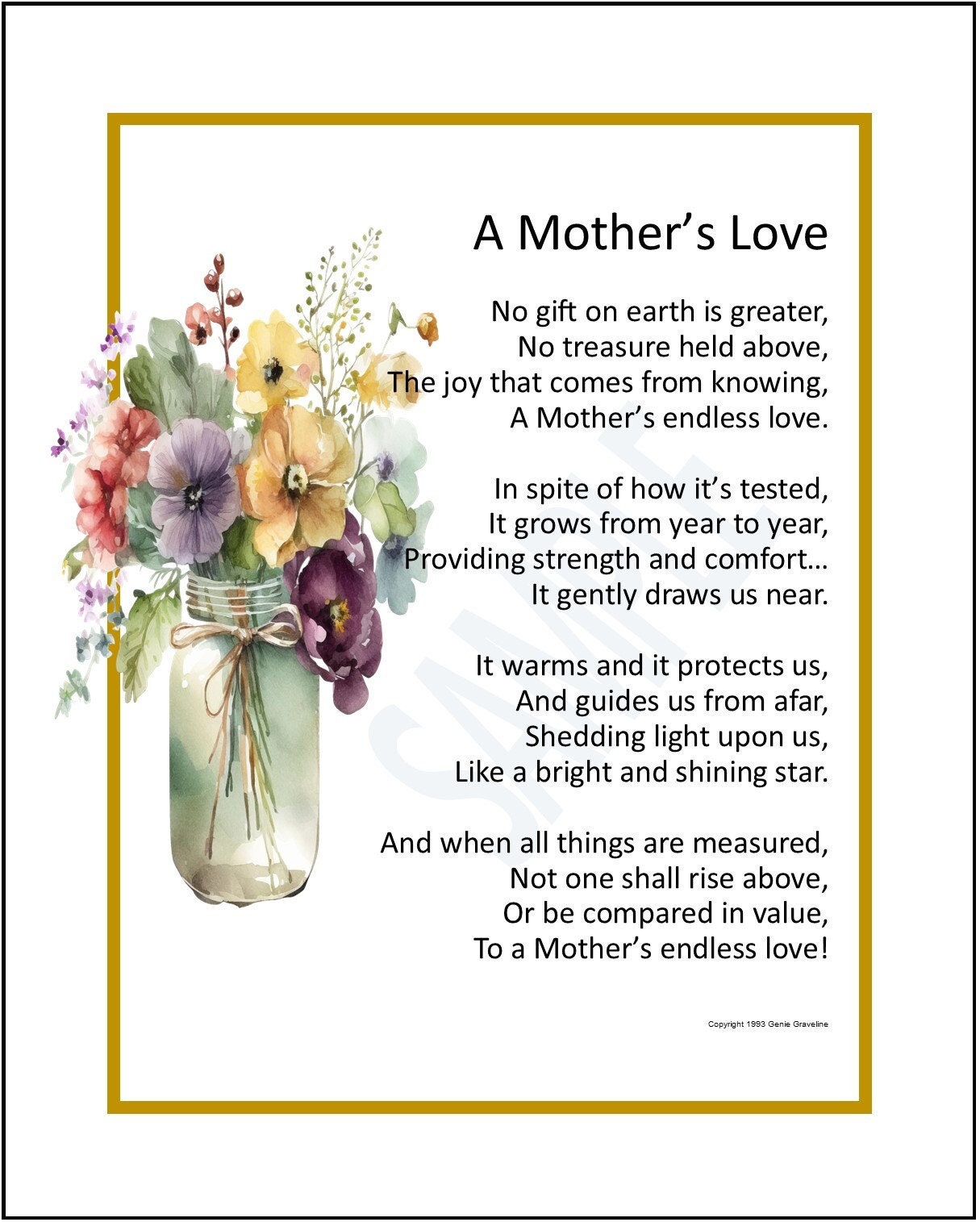
Capturing the essence of maternal devotion requires balancing sincere emotion with precise rhythmic structure. A short poem about a mother's love in verse utilizes poetic devices such as meter, rhyme, and imagery to condense complex feelings into a manageable, memorable form, serving as a powerful medium for personal expression or commemorative gifts.
Understanding the Architecture of Verse
Verse, in its simplest form, refers to writing arranged with a metrical rhythm, typically having a rhyme scheme. When crafting a poem about a mother’s love, the choice of structure dictates the poem's emotional trajectory. Unlike prose, where sentences flow according to grammatical necessity, verse forces the writer to prioritize the sonic quality of the language.
The most common structures for a short poem include the quatrain (a four-line stanza) or the couplet (two consecutive lines that rhyme). For a subject as profound as maternal love, these structures provide a necessary boundary. The constraints of a rhyme scheme, such as AABB or ABAB, act as a container for intense emotion, preventing the sentiment from becoming overwhelming or abstract. By adhering to a rhythm—such as iambic tetrameter—the poem gains a heartbeat-like quality, mimicking the fundamental connection between mother and child.
The Role of Imagery and Metaphor in Maternal Poetry
A common mistake in writing about love is the reliance on overly broad, clichéd adjectives. To create an effective piece of verse, the writer must pivot toward concrete imagery. Instead of stating that a mother is "caring," a poet might describe her hands, her voice, or the specific environment she creates.
Metaphors rooted in nature are effective because they universalize the experience of love. Consider the light of a lamp, the growth of a garden, or the shelter of a tree. These elements are easily understood by the reader, providing a stable foundation for the deeper, more complex emotions tied to motherhood. When using verse, the poet must ensure that these images fit the meter. A "rushed" image that contains too many syllables can disrupt the cadence, causing the reader to stumble, which effectively breaks the emotional immersion.
Establishing Emotional Intent and Audience
Before putting pen to paper—or finger to keyboard—the writer must identify the purpose of the verse. Is the poem intended for a card, a commemorative plaque, a speech, or a personal journal? The audience determines the technical requirements of the language.
- The Intimate Gift: If the poem is for a mother’s birthday or Mother’s Day, the verse should focus on shared memories and personal quirks. This requires specific, localized language.
- The Commemorative Piece: If the verse is for a memorial or a significant milestone (such as a 2026 anniversary celebration), the language should be elevated, focusing on the legacy of the mother’s guidance and values.
- The Universal Tribute: Poems meant for publication or public reading should avoid overly obscure personal references, opting instead for shared experiences of comfort and protection.
Technical Elements: Meter and Scansion
For those new to versification, understanding "scansion"—the analysis of a line’s rhythmic structure—is vital. In English poetry, the most natural rhythm is the iamb, consisting of one unstressed syllable followed by a stressed syllable.
Example of Iambic Meter: "The hand that rocks the cra-dle rules the world."
When writing a short poem about a mother's love, aim for consistency. If the first line has four iambs, the subsequent lines should ideally follow that same beat. This consistency creates a sense of stability, which subtly reflects the theme of maternal reliability. If the poem feels "off," it is often because an extra syllable has been added that breaks the established rhythm. Reading the poem aloud is the most effective troubleshooting technique; if you find yourself tripping over a phrase, the meter is likely inconsistent with the rest of the work.
Comparison of Poetic Forms for Maternal Themes
| Poetic Form | Structure | Best Used For | Complexity |
|---|---|---|---|
| Couplet | Two rhyming lines | Short, punchy messages | Low |
| Quatrain | Four-line stanza (ABAB) | Standard greeting cards | Moderate |
| Haiku | 5-7-5 syllable count | Minimalist imagery | High (due to brevity) |
| Limerick | AABBA rhythm | Humorous or lighthearted notes | Moderate |
Addressing Challenges in Sentimentality
One of the primary difficulties in writing about a mother’s love is the risk of falling into saccharine territory. To ensure the verse resonates with authenticity, focus on the "cost" of love—the sacrifices, the late nights, or the silent labor. By acknowledging the reality of the work involved in motherhood, the poem avoids sounding like a generic greeting card.
- Avoid: Using abstract terms like "purest love" or "brightest light" exclusively.
- Embrace: Describing the act of sacrifice. A poem that mentions a tired hand or a quiet sacrifice often carries more emotional weight than one that uses grandiose, empty adjectives.
- Balance: If the poem begins with a soft, romanticized image, balance it with a reality-based observation in the second half. This creates a "tension and release" effect that is essential for good poetry.
Steps to Drafting Your Poem
- Brainstorming: List five specific, non-obvious traits of the mother. Focus on sensory details (scent, sound of voice, way of moving).
- Drafting the Core: Write a prose sentence expressing the main message you wish to convey.
- Converting to Verse: Break the sentence into chunks of similar length. Look for words that rhyme at the end of these chunks.
- Refining the Meter: Read the lines aloud. Tap your foot to the beat. If you skip a beat, adjust the word choice to add or remove syllables.
- Editing: Remove any words that don't serve the rhythm or the imagery. If a word is there only to force a rhyme, it is usually a distraction.
Common Questions Regarding Maternal Verse
How can I make a short poem feel substantial? Focus on quality over quantity. Even a four-line poem can feel profound if it contains a strong, singular realization or a unique metaphor. Use precise nouns and strong verbs rather than relying on heavy adverbs.
Is it acceptable to break the rhyme scheme? Yes, but only if it serves the poem. Occasionally, a "slant rhyme" (where words sound similar but don't perfectly rhyme) can be more effective than a perfect rhyme, as it sounds less forced and more conversational.
What is the best way to present the poem? If the poem is a gift, typography matters. Use a clean, legible font. Avoid ornate backgrounds that compete with the text. The poem should stand alone; the layout should support, not overwhelm, the words.
Can a poem be about a difficult relationship with a mother? Absolutely. Poetry is a valid tool for exploring complex, nuanced emotions. You do not have to write a "tribute." Honest poetry about the complexity of the mother-child bond is often more compelling than idealized verse.
How do I know when the poem is "finished"? When you can no longer remove a single word without losing the meaning or the rhythm, the poem is finished. Avoid over-editing; poetry is an attempt to capture a fleeting feeling, not a technical manual.
Final Recommendation
To begin, start with a simple quatrain. Focus on one specific memory of kindness or instruction. By limiting yourself to four lines, you force a discipline that encourages clarity and impact. Once you have mastered the four-line structure, you can expand or combine ideas to create longer, more complex works. Remember that the value of the poem lies in the intention and the honesty of the observation, rather than the complexity of the vocabulary.