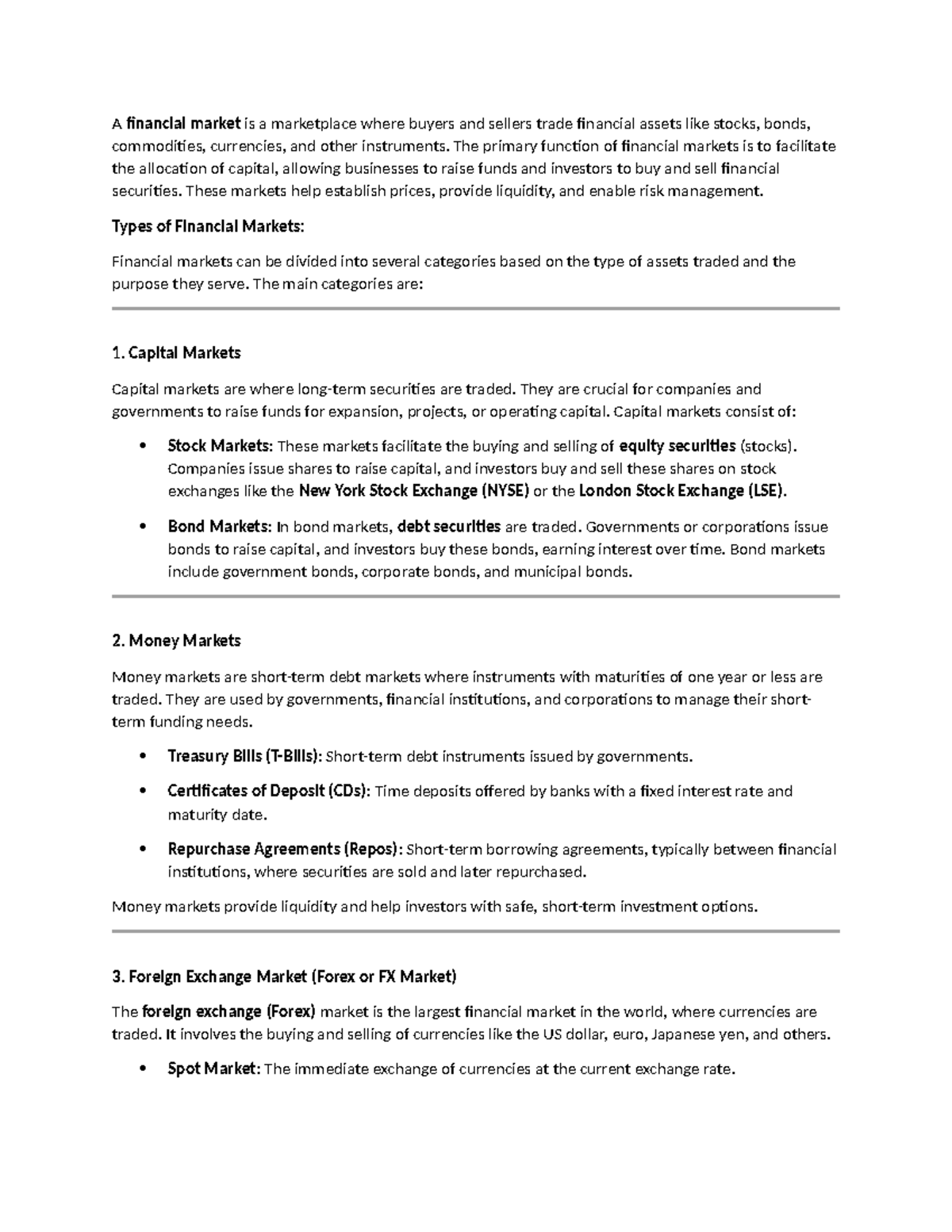
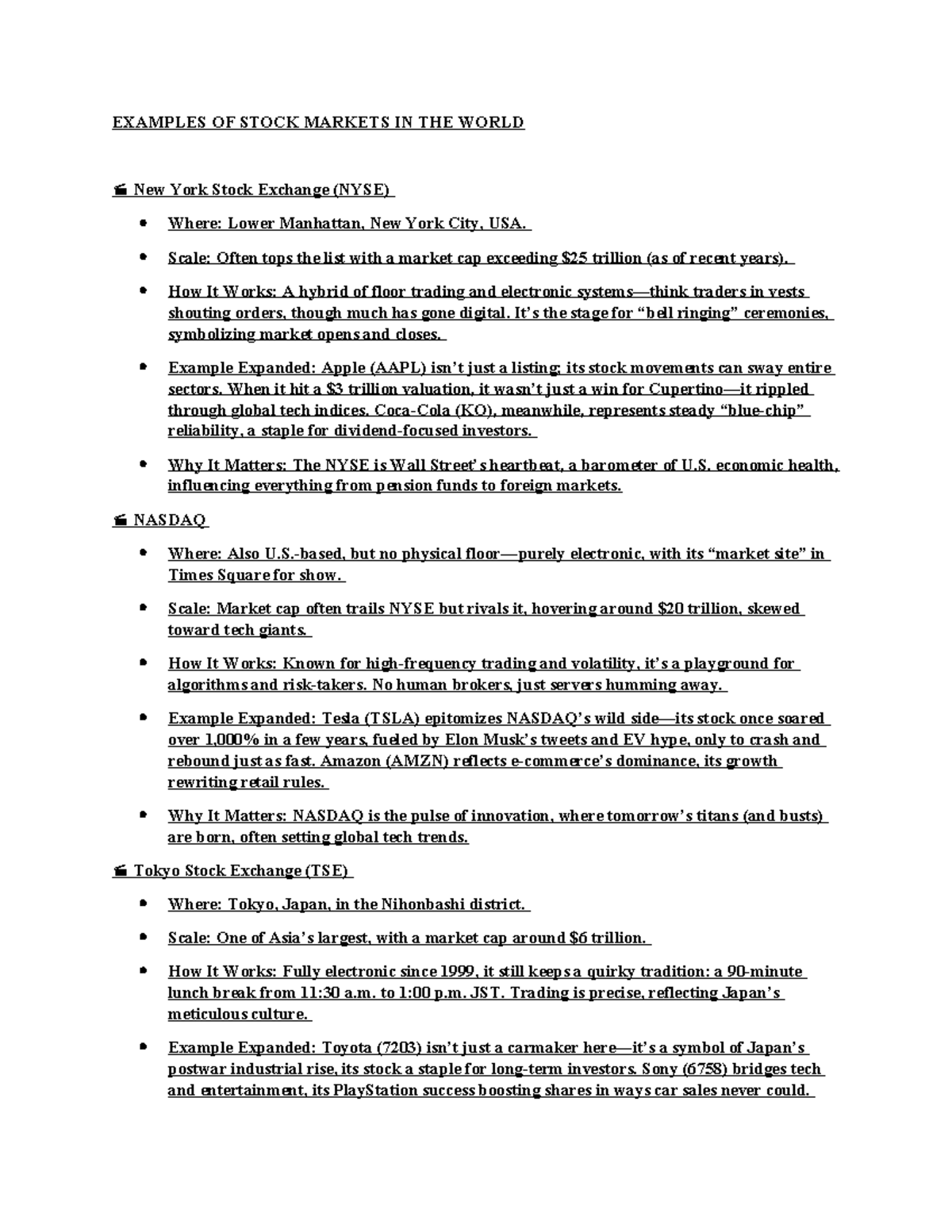
A primary example of a financial market is the stock market, such as the New York Stock Exchange (NYSE), where investors buy and sell shares of publicly traded corporations. Broadly, a financial market is any physical or digital venue that enables participants to trade financial assets, including equities, bonds, currencies, commodities, and complex derivatives.
What Defines a Financial Market? Core Architecture and Functions
At its foundation, a financial market is an institutional platform designed to facilitate the creation, exchange, and pricing of financial instruments. Rather than trading physical goods like apples or machinery directly for immediate consumption, participants in financial markets trade legal claims on future cash flows, ownership stakes in commercial enterprises, or contracts representing economic value.
Financial markets perform four essential economic functions:
- Capital Allocation: They direct capital from surplus units (savers, institutional investors, pension funds) to deficit units (corporations, governments, entrepreneurs) seeking capital for expansion, infrastructure, or operational funding.
- Price Discovery: By aggregating supply and demand signals from millions of global participants, financial markets determine the real-time clearing price of assets, reflecting market expectations, risks, and economic fundamentals.
- Liquidity Provision: They allow asset holders to convert financial instruments into liquid cash quickly and at predictable market rates, lowering liquidity risk for investors.
- Risk Management: Through hedging instruments such as futures, options, and interest rate swaps, financial markets enable businesses and investors to transfer undesired financial risks (e.g., currency volatility, interest rate hikes, or commodity price fluctuations) to institutions willing to bear them.
Financial markets operate across two structural tiers: the primary market, where new securities are created and issued through mechanisms like Initial Public Offerings (IPOs) or sovereign debt auctions, and the secondary market, where previously issued securities are resold among investors without direct involvement from the original issuing entity.
Furthermore, transactions occur either on centralized exchanges—formalized venues with standard contracts and central clearinghouses—or across Over-the-Counter (OTC) networks, where transactions are negotiated privately between counterparties via dealer networks.
Prime Example 1: The Stock Market (Equities Market)
The stock market represents the most widely recognized example of a financial market. It allows public companies to raise long-term equity capital while providing public investors with fractional ownership in corporate assets and earnings.
Primary Real-World Venues: NYSE and Nasdaq
The New York Stock Exchange (NYSE) and the Nasdaq Stock Market stand as the premier global venues for equity trading. The NYSE operates as a hybrid auction market utilizing Designated Market Makers (DMMs) who maintain fair and orderly order books on the trading floor and through electronic networks. In contrast, Nasdaq operates purely as a dealer-driven electronic market, relying on competing market makers connected through high-speed computer communications.
- PRIMARY MARKET
- Corporation Issues New Shares via Investment Bank Underwriters (Initial Public Offering)
- SECONDARY MARKET
- Investors Trade Existing Shares via Centralized Exchanges (NYSE, Nasdaq, London Stock Exchange, Tokyo Stock Exchange)
Market Mechanics and Settlement
When an investor buys shares of a company listed on the NYSE or Nasdaq, the trade is matched electronically through exchange matching engines. Equity transactions in major global markets follow strict clearing and settlement protocols managed by central securities depositories, such as the Depository Trust & Clearing Corporation (DTCC) in the United States.
Settlement follows standard settlement windows—most major markets, including the U.S. SEC jurisdiction, enforce a T+1 settlement cycle (trade date plus one business day), where cash and ownership titles are irrevocably transferred 24 hours after trade execution.
Prime Example 2: The Foreign Exchange (Forex) Market
The Foreign Exchange (Forex or FX) market is a decentralized, over-the-counter financial market responsible for exchanging national currencies. With daily turnover exceeding $7 trillion, according to data from the Bank for International Settlements (BIS), the FX market is the world's largest and most liquid financial venue.
Operational Structure
Unlike stock markets, the Forex market has no physical exchange building or centralized clearing organization. Instead, it functions as a global, continuous electronic network operating 24 hours a day during weekdays, bridging major financial centers across Sydney, Tokyo, London, and New York.
- INTERBANK TIER
- Central Banks, Commercial Banks, Global Investment Firms (Platforms: Refinitiv Matching, EBS)
- Liquidity Provision
- RETAIL AND CORPORATE TIER
- Multinational Corporations, Retail Forex Brokers, Hedge Funds
Currency Pairs and Market Participants
Currencies are always traded in pairs, such as the EUR/USD (Euro/U.S. Dollar) or USD/JPY (U.S. Dollar/Japanese Yen). The market consists of two main tiers:
- The Interbank Market: Reserved for major commercial banks, central banks, and institutional liquidity providers trading large volumes via systems like Electronic Broking Services (EBS) or Refinitiv Matching.
- The Retail and Corporate Market: Comprising multinational businesses converting currency to settle international trade, hedge funds engaging in macro speculation, and retail traders operating through online brokerages.
The foreign exchange market provides the liquidity required for international trade and cross-border capital flows.
Prime Example 3: The Fixed-Income (Bond) Market
The bond market, also called the debt or fixed-income market, is where governments and private corporations issue and trade debt securities. When an investor purchases a bond, they are lending capital to the issuer in exchange for periodic interest payments (coupons) and the return of the bond's principal (face value) at maturity.
Sovereign vs. Corporate Debt
The fixed-income market consists of two major asset classes:
- Sovereign Debt (Government Bonds): Issued by national governments to finance public deficits, infrastructure, and fiscal policy. Examples include U.S. Treasury securities (Treasury Bills, Notes, and Bonds), German Bunds, and Japanese Government Bonds (JGBs). U.S. Treasuries are widely regarded as the benchmark risk-free asset class for global finance.
- Corporate Bonds: Issued by businesses seeking debt capital without diluting equity ownership. Corporate debt is categorized by credit risk via rating agencies such as Standard & Poor's, Moody's, and Fitch, dividing issues into Investment Grade (lower yield, lower default risk) and High-Yield / Junk Bonds (higher yield, elevated default risk).
Trading Dynamics and Yield Relationships
Unlike stock markets, which rely heavily on public exchanges, the bond market is largely decentralized and OTC-driven. Institutional dealers facilitate the vast majority of trades. Bond prices share an inverse relationship with interest rates: as market interest rates rise, existing bond prices fall to align their yield to maturity with prevailing market conditions.
Prime Example 4: The Commodities and Futures Market
The commodities market is a financial venue dedicated to trading raw materials and primary agricultural products. These instruments are categorized into hard commodities (mined resources like crude oil, natural gas, copper, and gold) and soft commodities (agricultural products like wheat, soybeans, corn, and coffee).
The Role of the Chicago Mercantile Exchange (CME Group)
While physical commodities are traded directly between producers and industrial buyers in spot markets, the modern commodity financial market operates predominantly through standardized derivative contracts traded on exchanges such as the Chicago Mercantile Exchange (CME Group) and the Intercontinental Exchange (ICE).
| HEDGERS | SPECULATORS |
|---|---|
| Commercial Producers/Users (e.g., Airlines, Grain Elevators) | Hedge Funds, Traders (e.g., Trend Followers, Arbitrage) |
| Goal: Lock in prices & eliminate volatility risk. | Goal: Profit from price changes and provide market liquidity. |
Futures contracts obligate a buyer to purchase, and a seller to deliver, a set quantity of a commodity at a predetermined price on a specified future date. This structure enables two distinct groups to interact:
- Hedgers: Commercial enterprises seeking to lock in input costs or selling prices to mitigate adverse market moves (e.g., an airline purchasing jet fuel futures to cap fuel expenses).
- Speculators: Institutional and retail traders seeking to profit from price fluctuations, providing the market with essential liquidity.
Prime Example 5: The Derivatives Market
The derivatives market handles financial contracts whose valuation is derived from an underlying asset, index, or reference interest rate. Underlying assets can include individual stocks, stock indexes (like the S&P 500), commodities, foreign currencies, or sovereign bonds.
Core Derivative Contracts
Financial derivatives are broadly grouped into four standard types:
- Futures Contracts: Standardized agreements traded on public exchanges to buy or sell an asset at a set price on a future date.
- Forward Contracts: Customized, non-standardized agreements negotiated privately between two counterparties in the OTC market.
- Options Contracts: Financial instruments granting the buyer the right, but not the obligation, to buy (Call option) or sell (Put option) an underlying asset at a specified strike price within a given timeframe. Venues like Cboe Global Markets handle millions of option contracts daily.
- Swaps: Private OTC contracts where counterparties exchange cash flows based on different financial instruments, such as Interest Rate Swaps (exchanging fixed-rate interest payments for floating-rate payments) or Credit Default Swaps (CDS).
Risk Management and Central Clearing
Derivatives enable sophisticated risk-shifting strategies. However, counterparty default risk in OTC derivative networks historically posed systemic hazards. In response, modern financial regulations mandate that standardized OTC derivatives be processed through Central Counterparties (CCPs), which act as buyers to every seller and sellers to every buyer, minimizing default cascades.
Comparative Analysis of Major Financial Markets
The following table summarizes the structural differences, regulatory frameworks, primary assets, and liquidity characteristics across major financial market examples:
| Market Type | Primary Example Venues | Core Assets Traded | Market Structure | Primary Participants | Key Regulatory Oversight |
|---|---|---|---|---|---|
| Equities (Stock Market) | New York Stock Exchange (NYSE), Nasdaq, London Stock Exchange | Public Company Shares, Exchange-Traded Funds (ETFs) | Centralized Exchange | Retail Investors, Institutional Funds, Market Makers | U.S. SEC, FINRA (US), FCA (UK) |
| Foreign Exchange (Forex) | Interbank Dealer Networks (EBS, Refinitiv), FX Broker Platforms | Currency Pairs (e.g., EUR/USD, USD/JPY, GBP/USD) | Decentralized Over-the-Counter (OTC) | Central Banks, Commercial Banks, Corporations, Retail Traders | U.S. CFTC, NFA, Bank of England, ASIC |
| Fixed-Income (Bonds) | U.S. Treasury Market Network, Tradeweb, MarketAxess | Government Bills/Notes, Corporate Bonds, Municipals | Hybrid OTC and Electronic Trading Networks | Pension Funds, Central Banks, Insurance Companies, Dealers | U.S. SEC, FINRA, Federal Reserve Board |
| Commodities | Chicago Mercantile Exchange (CME Group), ICE, LME | Crude Oil, Natural Gas, Gold, Copper, Wheat, Corn | Centralized Futures Exchanges & Spot Markets | Farmers, Energy Firms, Commercial Buyers, Hedge Funds | U.S. CFTC, European Securities and Markets Authority (ESMA) |
| Derivatives | Cboe Global Markets, CME Group, OTC Swap Brokerage Networks | Stock Options, Index Futures, Swaps, Forward Contracts | Centralized Exchanges & Clearinghouse OTC Networks | Institutional Investors, Risk Managers, Arbitrageurs | U.S. CFTC, SEC, International Swaps and Derivatives Association (ISDA) |
How Orders Move Through a Financial Market: Step-by-Step Execution
Understanding how a financial market operates requires examining the lifecycle of an order from initial submission to final clearing.
- Step 1: Order Placement
- Investor submits order (Market/Limit) via brokerage interface or API.
- Step 2: Routing & Matching
- Broker routes order to exchange matching engine or market maker.
- Step 3: Trade Execution
- Matching engine pairs buy and sell orders; execution confirmation generated.
- Step 4: Clearing & Settlement
- Central Clearinghouse (e.g., DTCC) nets positions; T+1 cash/asset transfer completes.
Step 1: Order Placement
An investor or trader submits an order via a broker's interface or direct market access (DMA) API. The order specifies the target asset, quantity, and execution type:
- Market Order: Instructs the market to execute the trade immediately at the best currently available market price.
- Limit Order: Instructs the market to buy or sell only at a specific price or better, placing the order onto an order book until matched.
Step 2: Routing and Matching
The brokerage system routes the order to a execution venue. On centralized exchanges like Nasdaq, an automated electronic matching engine compares the price and time parameters of incoming bid (buy) and ask (sell) orders. If the parameters match, a trade execution is recorded instantly.
Step 3: Trade Execution Confirmation
Once paired, the exchange sends an electronic execution report back to both buying and selling brokerages, updating their respective order books and locking in transaction prices.
Step 4: Clearing and Settlement
Trade data moves to a central clearing organization. The clearinghouse validates trade parameters, nets offsetting obligations between brokerages, and manages counterparty risk. On settlement day (e.g., T+1 for U.S. equities), the securities depository adjusts ownership records while funds transfer between clearing banks, finalizing the trade.
Regulatory Oversight and Investor Protection Safeguards
Financial markets rely on public trust, transparent pricing, and systemic stability. Independent government regulatory agencies and self-regulatory organizations (SROs) enforce operational integrity across these venues.
Principal Regulatory Bodies
- Securities and Exchange Commission (SEC): Regulates U.S. equity markets, securities exchanges, investment advisers, and public corporate disclosures. Detailed regulatory framework and enforcement mandates are published on the official U.S. Securities and Exchange Commission website.
- Commodity Futures Trading Commission (CFTC): Oversees U.S. futures, options, and swaps markets to prevent market manipulation, fraud, and systemic failure. Regulatory filings and guidelines are accessible via the official Commodity Futures Trading Commission website.
- Financial Industry Regulatory Authority (FINRA): Acts as an independent, non-governmental SRO authorized by U.S. law to license, oversee, and examine broker-dealers and brokerage firms.
- European Securities and Markets Authority (ESMA): Enhances investor protection and promotes stable financial markets across the European Union.
Core Protective Safeguards
- Disclosure Rules: Publicly traded entities must submit standardized financial statements (e.g., 10-K annual reports and 10-Q quarterly filings) to ensure investors have equal access to material information.
- Anti-Money Laundering (AML) and Know Your Customer (KYC): Financial intermediaries must verify investor identities and report suspicious transactions to combat illicit financial flows.
- Market Circuit Breakers: Exchanges deploy automated trading halts triggered by extreme single-day market declines (e.g., 7%, 13%, or 20% drops in the S&P 500 index) to curb panic selling and restore orderly price discovery.
- Investor Capital Protection: In the United States, the Securities Investor Protection Corporation (SIPC) protects customer accounts up to $500,000 (including a $250,000 cash limit) against financial distress or insolvency of a broker-dealer.
Key Considerations for Navigating Financial Markets
Disclaimer: The information provided in this section and throughout this article is intended strictly for educational and informational purposes and does not constitute personalized investment, legal, tax, or financial advice.
Before participating in any financial market, participants should evaluate several core operational parameters:
Transaction Costs and Friction
Trading costs extend beyond explicit brokerage commissions. Investors must consider implicit costs such as the bid-ask spread (the difference between the highest price a buyer is willing to pay and the lowest price a seller is willing to accept) and slippage (the difference between expected order price and actual execution price during volatile periods).
Market Liquidity Risk
Highly liquid markets (such as large-cap stocks or major FX pairs) allow large order execution without significantly disturbing asset prices. Conversely, illiquid markets (such as micro-cap equities or private debt) present liquidity risk, where market participants may struggle to exit positions without taking substantial price discounts.
Systemic and Fundamental Risk Factors
All market investments carry risk. Market participants must account for broad macroeconomic risks (interest rate hikes, inflation spikes, geopolitical shocks) alongside asset-specific credit, counterparty, and operational risks. Diversification across market types and asset classes remains a standard strategy to mitigate non-systemic risks.
Frequently Asked Questions
What is the most common example of a financial market for individual investors?
The stock market—specifically public exchanges like the New York Stock Exchange (NYSE) and Nasdaq—is the most common financial market for retail investors. It allows individuals to purchase equity shares in publicly traded companies via accessible brokerage accounts.
How does a financial market differ from a traditional goods market?
A traditional goods market involves exchanging cash for tangible physical products meant for consumption or direct utility (such as groceries or vehicles). A financial market involves trading legal claims, contracts, or securities (such as stocks, bonds, currencies, or futures) whose value reflects underlying financial assets, corporate earnings, or future cash flows.
What is the difference between a primary market and a secondary market?
In a primary market, new financial securities are created and sold for the first time by issuers (e.g., a company raising capital through an IPO or a government issuing new Treasury bonds). In a secondary market, investors trade previously issued securities among themselves, with zero proceeds going directly to the original issuing entity.
Can individual retail investors trade directly on major financial exchanges?
No. Individual retail investors typically cannot execute trades directly on exchange matching engines. Instead, they must submit orders through licensed intermediaries, such as registered broker-dealers or online brokerage platforms, which possess direct exchange connectivity and clearing privileges.
What primary role do central banks play in financial markets?
Central banks (such as the Federal Reserve, European Central Bank, or Bank of Japan) act as monetary authorities and regulators. They influence financial markets by setting benchmark short-term interest rates, conducting open market operations (buying or selling government debt), managing money supply, managing national reserves, and serving as lenders of last resort during liquidity crises.
Next Steps for Market Participants
To build a strong practical understanding of financial markets:
- Identify Your Objective: Determine whether your goal is long-term capital appreciation (equities), income generation (fixed income), risk mitigation (derivatives/hedging), or liquidity management (money markets).
- Study Market Fundamentals: Review foundational materials provided by regulatory bodies such as the SEC's Investor.gov resources or financial regulatory educational databases.
- Select a Registered Intermediary: Choose a reputable broker regulated by primary enforcement agencies (such as SEC/FINRA in the U.S. or FCA in the UK) with clear disclosures on trading fees, execution policies, and account protections.
- Utilize Simulated Trading Tools: Practice executing orders via demo trading accounts to understand order types, bid-ask dynamics, and portfolio tracking before committing real capital.