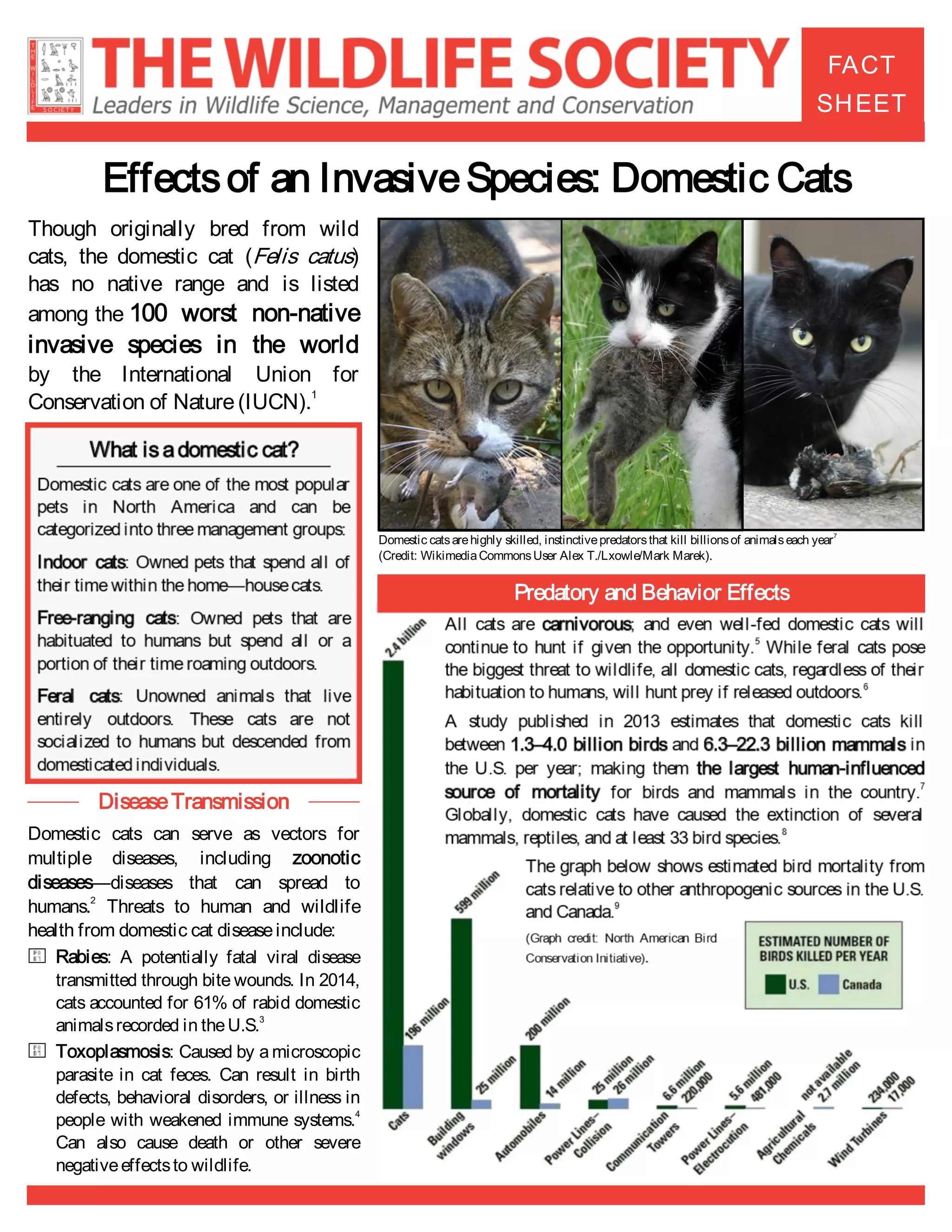
Free-ranging domestic cats (Felis catus) are classified as an invasive species in the United States by conservation scientists and federal agencies. Because they are a non-native predator that causes documented, significant harm to native wildlife and ecosystems—contributing to billions of animal deaths annually—they meet the biological and legal criteria for invasive status.
Domestic cats are among the most beloved companion animals in the world, yet their presence in the North American environment represents one of the most complex ecological challenges of 2026. While a cat living strictly indoors is a domestic pet, a cat that roams outdoors—whether it is a "community cat," a feral individual, or a house pet allowed outside—functions as an invasive predator. The distinction between a "pet" and an "invasive species" is not determined by the animal's relationship with humans, but by its impact on the local ecology where it was introduced.
Defining the Invasive Status of Felis Catus
To understand why cats are considered invasive, one must first look at the scientific definition of an invasive species. According to the United States Department of Agriculture (USDA) and Executive Order 13112, an invasive species is a species that is non-native to the ecosystem under consideration and whose introduction causes or is likely to cause economic or environmental harm or harm to human health.
Domestic cats are not native to North America. They were domesticated from the Near Eastern wildcat (Felis lybica) and brought to the Americas by European settlers in the 17th century. Because they did not evolve alongside North American birds, small mammals, and reptiles, many native species lack the necessary defense mechanisms to survive their hunting tactics.
The invasive classification is primarily supported by organizations such as the American Bird Conservancy and The Wildlife Society. These groups point to the fact that cats have contributed to the extinction of at least 63 species of birds, mammals, and reptiles globally. In the U.S., they are considered a "pervasive" invasive species, meaning they are found in almost every habitat, from urban centers to remote wilderness areas.
The Ecological Impact: Predation Statistics
The primary reason cats are labeled invasive is the sheer volume of native wildlife they kill. While many owners believe their well-fed cat only catches the occasional mouse, scientific data suggests a much darker reality. A landmark study by the Smithsonian Conservation Biology Institute and the U.S. Fish and Wildlife Service (USFWS), published in Nature Communications, established the baseline for these impacts.
As of 2026, these figures remain the gold standard for assessing the damage caused by free-ranging cats:
- Bird Mortality: Cats kill between 1.3 billion and 4.0 billion birds annually in the contiguous United States.
- Mammal Mortality: Between 6.3 billion and 22.3 billion small mammals (such as voles, chipmunks, and squirrels) are killed each year.
- Reptile and Amphibian Mortality: Hundreds of millions of lizards, snakes, and frogs are also victims of cat predation.
Importantly, the majority of this predation (approximately 69% to 89%) is carried out by unowned or "feral" cats. However, owned cats that are allowed outdoors still contribute significantly to these totals. Unlike native predators like hawks or foxes, which have populations limited by the availability of prey, domestic cat populations are artificially inflated by human supplemental feeding. This allows cat densities to remain high even when they have decimated local wildlife populations, a phenomenon known as "hyper-predation."
Disease Transmission and Public Health
Beyond direct predation, cats act as an invasive force through the spread of diseases. This affects both wildlife and human populations, complicating their status in public policy.
Toxoplasmosis
Cats are the only definitive hosts for the parasite Toxoplasma gondii. This parasite can only sexually reproduce in the feline digestive tract, shedding oocysts (eggs) in the cat's feces. These oocysts are incredibly hardy and can survive in soil and water for years. When cats roam outdoors, they deposit these oocysts into the environment, where they can infect birds, land mammals, and even marine life.
Rainwater runoff carries these parasites into the ocean, where they have been linked to the deaths of endangered Hawaiian monk seals and California sea otters. In humans, toxoplasmosis can cause serious complications for pregnant women and immunocompromised individuals, and recent studies continue to investigate its links to neurological disorders.
Rabies and Other Pathogens
Cats are consistently among the most common domestic animals to test positive for rabies in the U.S. This is largely because feral cat colonies often interact with wildlife like raccoons or skunks. Because people are more likely to approach a "stray" cat than a wild raccoon, cats serve as a dangerous bridge for zoonotic diseases (diseases that jump from animals to humans).
The Policy Conflict: TNR vs. Conservation
The classification of cats as invasive has led to a deep-seated conflict between animal welfare advocates and conservationists. The most contentious issue is the management of feral cat colonies through Trap-Neuter-Return (TNR).
TNR programs involve trapping feral cats, sterilizing them, and returning them to the "colony" where they were found. Supporters of TNR, such as Alley Cat Allies, argue that it is the most humane way to reduce populations over time. However, many peer-reviewed studies have shown that TNR is rarely effective at reducing populations at a landscape level unless an impossibly high percentage of the population (often cited as over 75-80%) is sterilized simultaneously.
From a conservation perspective, TNR is often viewed as "sanctioned abandonment." Conservationists argue that returning a sterilized invasive predator to the environment does nothing to stop it from killing birds or spreading Toxoplasma gondii for the remainder of its life. This has led to legal battles in various states over whether it is legal to release a non-native species back into the wild.
Comparing Cats to Other Invasive Species in the US
To provide context on the severity of the issue, it is helpful to compare the impact of cats with other well-known invasive species.
| Invasive Species | Primary Impact | Range in US | Management Strategy |
|---|---|---|---|
| Domestic Cat | Predation (birds/mammals), disease (Toxoplasmosis) | National (Urban & Wild) | TNR, Indoor Advocacy, Local Ordinances |
| Feral Hog | Habitat destruction, crop damage, disease | Southern & Western US | Lethal control, trapping, exclusion |
| Burmese Python | Predation (mammals/birds) | Florida Everglades | Bounty programs, physical removal |
| European Starling | Competition with native birds, crop damage | National | Removal of nesting sites, agricultural control |
| Asian Longhorned Beetle | Timber/Forest destruction | Northeastern US | Quarantines, tree removal and destruction |
As the table illustrates, cats are unique because their range is national, and their management is heavily influenced by their status as pets, whereas other invasive species are managed strictly through removal or eradication.
The Economic Burden of Invasive Cats
The financial cost of cats as an invasive species is often overlooked. Economic impacts include:
- Loss of Ecosystem Services: Birds provide essential services like pest control and pollination. The loss of billions of birds necessitates increased pesticide use, which has its own economic and environmental costs.
- Healthcare Costs: The treatment of cat-borne diseases like toxoplasmosis, cat-scratch fever, and rabies post-exposure prophylaxis totals hundreds of millions of dollars annually.
- Endangered Species Recovery: The federal government spends millions of dollars every year to protect and recover endangered species, such as the Piping Plover or the Florida Scrub-Jay, which are frequently preyed upon by cats.
Solutions and Responsible Ownership in 2026
The "invasive" label does not mean that cats are "bad" animals; rather, it identifies a human-caused environmental imbalance. In 2026, the focus has shifted toward responsible ownership and "containment" strategies to mitigate these impacts.
The Indoor Movement
The most effective way to prevent cats from acting as an invasive species is to keep them indoors. Indoor cats live significantly longer lives, as they are protected from cars, predators (like coyotes), and diseases. Many veterinary associations now exclusively recommend indoor lifestyles for domestic felines.
"Catios" and Leash Training
For owners who want their cats to experience the outdoors, "catios" (enclosed outdoor patios for cats) have become a mainstream solution. These allow for sensory enrichment without permitting the cat to hunt or interact with native wildlife. Similarly, leash training cats with harnesses has gained popularity as a way to provide outdoor time under direct supervision.
Legislative Changes
Some municipalities have begun implementing "cat-at-large" ordinances, similar to leash laws for dogs. These laws make it illegal for pet owners to allow their cats to roam off their property. While controversial, these measures are increasingly seen as necessary to protect local biodiversity and reduce the burden on animal shelters.
Frequently Asked Questions
Is it illegal to have an outdoor cat?
In most parts of the U.S., it is not federally illegal, but local laws vary significantly. Some cities have passed ordinances that prohibit cats from roaming off their owner's property. Even where it is legal, owners may be held liable if their cat destroys property or kills protected migratory birds under the Migratory Bird Treaty Act.
Can a cat be both a pet and an invasive species?
Yes. "Invasive" is a biological classification based on a species' origin and its impact on an ecosystem. An individual animal can be a cherished family member while simultaneously being part of a larger population that functions as an invasive force in the environment.
Do bells on collars stop cats from killing birds?
While bells may alert some birds to a cat's presence, they are not a reliable solution. Studies have shown that cats are ambush predators that can learn to hunt silently even with a bell. Furthermore, bells do nothing to protect nestlings (baby birds) or fledglings that cannot fly away. Specialized collars like the "Birdsbesafe" (a bright fabric ruff) are more effective at reducing bird kills but do not prevent the killing of mammals or the spread of disease.
Why doesn't the government just remove all feral cats?
The logistics and ethics of such an undertaking are incredibly complex. There are estimated to be between 60 million and 100 million unowned cats in the U.S. Massive removal programs are expensive and often face significant public backlash from animal rights groups. Current strategies focus more on education, local ordinances, and incentivizing indoor-only ownership.
Does feeding a feral cat stop it from hunting?
No. The hunting instinct in cats is separate from the hunger drive. Many cats will hunt and kill prey even if they are well-fed at home or at a colony feeding station. This is why supplemental feeding often exacerbates the problem by keeping the predator population high regardless of the health of the prey population.
Practical Recommendation
If you are a cat owner or a concerned citizen, the most impactful action you can take is to ensure that domestic cats are kept contained. For owners, this means transitioning to an indoor-only lifestyle or using secure outdoor enclosures. For communities, it involves supporting local policies that discourage free-roaming cats and prioritize the protection of native wildlife. By treating cats with the same responsibility we apply to other domestic animals like dogs, we can protect our pets and the American ecosystem simultaneously.