Whether attorney fees are tax deductible depends heavily on the nature of the legal proceeding, whether the expense is tied to a trade or business, and current Internal Revenue Service regulations. For most individual taxpayers, personal legal expenses are non-deductible, whereas business-related or capital-recovering legal fees often qualify for distinct tax treatment.
Navigating the tax treatment of attorney fees requires a close examination of the origin of the claim, the categorization of the underlying legal dispute, and the distinction between above-the-line deductions, itemized deductions, and capitalized costs. Because tax laws are nuanced and subject to strict federal guidelines, understanding these classifications helps taxpayers maximize eligible savings while remaining compliant with current reporting standards.
The Origin of the Claim Doctrine
The fundamental framework for determining whether attorney fees are deductible rests on the "origin of the claim" doctrine. Established through Supreme Court precedent, this doctrine dictates that the tax deductibility of legal expenses depends entirely on the origin and character of the litigation out of which the expense arose, rather than the potential consequences that the lawsuit might have on a taxpayer's income-producing property or financial life.
Under this rule, if a legal dispute originates from a personal matter—such as a divorce, custody battle, or defense of a personal civil suit—the associated attorney fees are classified as personal, living, or family expenses. Section 262 of the Internal Revenue Code explicitly disallows deductions for these types of expenses. Conversely, if the lawsuit originates from profit-seeking activities, such as managing a rental property, operating a sole proprietorship, or collecting taxable business income, the legal fees are evaluated for potential deductibility under Section 162 (business expenses) or Section 212 (expenses for the production of income).
Evaluating the origin of the claim requires looking past the immediate relief sought by the plaintiff or defendant. Tax professionals examine the core transaction or event that triggered the legal action. If multiple claims are brought within a single lawsuit, an allocation of attorney fees based on the relative time, effort, and financial recovery of each claim is frequently required.
Business-Related Attorney Fees
For business owners, freelancers, and independent contractors, the rules surrounding the deductibility of legal fees are generally more favorable than they are for individual wage earners. Ordinary and necessary attorney fees incurred in connection with operating a trade or business are fully deductible as business expenses on the applicable schedule, such as Schedule C for sole proprietorships, Form 1120 for corporations, or Form 1065 for partnerships.
Examples of fully deductible business legal fees include:
- Defending against claims regarding breach of a commercial contract.
- Drafting operational agreements, customer contracts, or employment terms.
- Defending the business against intellectual property infringement or protecting patents and trademarks.
- Handling routine collection actions against delinquent clients or customers.
- Defending the business during a routine operational tax audit or regulatory compliance review.
However, not all business-related legal expenses can be deducted immediately in the year they are paid. Legal fees incurred to acquire long-term assets, restructure a business entity, or defend title to property must often be capitalized. Capitalized legal fees are added to the basis of the underlying asset and recovered over time through depreciation, amortization, or upon the eventual sale of the asset.
Employment and Discrimination Lawsuits
The tax treatment of attorney fees stemming from employment disputes has undergone significant legislative evolution, particularly with the passage of the Tax Cuts and Jobs Act. Historically, employees who successfully sued their employers for wrongful termination, discrimination, or wage violations faced a severe tax penalty: even if their attorney took a 40% contingency fee, the employee was often required to report the gross settlement amount as taxable income while treating the legal fees as a miscellaneous itemized deduction subject to a 2-percent adjusted gross income floor. Under certain tax regimes, this created situations where individuals owed taxes on money they never actually received.
To remedy this, federal law includes an above-the-line deduction for attorney and court costs paid in connection with certain unlawful discrimination and whistleblower claims. Under Internal Revenue Code Section 62(a)(20) and related provisions, taxpayers who pursue claims involving:
- Unlawful discrimination under federal, state, or local civil rights laws;
- The National Labor Relations Act;
- The Fair Labor Standards Act;
- Whistleblower protection programs; or
- Certain violations of federal securities laws;
may deduct their attorney fees "above the line." This means the deduction is subtracted directly from gross income to calculate adjusted gross income, regardless of whether the taxpayer itemizes deductions. This above-the-line treatment ensures that plaintiffs are not taxed on the portion of a settlement or judgment paid directly to their legal counsel.
Investment, Property, and Tax Preparation Fees
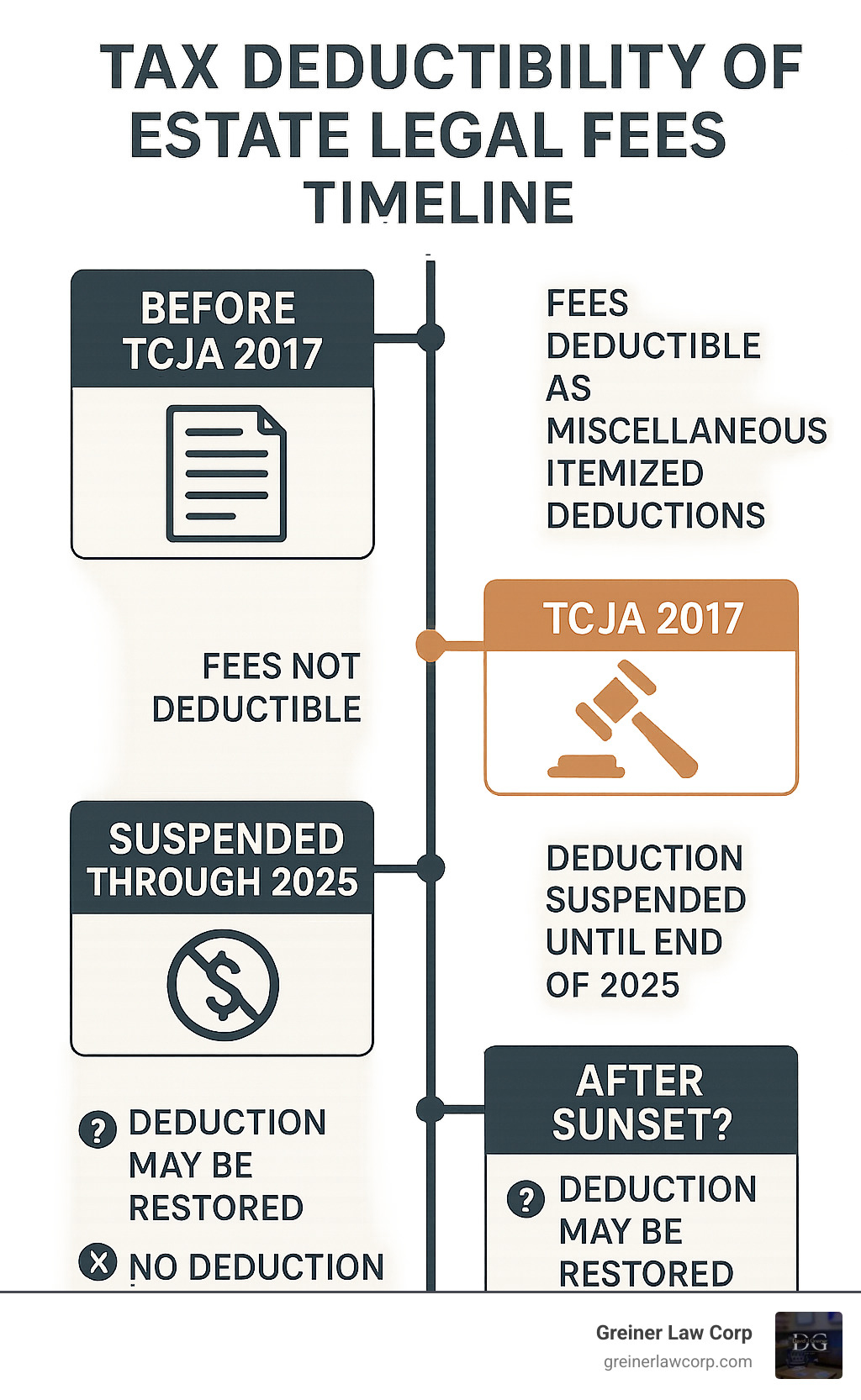
For non-business taxpayers, certain legal expenses tied to income generation or asset management historically fell under miscellaneous itemized deductions. However, major tax legislation suspended miscellaneous itemized deductions subject to the 2% adjusted gross income floor. As a result, many common categories of personal legal deductions are temporarily unavailable.
| Category of Legal Expense | General Tax Treatment | Primary Condition or Limitation |
|---|---|---|
| Business Operations | Fully Deductible | Must be ordinary and necessary for trade or business (Section 162). |
| Capital Asset Acquisition | Capitalized | Added to the cost basis of the property rather than expensed immediately. |
| Employment Discrimination | Above-the-Line Deduction | Applies to specific civil rights, labor, and whistleblower claims. |
| Divorce and Family Law | Non-Deductible | Personal expenses; tax advice portion may occasionally qualify. |
| Tax Advice and Planning | Suspended (Temporarily) | Previously deductible under miscellaneous itemized deductions; currently restricted. |
| Production of Investment Income | Suspended (Temporarily) | Expenses related to managing securities or investment portfolios are currently non-deductible. |
Taxpayers should note that while legal fees for general tax planning were previously deductible under miscellaneous itemized deductions, the suspension under current tax rules limits these deductions. Legal fees incurred to secure taxable alimony are also impacted by broader structural changes in family law taxation, making precise categorization essential.
Divorce, Family Law, and Estate Planning
Family law proceedings represent one of the most common areas where individuals incur substantial legal fees, yet they offer some of the most restrictive tax deduction rules. Under the origin of the claim doctrine, legal fees paid for divorce, child custody, alimony negotiations, and property settlement are treated as personal expenses and are entirely non-deductible.
There are, however, narrow statutory exceptions within family law and estate planning:
- Tax Advice in Divorce: Under Internal Revenue Code Section 212(3), expenses incurred in connection with the determination, collection, or refund of any tax can sometimes be deducted if properly itemized, provided the miscellaneous itemized deduction suspension is lifted or bypassed. If a divorce attorney itemizes and bills specifically for tax planning advice related to the division of property or alimony, that specific portion of the fee may theoretically be deductible. The billing statement must provide a clear, distinct breakdown of the time spent solely on tax advice.
- Estate Planning and Administration: Legal fees incurred by an executor to manage an estate or handle administrative probate tasks are generally deductible on the estate's fiduciary income tax return (Form 1041), as these are expenses necessary to manage and conserve estate property. However, legal fees paid by individual beneficiaries to contest a will or protect their personal inheritance are generally treated as capital expenditures or personal expenses, depending on whether the asset sought is income-producing.
Recordkeeping, Documentation, and Billing Requirements
Proving the deductibility of attorney fees to tax authorities requires meticulous recordkeeping and explicit invoice structuring. When an attorney handles a hybrid matter—such as a lawsuit involving both business asset recovery and personal defamation—the burden of proof rests entirely on the taxpayer to allocate the expenses accurately between deductible and non-deductible components.
To withstand potential scrutiny during a tax audit, taxpayers should insist on the following documentation practices from their legal counsel:
- Detailed Time and Billing Records: Invoices should itemize tasks performed, separating business-related consultations from personal matters or capital asset acquisitions.
- Allocation of Contingency Fees: If an attorney is paid via a contingency fee arrangement from a settlement, the settlement agreement and the attorney's disbursement statement must clearly reflect how gross proceeds, taxable recoveries, and deductible expenses are divided.
- Retain Agreement Review: The initial retainer agreement should outline the scope of the legal representation, specifically identifying whether the proceeding is designed to produce taxable business income, recover capital, or resolve personal domestic issues.
Failing to maintain distinct documentation can result in the complete disallowance of a legal expense deduction if the IRS determines that the costs are commingled or cannot be reliably attributed to a deductible category.
Frequently Asked Questions
Can I deduct attorney fees paid for a personal injury settlement?
Generally, attorney fees associated with personal physical injury or physical sickness settlements are excludable from gross income or deductible, depending on how the recovery is structured. If the settlement compensates for physical injuries or physical sickness, the damages are typically excluded from gross income entirely under Section 104(a)(2), which means the corresponding attorney fees paid out of that recovery are not deductible because the underlying income is not taxed. However, punitive damages and settlements for non-physical injuries (such as emotional distress not stemming from physical injury) are taxable, and the deductibility of legal fees associated with them depends on the origin of the claim.
Are legal fees paid to draft a will or trust tax deductible?
No. Legal fees paid for personal estate planning, drafting wills, establishing living trusts, or executing powers of attorney are considered personal, family living expenses. Consequently, they are not deductible for individual income tax purposes.
What happens to legal fees if my lawsuit is unsuccessful?
The outcome of the lawsuit does not automatically dictate tax treatment. If you incurred legal expenses in an unsuccessful attempt to defend a business or collect taxable business income, those expenses remain deductible as ordinary and necessary business expenses under Section 162. If the lawsuit was personal in nature, the loss of the case does not turn non-deductible personal legal fees into deductible expenses.
How do contingency fee arrangements affect tax reporting?
Under landmark judicial precedent (such as the Supreme Court case Commissioner v. Banks), taxpayers who enter into contingency fee arrangements must generally include the gross amount of a taxable settlement or judgment in their gross income—including the portion paid directly to the attorney. Taxpayers then claim an offsetting deduction if they qualify for business deductions, capital adjustments, or above-the-line civil rights deductions.
Can small business owners deduct legal fees paid to form an LLC?
No. Legal fees incurred to organize a business entity—such as filing articles of organization for an LLC or drafting corporate bylaws—are treated as startup expenditures or organizational costs. Under Internal Revenue Code Section 195 and Section 248, businesses can elect to deduct a limited amount of these organizational costs in the year active trade or business begins, with the remaining balance amortized over a specific statutory period. They cannot be deducted entirely as immediate operating expenses.
Conclusion and Next Actions
Determining whether attorney fees are deductible requires careful analysis of the origin of the claim, the structure of the legal billing, and current federal tax statutes. Business owners, individuals involved in employment discrimination suits, and taxpayers navigating complex financial disputes should consult a certified public accountant or tax attorney before filing their returns. To ensure full compliance and maximize potential savings, taxpayers should request itemized, detailed billing statements from their legal counsel immediately upon the conclusion of any legal proceeding.