The animals with the longest lifespans range from the 200-year-old bowhead whale to the biologically immortal Turritopsis dohrnii jellyfish. While humans consider a century a remarkable achievement, various species—particularly those in deep-sea or cold-water environments—routinely live for hundreds or even thousands of years through unique cellular repair mechanisms and slow metabolic rates.
The Spectrum of Longevity: From Centuries to Millennia
When discussing the animals with the longest lifespan, it is essential to distinguish between chronological age and biological immortality. Most vertebrates have a defined "natural" end to their life cycle, whereas certain invertebrates possess the ability to regenerate tissues indefinitely. As of 2026, scientific advancements in genomics and radiocarbon dating have allowed us to pinpoint the ages of these creatures with unprecedented accuracy, revealing that the secrets of long life are often hidden in the coldest, deepest parts of our oceans.
The quest to understand longevity is not merely a matter of curiosity. By studying these long-lived species, researchers aim to uncover pathways for treating age-related diseases in humans. The animals listed below represent the pinnacle of survival, having evolved strategies to resist cancer, repair DNA damage, and maintain physiological function far beyond the limits of most terrestrial life.
The Invertebrate Champions: Living Beyond Millennia
Invertebrates hold the absolute records for longevity. Because many of these organisms lack complex internal organs that fail over time, or because they live in extremely stable environments, they can survive for thousands of years.
Glass Sponges (Hexactinellid)
Glass sponges are among the most ancient living animals on Earth. Found primarily in the deep ocean, these creatures possess a skeleton made of silica (glass). Estimates for their lifespan often exceed 10,000 years. Their longevity is attributed to the incredibly slow pace of life in the deep sea, where temperatures are near freezing and food sources are scarce. This low-energy existence prevents the accumulation of metabolic waste and cellular damage that typically limits the lifespan of more active animals.
Black Corals (Leiopathes sp.)
Black corals are colonial organisms, but the individual colonies can be incredibly old. Specimens found off the coast of Hawaii have been radiocarbon-dated to over 4,000 years old. Unlike the corals found in shallow, tropical reefs, black corals live in the "twilight zone" of the ocean (300 to 3,000 feet deep). Their slow growth—sometimes only micrometers per year—enables them to persist through centuries of environmental shifts.
Ocean Quahog (Arctica islandica)
The ocean quahog is a species of edible clam that inhabits the North Atlantic. These clams are famous for their "growth rings," similar to those of a tree, which can be counted to determine their age (a field known as sclerochronology). The most famous specimen, nicknamed "Ming" the clam, was determined to be 507 years old when it was collected in 2006. If left undisturbed, these clams could theoretically live even longer, as they show very few signs of "senescence" (biological aging) even after five centuries.
The Kings of the Ocean: Long-Lived Vertebrates
While invertebrates may live longer, the longevity of vertebrates is often more impressive to scientists because of the complexity of their biological systems. Maintaining a heart, brain, and nervous system for centuries requires extraordinary evolutionary adaptations.
Greenland Shark (Somniosus microcephalus)
As of 2026, the Greenland shark remains the longest-lived vertebrate known to science. These massive predators, which inhabit the frigid waters of the North Atlantic and Arctic Oceans, grow at a rate of only about one centimeter per year. In a landmark 2016 study utilizing radiocarbon dating of the crystal proteins in their eye lenses, researchers found that these sharks can live for at least 272 to 400 years. Interestingly, they do not even reach sexual maturity until they are roughly 150 years old. Their longevity is largely attributed to their extremely slow metabolism and the cold environment, which helps stabilize proteins and slow down cellular degradation.
Bowhead Whale (Balaena mysticetus)
The bowhead whale is the longest-lived mammal on Earth. While most large whales live between 50 and 100 years, bowheads are known to exceed 200 years. Evidence for this first emerged when traditional stone harpoon points were found embedded in the blubber of whales caught in the late 20th century—points that hadn't been used since the 1800s. Genetic analysis has revealed that bowhead whales have unique duplications in genes associated with DNA repair and cell cycle regulation, which may explain their relative immunity to cancer despite having billions of cells.
Rougheye Rockfish (Sebastes aleutianus)
Found in the North Pacific, the rougheye rockfish can live for more than 205 years. These fish inhabit deep-water slopes and grow very slowly. Scientists believe their longevity is linked to their ability to maintain high levels of antioxidant activity, which neutralizes the free radicals that typically cause cellular aging.
Terrestrial Giants: Longest-Living Land Animals
On land, the metabolic demands of gravity and fluctuating temperatures generally lead to shorter lifespans compared to the ocean. However, certain reptiles have defied these odds.
Giant Tortoises
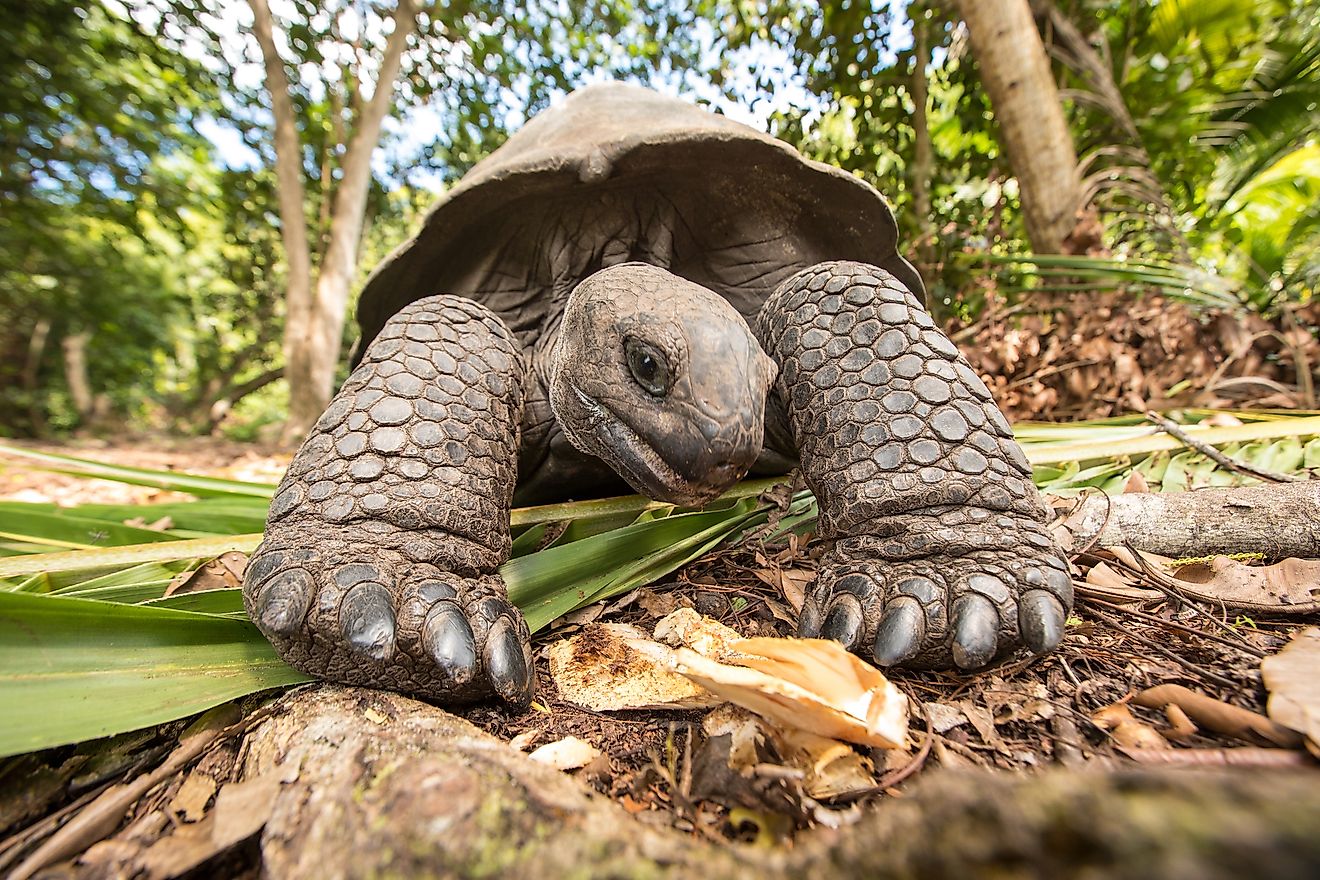
The Aldabra giant tortoise and the Galapagos tortoise are the poster children for terrestrial longevity. Jonathan, an Aldabra giant tortoise living on the island of Saint Helena, is currently the oldest known living land animal in 2026, with an estimated age of 194 years (having arrived on the island in 1882). These tortoises have incredibly slow metabolic rates and can survive for months without food or water. Their sedentary lifestyle and hardy shells protect them from predators and environmental stress, allowing them to age with minimal physiological decline.
Tuatara (Sphenodon punctatus)
Native to New Zealand, the tuatara is a "living fossil" and the only surviving member of an order that flourished 200 million years ago. These lizard-like reptiles can live for over 100 years, with some estimates suggesting they can reach 200 in optimal conditions. They thrive in cool climates and have a very low optimal body temperature for a reptile, which contributes to their slow aging process.
Biological Immortality: The Curious Case of Turritopsis Dohrnii
No discussion of animal lifespan is complete without the Immortal Jellyfish (Turritopsis dohrnii). Unlike other animals that eventually die, this jellyfish can revert its cells back to their earliest form. When faced with physical damage or starvation, the adult jellyfish (medusa) transforms back into a polyp, essentially restarting its life cycle.
This process, called transdifferentiation, involves a cell transforming from one specialized type into another. While these jellyfish can still be eaten by predators or killed by disease, they do not die of "old age" in the traditional sense. They are the only known animal capable of a total reversal of its life cycle.
Comparison of Long-Lived Animal Species
| Species Name | Common Name | Estimated Lifespan | Primary Habitat |
|---|---|---|---|
| Turritopsis dohrnii | Immortal Jellyfish | Biologically Immortal | Global Oceans |
| Hexactinellida | Glass Sponge | 10,000+ Years | Deep Ocean |
| Leiopathes sp. | Black Coral | 4,000+ Years | Deep Ocean |
| Arctica islandica | Ocean Quahog | 500+ Years | North Atlantic |
| Somniosus microcephalus | Greenland Shark | 250 - 400+ Years | Arctic/North Atlantic |
| Balaena mysticetus | Bowhead Whale | 200+ Years | Arctic Waters |
| Sebastes aleutianus | Rougheye Rockfish | 200+ Years | North Pacific |
| Aldabrachelys gigantea | Giant Tortoise | 150 - 190+ Years | Seychelles / Galapagos |
| Strongylocentrotus | Red Sea Urchin | 200 Years | Pacific Coast |
Biological Secrets of Extreme Longevity
What allows a Greenland shark to live for four centuries while a domestic dog rarely makes it to fifteen? The answer lies in a combination of genetics, environment, and metabolic efficiency.
1. The Rate of Living Theory
This theory suggests that animals with slower metabolic rates tend to live longer. A slow metabolism produces fewer reactive oxygen species (ROS) or "free radicals." These molecules are byproducts of energy production that can damage DNA and proteins. Animals like the Greenland shark and the giant tortoise move slowly and process energy at a fraction of the rate of mammals or birds, effectively "stretching out" their biological clock.
2. Enhanced DNA Repair
Every time a cell divides, there is a risk of genetic mutation. Over time, these mutations accumulate, leading to organ failure or cancer. Long-lived animals like the bowhead whale have evolved superior DNA repair mechanisms. They possess multiple copies of genes like ERCC1, which is involved in repairing damaged DNA strands. This "redundancy" allows them to maintain genomic stability even after two centuries of life.
3. Negligible Senescence
Some animals experience what biologists call "negligible senescence." This means they do not show a measurable decline in survival probability or reproductive capability as they age. For example, a 100-year-old sea urchin is often just as healthy and fertile as a 10-year-old urchin. These species have evolved to prioritize cellular maintenance over rapid growth or early reproduction.
4. Environmental Stability
Most of the world's longest-lived animals reside in the deep ocean or the Arctic. These environments are characterized by extreme stability and cold temperatures. Cold water acts as a natural preservative, slowing down chemical reactions within the body. Furthermore, the deep sea offers protection from many of the environmental stressors found at the surface, such as UV radiation and rapid temperature fluctuations.
Challenges in Determining Animal Age
Determining the age of a wild animal is a significant scientific challenge. For many years, scientists relied on visual cues, which are often misleading. Modern techniques have revolutionized our understanding:
- Radiocarbon Dating: By measuring the levels of Carbon-14 (particularly the "bomb pulse" from 1950s nuclear testing) in tissues that do not turnover, such as eye lenses or certain shells, scientists can pinpoint ages with high precision.
- Sclerochronology: This involves counting growth increments in hard structures like clam shells, coral skeletons, or fish ear bones (otoliths).
- Epigenetic Clocks: A newer frontier in 2026, researchers look at DNA methylation patterns—chemical changes to DNA that happen predictably over time—to estimate biological age in living animals without needing to harm them.
Frequently Asked Questions
What is the oldest individual animal ever recorded?
The oldest non-colonial animal ever recorded was an Ocean Quahog nicknamed "Ming," which was 507 years old. However, colonial organisms like glass sponges can have individual genetic units that have persisted for over 10,000 years.
Do animals in captivity live longer than those in the wild?
In most cases, yes, because they are protected from predators, starvation, and extreme weather. However, for some highly social or migratory species like orcas or certain sharks, the stress of captivity can actually shorten their lifespan compared to their wild counterparts.
Can we apply the longevity of these animals to humans?
Research is ongoing. Scientists are specifically looking at the "anti-cancer" genes of the bowhead whale and the "regeneration" genes of the immortal jellyfish. While we cannot simply copy their DNA, understanding the proteins they produce could lead to new therapies for age-related decline in humans.
Why do smaller animals usually have shorter lifespans?
Smaller animals typically have higher metabolic rates and higher heart rates, leading to faster cellular "wear and tear." Additionally, small animals are more likely to be eaten by predators, so evolution favors "living fast and dying young"—investing energy in rapid reproduction rather than long-term body maintenance.
Is there a limit to how long an animal can live?
Biologically, there does not seem to be a hard "cap" for all life, as evidenced by the immortal jellyfish. However, for complex vertebrates, the accumulation of DNA damage and the limits of cellular division (the Hayflick limit) eventually lead to organ failure.
Final Recommendations for Enthusiasts and Researchers
To appreciate these long-lived wonders, it is vital to support marine conservation efforts. Many of the animals with the longest lifespans, such as the Greenland shark and various deep-sea corals, are extremely vulnerable to bottom trawling and climate change. Because they grow and reproduce so slowly, their populations cannot recover quickly from human interference. If you are interested in learning more, consider visiting reputable aquariums that participate in longevity research or supporting organizations like the Marine Biological Association that track these ancient residents of our planet.