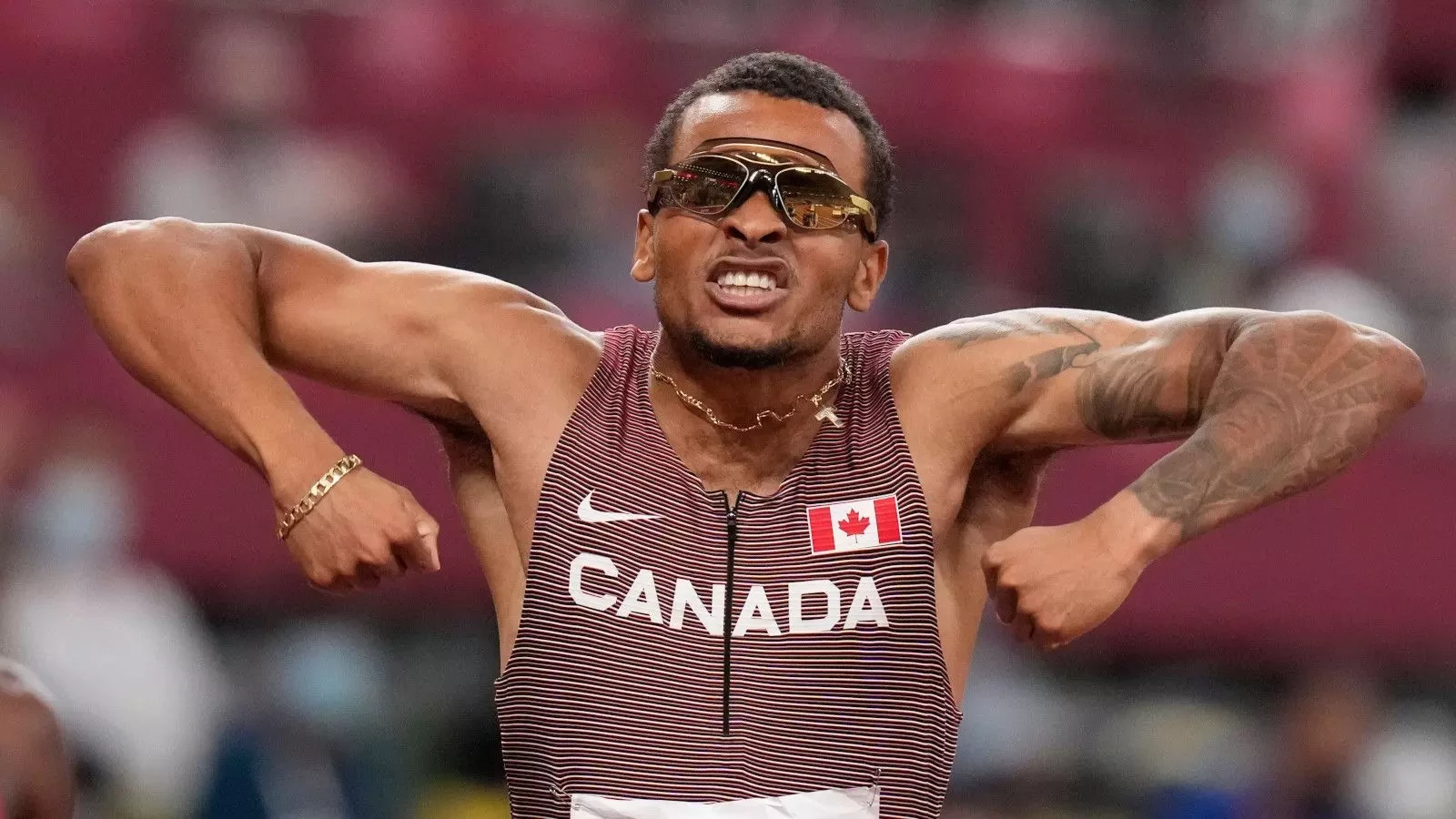
Andre De Grasse stands as one of the most decorated track and field athletes in Canadian history, having earned seven Olympic medals across three consecutive Games (Rio 2016, Tokyo 2020, and Paris 2024). His ability to deliver peak performances on the world’s largest athletic stages positioned him as a premier global sprinting icon. This athletic track record enabled De Grasse to build a groundbreaking commercial portfolio, highlighted by a historic multi-year deal with Puma and long-term partnerships with major national and international brands.
The Rise of an Athletic Powerhouse: From High School Tracks to Global Stages
Andre De Grasse’s journey to the pinnacle of world sprinting is notably distinct from many of his peers. Raised in Markham, Ontario, De Grasse did not pursue formal track training until the age of 17. Wearing basketball shorts and borrowed spikes, he clocked a 10.91-second 100-meter dash at a York Region high school meet. This raw talent immediately caught the attention of former Canadian Olympic sprinter Tony Sharpe, who began mentoring the young athlete at the Speed Academy Athletics Club.
De Grasse’s transition to collegiate athletics accelerated his technical development. He initially attended Coffeyville Community College in Kansas, where he secured multiple NJCAA titles, before transferring to the University of Southern California (USC) under coach Caryl Smith Gilbert. At the 2015 NCAA Division I Outdoor Track and Field Championships, De Grasse delivered a defining double victory, running a wind-assisted 9.75 seconds in the 100 meters and 19.58 seconds in the 200 meters.
That same summer, De Grasse transitioned to international competition. At the 2015 Pan American Games in Toronto, he won gold in both the 100-meter and 200-meter events. Weeks later, at the 2015 IAAF World Championships in Beijing, he announced his arrival on the elite international stage by claiming bronze in the 100 meters alongside Trayvon Bromell, running a personal best of 9.92 seconds against a field that included Usain Bolt and Justin Gatlin.
Early Career Trajectory:
- 2012: High School Debut (10.91s)
- 2013-2014: Coffeyville CC (NJCAA Champion)
- 2015: USC Trojans (NCAA Double Champion)
- 2015: Pan Am Games (Gold 100m/200m) & Beijing World Champs (Bronze 100m)
Championship Execution: The Medalling Consistency of Andre De Grasse
What distinguishes De Grasse from many sub-10-second sprinters is his consistency at major international championships. While some sprinters record fast times in early-season Diamond League circuits but fail to reach finals, De Grasse consistently elevated his performance during Olympic and World Championship finals.
Rio 2016: The Olympic Debut
At the 2016 Rio de Janeiro Olympics, De Grasse became the first Canadian sprinter to win three medals at a single Games since Alex Wilson in 1932. He captured bronze in the 100 meters (9.91s), silver in the 200 meters (19.80s), and anchored the Canadian 4x100-meter relay team to a bronze medal (37.64s, setting a national record at the time).
His 200-meter semi-final performance in Rio became an iconic moment in modern Olympic history when he pressed Usain Bolt to the line, earning a famous shared smile between the competitors. Beyond the media narrative, the race highlighted De Grasse’s tactical willingness to challenge established champions.
Tokyo 2020: Reaching the Summit
The Tokyo Games (held in 2021) marked the operational peak of De Grasse’s individual career. After earning another bronze in the 100-meter final with a personal best of 9.89 seconds, De Grasse captured the gold medal in the 200 meters.
His winning time of 19.62 seconds broke his own Canadian record and made him the eighth-fastest man in history over the distance at the time. He concluded the Tokyo Games by anchoring Canada's 4x100-meter relay team to a medal performance (subsequently upgraded to silver following a anti-doping disqualification of the Great Britain squad).
Paris 2024: Veteran Leadership and Relay Gold
Despite entering the Paris 2024 Olympic cycle dealing with coaching shifts and hamstring nagging injuries, De Grasse’s championship execution re-emerged in the relay events. While he missed the individual 100m and 200m finals by thin margins, he anchored the Canadian men’s 4x100-meter relay team—alongside Aaron Brown, Jerome Blake, and Brendon Rodney—to an Olympic Gold medal in 37.50 seconds. This victory solidified his tally at seven Olympic medals, tying swimmer Penny Oleksiak as Canada's most decorated Summer Olympian.
Comparative Performance Breakdown: Olympic and World Medals
The following table outlines Andre De Grasse’s major medal achievements across senior international competitions, documenting the times and context of his performances.
| Competition | Year | Event | Result | Mark (Time) | Key Milestone / Significance |
|---|---|---|---|---|---|
| World Championships (Beijing) | 2015 | 100m | Bronze | 9.92s | First senior international championship medal. |
| World Championships (Beijing) | 2015 | 4x100m Relay | Bronze | 38.13s | Established Canada's modern relay foundation. |
| Olympic Games (Rio) | 2016 | 100m | Bronze | 9.91s | First individual Olympic medal. |
| Olympic Games (Rio) | 2016 | 200m | Silver | 19.80s | Challenged Usain Bolt in final; established national profile. |
| Olympic Games (Rio) | 2016 | 4x100m Relay | Bronze | 37.64s | Set Canadian national record at the time. |
| World Championships (Doha) | 2019 | 100m | Bronze | 9.90s | Returned from major hamstring injuries in 2017–2018. |
| World Championships (Doha) | 2019 | 200m | Silver | 19.95s | Solidified status as elite dual-threat sprinter. |
| Olympic Games (Tokyo) | 2021 | 100m | Bronze | 9.89s | Personal best in the 100m event. |
| Olympic Games (Tokyo) | 2021 | 200m | Gold | 19.62s | Canadian National Record; first Olympic Gold medal. |
| Olympic Games (Tokyo) | 2021 | 4x100m Relay | Silver | 37.70s | Upgraded to silver following anti-doping rulings. |
| World Championships (Eugene) | 2022 | 4x100m Relay | Gold | 37.48s | Defeated USA on home track; set new Canadian Record. |
| Olympic Games (Paris) | 2024 | 4x100m Relay | Gold | 37.50s | Captured 7th career Olympic medal; tied Canadian record. |
The Commercial Architecture: Sponsorships and Brand Endorsements
Sponsorship dynamics in track and field differ substantially from team sports like soccer, basketball, or ice hockey. Track athletes lack base salaries provided by franchises; instead, their income relies on shoe sponsor retainers, competition prize money, performance incentives, and corporate endorsements. De Grasse’s commercial career represents a model case study in track and field athlete monetization.
Income Structure of Elite Sprinters:
- Corporate / Brand Sponsorships (Puma Base Retainer, National Brand Alignments, etc.)
- Performance Incentives (Medals/Records)
- Appearance Fees & Prize Money (DL)
The Benchmark Puma Contract
In December 2015, immediately after turning professional following his junior year at USC, De Grasse signed an endorsement deal with German sportswear brand Puma. Reported by sports business outlets at the time to be worth up to $11.25 million USD over its initial term including performance bonuses, it stood as one of the largest inaugural shoe contracts in track and field history.
Puma’s strategy was clear: with Usain Bolt approaching retirement following the 2016 Rio Olympics, the manufacturer required a charismatic, young, world-class sprinter to anchor its running and track category. De Grasse provided an ideal fit:
- Global Reach: Competed directly against top American and European sprinters in high-visibility events.
- Championship Dependability: Consistently advanced to finals, guaranteeing maximum broadcast visibility during key Olympic and World Championship windows.
- Clean Public Profile: Maintained a professional, low-controversy reputation, making him appealing for broad consumer marketing.
Puma extended its relationship with De Grasse across multiple Olympic cycles, designing custom competition apparel, signature spike colorways, and featuring him prominently in international product launches.
Portfolio Diversification: National and International Partners
While Puma secured exclusive rights in the athletic footwear and apparel category, De Grasse leveraged his profile to construct a multi-sector endorsement portfolio. His agency, Landmark Sports Group, systematically positioned him across diverse consumer touchpoints:
- Financial Services and Insurance: Partnerships with major institutions like TD Bank and Sun Life Financial tapped into his image of reliability, goal-setting, and long-term planning.
- Consumer Goods and Fast-Moving Consumer Goods (FMCG): Endorsements with brands like Cheetos, Pizza Pizza, and Gatorade utilized his playful, approachable media persona to target younger demographics.
- Nutrition and Wellness: Alignments with sports nutrition companies such as BioSteel provided product-integration opportunities aligned with athletic performance and recovery.
- Automotive and Technology: Regional and national campaigns with manufacturers like Genesis Motors showcased his status as a premium Canadian figure.
Leveraging Olympic Charter Rule 40
A critical factor in maximizing athlete sponsorship value is navigating International Olympic Committee (IOC) guidelines, specifically Rule 40. Historically, Rule 40 severely restricted non-Olympic sponsors from using an athlete's image or name during the "blackout period" surrounding the Games.
De Grasse’s team effectively navigated the relaxed Rule 40 guidelines introduced ahead of Tokyo 2020 and maintained through Paris 2024. By establishing long-term generic campaigns with non-official Olympic partners well before the Games, sponsors were able to run compliant, continuous advertising that capitalized on his heightened visibility without violating IOC intellectual property regulations.
Marketing Analysis: Why De Grasse Succeeded Commercializing Track & Field
Track and field sprinters often struggle to secure sustained financial support outside of Olympic years. The sport's audience fluctuates dramatically in four-year cycles. De Grasse mitigated this structural challenge through several key factors:
1. The "Clutch" Brand Identity
In consumer marketing, reliability under pressure is a premium attribute. De Grasse acquired a reputation as a big-stage racer—an athlete who recorded personal bests in Olympic finals rather than early-season trials. Brands in the financial, automotive, and technology sectors frequently aligned their messaging with this "clutch performance" narrative.
2. High Domestic Market Share
While American sprinters must share domestic sponsorship budgets across dozens of Olympic stars, De Grasse operated as the undisputed face of Canadian track and field for nearly a decade. Canadian corporations seeking to align with Summer Olympic success turned to De Grasse as a primary national ambassador.
3. The Usain Bolt Dynamic
The timing of De Grasse's entry into professional sprinting coincided with the sunset of Usain Bolt’s career. By racing competitively alongside Bolt and earning his visible respect, De Grasse received immediate global media validation. Marketing campaigns routinely referenced him as the leader of sprinting's post-Bolt era.
Post-Bolt Era Sprinting Landscape:
- Usain Bolt Era (2008-2016)
- High Global Media Visibility
- Transition Window (2016-2017)
- De Grasse Emerges as Direct Competitor & Torchbearer
- Sustained Global Marketability (2018-2026)
4. Philanthropy and Community Alignment
Through the Andre De Grasse Family Foundation, De Grasse focused on supporting youth through sports and education. The foundation hosts the annual Andre De Grasse Future Stars Series, providing track opportunities to young Canadian athletes. This philanthropic commitment provided corporate partners with opportunities for cause-marketing and community engagement programs.
Technical and Tactical Evolution
Understanding De Grasse’s longevity requires examining his technical adjustments over his competitive career. Sprinting at an elite level requires managing high ground-reaction forces, precise stride frequency, and low energy loss during acceleration.
Start Mechanics vs. Top-End Speed
Early in his career, De Grasse's primary weakness was his reaction time and initial acceleration phase (the first 30 meters). His start mechanics were less explosive than competitors like Christian Coleman or Su Bingtian. However, his top-end speed endurance—the ability to maintain maximum velocity between 60m and 100m while minimizing deceleration—was among the best in the world.
100m Velocity Profile Analysis:
- 0m to 30m: Acceleration Phase
- Slower start mechanics
- Relies on reaction
- 30m to 60m: Max Velocity Phase
- Smooth transition phase
- Stride frequency peaks
- 60m to 100m: Speed Maintenance Phase
- Elite deceleration resistance
- Catches field in final 30m
Over successive training cycles with elite coaches including Rana Reider, Stuart McMillan, and John Smith, De Grasse refined his block clearance and drive phase mechanics:
- Pillar Alignment: Improving core stability to prevent lateral hip posture collapse during maximal acceleration.
- Ground Contact Time: Reducing contact time in the drive phase to translate horizontal force more efficiently into the track.
- Relaxation under Force: Maintaining relaxed facial and upper-body musculature during peak velocity to prevent nervous system fatigue in the final 20 meters of races.
These adjustments allowed him to remain competitive in the 100 meters while preserving the late-race acceleration required to win titles in the 200 meters and anchor 4x100m relay teams.
Frequently Asked Questions
What made Andre De Grasse's initial Puma contract historic?
Signed in late 2015 upon turning professional, De Grasse’s contract with Puma was valued at up to $11.25 million USD over its initial term including bonuses. It represented one of the largest initial endorsement contracts ever awarded to a newly professional track and field athlete, reflecting Puma's strategy to secure a primary brand ambassador as Usain Bolt approached retirement.
How many Olympic medals has Andre De Grasse won?
Andre De Grasse has won seven Olympic medals:
- Gold (2): 200m (Tokyo 2020), 4x100m Relay (Paris 2024)
- Silver (2): 200m (Rio 2016), 4x100m Relay (Tokyo 2020)
- Bronze (3): 100m (Rio 2016), 4x100m Relay (Rio 2016), 100m (Tokyo 2020)
What is Andre De Grasse's personal best time in the 100m and 200m?
De Grasse's personal best in the 100 meters is 9.89 seconds, set during the final at the Tokyo Olympics in 2021. His personal best in the 200 meters is 19.62 seconds, also set in Tokyo, which stands as the Canadian national record.
How do sprinters like De Grasse make money outside of the Olympics?
Elite sprinters generate income through four main channels: annual base retainers from shoe sponsors, corporate brand endorsement contracts, appearance fees at major Diamond League meets, and performance-based prize money from World Athletics events and championship medal bonuses.
What role does the Andre De Grasse Family Foundation play in his public profile?
The Andre De Grasse Family Foundation focuses on empowering youth through sports and education. By organizing events like the Future Stars Series and supporting youth mental health initiatives, the foundation expands De Grasse’s brand beyond athletic performance, establishing a long-term community footprint that appeals to corporate partners focused on social responsibility.
Practical Takeaways for Sports Marketers and Track Enthusiasts
For athletic directors, brand strategists, and sports analysts studying De Grasse’s career model, several key lessons emerge:
- Prioritize Championship Reliability: Long-term brand value in Olympic sports depends more on delivering peak performances at major championships than setting early-season records.
- Anchor in Home Markets: Securing dominant status within a specific national market (such as Canada) provides leverage when negotiating international commercial agreements.
- Structure Diversified Partnerships: Combining exclusive primary kit sponsors with non-competing regional corporate brands protects an athlete's income baseline across changing athletic cycles.
- Invest in Post-Athletic Infrastructure: Establishing charitable foundations and youth programs early in a career builds infrastructure for long-term relevance beyond competitive track racing.