The Great Pyramid of Giza remains one of the most sophisticated engineering achievements in human history, constructed from over 2.3 million stone blocks with an accuracy that rivals modern construction. Built for the Pharaoh Khufu around 2560 BCE, it served as a royal tomb, an astronomical observatory, and a symbolic ladder to the stars, incorporating mathematical constants like Pi and the Golden Ratio centuries before their formal documentation.
The Magnitude of Construction and Material Logistics
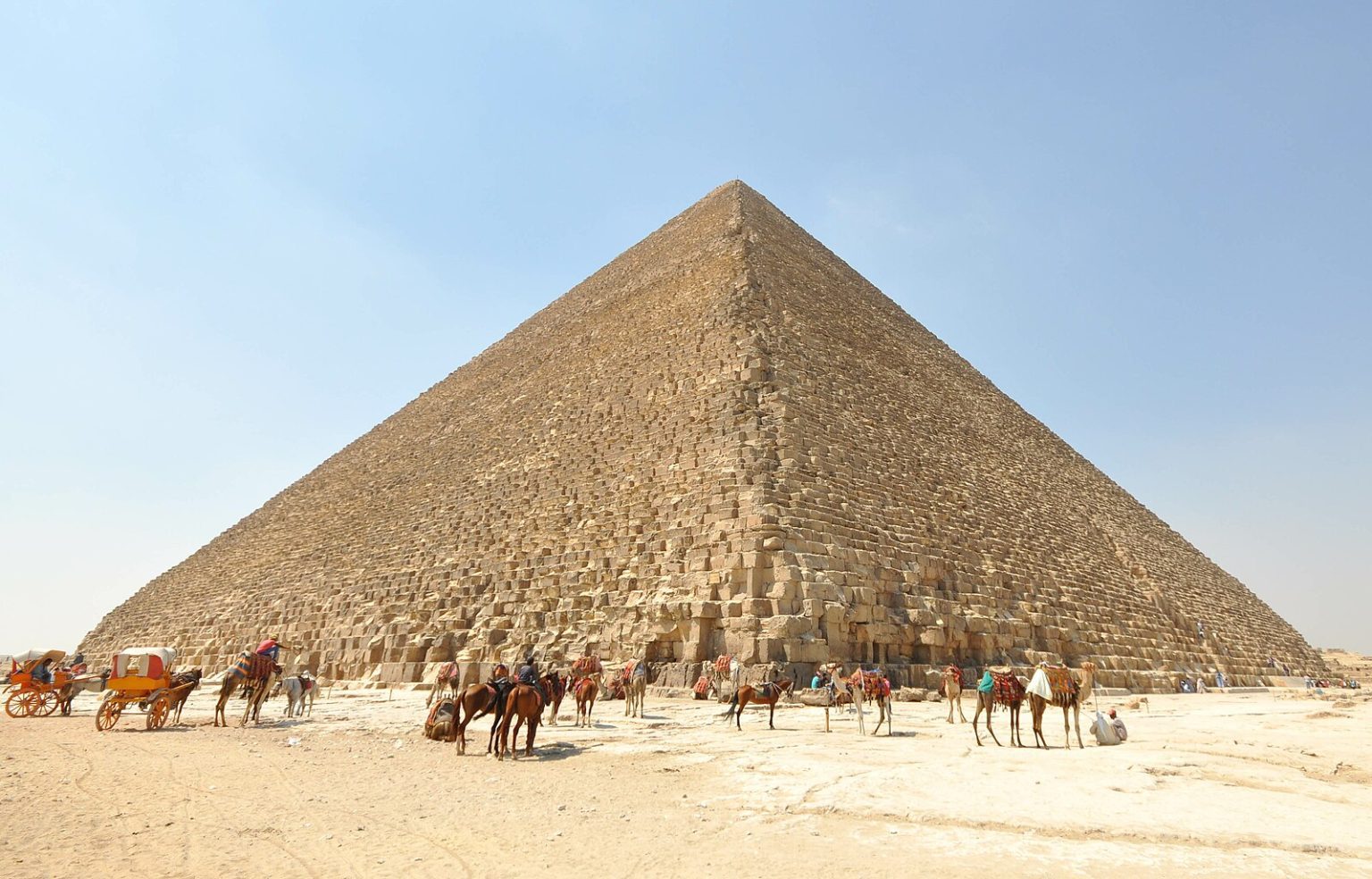
When discussing amazing facts about the pyramid, the sheer scale of the Great Pyramid of Giza—the only surviving member of the Seven Wonders of the Ancient World—is the most logical starting point. The structure originally stood at 146.6 meters (481 feet), though erosion and the removal of its limestone casing have reduced it to approximately 138 meters. For over 3,800 years, it was the tallest man-made structure on Earth, a title it held until the completion of Lincoln Cathedral in England in 1311.
The logistical undertaking was monumental. The pyramid is composed of approximately 2.3 million individual stone blocks. While the average weight of these blocks is about 2.5 tons, some of the massive granite slabs used in the ceiling of the King’s Chamber weigh as much as 80 tons. Transporting these massive stones from the Aswan quarries, located over 800 kilometers (500 miles) to the south, required a sophisticated understanding of hydrology and seasonal Nile flooding.
Archaeologists have identified that the Egyptians used a complex system of canals and harbor basins to bring the stones directly to the foot of the Giza Plateau. Research published by the Ancient Egypt Research Associates (AERA) confirms that the workforce was not a mass of slaves, as long suggested by Greek historian Herodotus, but a highly organized bureaucracy of skilled laborers and seasonal farmers who were well-fed and housed in a nearby "Lost City of the Pyramid Builders."
Astronomical and Geographic Precision
One of the most profound aspects of the Great Pyramid is its orientation to the cardinal points of the compass. The four sides of the pyramid are aligned with North, South, East, and West with an error of less than 0.06 percent. This precision suggests that the builders possessed an advanced knowledge of astronomy, likely using the transit of stars across the meridian to establish a true north-south line.
The Orion Correlation and Stellar Shafts
A popular theory among researchers is the relationship between the Giza pyramids and the stars of Orion’s Belt. While the "Orion Correlation Theory" remains a subject of academic debate, the physical evidence of the "air shafts" within the Great Pyramid points to a celestial connection. These narrow shafts, which lead from the King’s and Queen’s chambers to the exterior, were once thought to be for ventilation. However, calculations of the night sky in 2500 BCE suggest they were precisely aimed at specific stars, such as Sirius and Alpha Draconis, intended to serve as symbolic pathways for the Pharaoh’s soul to ascend to the heavens.
Geographic Center of the Earth
While often sensationalized, there is a mathematical basis for the claim that the Great Pyramid sits near the geographic center of the Earth’s landmass. If one draws two lines of longitude and latitude—one through the pyramid and one that bisects the most land area—the intersection is remarkably close to the Giza Plateau. While this may be a byproduct of the plateau's stable limestone bedrock, it underscores why the site was chosen for a structure intended to last for eternity.
Mathematical Constants and Geometric Sophistication
Long before the Greeks "discovered" Pi ($\pi$) or the Golden Ratio ($\phi$), the Great Pyramid seemingly incorporated these values into its very dimensions. The relationship between the perimeter of the base and the height of the pyramid is roughly $2\pi$. If you divide the perimeter of the pyramid by twice its height, the result is approximately 3.14159.
Furthermore, the geometry of the structure reflects the Golden Ratio. The ratio of the length of the face (the slant height) to half the length of the side of the base is approximately 1.618. Whether these mathematical properties were intentional or a natural result of using a "rolling drum" measurement system (which inherently introduces Pi) is a point of ongoing scholarly discussion. However, the result is a structure of perfect aesthetic and structural balance that has withstood seismic activity and environmental degradation for nearly five millennia.
The Internal Layout: Chambers and the "Big Void"
Unlike many other pyramids that feature simple burial chambers beneath the structure, the Great Pyramid is unique because its primary chambers are located deep within the masonry.
- The Subterranean Chamber: Carved directly into the bedrock, this chamber appears unfinished. Some theories suggest it was the original planned burial site, abandoned as the project grew more ambitious.
- The Queen’s Chamber: Situated at the end of a long horizontal passage, this chamber contains two shafts that do not reach the exterior, ending instead at limestone "doors" with copper handles, discovered via robotic exploration.
- The Grand Gallery: A magnificent corbelled hall that rises at a steep angle toward the King’s Chamber. The precision of the stonework here is so fine that a razor blade cannot be inserted between the blocks.
- The King’s Chamber: Constructed entirely of red granite, it contains the sarcophagus of Khufu. The chamber is protected from the immense weight above by five "relieving chambers" designed to redirect the pressure of the masonry.
In recent years, the ScanPyramids project, utilizing muon tomography (a non-invasive technique that uses cosmic ray particles), discovered a massive internal space above the Grand Gallery, known as the "Big Void." As of 2026, research continues to determine if this space served a structural purpose—to reduce weight—or if it contains undiscovered archaeological treasures.
Comparison of the Giza Pyramids
While the Great Pyramid is the most famous, it is part of a larger complex. Understanding the differences between these structures highlights the evolution of Egyptian engineering.
| Feature | The Great Pyramid (Khufu) | Pyramid of Khafre | Pyramid of Menkaure |
|---|---|---|---|
| Original Height | 146.6 Meters | 143.5 Meters | 65 Meters |
| Base Length | 230.3 Meters | 215.5 Meters | 103.4 Meters |
| Material (Core) | Local Limestone | Local Limestone | Local Limestone |
| Casing Material | Tura Limestone (White) | Tura Limestone & Granite | Red Granite (Lower levels) |
| Internal Complexity | High (Multiple chambers) | Moderate (Single path) | Moderate (Complex sub-levels) |
| Construction Era | ~2560 BCE | ~2520 BCE | ~2490 BCE |
The Missing Casing Stones and the Golden Capstone
In antiquity, the pyramids did not look like the rugged, stepped structures we see today. They were encased in polished Tura limestone that was so white and reflective it was said the pyramids could be seen from miles away, shining like a "star on earth." Most of these casing stones were stripped away in the 14th century to build mosques and fortresses in Cairo following a massive earthquake that loosened the stones.
At the very top of the pyramid sat the Pyramidion, or capstone. Many of these were covered in gold or electrum to catch the first rays of the sun. The capstone of the Great Pyramid is long gone, leading to various theories ranging from it being a miniature version of the pyramid itself to more esoteric claims. Its absence contributes to the "unfinished" appearance of the summit, which now serves as a flat platform about 10 meters square.
Acoustic Properties and Thermal Stability
Visitors to the King’s Chamber often report strange acoustic phenomena. The chamber was built using resonant granite, and the dimensions are such that it can amplify certain frequencies. Some researchers suggest that the chamber was designed to produce low-frequency vibrations during religious rituals, intended to induce a meditative or transcendental state in the priests or the Pharaoh.
Furthermore, the Great Pyramid acts as a massive thermal heat sink. Despite the scorching Egyptian sun, the interior temperature of the pyramid remains remarkably constant at around 20 degrees Celsius (68 degrees Fahrenheit), which is the average temperature of the Earth at that latitude. This thermal stability has helped preserve the structural integrity of the internal chambers by minimizing expansion and contraction of the stones.
The Cultural Impact: From Ancient Tombs to Modern Tourism
As of 2026, the Giza Plateau has undergone significant modernization to accommodate the millions of visitors who flock to see these "amazing facts about the pyramid" in person. The Grand Egyptian Museum (GEM), located just a short distance from the pyramids, now houses the complete collection of King Tutankhamun and provides deep context for the Old Kingdom's architectural achievements.
The Great Pyramid is not just a monument of the past; it is a catalyst for modern technological development. From the use of muons to map its interior to the deployment of autonomous "micro-robots" into its narrowest shafts, the pyramid continues to drive innovation in physics and engineering.
Frequently Asked Questions
Was the Great Pyramid built by slaves?
No. Archaeological evidence, including the discovery of worker cemeteries and bakeries, proves that the pyramid was built by a paid, professional workforce. These workers were highly respected, provided with medical care, and fed high-protein diets including beef and fish.
How were the stones lifted so high?
While no contemporary records exist, most experts agree that a system of internal or external ramps was used. Recent theories, supported by evidence from the Hatnub quarries, suggest that a "sled and pulley" system using water to lubricate the sand was employed to reduce friction, allowing smaller teams to move massive blocks.
Are there hieroglyphs inside the Great Pyramid?
Interestingly, there are no formal hieroglyphic inscriptions or wall paintings inside the Great Pyramid’s chambers. This is a sharp contrast to the later pyramids of the 5th and 6th dynasties (such as the Pyramid of Unas), which are filled with the "Pyramid Texts." The only inscriptions found are "quarry marks"—graffiti left by the work gangs (e.g., "The Friends of Khufu Gang").
Is the pyramid a power plant or an energy generator?
While popular in alternative history circles, there is no scientific evidence to support the "Giza Power Plant" theory. The pyramid lacks the necessary conductive materials or mechanical components required for energy generation. Its primary purpose, supported by extensive archaeological and textual evidence, was funerary and religious.
Can you still go inside the Great Pyramid?
Yes, visitors can enter the Great Pyramid through the "Robbers' Tunnel," an entrance created in the 9th century by Caliph al-Ma'mun. However, access is often limited to a certain number of tickets per day to control humidity and carbon dioxide levels, which can damage the limestone.
Final Recommendation for Exploration
If you are planning to explore the wonders of the Giza Plateau, the most effective next action is to visit the Grand Egyptian Museum (GEM) before heading to the pyramids themselves. The museum provides the essential historical and technological context needed to appreciate the engineering precision of the Fourth Dynasty. For those interested in the latest discoveries, following the annual reports from the Ministry of Tourism and Antiquities in Egypt is the best way to stay informed about the ongoing ScanPyramids project and the potential opening of the "Big Void" to the public.