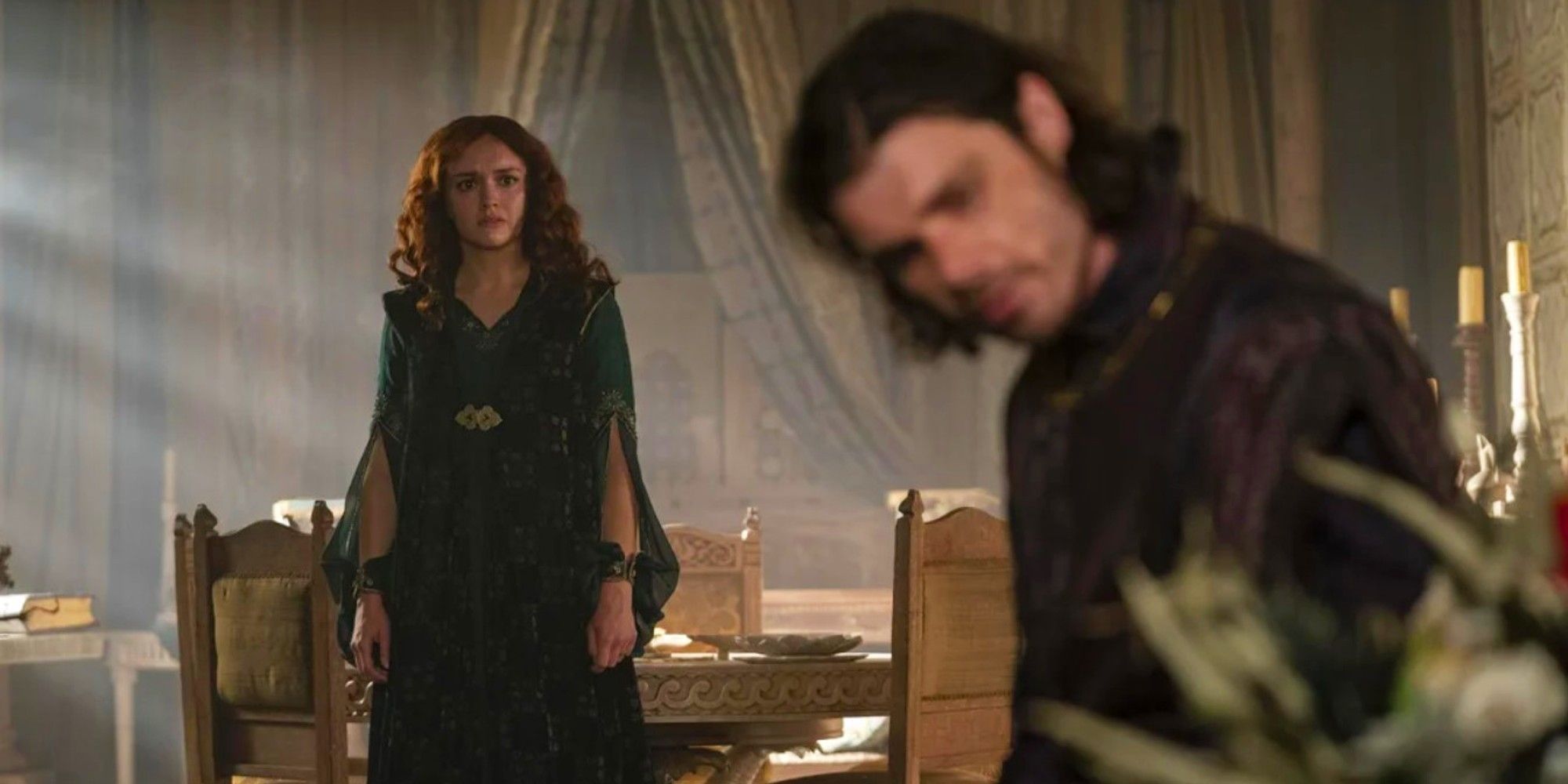
In House of the Dragon Season 1, Episode 9, Queen Alicent Hightower reveals her feet to Larys Strong as a form of payment for his political intelligence. This scene depicts a transactional, non-consensual power dynamic where Alicent uses her body as currency to maintain her influence and secure the throne for her son.
The scene occurs during "The Council of the Green," an episode that chronicles the immediate aftermath of King Viserys I Targaryen's death and the frantic maneuvers to crown Aegon II. While the series is known for its sweeping dragon battles and intricate political backstabbing, this specific moment between Alicent and Larys became one of the most discussed and analyzed sequences in the franchise's history. As of 2026, it remains a landmark example of how the series explores the intersection of sexual exploitation, political necessity, and the loss of female agency in a patriarchal society.
The Context of the Transaction: Episode 9 Analysis
To understand why the "feet scene" occurs, one must look at the immense pressure Alicent Hightower is under during the ninth episode. Her father, Otto Hightower, has been plotting for years to usurp Rhaenyra Targaryen’s claim. Alicent, who has spent her life trying to be the "perfect" queen—pious, dutiful, and obedient—finds herself caught between her father’s cold ambitions and her own desire to protect her children.
Larys Strong, known as "Larys the Foot" due to his clubfoot, has positioned himself as Alicent’s most effective, albeit most dangerous, ally. He provides the Queen with information that even the Master of Whisperers cannot obtain. However, this information is never free. In earlier episodes, Larys orchestrated the deaths of his own father and brother to clear the path for Otto Hightower’s return as Hand of the King, effectively "bonding" himself to Alicent through shared secrets and blood.
By Episode 9, the relationship has evolved into a formalized, repetitive exchange. As Alicent sits across from Larys, the atmosphere is not one of romance or mutual attraction, but of a weary, business-like resignation. The scene is a stark reminder that even as a Queen, Alicent’s power is often tethered to the whims of men who demand different forms of "tribute."
A Deep Dive into the "Quid Pro Quo" Dynamics
The scene begins with Larys informing Alicent of a "web of spies" within the Red Keep, specifically mentioning the influence of the White Worm (Mysaria). He offers to "cleanse" the palace of these informants. In response, Alicent does not offer gold or titles; she understands the unspoken price.
The Physicality of the Scene
Alicent sits on a chaise, removes her shoes, and pulls back her hosiery. The camera focuses on Larys’s reaction—a mixture of intense focus and gratification. While Alicent looks away, her face etched with a combination of disgust and pragmatism, Larys begins to pleasurably gratify himself.
The choreography of the scene is intentional. There is no physical contact between the two characters. This distance emphasizes the dehumanizing nature of the exchange; Alicent is not a partner in this act, but an object of observation. Her feet are the medium through which Larys exerts control over a woman who outranks him in every social and political hierarchy.
The Psychology of Larys Strong
Larys Strong’s fetish is not merely about physical attraction; it is about power. By compelling the Queen of the Seven Kingdoms to expose herself in a way she finds demeaning, Larys levels the playing field. He knows that Alicent prides herself on her morality and religious devotion. Forcing her to participate in this "indecency" is a way of stripping her of her moral high ground and ensuring she remains dependent on him.
Symbolism and the Theme of Female Agency
The "feet scene" serves as a powerful metaphor for Alicent's entire life. Since the first episode, Alicent has been a pawn. Her father forced her to comfort a grieving King Viserys, eventually leading to a marriage she did not seek. Throughout the series, her body has been a tool for the Hightower family—first to produce heirs, and now to procure secrets.
The Illusion of Power
Alicent believes she is taking charge of the situation by utilizing Larys to outmaneuver her father. However, the scene suggests the opposite. While she gets the information she needs to find Aegon II before Otto does, she pays for it with her dignity. It highlights the recurring theme in House of the Dragon: in Westeros, women can wear crowns, but they are rarely the ones who hold the ultimate leash.
The Contrast with Rhaenyra
The show frequently contrasts Alicent’s path with that of Rhaenyra Targaryen. While Rhaenyra seeks power through her birthright and personal desires, Alicent seeks it through adherence to systems and transactional relationships. The foot scene is the ultimate expression of Alicent’s "dutiful" approach to power—she treats her own humiliation as just another duty to be performed for the sake of her family’s survival.
Production Insights: The Making of the Scene
The inclusion of this scene was a deliberate choice by the show’s writers and directors, rather than something pulled directly from George R.R. Martin’s Fire & Blood. In the source material, Larys Strong is a mysterious figure, but the specific nature of his "payment" from Alicent is not detailed.
Directorial Choices by Clare Kilner
Director Clare Kilner has spoken about the scene’s intent in various interviews. The goal was to portray the "muck" of politics. The production team wanted to avoid a standard "sex scene," opting instead for something that felt more intrusive and psychologically complex. By focusing on a foot fetish, the show creators highlighted the idiosyncratic and often hidden perversions of those in power.
Performance by Olivia Cooke and Matthew Needham
Olivia Cooke’s performance in this scene is widely praised for its subtlety. She conveys a sense of "checking out" mentally—a common psychological defense mechanism for those enduring unwanted sexual situations. Matthew Needham, as Larys, manages to be repulsive without being a caricature, portraying a man who is fully aware of the leverage he holds.
| Element | Production Detail | Significance |
|---|---|---|
| Director | Clare Kilner | Focused on the "uncomfortable" nature of power exchanges. |
| Writer | Sara Hess | Aimed to show a different side of Larys's manipulation. |
| Visual Focus | Extreme Close-ups | Emphasizes the fetishistic and intrusive nature of the act. |
| Character State | Resignation (Alicent) | Highlights the loss of agency and "duty" as a burden. |
| Source Material | Not in Fire & Blood | A show-original invention to deepen character dynamics. |
Public Reception and Cultural Impact
Upon its release in late 2022, the scene sparked a massive wave of social media discourse. The reaction was a mix of shock, humor (memes), and serious feminist critique.
- The "Larys the Foot" Memes: The internet quickly dubbed the character with various foot-related nicknames. While some of this was lighthearted, it underscored how memorable the scene was compared to more traditional violence in the show.
- Discussions on Consent: Many viewers and critics analyzed the scene through the lens of workplace harassment and coerced consent. Because Larys holds vital information that Alicent needs to protect her life and the lives of her children, her "choice" to show her feet is seen by many as a forced transaction rather than a consensual act.
- Character Development: For Alicent’s character arc, the scene was a turning point. It showed how far she had fallen from the innocent girl in the godswood. It established that her "Green" faction was built on a foundation of moral compromise.
Comparison to Game of Thrones' Mature Themes
House of the Dragon has often been compared to its predecessor, Game of Thrones, regarding its depiction of sexual themes. While the original series was often criticized for "sexposition" (using sex scenes to deliver backstory), House of the Dragon tends to use these moments for more specific character studies.
The Alicent/Larys scene is less about titillation and more about the "grotesque" nature of their alliance. Unlike the more explicit scenes in the early seasons of Game of Thrones, the foot scene in House of the Dragon is filmed with a sense of dread and clinical detachment, making it more of a psychological horror beat than a traditional adult sequence.
The Technical Execution of the Scene
From a technical standpoint, the lighting and framing of the scene contribute to its effectiveness. The room is dimly lit, with warm tones that should feel intimate but instead feel stifling. The camera stays low, often at the level of the table or the floor, mirroring Larys's perspective. This "low-angle" storytelling forces the audience to participate in Larys's voyeurism, making the viewer feel complicit and uncomfortable—a common technique used to evoke a specific emotional response from the audience.
The sound design is also minimal. There is no sweeping orchestral score; instead, the silence is punctuated only by the rustle of fabric and Larys’s breathing. This creates a raw, visceral feeling that strips away the "fantasy" veneer of the show, grounding the moment in a harsh, uncomfortable reality.
FAQs: Understanding the Alicent Foot Scene
Why did Alicent show her feet to Larys?
Alicent showed her feet as a form of payment for information. Larys Strong acted as her primary intelligence officer, and because Alicent could not pay him with public accolades or traditional romantic affection, he demanded this specific fetishistic display in exchange for his loyalty and secrets.
Is the foot scene in the book "Fire & Blood"?
No, the scene is not in the book. George R.R. Martin’s Fire & Blood is written as a historical chronicle by various maesters who would not have been present for such a private interaction. The writers of the television series added this dynamic to provide more depth to Larys Strong’s character and to illustrate the sacrifices Alicent makes for power.
What does this scene say about Alicent’s character?
The scene illustrates Alicent’s pragmatic but tragic descent into the world of political maneuvering. It shows that she is willing to endure personal humiliation and sacrifice her own moral standards if she believes it is necessary to secure her family's future and outplay her rivals like her father or Rhaenyra.
How did the actors feel about filming the scene?
Olivia Cooke has described the scene as "uncomfortable" but necessary for the narrative. She and Matthew Needham worked closely with intimacy coordinators to ensure that, while the scene looked exploitative on screen, the filming environment was professional, safe, and respectful for the performers.
Did Larys Strong actually help Alicent because of this?
Yes. Immediately following this exchange, Larys moved to eliminate the "web of spies" in the city, which included burning down the manse of the White Worm. This act solidified the Greens' control over the capital during the critical hours before Aegon II's coronation.
Summary and Next Actions
The "feet scene" in House of the Dragon is a pivotal moment that defines the dark, transactional nature of the "Green" faction's rise to power. It is a sequence that prioritizes character psychology over simple shock value, providing a window into the compromises required to survive in the Red Keep.
For viewers looking to understand the full scope of this dynamic, it is recommended to:
- Re-watch Season 1, Episode 5: Look for the early interactions between Alicent and Larys after the death of the Strongs to see how the seeds of this relationship were planted.
- Analyze the "White Worm" Subplot: Compare how Mysaria uses information for gold versus how Larys uses it for personal gratification.
- Follow Season 2 and 3 Developments: Observe how this power imbalance shifts as the war (The Dance of the Dragons) progresses and whether Larys continues to hold this specific leverage over the Queen Mother.
By examining this scene not just as a viral moment but as a piece of narrative architecture, fans can better appreciate the complex, often tragic, journey of Alicent Hightower.