The term "African National Anthem" typically refers to one of two major compositions: the South African National Anthem, which famously blends five languages (isiXhosa, isiZulu, Sesotho, Afrikaans, and English), or the African Union (AU) Anthem, titled "Let Us All Unite and Celebrate Together." Both serve as powerful symbols of liberation, unity, and continental identity.
While the South African anthem is the most recognized globally due to its unique multi-lingual structure, the African Union anthem represents the collective aspirations of the 55 member states of the African continent. This guide provides the full English lyrics, historical context, and linguistic breakdowns for both, as they stand in 2026.
The South African National Anthem: A Linguistic Masterpiece
The South African National Anthem is a unique hybrid of two different songs: "Nkosi Sikelel' iAfrika" (God Bless Africa) and "Die Stem van Suid-Afrika" (The Call of South Africa). Since 1997, these have been combined into a single, shortened anthem that uses five of the country's eleven official languages.
In practice, when people search for "African national anthem lyrics in English," they are often looking for the English translation of the Xhosa, Zulu, and Sesotho stanzas, or the final stanza which is written natively in English.
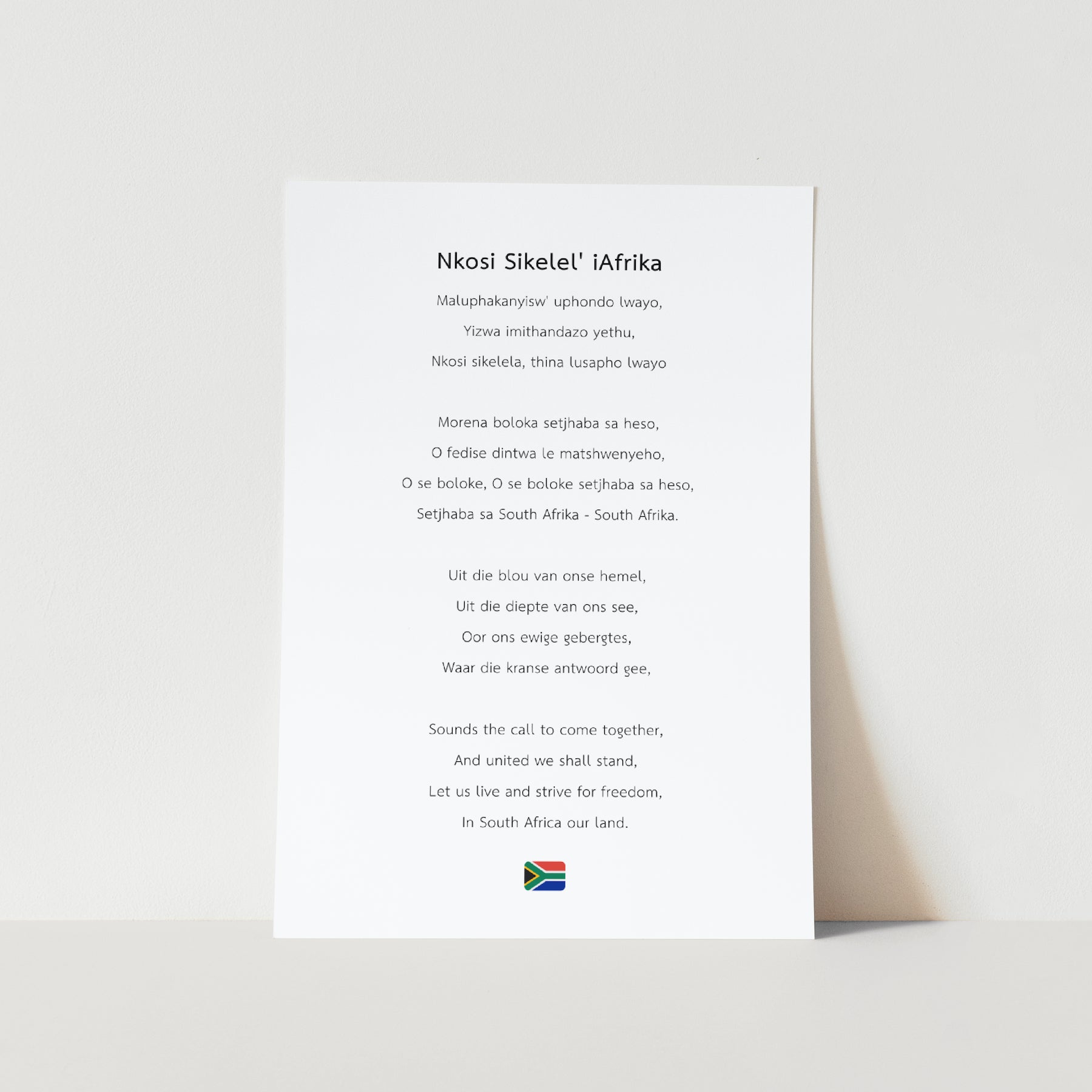
Full Lyrics and English Translation
The anthem is performed in a specific sequence. Below is the lyrical structure as performed in official capacities in 2026, alongside the English translation for the non-English sections.
| Language | Original Lyrics | English Translation |
|---|---|---|
| isiXhosa | Nkosi Sikelel' iAfrika | Lord bless Africa |
| Maluphakanyis' uphondo lwayo, | May her glory be lifted high, | |
| isiZulu | Yizwa imithandazo yethu, | Hear our petitions, |
| Nkosi sikelela, thina lusapho lwayo. | Lord bless us, us your children. | |
| Sesotho | Morena boloka setjhaba sa heso, | Lord we ask You to protect our nation, |
| O fedise dintwa le matshwenyeho, | Intervene and end all conflicts, | |
| O se boloke, O se boloke setjhaba sa heso, | Protect us, protect our nation, | |
| Setjhaba sa South Afrika — South Afrika. | Our nation South Africa — South Africa. | |
| Afrikaans | Uit die blou van onse hemel, | From the blue of our heavens, |
| Uit die diepte van ons see, | From the depths of our seas, | |
| Oor ons ewige gebergtes, | Over our everlasting mountains, | |
| Waar die kranse antwoord gee, | Where the echoing crags resound, | |
| English | Sounds the call to come together, | (Natively in English) |
| And united we shall stand, | (Natively in English) | |
| Let us live and strive for freedom, | (Natively in English) | |
| In South Africa our land. | (Natively in English) |
The History and Significance of "Nkosi Sikelel' iAfrika"
The first half of the anthem, "Nkosi Sikelel' iAfrika," was composed as a Christian hymn in 1897 by Enoch Sontonga, a teacher at a Methodist mission school in Johannesburg. Originally, it was a prayer for divine blessing upon the continent and its people during the height of colonial expansion.
By the early 20th century, the song had evolved into a political anthem of defiance against racial oppression. In 1925, it was adopted by the African National Congress (ANC) as its official closing hymn. For decades, singing the song was an act of protest against the apartheid regime. Because of its powerful message of unity, versions of the melody were also adopted by other nations upon their independence, including Tanzania (Mungu ibariki Afrika) and Zambia (Lumbanyeni Zambia).
The 1994 Transition and Merger
Following the first democratic elections in 1994, South Africa briefly had two co-official national anthems: "Nkosi Sikelel' iAfrika" and the apartheid-era "Die Stem van Suid-Afrika." To foster national reconciliation, President Nelson Mandela mandated that the two be merged. The current version, finalized in 1997, represents a compromise that acknowledges the country’s diverse and often painful history while looking toward a shared future.
The African Union Anthem: "Let Us All Unite and Celebrate Together"
While individual countries have their own anthems, the African Union (AU)—the continental body representing all African nations—has its own official anthem. This is the definitive "African Anthem" in a geopolitical sense.
Adopted in 2002 (replacing the OAU anthem), this song is performed at AU summits, continental sporting events, and diplomatic ceremonies. Unlike the South African anthem, the official version of the AU anthem is frequently performed entirely in English, or in the other official AU languages (French, Arabic, Portuguese, Spanish, and Swahili).
English Lyrics of the African Union Anthem
The AU anthem is designed to be upbeat and celebratory, focusing on the end of colonialism and the beginning of an era of prosperity.
Stanza 1: Let us all unite and celebrate together The victories won for our liberty Let us dedicate ourselves to rise together To defend our liberty and unity.
Chorus: O Sons and Daughters of Africa Flesh of the Sun and Flesh of the Sky Let us make Africa the Tree of Life.
Stanza 2: Let us all unite and sing together To uphold the bonds that frame our destiny Let us dedicate ourselves to fight together For lasting peace and justice on our earth.
Stanza 3: Let us all unite and toil together To give the best we have to Africa The cradle of mankind and fount of culture Our pride and hope at break of dawn.
Meaning and Symbolism of the AU Anthem
The lyrics of the AU anthem emphasize several key themes relevant to the continent’s modern trajectory:
- Unity over Sovereignty: The repeated call to "unite and celebrate together" reflects the Pan-African goal of regional integration.
- The "Cradle of Mankind": By referencing Africa as the "fount of culture," the anthem reclaims the historical narrative of the continent as the origin of human civilization.
- Environmental and Spiritual Connection: Phrases like "Flesh of the Sun" and "Tree of Life" connect the people of the continent to its natural resources and climate.
Regional Variations of "God Bless Africa"
It is a common mistake to assume that the English lyrics for "Nkosi Sikelel' iAfrika" are the same across all countries that use the melody. Because the melody is so iconic, several nations adapted it with their own unique lyrics in their local languages, which translate differently into English.
- Tanzania (Mungu ibariki Afrika): The lyrics focus heavily on the blessing of the nation and its leaders. The English translation of the first line is "God bless Africa, Bless its leaders."
- Zambia (Lumbanyeni Zambia): Zambia uses the same melody but changed the lyrics significantly to focus on the specific land of Zambia, moving away from the broader continental focus of the original hymn. Its English lyrics begin with "Stand and sing of Zambia, proud and free."
- Zimbabwe (Historical): Zimbabwe used a version of the melody as its national anthem from 1980 to 1994 before switching to "Kalibusiswe Izwe leZimbawe" (Blessed be the Land of Zimbabwe).
Performance Protocol and Etiquette in 2026
When performing or attending a rendition of these anthems, certain protocols are expected in both domestic and international settings.
South African Protocol
According to the South African Government's official guidelines, citizens are expected to stand at attention with their hands at their sides. It is considered respectful to sing along, even if you are not fluent in all five languages. In 2026, digital displays at international sports venues often provide phonetic subtitles to encourage crowd participation.
African Union Protocol
The AU anthem is typically played after the host nation's national anthem at official events. Unlike national anthems, which are often sung with great emotional intensity, the AU anthem is often played as an instrumental during the raising of the AU flag, though the singing of the lyrics is becoming more common in educational institutions across the continent.
Linguistic Technicalities: Why Five Languages?
The inclusion of five languages in the South African anthem is not merely symbolic; it is a technical feat of arrangement.
- IsiXhosa and IsiZulu: These are the most widely spoken first languages in South Africa. They belong to the Nguni language group.
- Sesotho: This represents the Sotho-Tswana language group, ensuring representation for the inland provinces.
- Afrikaans: Including Afrikaans was a controversial but necessary step in 1994 to signal that the white population, particularly those of Dutch descent, remained part of the "Rainbow Nation."
- English: As the lingua franca of business, government, and international relations in South Africa, English acts as the "glue" that concludes the anthem.
From a musical perspective, the anthem transitions from a prayer-like hymn (the Nguni and Sotho sections) into a more traditional European-style march (the Afrikaans and English sections). This shift in tempo and time signature is a deliberate reflection of the blending of African and European cultural influences.
Frequently Asked Questions
What is the official name of the "African National Anthem"?
There is no single "African National Anthem." Usually, people mean the South African National Anthem ("Nkosi Sikelel' iAfrika") or the African Union Anthem ("Let Us All Unite and Celebrate Together").
Is "Nkosi Sikelel' iAfrika" still the anthem of other countries?
The melody remains the basis for the national anthems of Tanzania and Zambia. Namibia used it as an interim anthem after independence in 1990 before adopting "Namibia, Land of the Brave" in 1991.
Why is the South African anthem sung in so many languages?
It was designed to promote national unity and reconciliation following the end of apartheid. By including the languages of both the former oppressors and the oppressed, the anthem serves as a musical "peace treaty."
Who wrote the English part of the South African anthem?
The English lyrics were composed by a committee during the 1997 transition. They were designed to encapsulate the spirit of the new constitution, focusing on freedom, unity, and the land.
Where can I find the sheet music for the African Union anthem?
The sheet music and official recordings are maintained by the African Union Commission. It is arranged for various ensembles, from full orchestras to solo piano.
Practical Recommendation for Learning the Lyrics
If you are preparing to perform the South African national anthem, do not rely solely on the English translation. The power of the anthem lies in its original languages.
- Phonetic Practice: Focus on the "clicks" in the isiXhosa section. The 'X' in "isiXhosa" and "Nkosi" involves a side-of-the-tongue click that is central to the language's identity.
- Listen to 2026 Recordings: Modern arrangements often emphasize the choral harmonies. Listen to performances by the Ndlovu Youth Choir or similar ensembles to understand the rhythmic phrasing of the Sesotho and Zulu stanzas.
- The AU Anthem for Events: If you are organizing a Pan-African event, the AU anthem is the most appropriate choice to represent the continent as a whole.