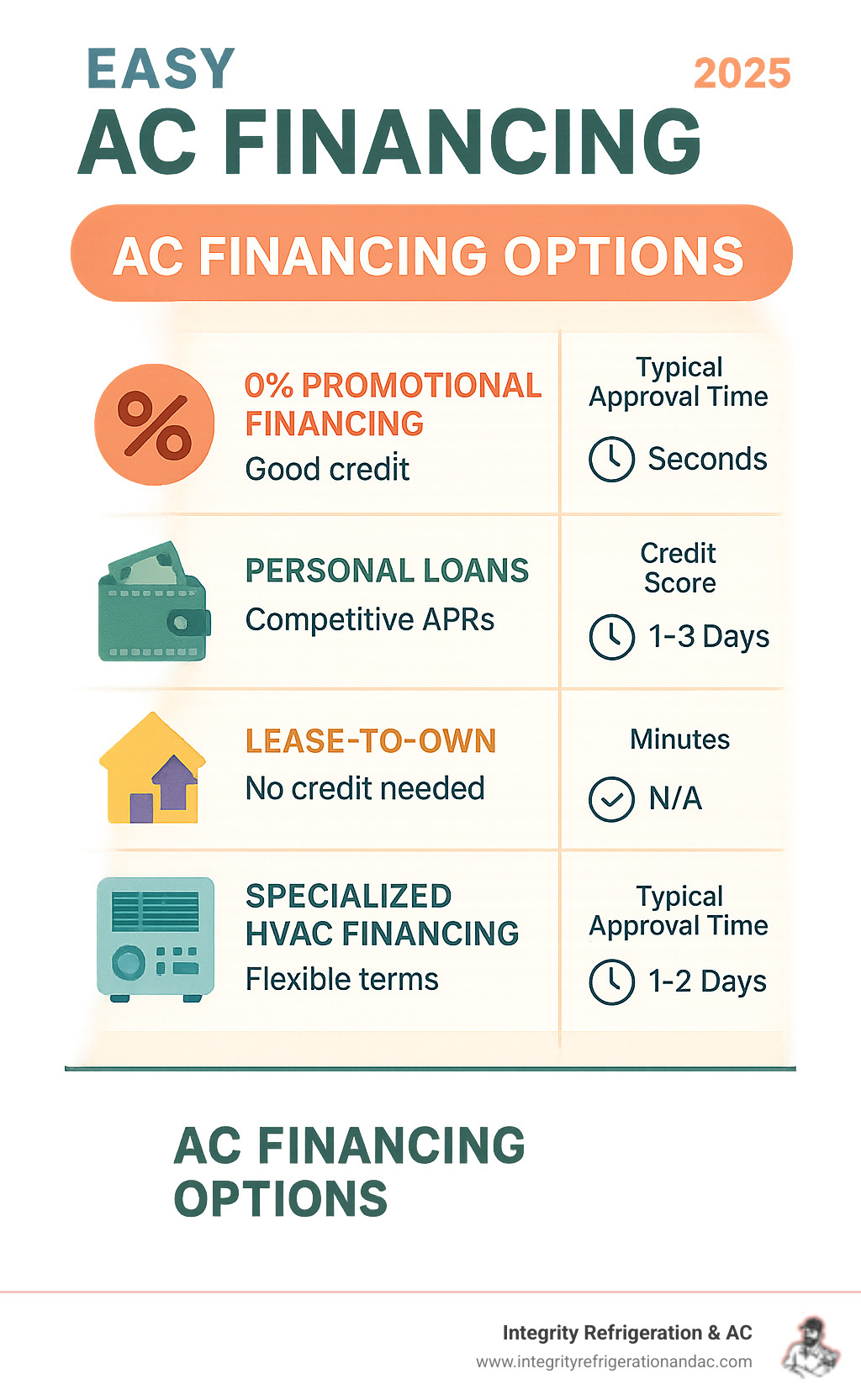
AC financing options include dealer-sponsored programs, personal loans, and energy-efficient government incentives designed to make high-cost HVAC replacements affordable. By leveraging these tools, homeowners can manage upfront costs through monthly installments, often benefiting from 0% APR introductory periods or low-interest rates specifically tied to residential energy improvements and modern heat pump installations.
Understanding the Financial Landscape of HVAC in 2026
As of 2026, the cost of a central air conditioning system or a high-efficiency heat pump has reached a point where the majority of American households opt for some form of financing. Driven by stricter SEER2 (Seasonal Energy Efficiency Ratio) standards and the transition to newer, low-GWP (Global Warming Potential) refrigerants, the average cost for a full system replacement typically ranges from $8,000 to $16,000, depending on the complexity and capacity of the unit.
Financing is no longer just a "last resort" for emergency failures; it has become a strategic tool for homeowners to upgrade to high-efficiency systems that offer long-term utility savings. By spreading the cost over five to ten years, the monthly energy savings generated by a new, high-efficiency unit can often offset a significant portion of the loan payment. Understanding the nuances of each financing vehicle—from dealer-backed credit to federal green energy loans—is essential for making an economically sound decision.
Primary AC Financing Options
Selecting the right financing path requires balancing the speed of approval against the long-term cost of interest. In 2026, the following four categories represent the most prevalent methods for funding a new cooling system.
1. Manufacturer and Dealer-Sponsored Financing
Most large HVAC manufacturers (such as Carrier, Trane, and Lennox) partner with third-party lenders like Wells Fargo, Synchrony Bank, or GreenSky to offer "point-of-sale" financing. This is often the most convenient option because the HVAC contractor handles the application process during the initial consultation.
These programs frequently feature promotional periods, such as "90 days same as cash" or "0% APR for 60 months." However, homeowners must be vigilant regarding "deferred interest" clauses. If the balance is not paid in full by the end of the promotional period, interest may be retroactively applied to the original purchase amount at a much higher rate. In 2026, dealer financing remains popular for its high approval rates and rapid processing, often providing a decision within minutes.
2. Personal Loans (Unsecured)
Unsecured personal loans are a flexible alternative that does not require using your home as collateral. Banks, credit unions, and online lenders (such as SoFi or LightStream) offer fixed-rate personal loans specifically for home improvements.
The primary advantage of a personal loan is that the funds are often deposited directly into your bank account, allowing you to pay the HVAC contractor as a "cash buyer." This can sometimes lead to a small discount from the contractor, who avoids the merchant fees associated with dealer-sponsored financing. In 2026, personal loan rates for those with excellent credit (740+) typically hover between 7% and 12%, making them more expensive than promotional dealer rates but more stable than credit cards.
3. Home Equity Loans and HELOCs
For major HVAC overhauls—especially those involving new ductwork or multi-zone heat pump installations—using home equity is often the most cost-effective long-term strategy. A Home Equity Loan provides a lump sum with a fixed interest rate, while a Home Equity Line of Credit (HELOC) works more like a credit card tied to your home's value.
The interest rates for equity-based financing are generally the lowest available, as the loan is secured by the property. Furthermore, if the HVAC upgrade is considered a permanent improvement that adds value to the home, the interest may be tax-deductible (consult a tax professional for current 2026 IRS guidelines). The downside is the length of the approval process, which can take several weeks and may require a home appraisal.
4. Specialized Energy Efficiency Loans (PACE)
Property Assessed Clean Energy (PACE) financing is a unique model where the loan is tied to the property rather than the individual. The "loan" is repaid via an assessment on your property tax bill. In 2026, PACE programs are increasingly common in states focused on decarbonization.
PACE financing is particularly useful for homeowners who may not qualify for traditional bank loans due to credit score challenges, as eligibility is based primarily on home equity and tax payment history. However, these loans can complicate the sale of a home, as many mortgage lenders require the PACE lien to be paid off before a title transfer can occur.
Evaluating Credit Cards for AC Purchases
While using a standard credit card is generally the most expensive way to finance an AC unit due to high APRs, it can be a savvy move under specific conditions.
Many credit card issuers in 2026 offer 0% introductory APR periods of 12 to 21 months for new cardholders. If the cost of the AC unit is $10,000 and you are confident you can pay $500 per month, you can effectively finance the unit for free over 20 months. Additionally, charging a large purchase to a high-reward card can net significant cash back or travel points. The risk is the "cliff"—if the balance remains when the 0% period ends, the interest rate will likely jump to 20% or higher, quickly erasing any rewards benefits.
Comparison of AC Financing Methods (2026)
| Financing Type | Typical APR Range | Term Length | Approval Speed | Best For |
|---|---|---|---|---|
| Dealer Financing | 0% - 26.99% | 12 - 120 Months | Instant | Convenience and 0% APR promos |
| Personal Loan | 7% - 24% | 24 - 84 Months | 1 - 3 Days | High credit scores; "Cash" buyer status |
| HELOC / Equity | 6% - 10% | 5 - 20 Years | 2 - 4 Weeks | Major upgrades; lowest interest rates |
| 0% APR Credit Card | 0% (Intro only) | 12 - 21 Months | Instant | Short-term debt; reward enthusiasts |
| PACE Financing | 6% - 9% | 10 - 20 Years | 1 - 2 Weeks | Lower credit scores; energy efficiency |
Government Incentives and Tax Credits in 2026
A critical component of "financing" an AC in 2026 is the integration of federal and state incentives. Under the frameworks established by the Inflation Reduction Act (IRA), which remains a primary driver of home energy policy, homeowners can significantly reduce the net cost of their financing.
- Energy Efficient Home Improvement Credit (25C): Homeowners may be eligible for a tax credit of 30% of the cost of a high-efficiency AC or heat pump, capped at $2,000 annually for heat pumps. This credit is not a "rebate" received at the point of sale but a reduction in tax liability, which can be used to pay down a portion of the loan principal in the following tax year.
- HEEHRA Rebates: Depending on household income and state-level implementation, some families may qualify for "point-of-sale" rebates up to $8,000 for heat pump installations. These rebates directly reduce the amount that needs to be financed.
- Utility Rebates: Many local utility companies offer their own financing or rebates for customers who install "smart" thermostats or high-SEER2 equipment to reduce strain on the electrical grid.
Eligibility and Credit Score Requirements
Lenders in 2026 have streamlined their criteria, but the "best" terms are still reserved for those with strong financial profiles.
- Credit Score: A score of 720 or higher is generally required for 0% APR dealer promotions or the lowest-rate personal loans. Scores between 640 and 719 will still qualify for most financing but with higher interest rates (usually 10% to 15%).
- Debt-to-Income (DTI) Ratio: Lenders typically look for a DTI below 43%. If your monthly debts (mortgage, car, credit cards) exceed this percentage of your gross income, securing a new loan for an AC unit may be difficult.
- Proof of Ownership: For HELOCs, PACE loans, and many energy-efficiency programs, you must prove you are the legal owner of the property and that there are no outstanding liens or foreclosures.
Common Pitfalls to Avoid in HVAC Financing
- Ignoring the Total Cost of Interest: A "low monthly payment" can be deceptive. A $10,000 system financed over 10 years at 15% APR will result in total payments exceeding $19,000. Always look at the total "cost of credit" disclosed in the loan documents.
- Over-Financing: Do not let a salesperson convince you to finance a system larger than your home requires just because the monthly payment "only goes up by $20." An oversized AC unit will short-cycle, leading to higher energy bills and a shorter equipment lifespan.
- Skipping the Fine Print on Promotional Offers: Many 2026 HVAC promos are "interest-free" only if the balance is zeroed out by a specific date. Missing the deadline by even one day can trigger a massive interest charge.
- Not Factoring in Maintenance: Some financing agreements require proof of annual professional maintenance to keep the warranty (and sometimes the loan terms) in good standing.
Step-by-Step Guide to Securing AC Financing
- Audit Your Credit: Check your credit report for errors before applying. A few points can be the difference between a 0% offer and a 12% APR loan.
- Get Three Detailed Quotes: Ensure each quote includes the specific model number and efficiency rating. You cannot accurately apply for financing without a hard number from a contractor.
- Check for "Green" Incentives: Visit the Department of Energy’s website or your state's energy office to see which 2026 rebates apply to the specific units you are considering.
- Compare the Math: Use an online calculator to compare a 0% dealer offer with a lower-interest personal loan. Remember that the "cash price" of the unit might be lower if you use a personal loan.
- Review the Amortization Schedule: Ensure the loan term does not exceed the expected lifespan of the AC unit. You do not want to be paying for a 15-year loan on a unit that may only last 12 years.
Frequently Asked Questions
What is the average credit score needed for AC financing?
For the most competitive rates, such as 0% APR for 60 months, most lenders require a credit score of at least 720. However, many HVAC-specific lenders have programs for "sub-prime" borrowers with scores as low as 580, though these come with significantly higher interest rates (often 18% to 29%).
Is it better to use a credit card or a personal loan for HVAC?
A personal loan is generally better for long-term financing (3–7 years) because it offers a fixed interest rate and a set payoff date. A credit card is only superior if you use a new card with a 0% introductory APR and can pay off the entire balance before the promotional period ends. Standard credit card interest rates are almost always higher than personal loan rates.
Are there any no-credit-check AC financing options?
True "no-credit-check" options are rare and often predatory. However, PACE financing is a viable alternative for those with poor credit because it is based on your home's equity and your property tax payment history rather than your FICO score. Additionally, some "lease-to-own" HVAC programs exist, though these are typically the most expensive way to acquire a system.
How do energy efficiency tax credits affect financing?
Tax credits like the 25C credit under the Inflation Reduction Act do not provide immediate cash at the point of sale. Instead, they provide a credit on your next federal tax return. Most homeowners finance the full cost of the system and then use the tax refund or credit the following year to make a large principal payment on the loan, thereby shortening the term or reducing future interest.
Can I finance an AC repair, or only a full replacement?
While most manufacturer financing is reserved for new equipment, many third-party lenders and credit unions offer home improvement personal loans that can be used for major repairs (such as a compressor replacement). However, if a repair exceeds 50% of the cost of a new unit, most experts recommend financing a full replacement to take advantage of new warranties and higher efficiency.
Final Recommendation
When navigating AC financing options in 2026, your first step should always be to determine if you qualify for point-of-sale rebates or federal tax credits. These incentives can effectively reduce your loan principal by thousands of dollars. If you have excellent credit, seek out a 0% APR dealer promotion, but remain disciplined about paying it off within the window. If your credit is average, a fixed-rate personal loan provides the most transparency and protection against fluctuating interest costs. Always prioritize high-efficiency equipment; while the upfront cost is higher, the availability of specialized "green" loans and the resulting utility savings often make it the most financially responsible path.